 Skip to content
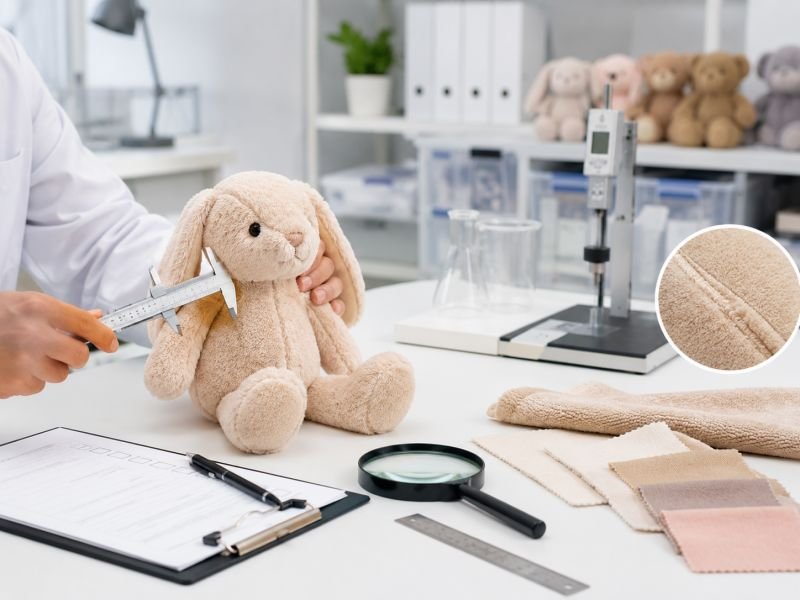
A plush toy can look soft, friendly, and harmless, but safety is never decided by cuteness alone. A small plastic eye, a loose bow, a weak seam, an exposed filling area, a missing warning label, or an unplanned magnet can turn a beautiful plush project into a delay, rejection, recall, or brand problem. For custom plush projects, safety should not begin after bulk goods are finished. It should begin when the design is still on the table.
Plush toy safety testing helps Partners confirm whether a custom plush product is suitable for its target age group, sales region, materials, accessories, labels, and use scene. Key checks may include fabric safety, small parts, pull strength, seam strength, filling leakage, flammability, chemical review, needle detection, warning labels, and third-party testing based on the destination country and product structure.
For brand plush, IP character plush, plush keychains, baby cloth books, educational plush, retail stuffed animals, and private label plush lines, safety testing is not only a lab issue. It connects artwork review, pattern design, material selection, accessory planning, sample approval, bulk quality checks, labels, packing, and shipment preparation. A strong plush project treats safety as part of development, not as a final obstacle.
Heyzizi is a Guangdong-based custom plush products factory serving global brands, IP programs, retailers, e-commerce brands, promotional projects, educational product teams, private label Partners, and long-term custom plush product programs. With 600+ staff, around 18,000㎡ factory space, 35+ pattern makers, 80 QC inspectors, 30+ production lines, and 20+ years of OEM / ODM plush project experience, Heyzizi supports custom plush projects from design review to sampling, bulk production, QC, needle detection, packing, and third-party testing coordination when required.
What Is Plush Toy Safety Testing?
Plush toy safety testing is the process of checking whether a plush product is suitable for its intended age group, sales region, structure, materials, accessories, and labels. It may involve factory checks and third-party lab testing. The goal is to reduce risks such as choking, loose parts, broken seams, exposed filling, flammability concerns, chemical issues, incorrect labels, and shipment delays.
Safety testing is often misunderstood. Some teams think it means asking a factory, “Do you have certificates?” That is not enough. A certificate may belong to a material, a past product, a different toy, or a different sales region. The more useful is: what does this specific plush design need?
A soft plush bear with embroidered eyes is not the same as a plush keychain with a metal ring. A baby cloth book is not the same as an adult collector doll. A plush backpack with zipper and straps is not the same as a sitting stuffed animal. Each structure can change the safety review.
Safety testing also has timing. If the project includes plastic eyes, magnets, sound modules, batteries, small beads, long ribbons, removable clothes, or hard accessories, those details should be reviewed before sampling. Waiting until finished goods are packed can create avoidable cost and delay.
Why Safety Testing Is More Than A Certificate
Safety testing is more than a certificate because a plush product must be reviewed by product type, age group, destination country, materials, construction, accessories, labels, and sales channel. A certificate is useful only when it matches the actual product and required rules.
For example, a fabric test alone does not prove that a finished plush toy is safe. The final product may still need review for seam strength, small parts, pull strength, filling leakage, warning labels, and packaging. A material may be acceptable, but a weak accessory can still create risk.
A serious plush safety review should connect the report, the product, and the intended use.
Which Plush Products Need Early Safety Review?
Plush products need early safety review when they are intended for children, sold through retail channels, used in education programs, shipped to regulated destinations, or designed with small parts, hard accessories, electronics, magnets, keyrings, straps, ribbons, or removable pieces.
Early review is especially important for:
| Plush Type | Safety Focus |
|---|---|
| Baby plush | Softness, seams, labels, small part avoidance |
| Children’s plush | Small parts, pull strength, filling, warning labels |
| Plush keychains | Metal parts, attachment strength, age positioning |
| Educational plush | Durability, age group, labels, repeated handling |
| Weighted plush | Filling control, leakage, seam strength |
| Sound plush | Battery, module, access, warning review |
| Retail plush | Labels, test documents, packing, carton control |
The earlier these risks are discussed, the easier it is to adjust the design before sampling.
What Should Partners Confirm Before Sampling?
Before sampling, Partners should confirm the target age group, destination country, sales channel, product use, material direction, accessory list, filling type, label needs, and whether third-party testing may be required. These details guide pattern work, craft selection, material sourcing, and safety planning.
A simple checklist before sampling:
- Who will use the plush?
- Where will it be sold or distributed?
- Is it positioned as a children’s toy, collectible, gift, or accessory?
- Does it include plastic parts, metal parts, magnets, sound, LED, or batteries?
- Are warning labels, care labels, barcodes, or retail packaging needed?
- Does the sales channel require specific test documents?
If your project involves children’s use, retail programs, or multi-country sales, send artwork, target age, destination country, quantity, material direction, and accessory details to info@heyzizi.com for an early safety review.
Why Does Target Affect Safety Testing?
Target affects safety testing because toy rules, labels, documentation, and testing expectations differ by destination country and sales channel. A plush product sold in the United States, European Union, United Kingdom, Canada, Australia, or other regions may need different standards, documents, and label review. One report may not automatically satisfy every country.
A common mistake is assuming that one plush safety report works everywhere. In real projects, destination matters. Sales region, product age grade, toy classification, materials, and accessories all affect what should be checked.
For a global brand program, safety planning should start with a country list. If the plush will be sold in several regions, the team should review testing and labeling needs before sampling. This helps avoid remaking labels, changing accessories, or retesting after the product is already developed.
Safety planning is not only about avoiding legal issues. It also protects launch timing. A late testing surprise can push back retail delivery, online launch, event distribution, or warehouse receiving.
Is ASTM F963 Required For Toys In The United States?
For toys intended for children in the United States, ASTM F963 is a key toy safety standard referenced by CPSC requirements. Children’s toys typically need third-party testing and certification based on applicable safety rules. Whether a custom plush project needs specific ASTM F963 sections depends on the product, age group, materials, and structure.
For plush projects, ASTM-related review may touch small parts, mechanical and physical properties, flammability, heavy elements, and other relevant sections. The exact test plan should be confirmed by product details and a qualified lab.
A plush made for adult collectors may follow a different review path than a children’s plush sold in a toy aisle. That distinction should be decided early, not after packaging is printed.
ASTM F963 And CPSIA For The United States
For the U.S., children’s toys are commonly reviewed around ASTM F963 and CPSIA-related requirements. A Children’s Product Certificate may be needed for children’s products based on third-party testing from a CPSC-accepted lab.
For custom plush projects, this means the team should know:
| Item | Why It Matters |
|---|---|
| Age group | Affects small parts and warning label direction |
| Product use | Toy, accessory, collectible, education item |
| Materials | Fabric, filling, trims, plastics, coatings |
| Accessories | Eyes, buttons, keyrings, magnets, electronics |
| Labels | Tracking, warning, care, and product information |
| Test documents | Lab report and certificate support |
A factory can help prepare product samples and project information, but final compliance direction should match the sales plan and qualified lab requirements.
EN71 And CE For The European Union
For the European Union, toys must meet essential safety requirements and carry CE marking when placed on the EU. EN71 standards are commonly used to assess toy safety, covering areas such as mechanical and physical properties, flammability, and chemical aspects depending on the product.
For plush toys, EN71 review may involve fabric, seams, small parts, cords, filling access, flammability, and certain chemical concerns. The exact scope depends on the design and intended age group.
CE marking should not be treated as a decorative logo. It represents a compliance responsibility. Labels, documentation, testing, and product classification should be planned carefully.
UK, Canada, Australia, And Other Destination Reviews
The UK, Canada, Australia, and other destinations may have their own safety requirements, labeling expectations, import rules, or retailer requirements. Some retailers may also request test reports beyond the minimum legal direction.
For multi-country plush projects, do not wait until the goods are finished to ask about destination rules. A plush toy with the wrong label, missing document, or unsuitable accessory may require rework.
The safest planning method is simple: list all destination countries before sampling, then review product type, target age, materials, accessories, and labels against each region.
Why One Test Report May Not Fit Every Country
One test report may not fit every country because testing standards, product classification, age group, report language, lab recognition, and label requirements may differ. A report for one material or one product version may not cover a new design, new accessory, changed fabric, or different destination.
If the product changes after testing, the test result may no longer fully match the current plush. Common changes include:
- New fabric
- Different plastic eyes
- Added keyring
- Added magnet
- Changed filling
- New sound module
- Different warning label
- New packaging
- Changed target age
For serious retail or licensed plush projects, keep testing plans connected with the final approved sample.
Which Plush Toy Safety Tests Matter Most?

The most important plush toy safety checks often include small parts, pull strength, seam strength, filling leakage, flammability, fabric safety, chemical and heavy metal review, needle detection, labels, and packing review. The exact checks depend on the product structure, intended age group, destination country, sales channel, and accessories used in the custom plush design.
Not every plush needs the same tests, but every plush needs a safety mindset. Soft toys can fail for very practical reasons: a plastic eye detaches, a seam opens, filling leaks, a magnet becomes accessible, a label is missing, or a broken needle fragment remains after sewing.
For brand teams, the most useful approach is to look at the plush as a child, parent, retailer, inspector, and warehouse receiver might see it. Can anything be pulled off? Can filling escape? Is the label correct? Does the packaging create confusion? Does the intended age match the design?
Small Parts And Choking Risk
Small parts are a major safety concern, especially for products intended for young children. Plastic eyes, noses, beads, buttons, bows, charms, zipper pulls, magnets, and loose decorative parts should be reviewed for size, attachment strength, and age suitability.
A part that looks adorable on a sample can become risky if it detaches during use. For plush products intended for younger age groups, embroidered or sewn-in alternatives may be safer than hard plastic components.
Small parts review should happen before sampling, because changing eyes, buttons, or accessories later can affect appearance, cost, test direction, and production setup.
Pull Strength And Accessory Attachment
Pull strength checks whether accessories stay attached under force. This is important for eyes, noses, bows, ribbons, buttons, labels, keyrings, hooks, straps, zippers, tails, ears, and clothing details.
Accessory attachment should be reviewed by both design and function. A plush keychain must hold the chain securely. A plush backpack strap must handle use. A mascot plush with a decorative bow should not have loose parts that detach easily.
For children’s products, pull strength expectations can be more strict, and the exact method should follow the applicable test requirement.
How To Test Plush Toy Seam Strength
Plush toy seam strength is usually tested by applying force to seams or checking whether seams open under tension, handling, or use. The goal is to confirm that filling does not leak, parts do not separate, and the product can withstand normal use for its intended age group and scene.
In factory review, seam strength can be checked by inspecting stitch density, seam allowance, thread strength, stress areas, and finished seams after stuffing. In lab testing, the method depends on the relevant safety standard and product type.
High-risk seam areas include the neck, limbs, tail, ears, accessory attachment , weighted filling sections, zipper openings, and areas closed by hand sewing.
Seam Strength And Filling Leakage
Seam strength and filling leakage are closely connected. A plush may look fine on the shelf, but if seams open during use, filling can become accessible. This can create safety, quality, and complaint risk.
For weighted plush, baby plush, educational plush, and children’s stuffed animals, filling control is especially important. Small pellets, beads, or special filling materials require careful structure and seam planning.
Good seam control starts with pattern design, seam allowance, stitch quality, stuffing pressure, and final inspection.
Flammability And Fabric Safety
Plush fabric should be reviewed for flammability and material suitability based on destination country and product use. Some and sales channels may require specific flammability testing or material declarations.
Fabric safety is not only about the outer plush. Lining, trims, ribbons, clothing fabric, printed fabric, and filling may also need review depending on the product.
For projects with mixed materials, each material should be considered in the safety plan.
Chemical And Heavy Metal Review
Chemical and heavy metal review may apply to fabrics, dyes, prints, coatings, plastics, paints, trims, and accessories. This is especially important for children’s products and products sold through formal retail channels.
Painted plastic eyes, printed graphics, coated accessories, metal parts, and dyed fabrics should be reviewed early if the product is going into regulated sales channels.
A practical rule: if a material or finish can be touched, pulled, mouthed, rubbed, or handled repeatedly, it should be considered in the safety review.
How Do Age Group And Use Scene Change Testing?

Age group and use scene change safety testing because a plush for babies, toddlers, children, adult collectors, education programs, retail stores, events, or fan merchandise may carry different risks. A product intended for young children usually needs stricter small parts, seam, filling, label, and material review than an adult collectible or decorative plush.
Age grading is one of the most important early decisions in plush development. It affects design, materials, accessories, labels, testing, packaging, and even how the product can be described.
A plush toy that looks childish may be treated differently from a collector plush with adult positioning. But simply calling a product “collectible” does not automatically remove safety responsibility if the product is clearly appealing to children or sold through child-facing channels.
The safest route is to discuss age group and use scene before the sample is made.
Baby Plush Vs Children’s Plush
Baby plush and children’s plush both need careful review, but baby products often require a stricter design mindset. Softness, seam strength, small part avoidance, label comfort, filling control, and washable structure may matter more.
For baby plush, avoid unnecessary hard parts, loose ribbons, beads, small decorations, or detachable elements. Embroidered faces are often preferred because they reduce detachable part concerns.
For children’s plush, the design may allow more detail, but small parts, pull strength, seam strength, and warning labels still need review.
Adult Collectible Plush Vs Children’s Toy
Adult collectible plush may have different safety considerations from children’s toys, especially when sold as fan merchandise, display items, or limited-edition collectibles. However, the product positioning, appearance, sales channel, and target audience must be clear.
A plush sold in toy stores or promoted to children may need a children’s toy safety path. A collector plush sold to adult fans may focus more on display quality, packaging, brand accuracy, and material finish, while still needing general product safety review.
This distinction should be discussed early because it affects labels, test scope, and product design choices.
Educational Plush, Retail Plush, And Event Gifts
Educational plush may be handled often by children, teachers, or classrooms, so durability, cleaning, seams, labels, and safety direction matter. Retail plush needs strong label and test document planning. Event gifts may focus on deadline, packing, and distribution, but safety should still match the intended audience.
Each use scene changes priorities:
| Use Scene | Safety Priority |
|---|---|
| Education | Durability, age group, labels |
| Retail | Test documents, labels, barcode, packaging |
| Event gifts | Audience, packing, delivery timing |
| Fan merchandise | Character accuracy, positioning, accessories |
| Private label | Repeat order records, product consistency |
Why Age Grading Should Be Decided Early
Age grading should be decided early because it affects small parts, warning labels, test direction, materials, accessories, and packaging. Late changes can force sample revision, label redesign, accessory replacement, or retesting.
For example, a plush with plastic eyes may work for one age group but not another. A keychain plush may be acceptable as an accessory, but not suitable as a toy for young children without extra review. A sound module may change the testing plan.
The earlier age grading is clear, the easier the product is to develop safely.
What Design Details Increase Safety Risk?
Design details increase safety risk when they can detach, break, expose filling, trap fingers, create sharp edges, be swallowed, or change the test direction. Plastic eyes, buttons, beads, magnets, sound modules, LED parts, batteries, keyrings, hooks, zippers, long cords, loose ribbons, and removable accessories should be reviewed before sampling, especially for children’s plush.
Many safety problems begin as “cute details” in artwork. A shiny eye makes the character more lively. A small bow adds charm. A keyring turns the plush into a bag charm. A magnet creates a fun feature. A sound module makes the product interactive. None of these details are automatically wrong, but each one changes the way the product should be reviewed.
For brand and IP plush, the challenge is to keep the character recognizable without adding unnecessary risk. Sometimes embroidery can replace plastic eyes. A stitched fabric shape can replace a loose accessory. A printed detail can replace a tiny sewn part. Good design review does not remove personality; it makes personality safer and easier to repeat in bulk.
Are Plush Toy Plastic Eyes Safe?
Plastic eyes can be safe when they are suitable for the intended age group, correctly attached, properly reviewed, and tested according to the relevant product requirements. However, for baby plush or young children’s plush, embroidered eyes are often a safer design choice because they avoid detachable hard parts.
Plastic eyes should be reviewed for size, material, attachment method, pull strength, surface finish, and product age grading. A plastic eye that looks fine on a sample still needs to stay secure during use, handling, packing, and shipment.
If the plush is positioned for young children, plastic eyes should be discussed before sampling. Changing them later may affect expression, cost, timing, and test direction.
Plastic Eyes, Noses, Buttons, And Beads
Plastic eyes, noses, buttons, and beads are common plush details, but they need careful review. They may create small part concerns if they detach. They may also change the product feel, age direction, and lab test plan.
For character plush, the face is often the most important design area. If hard parts create safety concern, embroidery, applique, or printed facial details may be better options. This is especially useful for baby plush, educational plush, and children’s stuffed animals.
The right method depends on the target age, sales channel, brand look, and desired hand feel.
Magnets, Sound Modules, LED Parts, And Batteries
Magnets, sound modules, LED parts, and batteries can make a plush more interactive, but they also add structure, safety, and testing complexity. Battery access, module placement, stitching strength, internal pocket design, sharp edges, and warning labels may all need review.
A sound plush should not be treated like a basic stuffed animal. The inside structure matters. The module should be secured, protected, and planned so it does not damage the plush body or become accessible during normal use.
For projects with electronics or magnets, safety planning should start before the first sample.
Keyrings, Hooks, Zippers, And Metal Accessories
Keyrings, hooks, zippers, and metal accessories are common in plush keychains, plush bag charms, plush backpacks, and functional plush products. These parts need attachment strength review, surface review, and packing review.
A plush keychain should not lose its ring after a few pulls. A plush backpack should not have weak strap. A zipper should work smoothly and should not create sharp or rough areas. Metal parts should also be checked for finish and placement.
For accessory plush, the product is not only cute. It must survive real handling.
Long Cords, Ribbons, Loose Parts, And Removable Pieces
Long cords, ribbons, loose parts, and removable pieces can create risk depending on age group and use. They may tangle, detach, fray, or become misplaced during packing. They can also slow production and increase inspection work.
If the detail is decorative only, the team should ask whether it can be shortened, stitched down, embroidered, printed, or simplified. If the part is functional, it should be reviewed for strength and safe use.
The best plush design is not the one with the most details. It is the one with the right details.
When Should Safety Be Reviewed In A Custom Plush Project?
Safety should be reviewed before sample development, during sample approval, before bulk production, and before packing and shipment. The earlier the review begins, the easier it is to adjust materials, structure, accessories, labels, and test direction. Waiting until finished goods are packed can lead to redesign, retesting, delay, or added cost.
Safety review is not a single event. It is a timeline. At the beginning, the main focus is design risk: age group, use scene, accessories, and materials. During sampling, the focus shifts to construction: seams, filling, plastic parts, labels, and function. Before bulk production, the standard must be clear. Before shipment, the product, labels, packing, and needle detection should be checked.
This step-by-step approach is especially useful for brand plush programs because product development often moves quickly. When launch dates, retail deadlines, or event schedules are involved, late safety changes can be expensive.
Before Sample Development
Before sample development, review the target age group, destination country, sales channel, product use, materials, accessories, and function parts. This helps avoid risky design choices before time and money are spent on a sample.
For example, if the plush is for young children, embroidered eyes may be better than plastic eyes. If the plush includes a magnet, the inner structure must be reviewed. If the plush needs a retail label, label size and position should be considered early.
A safer sample starts with a clearer brief.
During Sample Approval
During sample approval, check whether the product matches the intended age group and use. Review seams, filling access, accessory attachment, face method, labels, weight, size, and packing direction. A sample that looks good visually may still need safety adjustment.
The approved sample should not only show appearance. It should also confirm the construction path for bulk production.
If a safety detail changes after approval, the sample standard may need to be updated.
Before Bulk Production
Before bulk production, confirm the approved sample, material list, accessory list, label files, packing instructions, test direction, and special safety comments. This is the moment to prevent repeated mistakes.
Bulk production should not start with unclear warnings, missing labels, unconfirmed accessories, or uncertain testing plans. Once fabric is cut and parts are ordered, changes become harder.
Before Packing And Shipment
Before packing and shipment, review final product appearance, seams, filling, accessories, labels, needle detection, packing method, carton marks, and documentation needs. This stage protects the product before it leaves the factory.
For multi-SKU plush programs, packing review is critical. Wrong labels, mixed cartons, or unclear carton marks can create receiving and sorting issues even if the plush itself is made well.
How Does A Plush Factory Support Safety Control?

A plush factory supports safety control by reviewing materials, accessories, pattern structure, sewing strength, filling, in-line quality checks, final inspection, needle detection, labels, packing, and third-party testing support when required. A good factory does not simply wait for a lab report. It helps reduce preventable risks during development and bulk production.
Lab testing matters, but factory control matters too. A third-party lab can verify a sample against selected requirements, but the factory must still control the bulk order. Materials, sewing, filling, accessory attachment, labels, and packing all need daily attention.
This is where factory experience becomes important. Plush safety is practical. A seam that looks strong before stuffing may open after filling pressure. A small bow may detach if the attachment method is weak. A metal keyring may scratch another product if packed poorly. These are real production issues, not just lab terms.
Heyzizi supports custom plush projects with 35+ pattern makers, 80 QC inspectors, incoming material checks, in-line checks, finished product review, needle detection, packing review, and shipment preparation.
Material And Accessory Review
Material and accessory review checks whether the fabric, filling, trims, labels, hardware, eyes, noses, buttons, ribbons, zippers, magnets, electronics, or other parts are suitable for the product use and target age.
This review helps identify risks before production. For example, long plush may hide small embroidery. A hard accessory may need pull strength review. A weighted filling may need leakage control. A printed fabric may need rubbing or chemical review depending on the sales plan.
Pattern, Sewing, Filling, And Structure Review
Pattern, sewing, filling, and structure review help prevent shape problems and safety issues. A weak seam may expose filling. Too much filling may stress seams. A poor pattern may create sharp folds, twisted parts, or weak attachment areas.
For weighted plush, plush backpacks, baby cloth books, and functional plush products, structure review is especially important. The product must not only look right; it must hold up under use.
In-Line QC And Final Inspection
In-line QC checks products while they are being made. It can find sewing, embroidery, filling, shape, and accessory problems before the same issue repeats across the full order. Final inspection checks finished goods before packing or shipment.
For plush projects, QC should review:
| Stage | Common Check |
|---|---|
| Material arrival | Fabric, filling, trims, labels |
| Cutting | Direction, shape, size |
| Sewing | Stitch quality, seam strength |
| Filling | Balance, fullness, leakage risk |
| Finishing | Shape, face, accessories |
| Packing | Label, carton mark, SKU control |
How To Check Plush Toys For Needles
Plush toys are checked for needles through needle detection equipment and production control. The goal is to reduce the risk of broken needle fragments remaining inside finished products after sewing. Needle detection is especially important for children’s plush, retail plush, education plush, and products handled in public programs.
Factory teams should also control needle use during production. If a needle breaks, the area should be handled according to internal procedures before production continues. Finished products should pass needle detection before packing whenever required by the project.
Heyzizi applies needle detection as part of plush quality and safety control. For safety-sensitive projects, needle detection requirements should be discussed early.
Needle Detection And Packing Review
Needle detection helps manage metal fragment risk. Packing review helps protect the finished product and prevent label or SKU mistakes. These two steps are often close to the end of production, but they should not be rushed.
Packing review should confirm:
- Individual packing
- Hangtag
- Care label
- Warning label
- Barcode or SKU label
- FNSKU if needed
- Carton mark
- Mixed carton rule
- Packing list
- Product shape after packing
A safe plush project is not finished until the product is correctly checked, labeled, packed, and ready for the intended shipment path.
Testing Lab Vs Factory QC: What Is The Difference?
Factory QC checks production quality, construction, materials, sewing, filling, accessories, labels, needle detection, and packing during the project. A third-party lab tests selected samples against applicable safety standards and issues reports based on the test scope. Both are useful. Factory QC manages daily production risk, while lab testing supports safety documentation for the target destination and sales channel.
Factory QC and lab testing are not the same thing. One cannot fully replace the other.
Factory QC is practical and ongoing. It helps catch problems while products are being made. Lab testing is formal and document-based. It helps verify whether samples meet selected requirements. A plush project with good lab testing but poor factory control can still fail in bulk. A plush project with good factory control but missing required lab documents may still face channel or import issues.
The best approach is to connect both. Build the product correctly, then test the correct product version.
What Factory QC Can Check Internally
Factory QC can check material appearance, cutting accuracy, sewing quality, filling, shape, accessory attachment, loose threads, stains, labels, carton marks, packing, needle detection, and shipment preparation.
Factory QC is especially useful for catching repeated production issues. If a seam is weak, it can be found before more pieces are made. If a label is wrong, it can be corrected before packing spreads the error.
What Third-Party Labs Usually Verify
Third-party labs usually verify selected safety requirements based on product type, destination, age group, material, accessories, and standards. This may include mechanical and physical checks, small parts, flammability, chemical tests, heavy elements, labeling review, and other relevant tests.
The lab test scope should match the product. If the plush has plastic eyes, electronics, magnets, or special materials, the lab should know. If the product is changed after testing, the report may not fully represent the final version.
Why Both Are Useful For Brand Plush Projects
Both factory QC and lab testing are useful because brand plush projects need physical product control and proper documentation. QC helps keep bulk production stable. Lab reports help support sales, import, and retailer requirements.
For brand, IP, retail, education, and private label plush programs, both sides matter. The product should be made well, checked well, and documented properly.
What Labels And Documents Should Partners Prepare?
Partners should prepare labels and documents based on destination country, age group, product type, sales channel, and testing needs. Common items may include care labels, warning labels, barcode labels, SKU labels, FNSKU labels, carton marks, test reports, CPC, CE files, packing lists, and project records. Label planning should start before bulk production.
Labels are small, but they can create big delays. A plush product can be well made, but if the warning label, barcode, SKU, or carton mark is wrong, the shipment may still face receiving problems.
For retail and e-commerce plush, labels help warehouses, platforms, and stores identify the product correctly. For children’s products, warning and tracking information may require careful review. For multi-SKU programs, label accuracy becomes even more important because one wrong file can affect many cartons.
What Safety Certificates Do Plush Toys Need?
The safety documents a plush toy needs depend on destination country, age group, sales channel, product type, materials, and accessories. For U.S. children’s products, CPC and third-party test reports may be needed. For EU toy sales, CE-related documentation and EN71 testing direction are commonly reviewed. Other regions may require their own documents.
A plush toy does not automatically need the same certificate everywhere. The product should be reviewed by:
| Factor | Why It Matters |
|---|---|
| Destination | Different rules and documents |
| Age group | Children’s product or adult collectible |
| Structure | Basic plush or functional plush |
| Accessories | Plastic parts, metal, magnet, electronics |
| Sales channel | Retail, e-commerce, education, event |
| Label needs | Warnings, care, tracking, barcode |
Testing and certificates should be confirmed by project, not assumed from a past product.
Care Label And Warning Label
Care labels explain cleaning and care information. Warning labels communicate age suitability, small part warnings, or other relevant cautions depending on the product. For children’s plush, label wording and placement may need closer review.
A label should be planned with the product and packaging. If it is added too late, it may interfere with appearance, comfort, packing, or channel requirements.
Barcode, SKU, FNSKU, And Carton Marks
Barcode labels, SKU labels, FNSKU labels, and carton marks help control warehouse receiving, online fulfillment, retail scanning, and multi-SKU sorting. They are not safety tests, but they are important for delivery success.
For plush series with many characters or sizes, label control should be treated seriously. A wrong SKU can create inventory confusion even when the product itself is correct.
Test Report, CPC, CE Files, And Project Records
Test reports, CPC, CE-related files, and project records should match the final product version. If materials, accessories, labels, or structure change after testing, the documentation should be reviewed again.
Project records are useful for repeat orders. They help track previous materials, approved samples, test direction, label files, carton marks, and feedback.
Why Label Errors Can Delay Delivery
Label errors can delay delivery because they affect receiving, sales channel approval, product tracking, and safety communication. Missing warning labels, wrong barcodes, incorrect SKU files, or unclear carton marks can create costly rework.
For retail and e-commerce programs, label files should be approved before packing starts. The later an error is found, the more expensive it becomes.
How Do Safety Testing Needs Affect Price And Lead Time?
Safety testing needs can affect price and lead time because they may require extra sample preparation, third-party lab fees, material review, design adjustments, label changes, retesting, and documentation work. Projects for children, regulated regions, retail channels, or products with small parts, electronics, magnets, or special filling should plan safety costs and timing early.
Safety is not free, but late safety changes are usually more expensive than early planning. If a plastic eye fails pull strength, a magnet becomes a concern, or a warning label is missing after packing, the project may need redesign, new samples, re-labeling, or retesting.
The goal is not to add unnecessary testing to every product. The goal is to understand what the product truly needs before time is lost.
Testing Cost Vs Product Cost
Testing cost is separate from product cost. Product cost covers materials, sewing, filling, packing, and production work. Testing cost covers formal lab review based on selected standards and test scope.
For budget planning, teams should ask early whether testing is needed, which destination country applies, and whether the sales channel has its own requirements.
Sample Revision And Retesting Risk
Sample revision and retesting risk increases when safety details are not reviewed early. If a product changes after testing, the report may no longer match the final plush. If a label changes after packing, rework may be needed.
Common late changes include removing small parts, replacing plastic eyes, adjusting seams, changing fabric, adding warning labels, or updating packaging.
How Early Planning Reduces Delay
Early planning reduces delay by allowing safety needs to guide the first sample. When age group, destination country, accessories, labels, and test direction are known early, the factory can avoid risky construction choices.
This helps protect launch dates, retail delivery, event timing, and warehouse schedules.
Factory Vs Promotional Platform: Who Handles Safety Better?
A custom plush factory is usually better suited for safety-sensitive plush projects because it can review product structure, pattern, fabric, filling, accessories, sewing, QC, needle detection, packing, and third-party test support directly. A promotional platform may work for simple logo items, but custom plush safety needs deeper product review.
A simple promotional item may only need logo placement on an existing product. Custom plush is different. It may involve a new character, new pattern, new fabric, new accessories, new label rules, and new packaging. That means the safety review must follow the product, not just the artwork.
Heyzizi focuses on custom plush product development and bulk production, not one-piece personal gift customization or ready-stock retail selling. Standard MOQ starts from 500pcs per design. Custom plush samples usually require a sample fee, and sample fee refund or deduction can be reviewed when the single-style bulk order reaches 2,000pcs.
Why Custom Plush Needs Product Review, Not Only Logo Placement
Custom plush needs product review because shape, size, materials, stuffing, face method, accessories, labels, and packing can all affect safety. A logo-only review misses too much.
For example, a mascot plush with embroidered eyes may have one review path. The same mascot with plastic eyes, a removable cape, a keyring, or a sound module may need a different review.
Why In-House Pattern And QC Matter
In-house pattern and QC matter because many safety risks appear in structure and production. Pattern teams can help avoid weak seams, exposed filling, or unstable accessories. QC teams can check materials, sewing, filling, labels, needle detection, and packing before goods leave the factory.
Heyzizi’s 35+ pattern makers and 80 QC inspectors support custom plush development from artwork review to bulk inspection and shipment preparation.
Best Fit For Brand, IP, Retail, Education, And Private Label Projects
Safety planning is especially valuable for brand mascot plush, IP character plush, retail stuffed animals, plush keychains, baby cloth books, educational plush, weighted plush, promotional plush gifts, private label plush collections, and repeat order plush lines.
These projects often need clearer materials, labels, documentation, and quality control than a simple catalog product.
What Should You Send For A Plush Safety Review?

For a plush safety review, send artwork or reference photos, target size, quantity per design, target age group, destination country, sales channel, materials, filling, accessories, function parts, packing needs, labels, deadline, and shipping plan. These details help the factory review safety direction, sample structure, test needs, packing, and production feasibility.
You do not need every file ready before starting. But you should share enough information for a meaningful review. The factory cannot judge safety direction from one picture alone.
A project for children in the U.S. is different from an adult fan plush sold online. A plush keychain with metal hardware is different from a baby plush with embroidered details. A weighted plush is different from a basic stuffed animal. These differences matter.
Artwork, Size, Quantity, And Target Age
Artwork, size, quantity, and target age help define the project. Target age is especially important because it affects small parts, labels, test direction, and acceptable design choices.
If the age group is unclear, discuss it before sampling. It is easier to design for the right age group than to fix the product later.
Materials, Accessories, Filling, And Function Parts
Materials, accessories, filling, and function parts should be listed as early as possible. Include fabric preference, filling type, plastic eyes, buttons, keyrings, zippers, magnets, sound modules, LED parts, batteries, removable parts, or special features.
These details help the factory identify possible safety concerns before sample work begins.
Destination Country, Sales Channel, Packing, And Deadline
Destination country, sales channel, packing, and deadline affect testing, labeling, carton planning, and schedule. Retail, e-commerce, education, events, and private label programs may each need different preparation.
To start a custom plush safety review, send your artwork, target size, quantity, target age, destination country, accessory details, packing needs, and delivery deadline to info@heyzizi.com. Heyzizi will review product type, material direction, safety concerns, sampling path, packing, and production feasibility before the next step.
Closing Note
Plush toy safety is not a final box to tick before shipment. It is part of product development. The safest projects are usually the ones where age group, destination country, materials, accessories, labels, and testing direction are discussed before the first sample is made.
For brand and retail plush projects, a soft product still needs serious planning. A safe plush should look right, feel right, hold together, use suitable materials, carry the right labels, pass the required checks, and arrive ready for its intended channel. That is how a custom plush idea becomes a product that can be trusted in real use.