 Skip to content
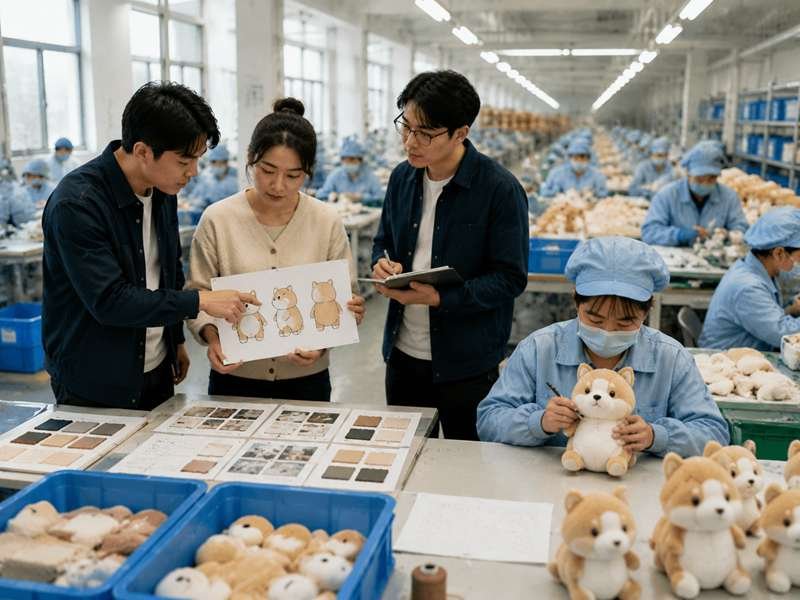
A custom plush project can appear perfectly organized while it is still inside a brand team’s inbox. The character artwork has been approved, colors are defined, packaging files look finished, materials have been discussed, and everyone agrees that the face must retain a very specific expression. None of those decisions, however, manufacture a product. Before a finished plush reaches a retailer or campaign launch, those priorities must pass through product development, pattern engineering, purchasing, embroidery, cutting, sewing, stuffing, finishing, inspection, packing, and shipment preparation.
Professional plush manufacturers transfer brand priorities to the factory floor by turning commercial and creative expectations into controlled production references. These normally include an approved Golden Sample, final patterns, a formal BOM, material and color specifications, embroidery and print files, packaging documents, process instructions, inspection checkpoints, and change-control rules. Those standards are reviewed before production, verified with first-piece or pre-production approval, monitored during bulk manufacturing, and used when deviations need to be escalated.
This distinction explains why a beautiful prototype does not automatically guarantee a good bulk order. A project can lose accuracy through a dozen small handoffs even when nobody makes an obvious mistake. The real manufacturing challenge is making sure the same priorities that mattered during sample approval are still visible to the person placing the embroidery, the operator filling the head, the inspector checking the face, and the team packing the final carton.
What Brand Priorities Must the Factory Understand?
A plush factory must understand which characteristics define the product, which requirements allow normal manufacturing variation, and which cannot change without approval. Brand priorities usually include character identity, safety, materials, hand feel, color, packaging, market requirements, launch timing, and repeat-order consistency. The most reliable projects rank these priorities before production begins instead of leaving individual departments to decide what matters most.
Product Identity
For character plush, product identity is rarely controlled by a single measurement. Recognition usually comes from a combination of head-to-body ratio, eye spacing, mouth position, cheek volume, ear angle, limb length, silhouette, fabric texture, embroidery shape, and stuffing pressure. Several of these details may each vary only slightly, yet the combined effect can make the finished character look noticeably different from the approved artwork or sample.
This is why experienced plush teams do not treat every millimeter as commercially equal. A small variation in an internal seam that remains hidden after stuffing may have almost no impact on the customer’s perception. The same numerical shift in an embroidered eye, however, can change the expression of the entire face. For licensed characters, mascots, collectibles, and recognizable brand figures, those visually sensitive points deserve more attention than ordinary construction details.
Before bulk production, it is useful to identify a limited set of identity-critical characteristics. For one character, these may be eye spacing, head width, mouth angle, and ear position. For another, recognition may depend more heavily on the body silhouette, costume proportions, tail structure, or a distinctive accessory. Turning these observations into explicit production priorities gives pattern makers, line supervisors, and inspectors a common understanding of which details deserve the strictest protection.
A practical internal classification separates requirements into three levels:
- Critical: Affects product safety, regulatory obligations, character identity, approved functionality, or formal customer approval.
- Major: Affects appearance, durability, hand feel, perceived quality, packaging presentation, or customer experience.
- Standard: Can accept an agreed level of normal manufacturing tolerance without materially changing the approved product.
This hierarchy prevents quality control from becoming a long list in which everything appears equally important. It also helps the factory allocate inspection attention intelligently. The goal is not to ignore ordinary workmanship, but to ensure that the most commercially sensitive details are never hidden inside a generic checklist containing dozens of lower-impact items.
Non-Negotiable Requirements
Some product characteristics are flexible preferences that can be optimized during engineering. Others are controlled requirements that should not change unless the appropriate people review and approve the change. Approved materials, tested components, safety-related construction, small-part attachment, warning labels, structural elements, functional modules, packaging specifications, and certain dimensions often fall into this second category.
The distinction becomes especially important when production pressure appears. Imagine that an approved minky fabric becomes temporarily unavailable. A substitute may appear nearly identical in photographs but have a different pile length, fabric weight, stretch behavior, recovery, hand feel, or dye lot. That change may influence the finished silhouette, embroidery visibility, stuffing response, packaging compression, or even the testing plan associated with the original material.
A mature manufacturer therefore separates process optimization from product redefinition. Sewing teams can often improve stitching sequence, workstation layout, handling methods, or fixture use without changing the approved product. Purchasing teams, by contrast, should not quietly introduce a substitute material simply because it is immediately available. The commercial impact of a material substitution can extend far beyond purchasing cost.
Heyzizi’s documented production controls illustrate this boundary. Once the formal BOM is approved, bulk purchasing and manufacturing are required to use the approved version, and unapproved changes to materials, suppliers, fabric weight, pile length, embroidery thread, filling, hardware, and packaging are not permitted. That rule is valuable not because paperwork is inherently important, but because it prevents production convenience from gradually redefining what the customer actually approved.
Commercial Priorities
Factories also need to understand what the product is expected to accomplish commercially. Two plush toys may use similar sewing methods yet require very different manufacturing decisions because one is a permanent retail item and another is a limited-edition collectible tied to a fixed launch date. A seasonal campaign, licensed character release, annual retail program, and ongoing replenishment item all create different risk priorities.
| Brand Priority | Factory-Level Effect | Practical Control |
| Character fidelity | Greater sensitivity to visual drift | Golden Sample comparison |
| Premium hand feel | Tighter material and filling control | Fabric and filling approval |
| Fixed launch date | Lower tolerance for scheduling delays | Early capacity and material review |
| Multi-SKU program | Higher risk of component mix-ups | SKU coding and version control |
| Retail-ready packaging | Packaging becomes product-critical | Barcode and pack-out verification |
| Repeat-order program | Future consistency becomes important | Material and file archiving |
| Target-market compliance | Development choices affect testing | Earlier compliance review |
| Defined cost target | Engineering decisions need boundaries | Controlled value engineering |
Commercial priorities should be ranked before they begin to conflict. A premium collectible may require a specific fabric feel, unusually detailed embroidery, and a fixed retailer delivery window. If a fabric delay threatens the launch, the factory should already know whether protecting hand feel, protecting the schedule, or reviewing an alternative material has the highest priority. Without that hierarchy, decisions tend to be made according to whichever department currently faces the most pressure.
The best manufacturing partners create a clear escalation path. Operators understand what they may adjust. Supervisors understand which process decisions they can approve. Project managers understand which changes must return to the customer. This allows day-to-day production to remain efficient without allowing important brand decisions to be diluted by routine factory problem-solving.
Priority Conflicts
Real production rarely offers perfect conditions. A softer fabric may increase cost. A complex embroidery pattern can reduce output. A decorative accessory may improve character fidelity but complicate durability testing. Additional inspection can improve consistency while consuming production time. A new packaging format may improve shelf presentation but increase volume, carton count, or freight cost.
These trade-offs become more complicated when a single order contains multiple characters, several sizes, different packaging versions, and a fixed launch date. Production teams should not be forced to decide from scratch which requirement wins every time two objectives compete. The project should already contain a hierarchy that distinguishes identity-critical features, compliance-related requirements, launch constraints, approved costs, and areas where technical optimization is acceptable.
From a manufacturing perspective, this is one of the clearest differences between simply receiving specifications and genuinely understanding brand priorities. Specifications tell the factory what should be made. Priorities tell the factory which characteristics must remain protected when materials, time, production efficiency, cost, or technical feasibility begin pulling the project in different directions.
How Are Brand Priorities Turned Into Production Standards?

Brand priorities become useful on the factory floor only when they are converted into controlled references. The core tools are normally the Golden Sample, final pattern set, formal BOM, embroidery and print files, material specifications, packaging documents, process instructions, inspection checkpoints, and revision records. Together, they replace personal memory and subjective interpretation with standards that can be repeated across departments, operators, shifts, and production batches.
Golden Sample
A Golden Sample is not simply the nicest prototype produced during development. It is the physical definition of the product the factory is expected to reproduce during mass production. That distinction matters particularly in plush manufacturing because several important characteristics are three-dimensional, tactile, or visually dependent on the way fabric, seams, embroidery, and stuffing interact after the product is assembled.
A specification sheet can state finished height, fabric type, approximate weight, and embroidery dimensions, but it cannot completely describe how full the cheeks should feel, how softly the body should compress when held, how the ears should sit after stuffing, how the fur direction affects the outline, or whether the overall facial expression still resembles the original character at normal viewing distance.
The documented Golden Sample standard used by Heyzizi covers size, weight, shape, head-to-body proportion, expression, fabric, color, pile direction, embroidery, printing, filling feel, clothing, accessories, hardware, labels, packaging, and special functions. For important projects, separate customer-approved, production-reference, quality-reference, and relevant material samples may also be retained.
Keeping more than one controlled reference solves a practical factory problem. Production does not have to borrow the only customer-approved master every time a line leader wants to confirm a detail, and quality inspectors can maintain a stable physical reference throughout the manufacturing period. Photographs remain useful, but for three-dimensional soft products, they rarely replace a real sample when the issue involves volume, hand feel, stuffing distribution, posture, or subtle visual balance.
BOM and Specifications
The Golden Sample shows what the finished product should become. The BOM and technical specifications define the materials and components required to achieve that result. A useful BOM therefore goes far beyond broad descriptions such as “pink plush fabric,” “polyester filling,” or “embroidered face.” Each of those descriptions may contain several variables that materially affect the finished product.
A well-controlled plush BOM can include:
- Main and secondary fabrics
- Color references
- Fabric weight
- Pile length
- Filling type
- Embroidery thread
- Sewing thread
- Printed components
- Woven labels
- Care labels
- Hardware
- Plastic parts
- Clothing components
- Webbing and zippers
- Weighted materials
- Electronic modules
- Packaging materials
- Material codes
- Supplier information
- Relevant testing documentation
Heyzizi’s documented BOM system includes these categories and requires review across product, purchasing, pattern, quality, and production functions before bulk use. The cross-functional review is important because each department sees a different kind of risk. Purchasing sees availability and supplier stability, pattern teams understand construction impact, quality teams focus on consistency, and production teams evaluate whether the approved combination can be manufactured repeatedly.
This is also where seemingly small material details become significant. A change in pile length can alter the visibility of embroidery or make a character appear visually larger. Filling with different recovery behavior can change the head profile even when the target weight remains similar. A different hardware finish can affect both visual quality and corrosion expectations. Treating the BOM as a production control document rather than a simple shopping list helps keep those relationships visible.
Pattern and File Control
A surprising number of bulk-production errors come from correct workmanship applied to the wrong revision. A custom plush project may move through several prototypes before approval. The head pattern changes, the face embroidery moves, the ear is reshaped, a label is updated, packaging artwork is revised, and a barcode changes. If different departments use different generations of those files, the factory can produce components that are individually well made but collectively incorrect.
A disciplined version-control system therefore gives each project and SKU a clear identity and defines which production files are officially released. Depending on the project, the controlled set may include the final pattern, embroidery file, printed artwork, BOM, material reference, label, barcode, packaging artwork, testing requirement, release date, and approval status.
Heyzizi’s documented project archive includes customer information, product images, pattern versions, BOM, embroidery and print files, Golden Sample, packaging files, barcodes, labels, test standards, and delivery plans. The operational goal is uncomplicated: every production department should be working from one current and clearly released version rather than selecting files from email histories, old folders, or previous sample rounds.
For projects containing ten, twenty, or more related SKUs, version control becomes even more important because many components may appear nearly identical. A facial embroidery file from Character A can easily look plausible when accidentally associated with Character B. Strong file identification and controlled release prevent those errors before they become stitched fabric that must later be scrapped or reworked.
Change Control
The most dangerous production changes are often the ones that look too small to document. A slightly different filling fiber, another hardware supplier, a revised seam line, a similar fabric with shorter pile, or a different packaging insert may appear harmless in isolation. Each can nevertheless influence appearance, functionality, hand feel, regulatory review, carton size, testing, durability, cost, or delivery timing.
A useful internal change-control process asks several practical questions before implementation. Does the proposed change alter the approved appearance? Could it influence product structure or functionality? Does it affect materials covered by testing or compliance documentation? Could it change cost, production timing, packing dimensions, or customer-facing information? If the answer to any of these questions is yes, the change deserves formal review.
Heyzizi’s documented Golden Sample rule requires reassessment when a proposed modification affects product appearance, structure, material, or function after approval. Combined with the approved-BOM rule, this establishes a stable product baseline while still allowing production teams to improve how they manufacture the item.
That balance is important. A factory should be free to improve workstation arrangement, sewing sequence, fixtures, inspection flow, or other process details where the customer-facing product remains unchanged. What it should not do is quietly redefine the approved product in the name of manufacturing convenience.
Which Teams Carry Requirements to the Factory Floor?

Brand requirements rarely move directly from the customer to a sewing operator. They pass through product management, pattern development, sampling, purchasing, production planning, factory supervisors, quality teams, packaging teams, and sometimes compliance specialists. Reliable manufacturers therefore define responsibility at each handoff rather than assuming one salesperson can carry technical requirements accurately through the entire development and manufacturing chain.
Product Management
The product manager sits at one of the most important translation points in a custom plush program. Customers naturally describe many requirements in brand language. They may say that the face should feel friendlier, the product should look more premium, the mascot needs to remain recognizable at a smaller size, or a licensed character must stay close to approved artwork. Those statements are meaningful but cannot be handed directly to a production operator.
Someone has to translate them into decisions about size, posture, pattern structure, fabric, embroidery, colors, filling, attachments, accessories, packaging, inspection criteria, and manufacturing feasibility. The product manager therefore acts as a bridge between creative intent and technical execution rather than functioning only as a communication coordinator.
Heyzizi’s documented product manager responsibilities include interpreting artwork and customer requirement files, confirming dimensions, posture, structure, function, use scenarios, target consumers, sales markets and channels, organizing manufacturability review, coordinating development teams, managing sample revisions, establishing specifications, preparing preliminary BOMs, and converting the final approved sample into the bulk-production standard.
The final part of that job is particularly important. “The customer approved Sample V4” is not enough information for the factory floor. Production needs to know exactly what changed between V3 and V4, which pattern or file has been replaced, whether the material remains the same, and which departments must behave differently because of the new approval.
Production Follow-Up
Once development reaches approval, the project changes from product creation into controlled execution. At this stage, production follow-up becomes the link between approved standards and the actual manufacturing schedule. The team has to determine whether the factory really possesses the documents, materials, packaging components, process instructions, quality requirements, capacity, and timing needed to start correctly.
Heyzizi’s documented production follow-up responsibilities include order review, project-code creation, BOM and production-file confirmation, material tracking, production scheduling, pre-production meetings, first-piece approval, progress follow-up, quality issue coordination, packaging-material tracking, third-party inspection arrangements, shipment planning, and delivery-risk warning.
This role becomes increasingly valuable as project complexity rises. Materials may be ready while packaging is delayed. The sewing department may have the new pattern while embroidery still has an earlier file. Labels may be approved for one market while another SKU requires different warning information. Production follow-up looks across these dependencies rather than assuming each department’s individual readiness means the entire project is ready.
The same logic applies to schedule risk. If an accessory supplier begins slipping behind plan, the issue matters differently depending on whether that accessory is added during early sewing, final assembly, or packing. Understanding where the delayed component enters the process helps the project team assess whether production can continue safely or whether a decision must be escalated.
Purchasing and Quality
Purchasing and quality teams protect two different parts of the approved product. Purchasing is responsible for protecting input consistency. Quality control protects output consistency. Both functions need access to the same approved project baseline, but they use it in different ways.
Purchasing may need to control fabric color, pile length, fabric weight, filling, embroidery thread, hardware, woven labels, care labels, accessories, and packaging. The team must confirm not only whether the item is available but whether what arrives matches the defined material or component standard.
Quality teams then verify whether those inputs have been transformed into the approved finished result. For custom plush products, inspection usually needs to go beyond obvious defects such as holes, loose stitches, or stains. Inspectors may need to evaluate dimensions, weight, fabric and color, pile direction, facial-feature position, embroidery, printing, sewing, filling, symmetry, accessory attachment, labels, barcodes, packaging, and consistency with the approved physical reference.
Heyzizi’s documented quality structure covers incoming inspection, first-piece inspection, production-process inspection, semi-finished inspection, finished-product inspection, packaging inspection, needle and metal control, shipment inspection, and quality-exception handling.
| Function | Documented Team Size | Primary Role in Requirement Transfer |
| Product managers | 6 | Convert customer priorities into product standards |
| Production follow-up | 16 | Move approved standards into production execution |
| Quality team | 60+ | Verify materials, processes, finished goods, and packaging |
| Compliance team | 6 | Coordinate market, testing, and labeling requirements |
The value of this separation is not headcount for its own sake. A large factory can still lose information if responsibilities are unclear. What matters is whether each function knows what it owns, which approved reference it should use, and what happens when the actual production situation no longer matches the original plan.
Clear Ownership
Projects become much more reliable when each major handoff has a named owner. If a visual problem appears, product development and pattern teams may need to investigate. If the issue involves material consistency, purchasing and quality should be involved. If the risk is related to timing or factory capacity, production follow-up and operational management need to act. When responsibility is vague, problems spend more time moving between departments than being solved.
Heyzizi’s documented project system assigns business, product, development, sample, production follow-up, quality, packaging, and logistics responsibilities instead of allowing one salesperson to carry the full technical and operational burden of the project. For larger or more complex programs, that structure becomes especially useful because customers should not have to coordinate separately with every internal department simply to keep one plush program moving.
Clear ownership also improves escalation. A problem that requires customer approval should not remain buried inside a factory chat group. A quality issue that can be solved internally should not unnecessarily stop the entire project while multiple people wait for somebody else to make a decision. The objective is to create enough structure that the right information reaches the right level of authority without slowing routine production.
How Do Pre-Production Controls Prevent Misinterpretation?
Pre-production controls expose misunderstandings before they multiply across hundreds or thousands of units. A structured order review, pre-production meeting, production-ready sample, and first-piece approval confirm that materials, patterns, artwork, packaging, testing, capacity, timing, and quality requirements are aligned. Their value is practical: correcting one wrong assumption before cutting is far easier than correcting the same assumption after mass production.
Production Readiness
Customer approval does not automatically mean an order is ready for bulk cutting. The factory must first confirm that the approved product has been converted into a complete and executable production package. Missing information that looks harmless while the order is still in the office can quickly become expensive once materials are committed and work begins.
A practical readiness review should confirm:
- Final sample approval status
- Released pattern version
- Formal BOM
- Bulk material availability
- Embroidery and print files
- Packaging artwork
- Labels and barcodes
- Testing requirements
- Production capacity
- Delivery schedule
- Outstanding deviations
- Special quality checkpoints
Heyzizi’s documented order-review stage brings product, purchasing, production, quality, packaging, and logistics functions together to confirm document completeness, final sample status, material availability, process stability, capacity, testing requirements, packaging status, and delivery feasibility.
This kind of review matters because many manufacturing failures begin as unanswered questions rather than obvious mistakes. If embroidery placement is unclear, the embroidery team eventually makes an interpretation. If packaging dimensions remain unresolved, someone will still have to order cartons. If a material is unavailable but nobody defines an escalation path, purchasing may begin searching for something similar. Pre-production control forces those uncertainties into the open before they become physical inventory.
Pre-Production Meeting
A useful pre-production meeting does much more than distribute files or read the specification sheet aloud. It turns the approved product into process-specific instructions and highlights which details are particularly sensitive at each manufacturing stage. The value comes from connecting product priorities to the daily decisions operators and supervisors actually make.
For cutting teams, important details may include pile direction, mirrored pattern pieces, color-panel allocation, material orientation, and final pattern version. Embroidery teams need the correct artwork, thread references, placement method, and awareness of distortion risk. Sewing teams may need alignment marks, construction sequence, symmetry controls, and information about small attachments or visually sensitive seams.
Stuffing teams need target weight, firmness, three-dimensional shape, balance, and hand feel. Finishing teams need guidance on brushing, fur direction, accessory position, final shaping, and character expression. Quality inspectors need to understand not only the general workmanship requirements but also which features have been classified as brand-critical.
This approach becomes especially important for character programs because different SKUs can fail in different ways. One character may be extremely sensitive to eye spacing, another to ear construction, and another to costume assembly. A single general plush checklist may identify normal sewing defects but still miss the visual characteristics that actually determine whether the product feels correct to the customer.
Good pre-production communication also explains the reason behind a control when that reason affects decision-making. Telling a supervisor that an eye position is controlled is useful. Explaining that the eye spacing is one of the strongest recognition features of the character makes it more likely that the supervisor will escalate drift instead of accepting it as normal variation.
First-Piece Approval
Even after a thorough pre-production meeting, the factory needs physical evidence that its interpretation works under real manufacturing conditions. That is the role of the first piece, first article, or pre-production sample. It should demonstrate not only that the product can be made, but that production materials and production methods can reproduce the approved result.
The Heyzizi fact base states that the pre-production sample should use official bulk fabric, the production-batch color, formal embroidery thread, production print, accessories, filling, labels, woven labels, hangtags, packaging, final pattern, final BOM, and final process. The approval review includes Golden Sample consistency, material consistency, dimensions, weight, hand feel, function, packaging, barcode, warning information, and production repeatability.
This checkpoint creates enormous practical leverage. If the production embroidery is several millimeters away from the approved visual position, discovering the problem on the first unit may require an adjustment to the embroidery placement method or fixture. Discovering the same problem after 10,000 completed products can require opening cartons, sorting inventory, removing packaging, reworking finished toys, reinspecting them, and repacking everything.
The purpose of first-piece approval is therefore not to slow production. It is to prevent the factory from becoming highly efficient at making the wrong version.
Production Repeatability
A beautiful first piece is still not sufficient if only a highly experienced sample maker can achieve that result. Sampling and mass production require different kinds of success. Sampling asks whether the product can be created. Production asks whether ordinary trained operators can reproduce it consistently within an agreed process and reasonable manufacturing tolerance.
A face shape that depends entirely on one person’s intuition about stuffing pressure is not yet fully standardized. A small accessory that requires several minutes of manual adjustment on every unit may need a positioning fixture, alignment mark, revised pattern, or different attachment method. A seam that consistently distorts a facial panel may require a construction change rather than repeated operator correction.
Experienced plush teams therefore look for process stability during pre-production approval. They evaluate whether the pattern is easy to align, whether embroidery can be positioned consistently, whether filling volume can be controlled, whether the finished toy naturally returns to the intended shape after handling, and whether inspection criteria can distinguish normal textile variation from commercially unacceptable drift.
This is one of the most important transitions in custom plush manufacturing. The development team proves that the product is possible. The manufacturing team proves that the approved standard is repeatable.
How Are Brand Priorities Checked During Bulk Production?

Brand priorities are protected during bulk manufacturing through staged inspection rather than a single final check. Incoming materials, cutting, embroidery, sewing, stuffing, finishing, labels, packaging, and completed products each reveal different types of risk. The strongest systems compare production with approved references throughout the process so that deviations can be contained before large quantities accumulate.
Golden Sample Comparison
The Golden Sample gives quality teams a shared answer to one of the hardest questions in soft-product manufacturing: what does “correct” actually look and feel like? For rigid products, a large proportion of the finished result may be described through dimensions. Plush products are more complex because fabric stretch, seam tension, pile direction, filling pressure, finishing, and handling influence the final three-dimensional form.
Inspectors may therefore need to compare head volume, body proportion, facial balance, eye and mouth position, ear direction, fabric appearance, filling distribution, hand feel, symmetry, clothing fit, accessory placement, and overall silhouette. Some of these characteristics can be supported by measurements, while others need comparison with the approved physical reference.
Heyzizi’s documented inspection system specifically includes consistency with the Golden Sample as part of its quality control process. The purpose is not to demand machine-like identity from a sewn textile product. Plush manufacturing naturally contains controlled variation. The real objective is to prevent ordinary variation from crossing the line into visible brand drift.
For character products, the difference is particularly important. Ten units may all meet nominal height and weight requirements while several still look noticeably different because eye positions, cheek filling, ear angles, or face shaping have shifted. A physical approved sample allows the inspector to see those relationships as a whole rather than treating each measurement as an isolated number.
Process Checkpoints
Different defects become visible at different points in manufacturing, so inspection timing has a direct effect on containment cost. A material problem can often be identified before cutting. An embroidery-position issue is easiest to address before the embroidered component is sewn into a finished head. Filling inconsistency is most efficiently corrected before clothing, accessories, and final packaging are added.
| Production Stage | Useful Priority Checks | Typical Risk |
| Incoming materials | Color, pile, weight, hand feel, hardware | Wrong or inconsistent input |
| Cutting | Pattern, orientation, pile direction | Shape distortion |
| Embroidery or printing | Position, artwork, color | Facial or graphic mismatch |
| Sewing | Alignment, symmetry, seam integrity | Structural or visual drift |
| Stuffing | Weight, firmness, balance | Shape and hand-feel inconsistency |
| Finishing | Expression, fur, accessories | Brand-visible appearance issues |
| Final inspection | Size, appearance, function | Uncontained production defects |
| Packaging | Label, barcode, assortment | Retail and SKU errors |
| Shipment | Lot condition and release status | Incorrect batch release |
The economic logic behind staged inspection is straightforward. If an embroidery issue is detected immediately after embroidery, the factory may need to review several trays of facial components. If the same issue is discovered only after sewing, stuffing, finishing, labeling, and packaging, complete finished products may require sorting and rework.
This is why final inspection should not be confused with the entire quality system. Final inspection is the last opportunity to catch problems that earlier controls did not contain. A stronger objective is to make serious drift increasingly difficult to produce as the product progresses from raw materials toward packed goods.
Multi-SKU Control
Multi-SKU programs create a class of information and identification risk that does not appear in the same way on a single-character order. Several characters may share similar body shapes while using different ears, facial embroidery, fabrics, clothes, accessories, hangtags, boxes, barcodes, or market-specific labels. To an operator unfamiliar with the project, some of those parts may look interchangeable.
Useful multi-SKU controls include:
- Unique SKU and project codes
- Controlled pattern identifiers
- Separate embroidery files
- Material and accessory kitting
- Clearly identified work-in-process containers
- SKU-specific reference samples
- Barcode verification
- Packaging reconciliation
- Carton assortment records
- Retained shipment records
Heyzizi’s documented production-follow-up system specifically recognizes version and packaging confusion in multi-SKU projects as a risk that dedicated project control is intended to reduce.
This capability deserves serious attention when brands evaluate suppliers. A factory can be excellent at producing one mascot while still struggling to manage fifteen related characters across different packaging versions. Manufacturing scale does not simply create more sewing work. It creates more information that must remain correctly associated with each product throughout purchasing, production, inspection, packing, and shipment.
For larger merchandise programs, the ability to control SKU identity can therefore be as important as sewing quality. A perfectly manufactured product inside the wrong retail box is still an unacceptable commercial result.
Repeat-Order Consistency
The factory floor also needs to think beyond the first order. Brands often evaluate a manufacturing relationship more critically on the second, third, and fourth production run because customers expect replenishment stock to match products already in the market. Repeat-order inconsistency can appear even when the first order was excellent if materials, suppliers, patterns, or production knowledge are not properly retained.
A useful repeat-order archive can contain the final pattern, approved BOM, material codes, supplier references, color information, embroidery files, packaging documents, Golden Sample, shipment sample, quality records, production notes, testing information, and customer feedback.
Heyzizi’s documented project-closing process retains final patterns, BOM information, material records, production records, quality records, testing reports, packaging documents, customer feedback, and after-sales records for reorders, replenishment, upgrades, and future series development.
Those records turn the previous production run into a manufacturing reference instead of forcing the factory to reconstruct the product from old emails or photographs months later. This is particularly important for seasonal returns, annual promotional programs, licensed merchandise, and long-running retail products where customers may compare a new batch directly with inventory purchased in a previous season.
Repeatability is one of the strongest signs that a manufacturer is managing a product standard rather than simply completing an order.
How Are Factory Deviations Escalated and Corrected?
Factory deviations should be contained, evaluated, and corrected through a defined escalation process rather than handled informally on the production line. Material shortages, color drift, construction changes, artwork errors, packaging problems, or process instability can all affect the approved product. Mature systems identify affected quantities, separate questionable goods, determine root cause, authorize corrective action, verify the result, and update future controls.
Changes Requiring Approval
Not every operational change should require customer involvement. Factories need reasonable freedom to improve sewing sequence, workstation layout, fixture design, handling methods, inspection flow, and other production details when those changes do not alter the approved product. Requiring formal approval for every internal efficiency improvement would make normal manufacturing unnecessarily slow.
The boundary changes when a decision affects what the customer has approved. Examples commonly include main-fabric substitution, supplier changes that affect material characteristics, visible color changes, different pile length, filling-material changes, pattern modifications, embroidery artwork revisions, hardware substitutions, functional-component changes, label revisions, warnings, or packaging configuration changes.
Heyzizi’s formal BOM rules prohibit unapproved changes to several controlled material and component categories, while its Golden Sample control requires reassessment when appearance, structure, material, or function is affected after approval.
The principle is practical rather than restrictive. The factory should be encouraged to improve how the product is made. It should not silently change what the product is. When the proposed change crosses that boundary, the brand needs enough information to evaluate its effect on appearance, cost, testing, lead time, packaging, and commercial positioning.
Containment
When a production problem appears, continuing at full speed is not always the fastest route to recovery. A small deviation can become much more expensive if affected components keep moving through sewing, stuffing, finishing, labeling, and packaging while the team is still trying to understand the issue.
A practical containment sequence can include:
- Identify the deviation and where it first became visible.
- Determine the affected production time, lot, workstation, or material batch.
- Separate questionable materials, work in progress, and finished goods.
- Compare the affected items with the approved reference.
- Decide whether production can safely continue or should pause.
- Investigate the most likely root cause.
- Approve the corrective action at the appropriate level.
- Rework, replace, or reproduce affected items where necessary.
- Reinspect the correction before normal production resumes.
- Record the issue so the same failure is less likely to return.
This approach changes the internal culture from blame toward control. An operator who reports a problem early may be the person who prevents several thousand defective units from being completed. Production systems work better when escalation is treated as part of responsible manufacturing rather than evidence that somebody has failed personally.
Containment also needs clear identification. If the factory cannot determine which units were produced with a questionable material batch or before a fixture adjustment, it may be forced to inspect a much larger quantity than necessary. Good batch and process records therefore reduce both quality risk and the cost of responding when something goes wrong.
Root Cause
Experienced factory teams learn not to accept the first explanation too quickly. An eye-position issue may initially look like sewing inconsistency but actually originate from an embroidery fixture. A crooked body may appear to be a stuffing problem while the real cause is a pattern notch. A change in hand feel may seem like operator variation but come from mixed filling batches.
A loose accessory may be blamed on assembly even though the underlying problem is a product design that provides too little attachment area. Packaging deformation may appear to be a freight problem while the actual cause is excessive compression at the factory. Corrective action becomes much more reliable when the team follows the problem backward through the process rather than fixing only the final visible symptom.
Useful questions include:
- What changed compared with the approved or previously stable process?
- At which production stage did the variation first appear?
- Which material, fixture, operator method, or document could have contributed?
- Did the existing inspection point have a realistic chance to detect the problem?
- Could the same condition affect other units, SKUs, or production lots?
- What change will reduce the chance of recurrence?
The strongest corrective actions usually improve the system rather than relying only on reminders. Better positioning marks, improved fixtures, revised pattern notches, more specific material identification, clearer production instructions, or an earlier inspection checkpoint are generally more repeatable than simply asking operators to “pay more attention.”
Human skill remains essential in plush manufacturing, but a mature production system supports that skill with controls that make the correct result easier to reproduce.
Supplier Audit
Brands can learn a great deal about a plush manufacturer by asking how information actually moves from project approval to the factory floor. Showroom samples and factory photographs are useful, but they reveal much less about whether a supplier can keep complex requirements intact through several months of development, production, inspection, and repeat orders.
Useful supplier-evaluation questions include:
- Who converts customer feedback into production instructions?
- What becomes the official Golden Sample?
- Who releases the final pattern?
- How is the BOM approved and controlled?
- How are obsolete revisions removed from production?
- What happens during the pre-production meeting?
- Is a first production piece reviewed before full release?
- How does QC compare bulk goods with the approved sample?
- Who can authorize material substitutions?
- How are multi-SKU components identified and separated?
- What project records remain available after shipment?
- How are previous problems incorporated into repeat production?
A credible manufacturer should be able to explain these steps with actual responsibility, documents, records, samples, and production practices rather than relying only on statements such as “we have strict quality control.” The project-management structure documented for Heyzizi assigns defined responsibilities across business, product development, sampling, production follow-up, quality, packaging, and logistics.
The value of that structure becomes visible when something changes. If a fabric batch arrives differently, the team knows who evaluates it. If a customer revises packaging, the updated file can be traced through the project system. If production begins drifting away from the approved character expression, the issue has a route from the QC floor back to product and factory management.
For brands managing recognizable characters, retail programs, licensed merchandise, or multi-SKU collections, that internal handoff system is often a better indicator of long-term reliability than the quality of a single presentation sample.
A strong plush manufacturing system does not transfer brand priorities through one email, one meeting, or one experienced production manager. It builds a chain in which each stage reinforces the previous one: brand intent becomes a product standard, the product standard becomes controlled files and physical references, those references are checked before production, the first production result is verified, bulk manufacturing is monitored at multiple stages, and completed project information is retained for future orders.
When that chain remains intact, the factory becomes far less dependent on individual memory. A new production shift can still understand what is important. A repeat order months later can return to the approved materials and files. A multi-SKU collection can remain separated correctly. A deviation can be traced back to the point where it entered the process. That is ultimately what brands should expect from a mature custom plush manufacturing partner: not merely the ability to create one impressive sample, but the discipline to preserve the same product priorities across thousands of units and future production cycles.
Frequently Asked Questions
How does a plush factory keep bulk production consistent with the approved sample?
Bulk consistency comes from treating the approved sample as only one part of a larger control system. The factory should connect the Golden Sample with final patterns, an approved BOM, material references, embroidery and print files, production instructions, first-piece approval, and staged quality checks. Comparing finished goods only at the end is much less effective than checking materials, embroidery, sewing, stuffing, finishing, and packaging while production is still in progress.
What is the difference between a Golden Sample and a pre-production sample?
A Golden Sample represents the approved appearance, structure, materials, and overall product standard that production is expected to reproduce. A pre-production sample or first article verifies that the factory can achieve that standard using the actual bulk materials, current production files, planned process, labels, and packaging. In practical terms, the Golden Sample defines the target, while the pre-production sample confirms that the intended mass-production method can realistically reach it.
What information should be included in a plush toy BOM?
A useful plush BOM normally includes the main and secondary fabrics, color references, fabric characteristics, filling, embroidery and sewing threads, printed parts, labels, hardware, plastic components, clothing, zippers, webbing, weighted materials where applicable, electronic modules, and packaging materials. More controlled projects may also record supplier information, material codes, required supporting documentation, and other details needed to prevent unintended substitutions between sampling and bulk manufacturing.
How can brands reduce sample-to-bulk differences in plush manufacturing?
The most effective approach is to reduce interpretation between development and production. Final patterns, the approved sample, BOM, embroidery files, material references, packaging files, and critical visual points should be locked before bulk manufacturing. A pre-production meeting and first-piece approval should then verify that the factory has interpreted those requirements correctly. During production, inspections should occur at the stages where likely deviations first become visible rather than relying entirely on final inspection.
How should a factory manage changes after the plush sample is approved?
Any proposed change should first be evaluated for its effect on appearance, structure, materials, functionality, compliance, cost, lead time, and packaging. Routine process improvements that do not change the approved product can usually remain internal. Material substitutions, pattern changes, visible color changes, embroidery revisions, hardware changes, functional-component changes, and packaging modifications typically deserve a higher level of review because they may alter what the customer originally approved.
What should brands check when auditing a custom plush manufacturer?
Brands should look beyond equipment and showroom samples and examine how the manufacturer controls information. Useful evidence includes project ownership, approved-sample management, BOM control, pattern revision control, pre-production review, first-piece approval, in-process inspection, multi-SKU identification, material traceability, deviation handling, and retained records for repeat orders. A manufacturer that can show how these controls operate in real projects provides more meaningful evidence of reliability than one that relies mainly on general quality claims.