 Skip to content
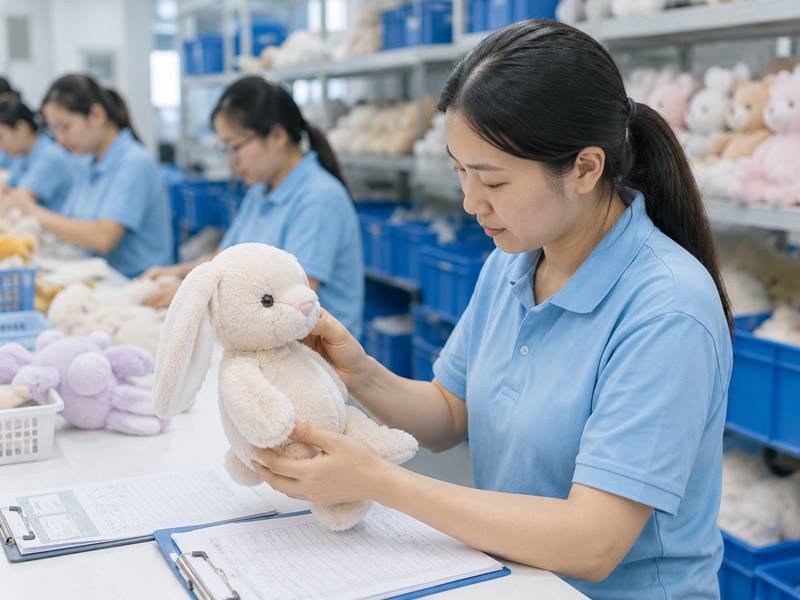
A custom plush project can look surprisingly safe during the sampling stage. The prototype may have the right expression, the fabric feels good, the embroidery is clean, and the quotation appears commercially workable. That is exactly when sourcing teams need to become more careful. A successful sample proves that a supplier can make one acceptable product under controlled conditions. It does not automatically prove that thousands of units can be manufactured with the same shape, materials, workmanship, packaging, testing status, and delivery discipline.
Before choosing a plush factory, brands should audit six connected areas: the supplier’s real manufacturing identity, product-development capability, material and supplier controls, sample-to-bulk quality system, product-specific compliance evidence, and realistic production and delivery capacity. A useful factory audit does not simply collect certificates and factory photographs. It verifies whether people, records, processes, approved samples, materials, and production controls consistently support the supplier’s claims.
The difference becomes obvious when production gets difficult. A fabric mill misses a dye lot. One embroidery file is updated but another department still uses the old version. Fifteen characters enter production together. A test report turns out to cover a different construction. Christmas shipment is approaching while packaging is still late. These are the moments when a professional manufacturing system matters. The purpose of an audit is to find out how that system works before your project becomes the test case.
What Should You Verify About the Factory?
Before approving a plush factory, verify its legal identity, actual manufacturing role, production resources, responsible teams, subcontracting structure, current operating activity, and supporting records. The objective is not merely to prove that a factory building exists. It is to confirm that the organization taking your order controls the decisions, information, materials, processes, and quality responsibilities that will influence the finished product.
Factory Identity and Responsibility
Start with the basic corporate picture. Compare the company name shown on quotations, contracts, business registration documents, payment instructions, export records, audit reports, and relevant testing documents. Different entities may legitimately perform different roles in international manufacturing, but the relationship among those entities should be understandable before the project moves forward. A trading entity, manufacturing entity, exporter, or authorized payment entity should not appear unexpectedly after the deposit has already been requested.
This becomes particularly important when a project includes licensed characters, confidential artwork, large advance payments, custom tooling, or retailer-specific compliance requirements. A sourcing team should be able to answer several straightforward questions: Who signs the manufacturing agreement? Who receives payment? Who manages production? Which factory actually performs the work? Which legal entity is responsible for quality disputes? Which entity appears on supporting compliance documents when relevant?
Heyzizi’s own documented operating model makes this distinction explicit. Its international brand function, legal operating entity, manufacturing resources, and strategic suppliers are defined separately rather than being presented as if every participant were the same company. The underlying fact library also states that externally coordinated resources should not automatically be described as self-owned factories. This is the kind of transparency a serious factory audit should expect from any prospective manufacturing partner.
The physical audit should then confirm that the organizational story matches reality. Request current production evidence instead of relying on a showroom filled with old samples. Look for pattern development, sample making, material storage, cutting, embroidery coordination, sewing, stuffing, finishing, inspection, packing, warehousing, and record management where those activities are claimed to be controlled by the supplier.
| Audit Point | Evidence Worth Checking | Common Risk Signal |
| Legal identity | Registration, contract entity, invoice details | Different entities with no clear explanation |
| Manufacturing role | Current work orders, production activity, facility tour | Only showroom samples are available |
| Development capability | Patterns, sample versions, engineering records | Development depends on verbal instructions |
| Production control | Schedules, work orders, line records | No connection between orders and production |
| Quality control | Incoming, first-piece, inline and final records | QC begins only after production finishes |
| Outsourcing | Process map and approved external resources | External work is hidden or unclear |
| Traceability | Project, material and batch records | Finished products cannot be traced backward |
In-House Processes and Real Control
The phrase “everything is in-house” is often used as a selling point, but it should not be treated as proof of stronger manufacturing. Plush products can involve specialized fabric mills, embroidery workshops, printing suppliers, woven-label manufacturers, molded parts, electronics, metal accessories, gift boxes, cartons, or other specialist processes. A factory may use several external resources and still maintain excellent control if those suppliers are qualified, specifications are controlled, and incoming work is properly inspected.
Build a process map for the actual product instead of auditing an abstract factory. A standard plush animal may require artwork review, pattern making, fabric purchasing, cutting, embroidery, sewing, stuffing, closing, finishing, needle detection, final inspection, labeling, and packing. A licensed collectible may add removable clothing, vinyl components, magnets, custom hardware, multiple embroidery files, special inserts, display packaging, and several approval stages.
The audit should identify which processes are internal, which are consistently handled by approved partners, which are project-specific, and which are nominated by the customer. The risk lies not in the existence of external processing but in the loss of specification control. If facial embroidery is completed externally, for example, the factory should still control the approved embroidery file, thread reference, placement, size, batch identification, and inspection requirements.
This is especially important when a visually small operation carries large commercial consequences. A five-millimeter error in eye position can change the expression of an entire character, while a barcode mistake can make thousands of otherwise acceptable units impossible to receive into a retailer’s system. Operational importance should determine audit depth, not whether the process happens inside one building.
Subcontracting and Peak-Season Control
Subcontracting becomes more sensitive when factories enter peak season. A supplier that performs most sewing and finishing internally during normal periods may add external capacity when several large programs overlap. That does not automatically create an unacceptable situation, but the brand should know which processes can move outside the primary production environment and which controls continue to apply after that move.
Ask how subcontractors are approved, how frequently they are reviewed, which quality requirements they receive, and whether customer approval is required for critical external production. More importantly, examine how technical information reaches those locations. An external sewing team should not be manufacturing from photographs sent through a messaging app when the main factory uses controlled patterns and Golden Samples.
The same rule applies to packaging. Multi-SKU programs can fail late in production when external packing resources receive the wrong hangtag, barcode, box artwork, or carton ratio. Finished plush products may be technically correct but commercially unusable because they were assigned to the wrong retail configuration. External processing therefore needs the same document discipline as internal production.
A controlled subcontracting system should make the flow visible. The factory should know who is completing the work, which product specification applies, how completed goods return, how inspection is performed, how defects are recorded, and how corrective actions reach the external supplier. When those answers remain vague, the brand is effectively approving a supply chain it cannot see.
Verifying Factory Claims
Important manufacturing claims should be verified through several independent forms of evidence. A supplier may claim strong capacity, sophisticated quality systems, long experience with licensed products, or advanced sampling ability. Each claim should be compared with what the records show and what the production environment demonstrates.
If a factory claims strong pattern-development capability, ask to see version-controlled patterns and sample-development histories. If it claims strict quality management, request actual inspection records from incoming material through shipment rather than blank forms prepared for visitors. If it claims strong production capacity, compare the claim with current schedules, staffing, equipment, active work orders, and recent output from products with similar complexity.
One useful principle is to triangulate critical claims from three directions: what management says, what operating records show, and what employees or production activity demonstrate. When all three tell the same story, confidence increases. When a sales presentation describes one process but production workers explain something different, the inconsistency deserves investigation before commercial approval.
Experienced sourcing teams do not expect a factory to be perfect. They expect the factory to be understandable. Strong organizations usually become clearer as the audit proceeds because responsibilities, files, samples, work orders, and inspection records connect logically. Weak systems often become more confusing the deeper the questions go, because the manufacturing story depends too heavily on individual explanations rather than repeatable records.
Which Development Capabilities Matter?
A capable plush factory should be able to transform artwork into repeatable manufacturing information, not simply handcraft an attractive prototype. Audit the supplier’s design interpretation, pattern engineering, sample revision, manufacturability review, production-file control, and ability to transfer sample-room knowledge to normal manufacturing. For character products, this development stage often determines whether bulk production will retain the approved appearance.
From Artwork to a Manufacturable Plush Product
Most character artwork is created to communicate visual identity rather than manufacturing instructions. A character may have an oversized head, tiny feet, thin fingers, floating accessories, extreme expressions, or proportions that work perfectly on screen but become difficult once fabric, seams, filling, and gravity enter the picture. A competent development team must translate the artistic concept into a three-dimensional soft product without losing the features that make the character recognizable.
During a supplier audit, pay close attention to the questions the development team asks before quoting or sampling. Experienced teams normally want to know the target size, intended age, destination market, expected order quantity, required pose, critical facial characteristics, fabric preference, packaging concept, accessories, functions, retail use, and whether the product will become part of a larger series. Those questions indicate that the supplier is trying to define the product rather than simply estimate sewing cost.
A useful evaluation exercise is to provide an artwork file that has not already been engineered and ask the factory to identify the manufacturing risks. A knowledgeable team may notice that narrow fingers will be difficult to turn after sewing, a heavy head needs better structural balance, long-pile fabric may obscure embroidered details, or removable accessories need a different safety review. The quality of that discussion can reveal more about real development capability than a showroom containing hundreds of finished toys.
The strongest product-development teams also understand that commercial success requires more than likeness. A design must be repeatable, inspectable, packable, testable when required, and compatible with the expected production quantity. The job is not simply to make the first sample attractive; it is to turn visual intent into a manufacturing system.
Pattern Engineering and Structure
Paper patterns are the structural engineering of most plush products. They determine volume, seam position, proportions, posture, facial curvature, limb angle, and the way a toy changes after stuffing. Two factories can use the same design, similar sewing machines, and similar fabric yet produce very different results because their pattern-development ability is different.
A small adjustment to a head gusset may change how round the face appears. A few millimeters around the muzzle can alter the expression. The base panels of a seated animal influence balance, while the shape of arms or legs changes how the final toy presents on a shelf. Pattern engineering therefore deserves far more attention during supplier qualification than it usually receives.
Ask the factory how patterns are numbered, revised, approved, and released to production. Experimental patterns should be clearly distinguishable from the final production version. If a customer changes the width of a face or angle of an ear, that modification should be reflected in a controlled pattern revision instead of remaining only in a message thread between the merchandiser and sample maker.
Material choice also affects pattern behavior. Different pile heights, stretch characteristics, backing constructions, and surface textures influence seam bulk, turning, embroidery appearance, filling, and final proportions. Heyzizi’s documented material-development framework recognizes that fabric properties such as pile direction, elasticity, surface structure, and density can influence the finished shape and bulk-production consistency.
For complex designs, ask whether the factory uses white samples, structural prototypes, or intermediate development stages before expensive final materials are committed. These steps can reveal balance, construction, and manufacturability problems before they become expensive sample revisions.
Sample Revision and Version Management
Complex characters may need several sample revisions, and the number of revisions alone should not be treated as a sign of weak development. What matters is whether each version moves the project forward in a controlled and understandable way. The supplier should be able to show what changed, which customer comment triggered the change, and which supporting production files were updated afterward.
A useful sample history records the SKU, sample type, sample version, pattern version, material references, embroidery or printing versions, important dimensions, major customer comments, approval status, and dates. This becomes essential when brand teams, licensing teams, designers, sourcing managers, quality staff, and retailers are all reviewing the same product at different times.
Without reliable version management, an old instruction can easily re-enter the project. The brand approves sample V4, but production receives a pattern that still contains part of V3. An embroidery file is updated, while the packing department continues working from an old visual. These are information failures rather than sewing failures, yet they can create thousands of incorrect products.
Heyzizi’s documented sample-management framework illustrates the level of control that brands should look for. Its sample process includes feasibility review, pattern development, physical sampling, revision, final sample sealing, and production-data locking. The recorded sample framework also links versions to photographs, dimensions, patterns, BOM information, material records, modification history, and approval status.
A simple audit exercise can be extremely revealing. Select one completed project and ask the factory to retrieve the final sample record, matching pattern version, BOM, embroidery file, material reference, and approval evidence. If staff can do this quickly, the system is probably being used in practice rather than existing only on paper.
Production Readiness
A beautiful prototype is not automatically a production-ready product. Sample makers often have greater skill and more time than normal production operators. They may manually adjust stuffing, steam a surface, reposition clothing, reshape the face, or repair small details until one piece looks excellent. Those techniques can be acceptable during development, but they become risky if they cannot be translated into controlled production methods.
Before final sample approval, ask which details depend on individual craftsmanship and which have been converted into measurable or visually controlled standards. Important production information may include filling weight, key dimensions, embroidery placement, fabric direction, seam position, attachment locations, clothing position, and visual comparison against a Golden Sample.
The bridge between the sample room and mass production should be visible during an audit. Strong factories usually use production-file locking, pre-production review, first-piece confirmation, and staged quality inspection. Heyzizi’s documented process similarly states that approved samples, patterns, BOMs, materials, process requirements, filling information, and packaging data are locked before mass production proceeds.
The critical question is whether ordinary production operators can recreate what the specialist sample maker created. If the approved appearance depends on one person manually correcting every finished toy, the product is still relying on craft rather than a repeatable manufacturing system.
How Should Materials and Suppliers Be Audited?

Materials should be audited for specification, appearance, traceability, supporting documentation, batch consistency, supply stability, and reorder availability. Brands should know which fabrics, fillings, threads, accessories, labels, and packaging materials were approved, how incoming batches are compared with those references, and how substitutions are controlled. Material consistency becomes especially important when the product is expected to remain active through multiple production runs.
Fabric, Filling, and Component Traceability
A vague description such as “soft white plush” or “high-quality PP filling” is not enough for a repeatable commercial program. Two fabrics that look similar in a photograph can behave differently because of pile length, density, stretch, backing construction, surface gloss, hand feel, or dyeing method. Those differences can affect not only appearance but also sewing, embroidery, stuffed shape, and productivity.
For important materials, the production system should maintain an identifiable reference. Depending on the product, this may include supplier, internal material code, color reference, physical swatch, fabric specification, construction, and relevant supporting documents. Filling materials and internal components should be controlled in the same way, particularly for products using weighted materials, pellets, foam, electronics, magnets, or other specialty components.
Traceability does not need to rely on complicated technology. The practical question is whether the supplier can connect the material in a finished batch to its purchasing and receiving records. During an audit, choose a finished product and ask the factory to trace one significant fabric or component backward. Then choose an incoming material batch and ask which current orders use it.
This becomes critical when something fails. If one fabric batch produces an unacceptable chemical result, significant color variation, or unusual shedding, the manufacturer needs to know which products used that material. Without traceability, the safest response may be to treat a much larger quantity of finished goods as potentially affected.
Color and Batch Consistency
Color is particularly sensitive in plush manufacturing because the surface is three-dimensional. Pile direction, density, gloss, backing color, surface texture, and viewing angle can change how the same nominal color appears. A Pantone reference is useful for communication, but it cannot always predict exactly how a finished plush fabric will look under real lighting.
Important brand colors should therefore be approved using physical material references whenever practical. The factory should retain the approved swatch and compare bulk fabric against that reference before cutting. For large orders using several rolls or dye lots, obvious variation should be identified before materials become mixed throughout production.
A practical color-control sequence often moves from brand color reference to supplier swatch or lab dip, physical approval, sample approval, bulk-fabric comparison, and finished-product review. The exact method can vary, but the supplier should not rely entirely on computer screens or photographs when the color has high commercial importance.
Reorders deserve additional attention because an identical fabric code does not guarantee that the next dye lot will appear exactly the same. The factory should compare the new batch with retained project references, especially for character faces, uniforms, corporate mascots, and other products where specific colors are part of the brand identity.
The same principle applies to embroidery and printed components. Each component may individually appear acceptable, yet the complete product can still look visually inconsistent if thread, fabric, print, and accessories do not work together.
Material Documentation
Material reports should be treated as evidence with a specific scope rather than as general proof that an entire product is compliant. A report may cover one fabric composition, one color family, one material source, or one particular test. It should not automatically be extended to every component or every finished toy that happens to contain a similar material.
Before relying on supporting documents, check what was actually tested, who supplied the material, which standard or method was applied, when the testing occurred, whether the current material matches the tested material, and whether the report is being used for an appropriate purpose.
This matters for chemical safety and also for sustainability claims. If a product program requires recycled-content fabric, certified paper packaging, or other documented sourcing attributes, the evidence should correspond to the actual supply chain used for the order rather than to an unrelated material held somewhere in the supplier database.
The fact base used by Heyzizi explicitly distinguishes material supporting documents from finished-product compliance evidence and prohibits treating one material report as proof that all finished products meet every applicable requirement. That distinction is valuable for any sourcing team because it prevents compliance documentation from becoming a marketing folder disconnected from the actual product.
A smaller set of relevant, traceable documents is more useful than a large folder containing reports that nobody has matched to the current production version.
Backup Materials and Supplier Stability
Supply continuity matters when a plush product is expected to remain on sale for several seasons or return through repeated promotional programs. Fabric mills can experience stock shortages, longer dye schedules, MOQ changes, discontinued constructions, or changes in production. A factory should therefore understand which materials are difficult to replace and which alternatives may be available.
A potential alternative is not the same as an approved substitute. Changing fabric can affect pile height, color, hand feel, stretch, sewing efficiency, embroidery appearance, product dimensions, stuffed shape, weight, and even the compliance assessment. Purchasing staff should not be allowed to replace a critical material simply because a substitute is cheaper or currently available.
For long-running products, it can be sensible to identify high-risk materials during development and determine whether a backup source should be evaluated before an emergency occurs. If the primary fabric becomes unavailable two weeks before production, there may be too little time to properly sample, approve, and review the alternative.
A controlled material-change process should identify what changed, which product characteristics may be affected, whether resampling is necessary, whether testing assumptions need to be reviewed, and who must approve the substitution. That discipline is particularly important for signature fabrics, brand colors, weighted materials, child-focused products, and components that influence the physical structure.
How Is Quality Controlled From Sample to Bulk?

Quality should be controlled through a sequence of approved standards and inspections rather than one final check after production. The Golden Sample, patterns, BOM, materials, artwork, key specifications, labels, and packaging requirements should form the production baseline. Incoming materials, first pieces, work in progress, finished products, needle controls, and packaging should then be checked before deviations spread across the entire order.
Golden Sample and Locked Production Standards
A Golden Sample is one of the most useful references in plush manufacturing because important visual characteristics cannot be completely expressed through measurements. It captures overall proportion, facial expression, fabric combination, filling feel, clothing position, posture, and other relationships that make the product look correct as a complete object.
The Golden Sample should not exist independently from the production documents. The factory should be able to identify which pattern version, BOM, embroidery or printing files, material references, filling requirements, packaging version, and important dimensions correspond with the sealed sample.
This prevents a common sourcing problem in which everyone agrees to “follow the approved sample,” but different departments are looking at different objects. The sample room has the final version, production retains an older pre-production sample, and sales has a specially refined photography sample. The phrase “approved sample” becomes meaningless unless the actual reference is controlled.
Changes after approval should follow a defined process. Purchasing should not quietly change fabric. Production should not adjust a pattern solely to increase efficiency. The packing team should not use an older barcode file because it is already printed. Small unapproved changes can accumulate until the shipment no longer represents the product the brand approved.
A structured pre-production review helps prevent this. Product, engineering, purchasing, manufacturing, quality, and packaging teams should all understand which files and physical references are current before the first large batch of fabric is cut.
Inspection at Multiple Stages
Final inspection remains important, but it is often the most expensive place to discover a recurring defect. If 5,000 plush toys have already been sewn and stuffed before someone notices that an embroidery file is positioned incorrectly, the problem is no longer just a quality issue. It becomes a schedule, cost, and potentially launch-date problem.
A stronger quality system checks risk as it enters production. Incoming inspection can identify material or color problems before cutting. First-piece approval can reveal pattern or process differences before thousands of units are released. Inline inspections can identify repeating sewing defects while production is still running. Final and packaging inspections then verify that the completed shipment remains within the approved standard.
| Production Stage | Main Controls | Problems Best Detected Here |
| Incoming materials | Fabric, color, accessories, identification | Wrong material or dye variation |
| First piece | Shape, pattern, embroidery, stuffing | Sample-to-line differences |
| Sewing process | Seam quality and component alignment | Repeating workmanship defects |
| Stuffing | Weight, fullness and shape | Inconsistent proportions |
| Finishing | Expression, symmetry, accessories | Visual inconsistency |
| Needle control | Broken needle and foreign metal procedures | Metal contamination |
| Final inspection | Workmanship, quantity, specification | Finished-product defects |
| Packaging | SKU, labels, barcode, carton details | Retail and warehouse errors |
The exact quality plan should reflect product risk. A simple promotional plush does not necessarily require the same controls as a baby product, weighted toy, product with electronics, or complex collectible with removable accessories. The important point is that the supplier can adjust its inspection plan to the product rather than applying one generic checklist to every order.
Heyzizi’s documented quality system, for example, separates incoming inspection, first-piece checks, process inspection, semi-finished inspection, finished-product checks, packaging inspection, needle or metal controls, and outgoing inspection functions. Regardless of supplier, a brand should look for the same principle of staged prevention rather than end-of-line sorting.
Sewing, Appearance, and Character Accuracy
Plush quality combines measurable specifications with visual judgment. A toy can technically fall inside dimensional tolerances and still look wrong because the facial expression is unbalanced, an ear sits at the wrong angle, the muzzle is twisted, the filling changes the silhouette, or a garment sits differently from the approved reference.
Critical visual characteristics should therefore be identified during development and communicated to production and quality staff. For a mascot, the most important details may include eye spacing, ear angle, mouth shape, logo position, and body posture. For another character, hairstyle, clothing shape, tail angle, or unusual proportions may carry more of the brand identity.
Sewing controls should also focus on recurring failure modes such as open seams, skipped stitches, poor closing seams, trapped pile, uneven limb positions, incorrect panel alignment, twisted components, weak attachment areas, or inconsistent seam allowances. When a defect repeats, the correct response is not simply to increase final sorting.
Suppose a seam repeatedly opens after stuffing. The factory should investigate the pattern, seam allowance, thread, operator method, sewing tension, fabric behavior, and stuffing pressure. If the root cause is never removed, inspectors will continue finding the same defect indefinitely.
Experienced quality teams learn to distinguish defects that are technically measurable from defects that damage character recognition. That combination of quantitative specification and trained visual evaluation is especially important for licensed characters, mascots, collectible products, and multi-SKU series.
Corrective Action and Quality Accountability
A useful quality system assumes that problems can occur and defines what happens when they do. The first responsibility is containment: stop affected goods from moving further through production or shipment. The second is identifying the root cause. The third is correcting affected units, and the fourth is modifying the process to reduce the chance of recurrence.
Consider a batch where a noticeable percentage of products has eyes positioned too low. Sorting out the affected units protects the shipment, but it does not explain what caused the problem. The embroidery placement mark may be wrong, fabric could be stretching, an operator fixture may have shifted, or an outdated artwork file may have reached production.
During a supplier audit, request anonymized examples of corrective actions from real production. A trustworthy manufacturer does not need to pretend that manufacturing defects never happen. In fact, a factory claiming that it has never experienced a significant quality issue should usually create more questions, not fewer. Manufacturing strength is demonstrated by how problems are detected, investigated, documented, and prevented from returning.
Quality responsibility should also extend beyond inspectors. An incorrect material from an outdated BOM may involve project management, engineering, purchasing, production, and quality. A barcode problem may involve packaging and document control. Heyzizi’s internal quality framework similarly assigns responsibility across project, engineering, purchasing, production, quality, business communication, packaging, and warehouse functions rather than attributing every problem to final inspection.
Which Compliance Evidence Should Brands Verify?

Compliance should be verified against the actual product, intended age, target market, construction, materials, production version, and applicable requirements. Factory audits, social responsibility reports, material documents, test reports, and product certificates serve different purposes. A brand should determine whether each document is genuine, current, within scope, and relevant to the specific product instead of simply counting certificates displayed by the supplier.
Product, Market, and Age Scope
The compliance review should begin by defining the product. A conventional stuffed animal, plush keychain, baby plush, weighted product, collectible, electronic plush, or toy containing magnets can present different physical and chemical risks. The intended age and destination market further influence which requirements need to be considered.
A knowledgeable factory should therefore ask the target market and age category before the project reaches final sample approval. It should also understand the important construction details, including removable accessories, hard components, cords, pellets, batteries, magnets, sound units, or other features that may change the product risk profile.
For U.S. children’s toys, ASTM F963 and applicable CPSC requirements may be relevant depending on the product and intended age. European products may involve EN 71-related testing and other applicable toy, chemical, labeling, and market requirements. Other countries operate their own frameworks. The exact combination should be determined according to the actual product rather than copied from a standard testing package.
The factory audit is therefore not a test of whether sales staff can recite regulatory abbreviations. It should show whether the organization can translate product type, age grading, materials, features, and sales market into an appropriate testing and documentation plan.
Age grading also needs to influence development rather than being added to packaging at the end. If a product intended for younger users gains a detachable accessory during sample revision, the design and compliance assumptions may need to be reviewed again before production proceeds.
Reading Test Reports Correctly
A passing result on the final page of a test report is not enough information for supplier approval. The product identification and scope should be examined first. Check the product name, photographs, model or SKU, materials or components represented, testing date, referenced standards, intended age where applicable, and laboratory information.
A report can be completely genuine and still be irrelevant to the current product. A 20-centimeter plush with embroidered eyes may have a valid report, while a new version adds hard plastic eyes, a sound module, and a detachable accessory. That change can alter the product risk profile even if the body shape remains similar.
The same principle applies when one report is presented for a large product family. Eight characters may share many components, yet one character could contain a unique accessory or different fabric requiring additional evaluation. Whether products can legitimately be grouped for testing should be based on technical reasoning rather than convenience or cost pressure.
Material reports need similar caution. A fabric report can provide valuable supporting information, but it is not automatically a finished-product test. Social-compliance audits, management-system certificates, environmental supply-chain documents, customer approvals, and finished-product safety reports should not be treated as interchangeable evidence.
Heyzizi’s documented compliance policy follows this principle by separating valid, expired, pending, factory-specific, material-specific, project-specific, and other document statuses. It also requires the subject, address, validity, and scope to match before information is presented as applicable evidence.
Testing Support and Product Changes
Third-party testing works best when it is integrated into development instead of treated as paperwork added shortly before shipment. Before samples go to a laboratory, the factory should know which production version is being tested and whether its materials and construction represent the intended mass-production product.
This matters because early samples frequently change. Fabric can be replaced, accessories revised, embroidery adjusted, filling modified, or packaging updated. Some changes may have no meaningful effect on compliance evidence, while others can materially change the risk assessment. A controlled factory should at least recognize when a technical review is necessary.
Ask who coordinates test samples, how samples are identified, how reports are stored, and what happens when a test fails. A failure should lead to investigation rather than immediate pressure on the laboratory or attempts to submit a different sample without understanding the root cause.
Depending on the result, the corrective action might involve material substitution, attachment redesign, seam construction, warning information, accessory changes, or other technical adjustments. The new tested version must then remain aligned with the version released to production.
Heyzizi’s documented compliance framework states that third-party testing can be coordinated according to destination-market requirements and that testing plans depend on product type, age grading, materials, and target market. That is an appropriate model for manufacturing support because it ties testing to the actual product instead of advertising one universal compliance package.
Labels, Packaging, and Traceability
A passing laboratory report does not complete the compliance process. The product shipped to market must still correspond to the approved construction, and the relevant labels, tracking information, warnings, age information, barcodes, and packaging details must remain correct for the intended destination and sales channel.
Packaging errors can be especially disruptive because the underlying plush product may be perfectly manufactured. A retailer may still reject inventory if the wrong barcode, language, warning, SKU, or product identifier appears on packaging. Multi-SKU programs add further risk because similar products can easily receive incorrect labels or cartons.
Audit how label and packaging artwork versions are controlled. The production team should know which version is current, who approved it, and how obsolete files are removed from circulation. The same discipline used for patterns and embroidery artwork should apply to compliance-sensitive printed information.
Traceability also becomes important if a problem appears after delivery. The brand should be able to identify which product version, material batch, testing evidence, manufacturing batch, and packaging version were associated with the affected shipment.
Compliance is therefore better understood as a connected evidence chain: product definition leads to design and materials, which lead to testing where required, which connects to the approved production version, labeling, batch records, and the units actually shipped. A folder containing certificates without those connections provides much less protection.
How Do You Audit Capacity and Delivery Risk?
Capacity should be audited against the specific product, SKU mix, production window, material lead times, quality requirements, current factory workload, and peak-season conditions. A headline monthly capacity number is not enough. Brands need to understand how much verified production capacity can actually be allocated to their program and which processes are most likely to become bottlenecks before shipment.
Product-Based Capacity
Unit output varies dramatically across plush products. An 8–12 centimeter keychain with relatively few pattern pieces and standard embroidery may move through production much faster than a 30-centimeter licensed character using several fabrics, detailed clothing, hand-installed accessories, and complex embroidery.
Large products also consume more cutting area, filling time, finishing space, storage volume, and packaging capacity. Weighted products introduce additional filling and internal construction controls. Electronic products require function checks and specialized components. Multi-SKU collections require more material changes, file control, line setup, packing verification, and production coordination.
A more useful question than “What is your monthly capacity?” is therefore: How much production capacity can you allocate to this particular product mix during our required manufacturing window?
The factory should be able to explain its estimate using product size, number of pattern pieces, embroidery or printing complexity, sewing operations, garments, hand-finishing time, accessories, stuffing requirements, SKU count, packaging, and existing factory workload.
Heyzizi’s own audit framework reflects this approach by listing monthly capacity, peak-season capacity, equipment, staffing, production scheduling, external-production ratio, and emergency-order capability as separate areas to evaluate rather than using one number as proof of capacity.
A credible capacity estimate explains the assumptions behind the number. If a supplier quotes exactly the same output for a simple mini plush and a complicated 40-centimeter collectible, the figure should be examined more carefully.
Available Capacity Versus Theoretical Capacity
A factory may genuinely be capable of producing a large number of equivalent units every month while having very little free capacity during the period your order needs to run. Existing customer commitments, holiday programs, machine maintenance, workforce availability, material lead times, testing schedules, and packaging capacity all influence how much of the theoretical output remains available.
During supplier qualification, ask for a high-level production schedule. Customer names and confidential information can be hidden. The purpose is to determine whether the factory actually allocates lines, labor, material arrival dates, inspection resources, and packing schedules against confirmed orders.
Capacity should include quality resources as well. Increasing sewing output without adding sufficient inspectors, line supervision, finishing staff, or packaging checks can create a situation where pieces are produced faster than the quality system can reliably control them.
The most credible production schedule separates material availability, manufacturing, testing where necessary, inspection, packing, and shipment preparation. Each stage should have realistic assumptions rather than being compressed into one optimistic production number.
A useful discussion should also identify the bottleneck. Every complicated product has one. It may be embroidery, sewing, hand finishing, accessory assembly, stuffing, packaging, testing, or a specialty material. A supplier that cannot identify any bottleneck may not yet have analyzed the project carefully enough.
Peak Season and Multi-SKU Programs
Seasonal orders reveal whether capacity management is proactive. Christmas programs, retail resets, licensing launches, promotional campaigns, and major events often create fixed shipment deadlines. When several customers need product at the same time, manufacturers may use overtime, temporary workers, external capacity, split production, or adjusted line priorities.
The audit should clarify which methods are normally used and which require customer approval. Overtime can absorb short-term pressure, but a production plan relying almost entirely on prolonged overtime may create fatigue, quality, and staff-stability risks.
Forecasting can substantially reduce these problems. For continuing programs, the brand can share approximate volume and SKU expectations before final artwork is complete. That allows the supplier to reserve production space, plan material procurement, and identify potential bottlenecks earlier.
Multi-SKU programs need special attention because unit quantity alone hides complexity. A 30,000-unit order containing one design is much simpler operationally than 30,000 units divided across fifteen characters with different fabric colors, embroidery files, hangtags, barcodes, and carton ratios.
Ask how SKUs will be grouped, scheduled, separated, and packed. Some may run simultaneously, while others may be grouped according to common fabrics or production processes. Packing also needs early planning because manufacturing can finish on time while labeling, assortment, and carton-ratio work becomes the final bottleneck.
The factory should demonstrate that project-management capacity grows with SKU complexity. When the number of characters rises, information control becomes just as important as sewing output.
Reorders, Recovery Plans, and Red Flags
A manufacturer should be evaluated for the second order as well as the first. Long-running products require retained patterns, approved BOMs, material references, artwork files, Golden Samples, packing specifications, and quality standards so that future production can reproduce the original product without restarting development from memory.
A reorder should still include a change review. The factory should check whether the material supplier is unchanged, whether the original fabric remains available, whether new dye lots match the historical reference, whether packaging artwork changed, whether the destination market remains the same, and whether any regulatory or customer requirements have changed.
Delivery risk also requires a recovery plan. If a material arrives late or an embroidery process falls behind, the supplier should be able to explain which actions are possible. Split shipments, revised production sequencing, added approved capacity, alternative materials requiring approval, or expedited logistics may all be reasonable options depending on the project. “We will work faster” is not a complete recovery plan.
Several red flags should prompt additional investigation before supplier approval. These include hidden subcontracting, sample versions that cannot be traced, production patterns that do not clearly match the approved sample, material changes made without approval, compliance documents presented without product scope, identical capacity claims across very different products, missing first-piece approval, reliance on overtime as the main peak-season strategy, unavailable corrective-action records, and delivery promises made before material availability is reviewed.
A weighted supplier score can help keep the final decision balanced. One practical model assigns approximately 10% to factory identity and transparency, 20% to development capability, 15% to material and supplier controls, 20% to quality management, 20% to compliance readiness, and 15% to capacity and delivery. The exact weighting should change according to product risk, but the score should always reflect evidence rather than sales confidence.
Choosing a plush manufacturer is ultimately an exercise in understanding how a company behaves when normal production becomes complicated. Almost any experienced supplier can show attractive samples. The more meaningful question is whether the same organization can control patterns, materials, people, approvals, testing evidence, production changes, quality problems, multiple SKUs, packaging, and delivery deadlines when thousands of units are moving at the same time.
A strong audit should therefore leave the sourcing team with more than photographs and a completed checklist. It should establish who is responsible, which evidence supports the supplier’s claims, how the approved product becomes a controlled production standard, how changes are managed, and what happens when something fails. When those answers are clear, a brand is no longer selecting a factory based primarily on confidence in one sample. It is evaluating whether the supplier has the systems required for a stable manufacturing relationship.
Frequently Asked Questions
What should I check first when auditing a plush factory?
Start with factory identity and manufacturing responsibility before evaluating price, samples, or certificates. Confirm which company signs the contract, which facility performs the important production processes, which operations are subcontracted, and who is responsible for product quality. Then compare management claims with current production records, engineering files, inspection reports, work orders, and an actual factory walk-through. A consistent operating picture is more valuable than a polished sales presentation.
How can I verify whether a plush supplier is a real factory?
Verification should use several sources of evidence rather than one certificate or video. Review legal company information, manufacturing addresses, current production activity, employee responsibilities, equipment, sample records, production schedules, quality documents, and recent anonymized work orders. During a physical or live video audit, request specific areas such as pattern development, sample making, material storage, sewing, stuffing, inspection, and packing instead of allowing the supplier to show only a prepared route.
What documents should a plush factory provide before an order?
The required documents depend on the product and commercial relationship, but supplier qualification commonly involves corporate registration information, manufacturing or audit documentation where applicable, product specifications, sample approvals, BOMs, material references, inspection procedures, testing evidence relevant to the project, and packaging or labeling approvals. The important issue is not document quantity. Each record should be current, identifiable, within scope, and clearly linked to the product or manufacturing process it is intended to support.
How do I know whether a plush sample can be reproduced in bulk?
Examine how the supplier converts the approved sample into production instructions. The final sample should connect to an approved pattern version, BOM, fabric references, embroidery or printing files, filling requirements, key measurements, and packaging details. Ask whether a pre-production meeting and first-piece approval are used. If the sample depends heavily on one specialist manually reshaping or correcting every unit, the design may not yet be sufficiently industrialized for consistent large-scale production.
What quality controls should a reliable plush factory have?
A reliable quality system normally checks risk at several production stages rather than depending only on final inspection. Useful controls include incoming material inspection, first-piece confirmation, process or inline inspection, stuffing and appearance checks, finished-product inspection, broken-needle or metal controls where applicable, packaging verification, and final shipment release. For character products, the inspection standard should combine measurable specifications with visual comparison against the approved Golden Sample so that expression and character identity are also protected.
How should brands verify plush toy compliance documents?
Start by defining the exact product, intended age, destination market, materials, and construction. Then examine whether each report or document actually covers that product or component. Check identification, photographs, dates, laboratory information, tested requirements, and scope. Do not treat a social audit, material report, finished-product test report, management certificate, or retailer approval as interchangeable evidence. Product changes involving materials, attachments, magnets, electronics, or other significant features may require additional compliance review.
How can I verify a plush factory’s real production capacity?
Do not rely only on the supplier’s stated monthly output. Ask how much capacity can actually be allocated to your specific product during the required production window. Compare the proposed schedule with similar recent orders, current factory loading, staffing, equipment, material lead times, SKU complexity, hand-finishing requirements, quality resources, and packaging workload. A credible supplier should be able to explain where the likely bottleneck is and how peak-season or delayed-production risks would be managed.