 Skip to content
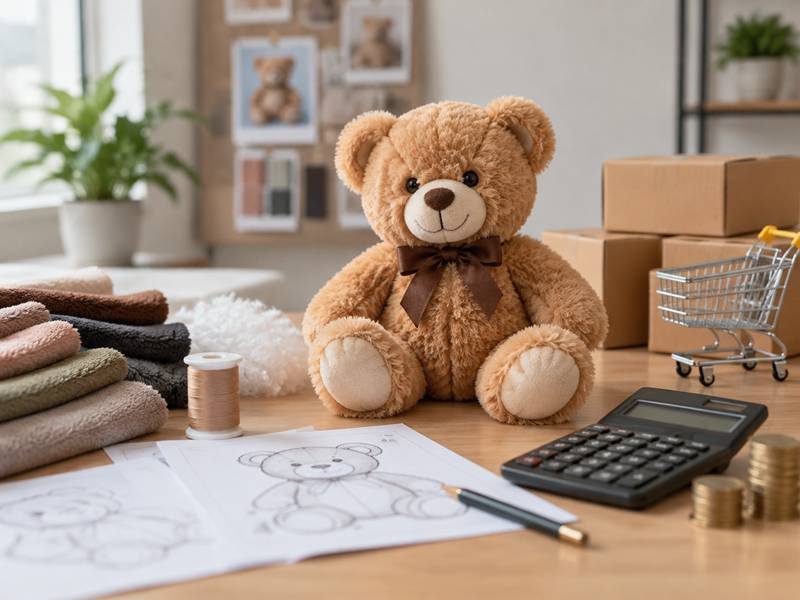
A custom plush project can look simple at the quotation stage. A size is selected, a quantity is estimated, artwork is shared, and a unit price appears on a spreadsheet. That number is useful, but it is rarely enough to describe the full financial picture.
The largest budget changes often come from details that are still unresolved when the first quotation is prepared. A face may require denser embroidery after the prototype is reviewed. A specific brand color may not exist in standard fabric stock. A jacket that looked simple in artwork may need four separate pattern pieces, lining, edge finishing, and two additional sewing operations. Retail packaging may double the packed volume compared with a standard individual bag. A late change to the age grade or destination can alter the testing scope.
Hidden expenses in custom plush projects most often come from development work, additional sample rounds, special fabrics, complex decoration, color matching, separate clothing, custom accessories, testing, retail packaging, inspection, freight, duties, and late-stage specification changes. The best way to control them is to define the physical product, packaging, compliance requirements, and delivery terms before bulk production rather than relying on the first unit price alone.
The key issue is not whether a quotation looks low or high. It is whether the number is built on a complete specification.
Consider two 1,000-piece character programs. The first appears cheaper at the beginning, but the prototype later needs a new fabric, revised embroidery, a larger carton, and retail-ready labels. The second starts from a more complete technical brief and includes those requirements from the start. By shipment, the project that looked less expensive may carry the higher landed total.
That is why a strong plush budget starts with one principle: every design decision eventually becomes a material, labor, packaging, testing, or logistics decision.
What Costs Are Often Missing From a Custom Plush Quote?
A custom plush quotation can look precise while still leaving several cost items unresolved. This usually happens because the first price is calculated before the final sample, exact fabric, embroidery coverage, labels, packaging, testing scope, carton size, and shipping method have all been confirmed.
The quoted unit price often covers the plush itself under a defined set of assumptions. Costs begin to change when those assumptions change.
For example, a 20 cm character quoted from artwork may later require a denser fabric, larger facial embroidery, a separate jacket, a custom-dyed color, a retail box, or additional test work. None of these changes is unusual, but each one can affect the final spend.
The most useful way to review a quote is to divide the project into separate cost layers rather than treating everything as one number.
| Cost Area | Common Items | When It Becomes Clear |
|---|---|---|
| Development | Pattern, prototype, embroidery setup, revisions | Sampling stage |
| Product | Fabric, filling, sewing, decoration, accessories | After sample confirmation |
| Packaging | Labels, bags, boxes, inserts, barcodes | Before packing approval |
| Compliance | Safety tests, documentation, retesting | After destination and product details are fixed |
| Quality Control | Inspection, sorting, rework | During and after bulk production |
| Logistics | Cartons, freight, compression, delivery term | After packing details are known |
| Import | Duty, tax, customs handling | Based on destination and trade term |
The important distinction is not whether a cost is “hidden” in a dishonest sense. In many cases, the cost simply cannot be calculated accurately until the related specification has been confirmed.
That is why an early quote should be treated as a working commercial estimate, while the approved sample and final specification should form the basis of the production price.
Initial Quote
An initial quote usually begins with the visible physical product.
For a standard plush, the calculation may include:
- Main outer fabric
- Secondary fabric
- Filling
- Cutting
- Sewing
- Standard embroidery
- Assembly
- Basic finishing
- Ordinary individual packing
However, two quotes for the same artwork may still describe two different products.
One may assume a standard short plush, while another uses a denser crystal velvet. One may calculate small embroidered eyes, while another assumes a larger embroidery area. One may include a woven label and individual bag, while another leaves those items for later confirmation.
Before comparing unit prices, the specification behind each number should be checked carefully.
A useful quotation should make the following items clear:
| Specification | What Should Be Confirmed |
|---|---|
| Finished size | Height, width, sitting height if relevant |
| Fabric | Type, pile, density, color |
| Filling | Material and intended firmness |
| Decoration | Embroidery, printing, appliqué |
| Accessories | Clothing, plastic parts, metal parts, cords |
| Labels | Care label, woven label, legal information |
| Packaging | Individual bag, retail pack, gift box |
| Quantity | Per design, not only total quantity |
| Testing | Included, excluded, or pending |
| Inspection | Standard control or third-party inspection |
| Delivery term | EXW, FOB, CIF, DDP or another agreed term |
If these details are not aligned, comparing prices becomes unreliable.
A difference of USD 0.20 per piece may look important on a 5,000-piece order, but that difference can disappear quickly if one option excludes packaging, test work, or a more expensive material already included elsewhere.
The correct comparison is therefore:
same design + same materials + same decoration + same packaging + same quantity + same delivery basis
Only then does the unit price become meaningful.
Sample Cost
Prototype development is one of the first areas that is often separated from the bulk price.
A custom plush sample is not simply one finished toy. It represents the work required to convert flat artwork into a repeatable three-dimensional product.
The process may include:
- Artwork evaluation
- Pattern development
- Material selection
- Embroidery file preparation
- Cutting
- Sewing
- Filling adjustment
- Hand shaping
- Visual correction
- Revision planning
For Heyzizi projects, sample fees are generally USD 100–300 per style, depending on size, structure, materials, embroidery, accessories, and overall difficulty. Standard MOQ starts from 500 pieces per design.
The amount can increase when the product includes features such as:
- Complex removable clothing
- Custom molded parts
- Electronics
- Magnets
- Special fabrics
- Unusual printing
- Multiple decorative components
- Complicated three-dimensional facial structures
The sample stage is also where many cost-driving details become visible for the first time.
A large head may require more filling than expected. A narrow arm may need a different construction to avoid becoming too hard. Long-pile fabric may hide small embroidery. A separate jacket may need additional seam finishing to sit correctly on the body.
These discoveries are valuable because they allow the cost structure to be corrected before hundreds or thousands of pieces are produced.
A well-developed sample should therefore answer several commercial and technical issues at once:
- Can the design be sewn consistently?
- Are the materials suitable?
- Is the character recognizable?
- Does the decoration work at the chosen scale?
- Is the filling level stable?
- Are the accessories practical?
- Can the product be packed efficiently?
The cheapest prototype is not necessarily the lowest-cost development route if it leaves these issues unresolved.
Revisions
Additional sample rounds are another common source of budget change.
The financial effect depends on what is being revised.
A minor correction may involve moving embroidery slightly, reducing filling, or adjusting a small feature.
A structural revision is different. Changing the head profile, muzzle, body proportion, limb length, or overall size may require new pattern work.
A major redesign can affect several areas at once.
| Revision Type | Example | Possible Impact |
|---|---|---|
| Minor | Shift eyes 3 mm | Limited adjustment |
| Moderate | Change muzzle shape | Pattern revision |
| Structural | Enlarge head and shorten body | New pattern and new sample |
| Material | Change short plush to faux fur | New sourcing and sewing review |
| Decoration | Replace printing with embroidery | New setup and machine time |
| Accessory | Add clothing or a removable item | New parts and assembly steps |
The most effective way to limit revision costs is to make feedback measurable.
Instead of:
“Make the face cuter.”
Use:
“Move both eyes 3 mm inward, reduce muzzle height by 4 mm, and increase cheek width without changing overall head height.”
This type of instruction reduces interpretation and makes the next sample easier to evaluate.
Feedback should also be consolidated whenever possible.
Five separate rounds of comments can create more development work than one complete review containing all agreed changes.
Late revisions deserve special attention.
Once bulk fabric, embroidery files, packaging, and production schedules have been confirmed, even a small change may affect several areas at once.
Changing the color of one fabric may require:
- New material sourcing
- New swatch approval
- New sample
- New embroidery thread selection
- Packaging image updates
- Additional lead time
The cost of a change therefore depends heavily on when it is made.
Setup
Certain costs are connected to preparation rather than the number of finished pieces.
These may include:
- Pattern development
- Embroidery digitizing
- Printing preparation
- Mold creation
- Special accessory tooling
- Packaging die lines
- Custom fabric treatment
Some of these may already be included in the sample fee or unit price. Others may be shown separately.
The important issue is whether the setup can be reused.
For example, an approved embroidery file can usually be repeated if the artwork and size remain unchanged. A pattern may be reused for a repeat order of the same style. A custom mold may continue to serve future runs of the same component.
A useful way to evaluate setup work is to ask:
- Is this a one-time expense?
- Can it be reused?
- Is it linked to one design only?
- Will a different size require a new version?
- Will a new color change anything?
- Is the work already included elsewhere?
These questions are particularly important for collections.
A 3,000-piece program containing one character is operationally very different from 3,000 pieces divided across six designs.
The second program may require:
- Six patterns
- Six sample approvals
- Six embroidery references
- Six color records
- Six bills of materials
- Six product codes
- Six packing references
The total quantity may be identical, but the development work is not.
Packaging
Packaging is frequently underestimated because it is often confirmed after the plush itself.
A standard individual bag creates a very different cost structure from a printed retail box or display pack.
Packaging can add expense through:
- Printed materials
- Die-cut structures
- Plastic windows
- Insert cards
- Hangtags
- Barcodes
- Warning labels
- Manual packing labor
- Larger master cartons
More importantly, packaging affects freight.
A soft plush packed in a flexible bag can be positioned efficiently inside a carton. The same product placed in a rigid retail box may occupy substantially more space.
For that reason, packaging cost should be reviewed together with shipping volume.
The following items should be confirmed before final pricing:
| Packaging Item | Cost Impact |
|---|---|
| Individual polybag | Material and sealing |
| Printed bag | Additional printing |
| Hangtag | Paper, finish, string |
| Barcode | Printing and application |
| Insert card | Printing and labor |
| Color box | Board, printing, assembly |
| Window box | Die cutting and transparent panel |
| Display pack | Larger structure and volume |
| Master carton | Size, strength, quantity |
For retail programs, the best time to review packaging is before the production sample is fully finalized.
That allows the plush dimensions and box dimensions to be optimized together.
Testing
Safety testing is another cost that may not appear in an early unit quote because the required scope depends on the destination, age grade, materials, and product features.
A basic embroidered plush can require a different assessment from a toy containing:
- Plastic components
- Metal accessories
- Magnets
- Batteries
- Electronics
- Detachable parts
- Long cords
- Printed coatings
Requirements may involve standards or regulations such as EN 71, ASTM F963, CPSIA, REACH, CE-related requirements, UKCA-related requirements, or other destination-specific obligations.
Testing cost is affected by the number of materials and components that need evaluation.
A collection that uses the same fabrics, filling, embroidery threads, and construction across several characters may be easier to organize than a collection in which every style uses different materials and accessories.
The most expensive scenario is often not the initial test.
It is a failure discovered after bulk production has already advanced.
A failed component can lead to:
- Replacement material
- New sample
- Revised attachment method
- Rework
- Retesting
- Delay
- Repacking
That is why compliance requirements should be discussed before final materials are committed.
Quality Control
Inspection and rework also belong in the real project budget.
The cost of correcting a problem depends heavily on when it is found.
If an embroidery position is wrong on the first few pieces, the process can be corrected early.
If the same issue is discovered after 3,000 pieces have been packed, the correction may involve:
- Opening cartons
- Removing individual packs
- Sorting
- Repairing or replacing pieces
- Reinspection
- Repacking
- Resealing cartons
Quality control therefore reduces cost when it finds issues early enough.
A practical production control sequence can include:
IQC → inline inspection → final inspection → needle detection
AQL-based inspection may also be used according to the agreed inspection plan.
The strongest reference is an approved sample supported by measurable specifications such as:
- Finished height
- Eye spacing
- Embroidery position
- Fabric direction
- Filling level
- Accessory placement
- Label position
- Stitch appearance
- Packing method
“Looks good” is difficult to reproduce consistently.
A measurement, approved swatch, embroidery file, or sealed sample is far more reliable.
One-Time vs Recurring Costs
The final step is to separate costs that occur mainly during development from those that repeat with every order.
| Cost Item | First Order | Exact Repeat |
|---|---|---|
| Pattern work | Usually required | Usually reusable |
| Sample development | Required | Often reduced |
| Embroidery setup | Required | Reusable if unchanged |
| Fabric | Recurring | Recurring |
| Filling | Recurring | Recurring |
| Labels | Recurring | Recurring |
| Packaging | Recurring | Recurring |
| Testing | Depends on scope | Depends on requirements |
| Freight | Recurring | Recalculated |
Repeat orders become more predictable when the following remain unchanged:
- Pattern
- Materials
- Colors
- Embroidery
- Accessories
- Labels
- Packaging
- Compliance scope
Once any of these changes, part of the project may return to the development stage.
This is why the most reliable way to control custom plush costs is to build a complete specification early, approve changes before bulk work begins, and compare every quotation against the same finished product—not against artwork alone.
Which Product Decisions Increase Custom Plush Costs?

Custom plush cost is shaped long before bulk production begins. The biggest changes usually come from product decisions made during design development: overall size, body volume, fabric type, panel count, embroidery coverage, printed details, Pantone requirements, clothing, accessories, filling level, and the number of styles in the order.
A seemingly small design choice can influence several cost areas at once. A larger head requires more fabric, more filling, longer seams, a larger individual pack, and often a larger shipping carton. A removable jacket adds its own materials, pattern pieces, sewing operations, fitting work, and inspection criteria. A precise color requirement may move the project from stock fabric into custom dyeing.
The most useful cost review therefore looks beyond appearance and traces each feature through the production process.
| Product Decision | Direct Cost Effect | Secondary Effect |
|---|---|---|
| Larger size | More fabric and filling | Higher carton volume |
| Thicker body | More filling | More shipping space |
| Long-pile fabric | Higher material handling | More sewing control |
| More pattern panels | More cutting and sewing | More dimensional variation |
| Dense embroidery | More machine time | Greater stabilization needs |
| Printed artwork | Additional print process | Color and durability approval |
| Custom Pantone color | Material development | Fabric minimums and longer lead time |
| Separate clothing | More parts and labor | More fitting and inspection |
| Hard accessories | Extra components | Attachment and safety evaluation |
| More styles | More development work | More production references |
The goal is not to make the plush as simple as possible. It is to spend complexity where it creates visible value.
Size
Finished size affects much more than fabric consumption.
As the plush becomes larger, several things usually increase together:
- Shell material
- Filling volume
- Seam length
- Embroidery scale
- Structural support
- Individual packaging size
- Master carton volume
This is why a 40 cm plush is not simply a 20 cm plush with every cost doubled.
Height, width, depth, head proportion, limb thickness, and body shape all influence material use differently.
A character with a 30 cm height and an oversized round head may use more fabric and filling than a taller but narrower character. A sitting animal with a deep belly may occupy more carton space than an upright figure with the same height.
For cost control, the useful dimensions are not only:
- Overall height
- Overall width
Also consider:
- Head depth
- Body depth
- Limb thickness
- Tail volume
- Ear size
- Finished packed dimensions
If cost reduction is needed, shortening the entire plush is not always the best solution.
A more effective approach may be to:
- Reduce head depth slightly
- Narrow thick arms or legs
- Reduce excessive body volume
- Simplify a large stuffed tail
- Adjust filling density
- Improve pack orientation
These changes can reduce material and freight impact while keeping the character’s recognizable height and visual proportions.
For retail display, perceived size can also matter more than actual material volume. Large ears, a wide silhouette, or a tall hat can make a plush appear substantial without requiring the same filling volume as a very thick body.
Fabric
Fabric choice influences material cost, cutting efficiency, sewing difficulty, appearance, hand feel, embroidery visibility, and quality consistency.
Common plush materials such as short plush, velboa, fleece, sherpa, faux fur, and crystal velvet behave differently in production.
A short-pile fabric is generally easier to control around:
- Small facial panels
- Embroidery
- Narrow limbs
- Tight curves
- Fine seam lines
Long-pile faux fur creates a richer surface, but it usually requires more attention during cutting and sewing.
The pile direction must be controlled carefully. Hair can become trapped inside seams. Small embroidery can disappear beneath the fibers. Uneven pile direction can make adjacent panels appear to have different shades even when they come from the same roll.
Fabric density is another important factor.
A lightweight fabric may appear acceptable when flat but reveal its backing once stretched around a round head or heavily filled body. A denser textile can create a richer appearance but may also increase material expense and reduce flexibility in very small components.
A useful fabric evaluation should include:
| Fabric Property | Why It Matters |
|---|---|
| Pile height | Affects appearance and detail visibility |
| Density | Influences coverage and hand feel |
| Stretch | Changes shape stability |
| Backing | Affects seam and embroidery performance |
| Surface finish | Changes perceived quality |
| Color availability | Influences development time |
| Sewing behavior | Affects consistency |
| Embroidery compatibility | Controls detail clarity |
A lower fabric price does not automatically create a lower finished cost.
If the material causes visible backing, unstable seams, poor embroidery, or inconsistent shape, the later correction cost can outweigh the initial saving.
The best material is the one that supports the desired appearance while remaining stable through cutting, sewing, filling, and repeated production.
Pattern
Pattern complexity is one of the most underestimated cost drivers in custom plush development.
Every three-dimensional curve must be created from flat fabric pieces.
A simple pillow-style character may use only a small number of panels. A sculpted mascot with a shaped muzzle, cheeks, curved paws, layered ears, dimensional belly, and complex feet can require many more.
Each additional panel can create another:
- Cutting operation
- Matching step
- Sewing seam
- Turning step
- Trimming operation
- Inspection position
The effect becomes more significant as the parts become smaller.
Small plush products are not always cheaper to sew simply because they use less fabric. Tiny ears, narrow arms, miniature clothing, and small curved panels can be harder to turn and align than larger components.
A 5 mm deviation on a large plush pillow may be barely noticeable. The same deviation around a 10 cm character’s eyes or muzzle can noticeably change the expression.
Pattern simplification should therefore be selective.
Good simplification removes construction that adds little visual value.
Poor simplification removes the seams that create the character’s identity.
For example:
- A separate muzzle panel may be essential.
- A shaped belly seam may define the silhouette.
- A three-piece paw may be necessary for a recognizable pose.
In contrast, decorative seams hidden under clothing or redundant panel divisions may add labor without improving the finished appearance.
A useful design review asks:
Which seams create shape, and which seams merely create work?
That distinction can lower labor while preserving character fidelity.
Embroidery
Embroidery cost is influenced mainly by stitch count, density, coverage, number of positions, thread changes, and placement difficulty.
Color count matters, but it is only one part of the calculation.
A small eye with dense satin stitching may take longer to produce than a larger logo with simple fill stitching.
Important variables include:
- Total stitch count
- Embroidery area
- Number of separate positions
- Thread density
- Number of thread changes
- Fabric stretch
- Backing requirement
- Placement tolerance
Facial embroidery requires particular control.
Small shifts in eye position can change the character dramatically. A few millimeters may be enough to make an expression look angry, tired, surprised, or asymmetrical.
For that reason, facial artwork should be approved against measurable placement references rather than visual judgment alone.
For example:
- Eye-to-eye distance
- Distance from eye to center seam
- Mouth width
- Nose height
- Embroidery angle
Dense embroidery can also stiffen soft fabric.
If a large decorative area is completely filled with thread, the embroidered section may become noticeably harder than the surrounding plush surface.
The right balance is often to reserve dense stitching for details that truly benefit from it.
Printing
Printing can be more suitable than embroidery when artwork contains:
- Gradients
- Fine illustrations
- Repeated patterns
- Large color areas
- Many color transitions
- Complex surface graphics
The cost depends on print method, coverage, fabric type, color requirements, artwork complexity, and order quantity.
Printing also introduces its own controls.
The printed area must remain visually stable after cutting and sewing. If artwork crosses a seam, panel alignment becomes more important. A repeated pattern may need positioning rules. Printed color must also be reviewed against the actual textile surface.
A common mistake is selecting a process based on perceived prestige rather than function.
Embroidery is excellent for:
- Eyes
- Mouths
- Logos
- Simple line details
- Small durable graphics
Printing can be more suitable for:
- All-over artwork
- Gradients
- Complex illustrations
- Large multicolor areas
The best result often comes from using each technique only where it performs well.
Pantone
Exact brand colors require more control than simply sending a Pantone code.
Pantone references provide a useful target, but plush fabric is not a flat printed surface.
Color appearance changes with:
- Fiber type
- Pile direction
- Pile height
- Surface gloss
- Density
- Dye lot
- Lighting
- Viewing angle
A soft plush surface can therefore appear slightly lighter or darker depending on how the fibers are brushed.
The most reliable color approval sequence is:
Pantone reference → fabric options → physical swatch → sample → approved bulk reference
If a suitable stock color already exists, the process can be straightforward.
If no available fabric comes close enough, custom dyeing may be needed.
That can introduce:
- Dye development
- Material minimums
- Additional lead time
- Swatch approval
- Dye-lot variation
- Extra fabric commitment
This becomes more complicated when several material types are used in one design.
A plush may combine:
- Short plush
- Felt
- Embroidery thread
- Printed fabric
- Ribbon
- Plastic accessory
All may be intended to represent the same brand color, but they will reflect light differently.
The practical goal should be a visually consistent finished product rather than an unrealistic expectation that every material will reproduce the reference identically.
For color-critical projects, approval should be made from physical samples rather than computer screens.
Clothing
Separate clothing adds more cost than its small size may suggest because each garment becomes a miniature construction project.
A jacket may require:
- Separate pattern development
- Its own fabric
- Cutting
- Multiple seams
- Edge finishing
- Printing or embroidery
- Fasteners
- Dressing during assembly
- Fit checks
Even simple garments can add several manual operations.
A removable outfit requires more control than a permanently attached one because it must fit correctly, remain functional, and survive repeated handling.
Fit is especially important.
If the jacket is slightly too tight, it can distort the plush body. If it is too loose, it can appear poorly finished. If sleeves are narrow, dressing each piece during assembly becomes slower.
Where removable clothing is central to the concept, the added work is justified.
Where it is only decorative, simpler alternatives may create a cleaner and more stable result.
Examples include:
- Sewn appliqué instead of a separate pocket
- Embroidered buttons instead of hard buttons
- Printed garment details instead of layered fabric
- Fixed scarf instead of removable scarf
The best choice depends on how much value the separate element adds to the final character.
Accessories
Accessories can alter both cost and construction risk.
Soft fabric accessories are generally easier to integrate than hard components, but even soft items can add multiple cutting and sewing steps.
Hard parts may involve:
- Separate sourcing
- Custom molds
- Material verification
- Attachment testing
- Additional inspection
- Different packing requirements
Common examples include:
- Plastic eyes
- Plastic noses
- Metal clips
- Key rings
- Magnets
- Zippers
- Buckles
- Electronic modules
- Sound components
A custom molded part may have a relatively small unit value but still require a separate tooling charge before production.
Attachment method also matters.
A hard accessory that looks attractive in artwork may need reinforcement inside the plush to withstand pulling. That reinforcement can add fabric layers, stitching, and assembly time.
Accessories should therefore be evaluated not only by piece price but by the complete work they create.
Filling
Filling level affects appearance, hand feel, weight, shape stability, and shipping volume.
More filling is not always better.
A very firm plush can lose the soft character expected from the product. Narrow limbs may become rigid. Seams can be placed under unnecessary tension. The toy may also occupy more shipping space.
Too little filling creates different problems:
- Collapsed shape
- Uneven body
- Weak head support
- Wrinkled surfaces
- Inconsistent appearance
The right filling level should be defined during sample approval.
Where possible, body areas should be reviewed separately.
The head may need firmer filling to maintain facial shape, while the arms or belly may need to remain softer.
This is especially relevant for:
- Large-headed characters
- Pillows
- Weighted plush
- Long-limbed characters
- Soft collectible designs
A stable filling reference improves both appearance and production consistency.
MOQ
MOQ affects unit price because development and production preparation must be distributed across the number of pieces produced.
Heyzizi’s standard MOQ begins at 500 pieces per design.
That distinction matters when a collection contains several characters.
Consider the same total volume arranged in three different ways:
| Program | Total Quantity | Styles | Pieces per Style |
|---|---|---|---|
| A | 3,000 | 1 | 3,000 |
| B | 3,000 | 6 | 500 |
| C | 3,000 | 10 | 300 |
Although the total quantity is identical, the workload is very different.
More styles can mean:
- More patterns
- More samples
- More embroidery files
- More fabric combinations
- More SKU records
- More packing references
- More quality references
For multi-character programs, cost can often be controlled by standardizing elements that are not central to visual identity.
Useful examples include:
- Shared body fabrics
- Common filling
- Standard care labels
- Common packaging size
- Shared carton dimensions
- Similar body sizes
- Reused accessory materials
This does not require making every character look alike.
The strongest cost control usually comes from standardizing what people do not notice while preserving what makes each character distinctive.
That approach protects visual identity while reducing unnecessary variation in development, production, packing, and repeat orders.
How Do Testing, Packaging, and Quality Control Add Cost?

Testing, packaging, and quality control can materially change the final spend because none of them exists in isolation. A new accessory may expand the test scope. A retail box may increase both packing expense and freight volume. A late defect may require sorting, repair, repacking, and another inspection. The safest approach is to define these requirements before bulk production, then control them against one approved product and packaging specification.
The full chain is easier to understand when each stage is connected:
Product specification → compliance scope → packaging format → inspection criteria → corrective action → shipment release
If one part changes late, several downstream expenses may change with it.
| Area | Main Cost Driver | What Usually Creates Extra Spend |
|---|---|---|
| Safety testing | Destination and test scope | More materials, colors, components, retesting |
| Packaging | Structure and print complexity | Rigid boxes, inserts, windows, special finishes |
| Labels | Content and SKU count | Reprints, relabeling, retailer-specific requirements |
| Inspection | Quantity and inspection level | Extra sorting or reinspection |
| Rework | Timing of defect discovery | Opening, repairing, repacking |
| Needle control | Product construction | Additional screening for sewn soft goods |
| Shipment release | Unresolved defects or documents | Delay, storage, urgent transport |
The expensive part is often not the original control activity. It is correcting an issue after thousands of pieces have already moved beyond the stage where the problem first appeared.
Test Scope
Safety testing should be defined from the final product construction, intended age grade, destination, and materials.
A simple embroidered plush with no hard components has a very different risk profile from a product containing magnets, batteries, sound modules, plastic parts, cords, metal clips, or detachable accessories.
Depending on destination and product features, the compliance plan may involve requirements connected with:
- EN 71
- ASTM F963
- CPSIA
- REACH
- Applicable CE conformity requirements
- Applicable UKCA conformity requirements
- California Proposition 65 considerations
The correct scope should be discussed before materials are frozen.
Important variables include:
- Intended age grade
- Main shell fabric
- Secondary textiles
- Filling
- Embroidery threads
- Printed coatings
- Plastic parts
- Metal parts
- Magnets
- Batteries
- Electronics
- Cords
- Detachable accessories
- Labels
- Retail packaging
A product that changes after testing may no longer be represented accurately by the existing report.
For example, replacing a printed fabric with another coated textile may appear to be a visual change, but it can also alter the chemical evaluation. Replacing a sewn accessory with a detachable hard part can introduce new mechanical concerns.
The practical rule is simple: testing should follow the product specification, not chase it.
Testing Cost
Safety testing fees are calculated from the work the laboratory must perform, not from the order quantity alone.
A useful way to understand the calculation is:
- *Base protocol
- material or chemical test items
- component-specific evaluation
- extra style coverage
- special reporting
- retesting if required**
The following factors have the greatest influence:
| Cost Driver | Why It Matters |
|---|---|
| Destination | Different regulations apply |
| Age grade | Younger children can require stricter controls |
| Material count | More materials may require more chemical evaluation |
| Color count | Different colorants may increase representative testing |
| Hard components | Mechanical checks may expand |
| Magnets | Containment and magnetic requirements may apply |
| Batteries/electronics | Additional safety work may be needed |
| Number of styles | Different constructions may need separate coverage |
| Rush timing | Faster laboratory handling may increase charges |
| Retesting | Corrected items may need another submission |
This is why it is difficult to give one fixed testing price for every plush project.
Two 25 cm characters may look similar but have very different laboratory scopes.
One may use:
- One main fabric
- One secondary fabric
- Embroidered eyes
- Polyester filling
Another may use:
- Three fabrics
- Printed coating
- Plastic nose
- Metal key ring
- Magnet
- Separate clothing
The second construction contains more variables and usually requires a broader review.
A five-style collection can also create additional complexity if each character uses different materials or accessories.
Where several styles share the same verified materials and construction, the laboratory may be able to organize the program more efficiently. Where every style differs, coverage can expand.
Third-Party Labs
Third-party laboratory work is most useful when the samples submitted represent the actual production specification.
Testing an early prototype made with temporary fabric may help identify obvious risks, but it should not automatically be treated as final evidence for bulk production made from different materials.
A disciplined sequence is:
- Approve the design structure.
- Freeze the main materials.
- Freeze accessories.
- Confirm intended age grade.
- Confirm destination.
- Define the test protocol.
- Prepare representative samples.
- Complete the required evaluation.
- Retain the approved records with the production file.
The timing matters because late material substitution can undermine earlier work.
For example, if the approved sample uses a certain short plush and the bulk order later changes to another fabric with a different coating or dye system, the compliance file may need review.
The same applies to:
- Printed ink
- Metal plating
- Plastic parts
- Coatings
- Battery modules
- Magnets
- Adhesives
The safest commercial decision is to freeze these items before final testing wherever practical.
Retesting
Retesting becomes expensive because it usually appears together with corrective work.
A failed test can trigger several expenses at once:
- Root-cause analysis
- Replacement component
- New sample
- Pattern adjustment
- Rework
- New laboratory submission
- Schedule delay
- Possible repacking
The first task is to isolate the cause.
Changing several components at once can make the corrective process slower because it becomes difficult to identify which adjustment solved the problem.
A cleaner process is:
Failure → root cause → targeted correction → revised sample → verification
For example, if a detachable accessory creates a mechanical issue, the solution may involve:
- Stronger attachment
- A different component
- A sewn-in alternative
- Removal of the detachable feature
Each solution has a different effect on appearance, labor, and repeat testing.
The earlier this decision is made, the lower the disruption.
A correction made during development may affect one or two prototypes.
The same correction after 5,000 pieces are assembled can affect the entire shipment.
Packaging Structure
Packaging can increase spend in two separate ways:
the pack itself + the logistics volume it creates
A standard individual bag usually has a much smaller physical footprint than a rigid printed box.
Common packaging elements include:
- Individual bag
- Printed warning bag
- Hangtag
- Insert card
- Barcode
- Gift box
- Window box
- Display carton
- Protective insert
- Master carton
Each additional layer adds material, printing, and packing work.
Rigid structures also reduce the ability to compress or reposition the plush inside the master carton.
Consider a simple example:
| Packing Format | Pieces per Master Carton | Relative Carton Demand |
|---|---|---|
| Flexible individual bag | 40 pcs | 1 carton reference |
| Compact retail box | 24 pcs | About 1.7× more cartons |
| Large display box | 16 pcs | About 2.5× more cartons |
These numbers are illustrative, not universal, but they show the underlying effect.
A retail pack that doubles the number of master cartons can influence:
- Freight
- Carton material
- Warehouse handling
- Unloading
- Storage
- Local delivery
For that reason, retail packaging should be reviewed together with carton efficiency rather than treated only as a design exercise.
Retail Labels
Labels look inexpensive until an error is repeated across an entire production run.
A commercial plush program may include:
- Sewn care label
- Fiber content
- Country of origin
- Warning statement
- Age information
- Hangtag
- Barcode
- SKU
- Retailer reference
- Carton mark
- Inner carton label
Before printing, the file should confirm:
- Final wording
- Language
- Product name
- SKU
- Barcode
- Label size
- Material
- Placement
- Print direction
- Attachment method
A barcode that cannot scan reliably may force relabeling.
A missing country-of-origin statement may require corrective work.
A care label positioned incorrectly may affect appearance and require reopening finished products.
These problems are small in isolation but expensive at scale.
A label correction applied to one sample is trivial.
The same correction applied manually to several thousand finished pieces can involve substantial labor.
Inspection
Inspection cost is easier to justify when compared with the financial impact of defects discovered later.
A practical soft-toy control sequence can include:
IQC → inline inspection → final inspection → needle detection
For programs handled by Heyzizi, the quality-control structure includes IQC, inline checks, final inspection with AQL-based control, and three needle-inspection stages.
Each stage addresses a different risk.
IQC checks incoming fabrics and components before they enter bulk work.
Typical checks may include:
- Fabric color
- Surface defects
- Pile direction
- Accessory condition
- Label information
- Component consistency
Inline inspection checks work while production is still active.
This is where issues such as the following can be found early:
- Incorrect embroidery position
- Uneven sewing
- Wrong accessory placement
- Inconsistent filling
- Fabric direction errors
- Shape distortion
Final inspection checks finished pieces against the approved reference.
Common criteria include:
- Finished dimensions
- Facial alignment
- Stitch condition
- Filling balance
- Label position
- Accessory security
- Cleanliness
- Packing method
The financial value of inline inspection is especially important.
A mistake found after 50 pieces may require a limited correction.
The same mistake found after 5,000 pieces can create a major rework project.
AQL Control
AQL-based inspection provides a structured method for evaluating a production lot through an agreed sampling plan.
The purpose is not to inspect only for cosmetic appearance.
Defects should normally be classified according to their seriousness.
A practical classification can include:
- Critical defects
- Major defects
- Minor defects
Critical issues can relate to safety or serious functional risk.
Major issues can make the product unacceptable for intended sale or use.
Minor issues may affect appearance without making the item unusable.
The exact inspection plan should be agreed before final inspection rather than decided after defects are found.
Important details include:
- Lot quantity
- Inspection level
- Sample size
- Defect definitions
- Acceptance criteria
- Approved reference sample
The approved sample is especially important.
Without it, inspectors may be comparing finished pieces against subjective expectations.
With it, they can compare measurable attributes against a defined standard.
Rework
Rework cost grows rapidly as the product moves further through production.
The cheapest defect is the one corrected before the next process begins.
Consider the difference:
During sewing
A misaligned ear is detected before stuffing.
Possible action:
- Reopen seam
- Correct position
- Continue production
After packing
The same issue is discovered after individual bags and cartons are complete.
Possible action:
- Open master cartons
- Remove individual packs
- Open bags
- Sort affected pieces
- Repair or replace
- Reinspect
- Repack
- Reseal cartons
The physical defect has not changed.
The correction expense has.
This is why quality control should be placed throughout production rather than concentrated entirely at the end.
Late rework can also affect delivery timing.
If the shipment misses a planned vessel because several days are needed for sorting and correction, the indirect cost may be larger than the repair itself.
Needle Control
Needle control deserves special attention in sewn plush because broken needle fragments create a serious risk.
A structured needle-control system should include production discipline as well as final screening.
Relevant measures can include:
- Needle issue records
- Broken-needle procedures
- Workstation control
- Fragment recovery
- Product isolation
- Needle detection before shipment
Heyzizi uses three needle-inspection stages as part of its plush control process.
The value is not simply the inspection step itself.
A strong needle-control procedure reduces the chance that a broken fragment travels unnoticed through filling, finishing, packing, and shipment.
If an incident is discovered late, the affected production may require isolation and additional screening.
That is another example of a small production event turning into a larger cost when traceability is weak.
Shipment Release
Shipment should be released only after the product, packaging, compliance records, and quality status are aligned.
A practical release file can confirm:
- Approved final sample
- Final dimensions
- Materials
- Embroidery
- Accessories
- Labels
- Packaging
- Inspection result
- Needle-control result
- Required test records
- Carton information
- Shipping marks
The purpose is not administrative complexity.
It is to prevent a shipment from leaving with one area still unresolved.
The total spend becomes much more predictable when testing, packaging, and quality control are connected from the beginning.
The strongest projects do not treat these as three separate expenses. They treat them as one continuous control chain:
design the product correctly → test the correct version → pack it correctly → inspect against the approved reference → release only after the records match the finished goods
That sequence reduces the likelihood that a small technical issue becomes a large commercial loss.
Why Do Shipping and Timing Create Hidden Costs?
Shipping and timing can change the total cost of a custom plush program far more than expected because plush products are light, bulky, compressible, and highly sensitive to launch dates. The final spend depends not only on product weight, but also on carton volume, packing method, delivery term, route, shipment split, destination handling, customs, and the time available between production completion and warehouse arrival.
A project that looks economical at the factory stage can become expensive if carton volume is inefficient or if a late approval forces part of the order onto air freight.
The most reliable planning sequence is:
Approved product → approved packing → carton data → shipping mode → trade term → warehouse arrival date
Skipping one of these steps creates uncertainty.
| Cost Driver | What Changes | Why It Matters |
|---|---|---|
| Carton volume | CBM and chargeable weight | Plush often ships by volume |
| Packing method | Pieces per carton | Affects freight efficiency |
| Retail box | Outer dimensions | Can sharply increase cube |
| Shipping mode | Air or sea | Changes speed and cost |
| Trade term | EXW, FOB, CIF, DDP | Changes who pays each stage |
| Shipment split | One lot or partial shipment | May add handling and freight |
| Late approval | Less schedule buffer | Can force faster delivery |
| Destination | Port, customs, local delivery | Changes landed total |
The safest logistics decision is made after the packed product is known, not from artwork or net weight alone.
Bulk Shipping
The main options for plush bulk shipments are generally sea freight and air freight.
For normal Heyzizi projects, air delivery is commonly around 7–12 days, while sea freight is commonly around 40–45 days, subject to route, destination, booking conditions, customs, and local delivery.
The right method depends on the commercial calendar.
Air freight is useful when:
- Launch dates are fixed
- Initial stock is needed quickly
- The shipment volume is relatively small
- A partial quantity must arrive first
- A late production finish has reduced the available delivery window
Sea freight is better suited to:
- Larger orders
- Planned seasonal programs
- Replenishment stock
- Products without urgent arrival requirements
- Orders where freight efficiency matters more than speed
A useful planning method is to split the order if necessary.
For example, instead of moving all 5,000 pieces by air, a first quantity can be sent by air for launch or promotion, while the remaining volume moves by sea.
This approach can reduce the financial impact of urgency.
The split quantity should be chosen carefully. Sending too little may create immediate stock pressure. Sending too much by air can erase much of the margin saved through large-volume production.
The decision should be based on actual launch demand rather than simply choosing the fastest method.
Air vs Sea
Air and sea freight differ in more than transit time.
Air shipments are highly sensitive to chargeable weight, while sea freight is strongly influenced by cubic volume.
For plush products, both methods can be affected by carton efficiency because the product contains a large amount of air.
| Factor | Air Freight | Sea Freight |
|---|---|---|
| Transit | Faster | Slower |
| Large-volume efficiency | Lower | Higher |
| Best use | Urgent or partial delivery | Main bulk order |
| Sensitivity to volume | High | High |
| Schedule flexibility | Stronger | Requires earlier planning |
| Launch protection | Better for urgent dates | Better with sufficient buffer |
The most expensive mistake is often not choosing air.
It is being forced into air because there is no longer enough time for sea.
For that reason, shipment planning should begin before bulk production is complete.
If the project calendar already shows that sea freight would miss the launch date, that issue should be addressed during development rather than after packing.
Early visibility creates more options:
- Approve materials faster
- Freeze packaging earlier
- Move part of the order first
- Adjust launch allocation
- Reserve air freight only for priority stock
Urgency becomes expensive when it is discovered late.
Carton Volume
Carton volume is one of the biggest hidden cost drivers in plush logistics.
A plush toy may weigh very little but occupy considerable space because of filling, large heads, ears, tails, clothing, and soft body volume.
For sea freight, total cubic volume is usually a critical figure.
A useful basic calculation is:
CBM = Length × Width × Height of carton × Number of cartons
When measurements are in meters, the result is cubic meters.
For example, if one carton measures:
0.60 m × 0.50 m × 0.50 m
the volume per carton is:
0.60 × 0.50 × 0.50 = 0.15 CBM
If the shipment contains 80 cartons:
0.15 × 80 = 12 CBM
That total can materially affect freight cost.
The same logic explains why two 20 cm plush designs can have very different logistics expenses.
A compact round character may pack efficiently.
A character with:
- Large ears
- Long legs
- Oversized clothing
- Wide wings
- Thick tails
may create much more unused space inside the carton.
The useful packing data should include:
- Carton length
- Carton width
- Carton height
- Pieces per carton
- Net weight
- Gross weight
- Total cartons
- Total CBM
These figures are far more useful for freight planning than product weight alone.
Dimensional Weight
Air freight often uses dimensional or volumetric weight because aircraft space is limited.
This matters greatly for plush products.
A carton may physically weigh only 12 kg but occupy enough space to be charged at a much higher volumetric weight.
Although the exact divisor depends on the carrier and route, the principle is simple:
large carton + low actual weight = higher volumetric exposure
This means a minor packaging redesign can sometimes reduce air freight more effectively than reducing several grams from the toy itself.
If air shipment is likely, the packing trial should examine:
- Carton size
- Pieces per carton
- Product orientation
- Compression level
- Empty space
- Retail box dimensions
The objective is not to crush the product into the smallest possible space.
It is to reduce wasted air while protecting appearance.
Vacuum Compression
Vacuum-compressed packing can reduce shipment volume for suitable plush products, but it should be tested against shape recovery before being adopted.
It works best when the product is:
- Fully soft
- Free from rigid internal structures
- Free from delicate shaped accessories
- Able to recover after unpacking
- Not dependent on immediate premium presentation
Compression may be less suitable for designs containing:
- Electronics
- Rigid parts
- Structured hats
- Large plastic accessories
- Delicate long-pile fabric
- Complex molded facial shapes
- Stiff clothing
- Retail-ready display boxes
A proper compression trial should evaluate the plush at four stages:
- Before compression
- Immediately after opening
- After several hours
- After light reshaping
The following areas should be checked:
- Head shape
- Limb shape
- Seam distortion
- Embroidery appearance
- Pile recovery
- Clothing condition
- Filling distribution
If the product requires extensive manual reshaping after unpacking, the logistics saving may simply create labor elsewhere.
For retail programs, packaging experience also matters.
A gift plush expected to look perfect immediately after opening may not tolerate the same compression level as a promotional plush shipped in bulk for later handling.
Compression should therefore be treated as an engineering choice, not only a freight-saving method.
Retail Packaging
Retail packaging can increase logistics cost even when the box itself is inexpensive.
A rigid box creates fixed dimensions.
Once the plush is inside, there is little flexibility to adjust the shape or rotate the product to improve carton efficiency.
A flexible bag allows much more efficient carton loading.
Consider two versions of the same plush:
Version A
- Individual bag
- Flexible placement
- 40 pieces per carton
Version B
- Printed retail box
- Fixed dimensions
- 20 pieces per carton
If the master carton size remains similar, the retail-box version may require roughly twice as many cartons.
That affects:
- Freight
- Carton material
- Warehouse handling
- Unloading
- Storage
- Local delivery
For this reason, the retail package should be evaluated alongside the shipping carton.
Before approving a box, check:
- How many pieces fit per master carton?
- Is there unused air around the toy?
- Can the box dimensions be reduced?
- Does the window or insert force unnecessary depth?
- Can multiple products share one packaging footprint?
A small adjustment to box depth can create significant savings across several thousand pieces.
Duties
Import cost is not normally represented by the plush unit price alone.
Depending on the agreed trade term, additional expenses may include:
- International freight
- Insurance
- Customs clearance
- Duty
- Import tax
- Port handling
- Documentation
- Destination delivery
These items depend on destination, product classification, shipment value, route, and local import requirements.
The key is to compare quotations on the same delivery basis.
An FOB quotation and a DDP quotation should not be placed side by side without adjusting for the different services included.
A useful comparison is:
Product cost + international freight + destination charges + import costs + local delivery
This produces a more realistic warehouse-level figure.
The lowest origin price does not always create the lowest delivered cost.
Trade Terms
Trade terms determine where cost and responsibility change hands.
Common terms include:
EXW
The goods are made available at the factory. Most transport and export arrangements sit outside the quoted product value.
FOB
The goods are delivered to the agreed port and loaded under the agreed export arrangement. Main freight and destination costs are handled separately.
CIF
Main ocean freight and insurance to the destination port are included, while destination clearance and local delivery may still remain outside the quoted amount.
DDP
The shipment is quoted on a delivered basis to the agreed destination, covering a much larger part of the logistics chain.
The best term depends on internal logistics capability.
An organization with established forwarders and negotiated freight may prefer FOB.
A program without its own import structure may prefer a delivered arrangement for clearer cost visibility.
The important issue is consistency.
When several quotations are being reviewed, every one should be converted to the same end destination before making a decision.
Rush Cost
A rush schedule can create cost in several places at the same time.
Common effects include:
- Priority material sourcing
- Express sample delivery
- Overtime
- Reduced production flexibility
- Split shipment
- Air freight
- Faster local delivery
- Additional handling
The most expensive acceleration is usually the one caused by delayed approvals.
A project may have enough time for sea freight at the beginning, then lose several weeks because:
- Artwork changes repeatedly
- Fabric is approved late
- Packaging remains open
- Barcode information arrives late
- Payment is delayed
- Sample feedback takes too long
By the time production is complete, air freight may be the only route left.
This is why schedule control starts with approvals.
A fast production line cannot recover all the time lost during development.
Turnaround Time
For standard Heyzizi custom plush projects, normal development timing is:
| Stage | Planning Reference |
|---|---|
| Standard sample | 3–7 days |
| Complex sample | 7–15 days |
| Bulk production | 25–45 days |
| Air delivery | About 7–12 days |
| Sea delivery | About 40–45 days |
These periods should be treated as planning references rather than guaranteed fixed dates because the actual schedule depends on:
- Number of styles
- Material availability
- Design complexity
- Accessories
- Packaging
- Testing
- Approval speed
- Production season
The most underestimated part of the schedule is often internal review.
If a sample takes five days to develop but approval takes ten days, the approval stage has already become the longer part of the process.
The same applies to packaging artwork, test decisions, and payment.
A reliable schedule therefore separates:
development time + approval time + production time + testing time + shipping time
This is much more accurate than using only factory production days.
Schedule Buffer
A project tied to a retail launch, trade show, seasonal promotion, or licensed release should include buffer time.
The closer the delivery date sits to the required launch date, the more expensive any disruption becomes.
Useful buffers allow time for:
- Sample correction
- Material substitution
- Laboratory review
- Production adjustment
- Vessel changes
- Customs inspection
- Local delivery delays
The goal is not to build excessive time into every order.
It is to avoid a schedule where one small delay forces an expensive shipping decision.
For a seasonal program, the required date should be defined as:
warehouse-ready date
rather than:
factory ship date
The warehouse-ready date is what matters operationally.
Landed Cost
The most accurate logistics view is the total cost to the final destination.
A simplified structure is:
- *Product cost
- packaging
- export handling
- international freight
- insurance
- duty and tax where applicable
- destination handling
- local delivery = landed cost**
This figure allows different shipping methods and trade terms to be compared properly.
A sea shipment may look slower but preserve margin.
A partial air shipment may protect a launch.
A smaller retail box may improve both packaging cost and freight.
Vacuum compression may reduce CBM if the product recovers well.
The strongest logistics decisions are rarely about choosing the cheapest single line item. They come from coordinating product shape, packaging, carton efficiency, timing, and delivery terms as one connected system.
That is where hidden logistics costs are most effectively controlled.
How Could You Avoid Hidden Costs Before Production?

Hidden costs are easiest to control before materials are committed, patterns are locked, packaging is printed, and production capacity is reserved. The strongest cost control comes from turning an early concept into a complete commercial and technical specification before bulk work begins.
A reliable pre-production file should define the product, materials, decoration, labels, packaging, compliance scope, quantity, delivery term, schedule, and payment milestones. Any item that is still open should be marked clearly rather than left to assumption.
The objective is simple: reduce the number of decisions that remain unresolved after bulk production begins.
| Area | What Should Be Locked | Risk If Left Open |
|---|---|---|
| Product | Size, shape, pattern, filling | Pattern changes and resampling |
| Materials | Fabric, color, accessories | New sourcing and delay |
| Decoration | Embroidery, print, appliqué | New setup and labor |
| Packaging | Labels, bags, box, carton | Reprinting and higher freight |
| Compliance | Destination, age grade, test scope | Retesting or redesign |
| Quantity | Pieces per style | Unit-price adjustment |
| Logistics | Trade term, shipping mode | Unexpected landed cost |
| Payment | Amount and timing | Production or shipment delay |
A project becomes much more predictable once every important assumption is replaced by an approved reference.
Complete Quote
A useful quotation should describe the finished product being priced, not only show a unit number.
At minimum, it should identify:
- Quantity per design
- Finished size
- Main fabric
- Secondary fabrics
- Filling
- Embroidery
- Printing
- Appliqué
- Clothing
- Accessories
- Labels
- Individual packing
- Retail packaging
- Sample fee
- Tooling or setup
- Testing responsibility
- Inspection arrangement
- Trade term
- Production timing
- Payment terms
The quotation should also distinguish four statuses:
Included
Already covered by the quoted amount.
Excluded
Known requirement that will be charged separately.
Optional
Feature that has not yet been selected.
Pending
Cost cannot be finalized until more information is confirmed.
That simple distinction prevents many later disputes.
For example, “individual packing included” is much clearer than “standard packing.”
“Standard packing” could mean a simple bag, a bag with warning print, tissue wrapping, or another format depending on the project.
The more precise the description, the more meaningful the price becomes.
Technical Specification
A commercial quotation should be supported by a technical specification.
Artwork alone is rarely sufficient for final pricing because artwork shows appearance but not all construction details.
The technical specification should record measurable information such as:
- Finished height
- Sitting height if relevant
- Head width
- Body depth
- Limb length
- Fabric type
- Pile direction
- Filling level
- Embroidery size
- Embroidery position
- Accessory dimensions
- Label placement
- Packing method
For character plush, facial positioning deserves special attention.
A difference of only a few millimeters can change expression noticeably.
Useful references include:
- Eye-to-eye distance
- Eye-to-center seam distance
- Nose height
- Mouth width
- Ear angle
- Muzzle projection
These details reduce interpretation during production and make later inspection much more objective.
A project controlled only by photographs is more vulnerable to inconsistency than one supported by measurements, material references, embroidery files, and an approved physical sample.
Sample Terms
Sampling should be treated as a defined development stage with clear boundaries.
For Heyzizi custom plush projects, sample fees are generally USD 100–300 per style, depending on size, structure, materials, embroidery, accessories, and development difficulty.
Before sample work begins, confirm:
- What the sample fee covers
- Whether courier cost is separate
- How many physical samples are included
- Which materials are temporary or final
- Whether custom tooling is separate
- Whether special accessories are separate
- How revisions are handled
- Expected development time
- What must be approved before bulk production
A useful sample should resolve more than appearance.
It should confirm whether the design can be produced consistently.
Important checks include:
- Is the head stable?
- Does the body hold the intended posture?
- Is the embroidery visible through the pile?
- Do the limbs have the right firmness?
- Does the clothing fit correctly?
- Are accessories securely attached?
- Can the product be packed efficiently?
When these areas are unresolved, moving into bulk production simply transfers development risk into a more expensive stage.
Revision Control
Design revisions should be managed according to their effect on production.
A practical classification is:
| Change Level | Example | Likely Effect |
|---|---|---|
| Minor | Move embroidery slightly | Limited adjustment |
| Pattern | Change muzzle or head shape | New pattern work |
| Material | Replace main fabric | Sourcing and approval |
| Decoration | Add larger embroidery | New setup and machine time |
| Accessory | Add clothing or hardware | New components and labor |
| Structural | Change overall size | Broad recalculation |
The timing of a change matters as much as the change itself.
A new fabric selected during early sampling may be easy to absorb.
The same change after bulk fabric has been ordered can create:
- Unused material
- New sourcing
- New swatches
- New sample
- Schedule changes
- Price adjustment
Feedback should also be consolidated.
One complete set of marked-up comments is usually more efficient than several small rounds sent over multiple days.
Measurable feedback reduces interpretation.
Instead of:
“Make the face softer.”
Use:
- Reduce muzzle height by 4 mm.
- Move both eyes 2 mm inward.
- Reduce filling in the cheeks.
- Keep overall head width unchanged.
Clear revision control protects both cost and timing.
Material Approval
Materials should be approved before large quantities are committed.
For each visible textile, the record should ideally include:
- Fabric type
- Color reference
- Pile height
- Surface feel
- Density
- Stretch
- Backing
- Approved swatch
Color-critical programs should rely on physical references.
A Pantone code is useful as a target, but plush fabric appearance changes with pile direction, lighting, surface gloss, and fiber type.
The safer sequence is:
Pantone target → fabric options → physical swatch → sample → approved material reference
If custom dyeing is required, confirm early whether it introduces:
- Material minimums
- Additional lead time
- Swatch approval
- Extra fabric commitment
Accessories should be treated the same way.
A metal clip, plastic eye, magnet, zipper, cord, or electronic component should be confirmed before bulk work if it affects structure, compliance, or packaging.
Compliance Scope
Compliance should be defined before materials and accessories are frozen.
The necessary scope depends on:
- Destination
- Age grade
- Product type
- Materials
- Printed areas
- Hard parts
- Cords
- Magnets
- Batteries
- Electronics
- Detachable components
Possible requirements may involve EN 71, ASTM F963, CPSIA, REACH, CE-related requirements, UKCA-related requirements, or other destination-specific obligations.
The key commercial issue is not only laboratory cost.
A failed test can also trigger:
- Component replacement
- Pattern adjustment
- New sample
- Rework
- Retesting
- Packaging changes
- Delay
For that reason, unusual components should be reviewed early.
If a design includes a magnet, hard accessory, battery module, or detachable element, the compliance implications should be considered before the feature becomes part of the approved sample.
Packaging Approval
Packaging should be finalized before bulk packing begins.
A complete approval may include:
- Individual bag
- Warning print
- Hangtag
- Barcode
- Care label
- Retail box
- Insert
- Display pack
- Master carton marks
- Pieces per carton
Small artwork errors can become expensive when repeated across thousands of pieces.
Before printing, confirm:
- Final wording
- Languages
- Product name
- SKU
- Barcode
- Country of origin
- Warning statements
- Dimensions
- Placement
- Print color
Packaging also affects freight.
A rigid retail box may significantly increase carton volume compared with a flexible individual bag.
For that reason, carton planning should happen before the retail package is locked.
Useful packing data includes:
- Individual pack dimensions
- Pieces per master carton
- Carton dimensions
- Gross weight
- Net weight
- Total cartons
- Total CBM
A packaging design should be evaluated both on presentation and logistics efficiency.
Quantity per Style
Total quantity alone is not enough for accurate costing.
A 3,000-piece order in one design is operationally different from 3,000 pieces divided across six designs.
Heyzizi’s standard MOQ begins at 500 pieces per design.
More styles can mean more:
- Patterns
- Samples
- Embroidery files
- Material combinations
- Product codes
- Packing references
- Inspection references
A collection can often control cost by standardizing invisible elements.
Examples include:
- Shared main fabrics
- Common filling
- Standard care labels
- Common packaging dimensions
- Similar body sizes
- Shared accessory materials
This preserves character identity while reducing unnecessary variation.
Shipping Basis
The delivery term should be confirmed before final commercial comparison.
EXW, FOB, CIF, and DDP include different responsibilities.
They should never be compared as if they represent the same delivered cost.
A more useful comparison is:
Product + packaging + international freight + destination charges + import costs + local delivery
The final destination should be the same for every option being reviewed.
For large plush programs, carton volume can materially affect freight because plush products are often bulky relative to their weight.
If possible, confirm:
- Carton size
- Pieces per carton
- Total cartons
- Total CBM
- Gross weight
- Shipping mode
- Delivery destination
before the final logistics decision is made.
Payment Terms
Payment timing should be confirmed at the same stage as production timing.
For Heyzizi projects:
- Sample payments can be handled by PayPal or card.
- Bulk production is generally handled by T/T.
- L/C can be considered for larger orders.
The exact payment structure should appear clearly on the commercial documents.
Payment milestones may be linked to:
- Material purchasing
- Production scheduling
- Completion
- Shipment release
Internal finance approval should therefore be planned in advance.
A project can be physically ready and still lose time if the shipment stage waits for an internal payment process that was not scheduled earlier.
Price Reconfirmation
The price should be reviewed whenever the approved product differs materially from the original quotation basis.
Common triggers include:
- New size
- New fabric
- More embroidery
- Added print
- Added clothing
- Added accessory
- Different packaging
- Quantity reduction
- More styles
- Different compliance scope
A useful habit is to reconnect every major design change to its commercial effect immediately.
For example:
Original concept:
- Printed logo
Approved version:
- Dense embroidery
- Sewn badge
- Separate jacket
Those are not simply visual changes.
They introduce new material, labor, setup, and inspection requirements.
Reviewing the price at the moment the feature changes allows the project team to decide whether the improvement justifies the additional spend.
Pre-Production Approval
Before bulk production begins, there should be one frozen reference containing everything required to reproduce the approved item.
A practical pre-production record should cover:
Product
- Final dimensions
- Pattern
- Fabric
- Color
- Filling
- Embroidery
- Clothing
- Accessories
- Labels
Packaging
- Individual pack
- Hangtag
- Barcode
- Retail pack
- Insert
- Carton marks
- Pieces per carton
Compliance
- Destination
- Age grade
- Test scope
- Required documentation
Commercial
- Quantity
- Unit price
- Additional charges
- Payment terms
- Delivery term
- Production timing
Any unresolved item should be marked clearly.
There should be no silent assumptions.
The strongest production stage is the one with very little left to interpret.
Change Control
After pre-production approval, any new change should be assessed before implementation.
A late request may affect more than one department.
For example, changing a hat from sewn-in to removable can affect:
- Pattern
- Sewing
- Attachment
- Label wording
- Compliance
- Packing
- Inspection
- Unit cost
Before approving a late change, review four things:
- Does it alter the approved sample?
- Does it affect materials already ordered?
- Does it affect compliance or packaging?
- Does it change price or timing?
This simple discipline prevents one visual adjustment from quietly creating several unrelated expenses.
Final Cost Check
Before production release, the final commercial check should reconcile the complete project rather than only the unit price.
A useful calculation is:
- *Product cost
- development charges
- tooling
- packaging
- testing
- inspection
- freight
- import-related expenses = expected delivered cost**
The closer this calculation is to the actual destination, the more useful it becomes.
That final review should also confirm that the commercial documents match the approved product.
If the specification, sample, quotation, packing instructions, and delivery term all describe the same item, most hidden-cost risk has already been removed before bulk production starts.
The most reliable way to protect a custom plush budget is not to eliminate every extra charge. It is to identify each cost-driving decision early enough to choose whether it is worth keeping.