 Skip to content
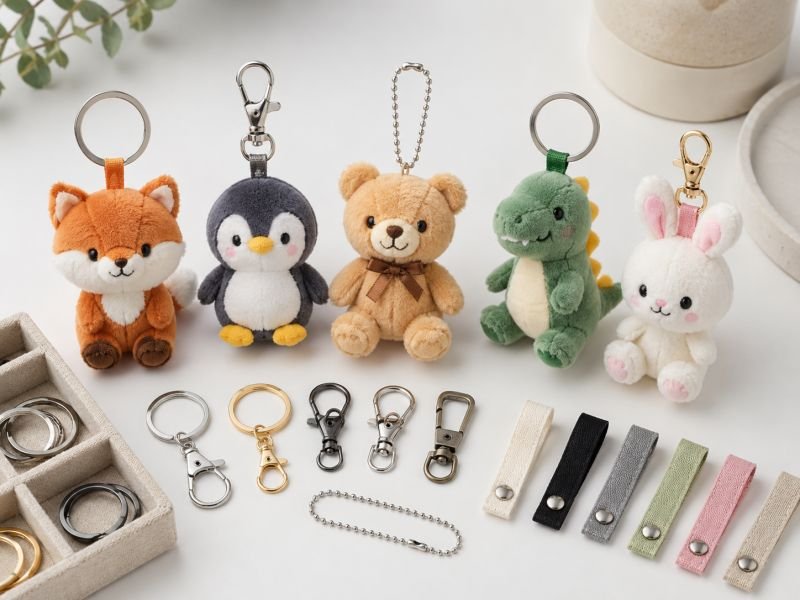
A plush keychain looks simple until a brand team has to approve thousands of pieces. Then the small metal or fabric part on top suddenly matters a lot. It affects how the product hangs, how it feels in hand, how it looks on a bag, how it survives daily use, how it packs inside a polybag, and how many complaints may appear after delivery.
For a mascot, IP character, retail gift, school program, event giveaway, or online store item, the attachment is not just a small accessory. It is part of the product structure. A weak loop can tear. A heavy clasp can pull the plush forward. A ball chain can open during use. A sharp metal edge can scratch fabric. A wrong hanging position can make the plush flip and hide the face. These are small details, but they can change how people feel about the whole product.
The best attachment for plush keychain orders depends on product size, use scene, target sales region, safety needs, budget, packaging method, and bulk order standard. Key rings work well for daily keys, lobster clasps suit bags and retail charms, ball chains fit light promotional use, while fabric or webbing loops help connect hardware more securely to the plush body. For brand, retail, IP, and event orders, attachment choice should be reviewed together with pull strength, sewing position, hardware finish, packing method, and approved sample records before bulk production.
At Heyzizi, attachment review is usually not separated from plush structure. Our team looks at character shape, top balance, loop width, hardware weight, seam strength, packaging, label needs, and later repeat orders together. That is the safer way to turn a small plush charm into a product that can be used, displayed, shipped, and repeated with fewer surprises.
What Are Plush Keychain Attachments?
Plush keychain attachments are the parts that connect a plush body to keys, bags, hooks, hang cards, or display fixtures. They may include metal key rings, lobster clasps, ball chains, split rings, swivel clasps, carabiners, silicone loops, plastic hooks, fabric loops, webbing tabs, ribbon loops, jump rings, and D-rings. In a bulk plush keychain project, these parts affect use, strength, appearance, cost, packaging, and safety.
A common mistake is treating the attachment as the last detail. In reality, it should be reviewed before sampling. The attachment decides where stress will be placed on the plush body. It may also affect how the character faces forward, how the product sits inside packaging, and whether the item feels like a premium retail charm or a simple event giveaway.
What Parts Count As Attachments?
An attachment is not only the visible metal part. In plush keychain production, the full attachment system includes three areas.
The first area is the outer hardware. This may be a key ring, lobster clasp, ball chain, split ring, swivel hook, carabiner, plastic clip, silicone loop, or phone strap.
The second area is the soft connection. This may be a fabric loop, webbing loop, ribbon loop, woven tape, or reinforced tab sewn into the plush seam.
The third area is the joining point. This is where the loop enters the plush body. It may be at the head, back, side, ear area, top seam, clothing part, or added fabric tab.
For bulk orders, all three areas should be clear in the approved sample. If a sample only says “keychain attachment,” it leaves too much room for mistake.
What Are The Different Types Of Keychain Attachments?
The most common types are key rings, split rings, lobster clasps, swivel clasps, ball chains, carabiner clips, plastic clips, silicone loops, fabric loops, ribbon loops, and webbing loops.
For plush products, metal hardware is often connected through a soft loop because the plush body itself cannot hold metal hardware safely without support. A key ring may look simple, but it still needs a stable loop. A lobster clasp may look strong, but it can become too heavy for a small plush. A ball chain may be light and low-cost, but it may not be the best choice for heavy daily use.
The right type depends on the product goal. A 7 cm event mascot does not need the same attachment as a 14 cm retail bag charm. A child-facing education item does not need the same hardware as a fan merchandise charm sold at a concert or theme store.
Why Attachments Affect More Than Hanging
Attachments influence how the product is used and how it is judged. A plush keychain can be cute in a photo but fail in real use if the attachment is weak or placed badly.
Think about a plush character with a large head and small body. If the loop is sewn too far back, the face may tilt down. If the loop is too far forward, the plush may lean backward. If the hardware is too large, it may overpower the product. If the loop is too narrow, it may twist, pull, or tear after repeated use.
That is why a good attachment choice should connect design, structure, use, safety, and packing.
Which Attachment Type Fits Your Order?

The right attachment type should match the way the plush keychain will be used. Key rings are practical for keys, lobster clasps are strong for bags and retail charms, ball chains are light for giveaways, swivel clasps help the plush rotate smoothly, carabiners feel more functional, and fabric or webbing loops improve the connection between hardware and the plush body. There is no single best option for every order.
Many teams start by asking, “Which attachment is cheapest?” A better starting place is, “How will this plush keychain be used after delivery?” The lowest-cost part may be fine for a short-term event. It may be risky for retail use. A premium clasp may look great for IP merchandise, but it may be too heavy or expensive for a school giveaway.
Key Ring vs Lobster Clasp
Key rings are familiar, simple, and suitable for daily keys. They give a classic keychain feel. They are often used when the plush is small to medium size and the final user may attach it to keys, zippers, or small accessories.
Lobster clasps are easier to clip onto bags, backpacks, pouches, or retail display items. They feel more like bag charms. They are convenient for users who want to remove or change the charm often.
For brand and retail programs, lobster clasps usually feel more flexible. For classic key use, a split key ring may be more familiar. Some projects use both: a lobster clasp with a small key ring attached. This gives more use options, but it may also add weight and cost.
Ball Chain vs Split Ring
Ball chains are light, simple, and easy to attach through hang holes or small loops. They are common for lightweight promotional items and small plush charms. They can also reduce cost pressure on large event quantities.
Split rings are stronger for long-term use. They hold better under daily pulling, especially when the plush has weight. They are not as fast to remove as ball chains, but they usually feel more secure.
For lightweight giveaways, ball chains may be enough. For retail plush keychains, character merchandise, and bag charms, split rings or clasps are often safer choices.
Swivel Clasp vs Carabiner
A swivel clasp can rotate, so the plush does not twist as easily when hanging from a bag or zipper. This can help with comfort and display direction. It also gives a more polished look.
A carabiner clip feels stronger and more functional. It works well for sporty, outdoor, campus, travel, or utility-style plush charms. However, it may look too large for a soft mascot unless the design style supports it.
Use swivel clasps when movement and retail feel matter. Use carabiners when the product needs a practical, bold, or active style.
Fabric Loop vs Webbing Loop
Fabric loops look soft and can blend with the plush body. They are useful when the charm must look cute, clean, and character-focused. But thin fabric loops may need extra reinforcement.
Webbing loops are usually stronger. They are good for heavier plush keychains, larger bag charms, or products that will be used often. Webbing may look more visible, so color, width, and placement should match the product design.
A good loop is not only about material. It must be sewn into the right seam, with enough depth and stable stitching.
Which Attachment Looks Best For Brand Projects?
Brand projects usually need the attachment to look intentional. The hardware should not feel like a random part added after the plush was finished.
For premium retail or IP items, metal finish matters. Silver, black nickel, gold, rose gold, or colored coating can change product mood. For children’s programs, smooth plastic or soft loop options may feel friendlier. For event giveaways, clean and reliable standard hardware may be enough.
The best-looking choice is the one that supports the character and use scene without stealing attention from the plush.
How Do Attachments Affect Plush Keychain Use?
Attachments decide where and how a plush keychain can be used. A product made for keys needs secure hardware. A bag charm needs easy clipping and good hanging balance. A retail item needs better finish and display control. An event giveaway needs cost control and fast packing. An IP charm needs character-facing display and repeatable quality across different characters or series.
This is why attachment choice should be linked to use scene from the beginning. When the use scene is unclear, the factory can still make a sample, but the sample may not represent the best product path.
For Keys
For keys, durability matters. The attachment will face pulling, friction, pocket movement, and repeated handling. A split ring or key ring is usually practical. The loop should be short enough to keep the plush close, but not so short that the metal rubs against the plush face.
Small plush keychains used with keys should avoid oversized hardware. If the ring is too large, it may look heavier than the plush itself.
For Bags And Backpacks
Bag use often favors lobster clasps, swivel clasps, carabiners, or a clasp plus ring combination. The charm needs to clip on and off easily. It also needs to hang in a pleasant direction.
For bag charms, flipping becomes a real issue. If the face turns backward, users may feel the product looks wrong. The loop position, body shape, center of gravity, and hardware movement all affect this.
For Retail Display
Retail items need to look clean in packaging and on hooks. The attachment should work with hang cards, display boxes, barcode labels, and shelf presentation.
A retail plush keychain may need a stronger clasp, better plating, cleaner loop stitching, and more controlled packing. The product should look good before opening the package, not only after being handled.
For Event Giveaways
Event giveaway plush keychains often need clear branding, fast packing, and cost control. Ball chains, standard key rings, or simple clasps may work, depending on budget and use.
The key is not to choose the cheapest part blindly. If thousands of pieces are handed out at a campaign, a weak attachment can hurt the event result. A small cost saving is not useful if the product breaks quickly.
For IP Merchandise
IP and fan merchandise needs stronger detail control. Fans notice face direction, hardware color, tag design, and how the charm hangs on a bag. A plush keychain may be small, but emotional value is high.
For IP series, it is common to use the same hardware style across characters so the full collection feels consistent. Different characters may use different colors, but the attachment standard should be recorded clearly.
What Keychains Sell The Most?
Plush keychains that sell well usually have three traits: a clear character, practical attachment, and giftable presentation. Mini animal charms, mascot keychains, character plush bag charms, seasonal plush keychains, school mascot charms, and IP series often perform well because they are easy to carry, easy to collect, and easy to gift.
For retail and online programs, the best-selling style is rarely only about the attachment. It is the combination of character appeal, size, softness, price, packaging, and how easy the product is to attach to a bag or keys.
In many programs, lobster clasps and split rings work well because they feel secure. Ball chains may work for lightweight collectible charms or lower-cost campaign items. The more often the product will be used in daily life, the more attention should go into attachment strength.
Why Does Attachment Strength Matter?
Attachment strength matters because the connection area takes repeated pulling, swinging, twisting, packing pressure, and daily friction. Many plush keychain problems do not come from the metal part itself, but from the loop, seam, or sewing position. If the loop tears out, the whole product fails. A strong plush body still needs a strong connection system.
For bulk orders, attachment strength should not depend on hope. It should be reviewed in sampling and checked again before production. A good-looking sample is not enough if the connection cannot survive normal use.
Where Plush Keychains Usually Fail
The most common weak areas are:
| Failure Area | What Happens | Usual Cause |
|---|---|---|
| Soft loop | Loop tears or stretches | Fabric too thin or stitch depth too shallow |
| Seam area | Top seam opens | Pulling force not reinforced |
| Ball chain | Chain opens or slips | Light hardware used for heavier plush |
| Jump ring | Ring bends open | Poor metal quality or wrong size |
| Hardware edge | Fabric gets scratched | Rough plating or sharp opening |
| Hanging angle | Plush flips backward | Loop position or body balance not reviewed |
A product can pass a quick visual check and still fail during real use. That is why the connection area should be part of the approved sample standard.
How To Attach A Keychain To A Plush Toy?
For a bulk plush keychain, the safer method is to build a strong loop or tab into the plush body during sewing, then connect the hardware to that loop. The loop is usually sewn into the top, back, side, or head seam. For heavier products, internal reinforcement may be added so the pulling force does not only sit on one thin fabric layer.
A simple DIY method may add a ring after the plush is made. That can work for one handmade piece, but it is not ideal for a professional order. In bulk production, the connection should be planned before cutting and sewing.
A good attachment setup usually includes:
| Part | Safer Practice |
|---|---|
| Loop material | Webbing, woven tape, strong fabric, or reinforced ribbon |
| Loop position | Top or back area based on character balance |
| Sewing method | Deep seam insertion with secure stitching |
| Hardware | Smooth, stable, suitable size and finish |
| Check | Pull review before bulk approval |
If you already have artwork and want to check whether the loop should be placed on the head, back, ear, or clothing part, you can send the design, target size, quantity, and use scene to info@heyzizi.com for review.
How Loop Position Affects Pull Strength
The loop position controls both strength and display. If the loop is too close to a thin seam, it may tear. If it is placed on a small ear or narrow part, the product may look cute but become weak. If it is too far from the body center, the plush may twist or flip.
For characters with big heads, top loops often need careful balance checks. For flat plush shapes, back loops may hang better. For plush bag charms, a side loop may look stylish, but it must not pull the character into an awkward angle.
Why Sewing Method Matters In Bulk Production
Sewing method matters because the loop is part of the product structure. A loop placed between seam layers is usually more stable than one attached only to the surface. A wider loop can spread force better than a narrow ribbon. Reinforced stitching can help reduce tearing in repeated use.
For bulk work, the sewing method should be clear in the approved sample. The team should know loop width, seam depth, stitch style, and placement. Without this, small changes can appear across batches.
Which Attachment Is Best For Children’s Products?

Children’s plush keychains need attachment choices that reduce sharp edges, loose small parts, weak seams, and rough metal contact. The best option depends on age group, product size, target sales region, and intended use. Smooth hardware, secure loops, strong stitching, clear labels, and early safety review matter more than choosing the most decorative clasp.
Not every plush keychain is a children’s toy. Some are collectibles, event gifts, or bag charms for teens and adults. But if the product may reach children, the attachment system should be reviewed more carefully.
Are Metal Parts Safe For Kids?
Metal parts can be used in some plush items, but they need the right context. Edges should be smooth. Open gaps should be controlled. Small detachable parts should be reviewed. The hardware should not create sharp contact with the plush fabric or with the user.
For younger children, softer options may be more suitable, or the product may need a different structure. Age labeling and target region requirements should be considered before sampling.
What Should Be Checked Before Sampling?
Before sampling a child-facing plush keychain, review these details:
| Check Item | Why It Matters |
|---|---|
| Age group | Affects small part and warning needs |
| Hardware edge | Reduces scratch and cut risk |
| Loop strength | Reduces detachment risk |
| Fabric around loop | Prevents tearing under pull |
| Label plan | Supports compliance and retail use |
| Packaging | Keeps metal away from face and fabric |
The safest path is to discuss the use scene before the first sample. Changing attachment structure after sample approval can delay the project.
When Should Safety Testing Be Planned?
Safety review should be planned before bulk production, not after packing. If a product needs third-party testing, the sample should represent the final material, attachment, label, and structure as closely as possible.
Testing late can create trouble. If the hardware fails, the loop must change. If the loop changes, the sample may need another review. If the sample changes, packaging may also need adjustment. Early planning saves time.
How Do Attachments Affect Price?
Attachments affect price through hardware type, material, finish, size, color, assembly time, reinforcement method, packing style, and inspection needs. A simple ball chain may cost less than a custom-plated lobster clasp, but lower price does not always mean better value. For retail, IP, and repeat orders, the attachment should protect product use, not only reduce the first quotation.
Many teams compare plush keychain prices without checking hardware. That can be misleading. Two products may look similar in size and fabric, but one uses a standard ball chain while the other uses a swivel lobster clasp with reinforced webbing. The cost and performance will not be the same.
Hardware Type And Unit Cost
Basic ball chains and simple key rings are often more cost-friendly. Lobster clasps, swivel hooks, carabiners, custom-plated rings, or special shaped hardware may cost more.
A larger clasp may also increase product weight, shipping weight, and packing requirements. If the plush is very small, an expensive clasp may not add enough value. If the plush is meant for retail or fan use, stronger hardware may be worth the added cost.
Custom Color, Plating, And Finish
Custom hardware color can improve brand feel. Black, gold, rose gold, antique brass, matte finish, or colored coating can make the plush charm look more polished.
But custom finish may need higher quantity, longer lead time, and color approval. It may also need extra checks for scratches, plating consistency, and rust resistance. For short-deadline events, standard finish may be safer.
Assembly Time And Packing Cost
Some attachments are faster to assemble. Others need extra steps. A ball chain may be quick. A clasp plus jump ring plus reinforced loop may take longer. If the product also needs hang cards, barcode labels, or mixed SKU packing, the attachment can affect the packing line.
This matters for large orders. A few extra seconds per piece can become meaningful when the order reaches thousands of units.
Why Cheap Attachments May Cost More Later
A weak attachment can create hidden cost. Returns, complaints, rework, replacement goods, delayed delivery, and brand damage can cost more than the hardware savings.
That does not mean every project needs premium hardware. It means the hardware should match the risk level. A short campaign giveaway can use a simple solution. A collectible retail charm needs a stronger standard.
How Should A Factory Review Attachment Details?
A plush keychain factory should review attachment details together with product size, weight, character shape, hanging position, loop material, hardware size, use scene, packaging, and pull performance. The goal is not only to attach metal to plush. The goal is to make the charm hang correctly, stay secure, look good, pack safely, and remain consistent across bulk production.
This review should happen before the first sample. When attachment selection is delayed, the sample may look fine on a table but perform poorly when hanging.
Product Size And Weight
Size and weight control hardware choice. A tiny 6 cm plush may look awkward with a large clasp. A 12 cm stuffed mascot may be too heavy for a thin ribbon loop. A flat plush charm may need different balance than a round stuffed character.
A practical rule: the attachment should support the plush without visually overpowering it.
Hanging Position And Balance
The best loop position depends on body shape. A round head may need the loop slightly behind the top center. A flat mascot may hang better from the top middle. A long animal character may need a back loop to reduce forward tilt.
The goal is simple: when the product hangs, the face should still be visible.
How To Stop A Plush Keychain From Flipping?
A plush keychain flips when the hanging point, body weight, and hardware movement are not balanced. To reduce flipping, review the loop position, body stuffing, attachment length, hardware weight, and where the plush center of gravity sits.
Useful ways to reduce flipping include:
| Method | How It Helps |
|---|---|
| Move loop closer to balance center | Helps the plush face forward |
| Use shorter connection length | Reduces swinging and turning |
| Use a swivel clasp carefully | Allows rotation without twisting the loop |
| Adjust stuffing balance | Prevents heavy head or bottom tilt |
| Add back support shape | Helps flatter plush hang neatly |
| Test while hanging | Shows real use better than table photos |
Flipping should be checked during sampling. A plush keychain that looks perfect flat may hang badly on a bag.
Hardware Size And Material
Hardware should fit the plush size. Zinc alloy, iron, stainless steel, plastic, and silicone each have different look, weight, cost, and strength.
For larger retail charms, stronger hardware may be better. For light event items, simple hardware may be enough. For children’s use, smooth finish and safety review matter more than shine.
Pull Check And Bulk Standard
A pull check is not only about force. It is about whether the loop, seam, hardware, and plush body work together.
Before bulk production, confirm:
| Detail | Should Be Recorded |
|---|---|
| Hardware type | Ring, clasp, chain, carabiner, etc. |
| Hardware size | Diameter, length, thickness |
| Finish | Silver, gold, black, colored, matte |
| Loop material | Fabric, webbing, ribbon, silicone |
| Loop width | Exact width or approved standard |
| Loop position | Top, back, side, seam location |
| Stitch method | Reinforced, double stitch, seam insertion |
| Pull check | Internal check or test direction |
These details help reduce batch variation.
What Should Be Confirmed During Sampling?

During sampling, attachment details should be confirmed as part of the approved product standard. The team should review attachment type, loop material, loop width, sewing position, hardware finish, hanging angle, flipping, pull strength, packing fit, and whether the attachment supports the final use scene. A sample should not only look good on a desk. It should work when clipped, carried, packed, and displayed.
Sampling is where many problems become visible. A plush that looks balanced in artwork may lean after stuffing. A loop that seems fine before filling may shift after the body becomes round. A clasp that looks premium may feel too heavy in hand.
Attachment Type
Confirm the exact type, not just “metal hook.” Is it a lobster clasp, split ring, swivel hook, carabiner, ball chain, or key ring? If there is a jump ring between parts, that should also be recorded.
Loop Material And Width
Loop width should match plush weight and design style. Very narrow ribbon may look neat but may not hold well for heavier use. Webbing is stronger but more visible. Fabric loops can blend in but may need reinforcement.
Sewing Position
The sewing position should be marked in sample notes. A few millimeters can change hanging angle on small plush charms. For character faces, this matters a lot.
Hardware Color And Finish
Hardware finish should be checked under normal light. Silver may work for most projects. Black nickel may feel more premium. Gold can look warm and gift-like. Colored hardware can match brand style, but it should be stable enough for bulk use.
Approved Sample Record
Once the sample is approved, take clear photos of the front, back, side, attachment close-up, loop close-up, and packaging. These photos help the production team follow the same standard.
Heyzizi keeps project details such as sample notes, material direction, attachment structure, packing requests, and label rules so repeat orders can move with fewer repeated explanations.
Flipping, Hanging Angle, And Balance Check
Do not only review the plush lying flat. Hang it from a key ring, bag strap, display hook, or hang card. Check whether the face turns forward, whether the body twists, and whether the hardware pulls the top seam out of shape.
This small check can prevent many later complaints.
How Do Attachments Affect Packaging?
Attachments affect packaging because metal, plastic, or silicone parts can scratch fabric, press into the plush body, tangle with tags, change product thickness, and affect display direction. For retail, online, event, and mixed SKU orders, the attachment must work with polybags, hang cards, barcode labels, carton marks, and packing method. A good attachment plan should make packing cleaner, not harder.
Packaging is often where attachment problems show up. A clasp may look fine on the sample table, but inside a tight polybag it may press against an embroidered eye. A ball chain may tangle with another charm. A carabiner may make the product too thick for a small box.
Polybag Packing
For simple packing, the attachment should be positioned so it does not damage the plush face. If needed, the hardware can be folded behind the body or placed away from embroidery.
For soft plush, avoid letting sharp or rough parts press directly into the fabric during long transport.
Hang Card And Retail Display
For retail, the attachment may need to work with a hang card. The hole position, card thickness, barcode placement, and product hanging direction should be checked.
If the charm faces backward on the hang card, shelf presentation suffers. The product should show its face clearly before opening.
Mixed SKU Packing
Multi-style orders need careful attachment control. Different characters may have different colors or hardware sizes. Packing teams need clear SKU labels, barcode stickers, and carton rules.
A mixed carton without clear separation can create warehouse and retail problems.
Carton Mark And Shipment Check
Carton marks should match product version, SKU, quantity, and destination. For orders with different attachment versions, carton marking becomes even more useful.
Before shipment, check that hardware type, tag version, barcode, and packing method match the approved list.
Who Needs A More Durable Attachment?
More durable attachments are needed for retail brands, IP merchandise teams, event programs with heavy use, school and education programs, bag charm collections, online store products, and repeat sales programs. If the plush keychain will be carried daily, sold as a collectible, clipped onto backpacks, or used by children, the attachment should be stronger than a short-term giveaway solution.
Durability should be matched to use. A one-day event charm does not need the same hardware as a collectible plush bag charm. But if brand reputation is attached to the item, the attachment should not be treated as an afterthought.
Retail Brands
Retail products face shelf display, handling, transport, returns, and repeat purchase expectations. Stronger hardware and cleaner finish help protect brand experience.
IP And Fan Merchandise Teams
Fans look closely at everything. They may attach the charm to ita bags, backpacks, display walls, or collection boards. A weak connector can damage trust in the release.
Event And Promotion
Event pieces often focus on quantity, timing, and budget. Still, if the item breaks soon after distribution, the promotion loses value. A simple but stable attachment is often better than a decorative but weak one.
School And Education Programs
School and education items may be used by children, teachers, parents, or class groups. Safety, softness, and strong stitching matter. The product may need labels and packaging that match the use scene.
How Long Does Attachment Selection Take?
Attachment selection can be quick when standard hardware is used, the plush is simple, the target use is clear, and packaging is basic. It takes longer when custom hardware color, special plating, safety review, multi-SKU control, retail packaging, or unusual hanging position is needed. For most plush keychain projects, attachment direction should be confirmed before or during the first sample stage.
The selection itself may only take a short discussion. The real time comes from sampling, checking, revising, and confirming the standard.
When Standard Hardware Is Enough
Standard hardware is usually enough when:
| Project Type | Suitable Direction |
|---|---|
| Light event giveaway | Ball chain or simple key ring |
| Small mascot charm | Split ring or small lobster clasp |
| Simple school gift | Smooth ring or soft loop option |
| Basic online store item | Key ring or clasp based on use |
If there is no custom color, unusual shape, or special testing need, the hardware choice can be confirmed faster.
When Custom Hardware Needs More Time
Custom hardware may need more time when the project requires:
- Brand color coating
- Special plating
- Larger or smaller clasp size
- Logo-shaped metal part
- Unusual ring shape
- Safety review
- Multi-SKU color matching
- Retail display packing
These details should be discussed early. Waiting until after the sample is finished can cause avoidable delay.
How Sampling Helps Reduce Order Risk
Sampling lets the team see how the attachment behaves in real life. It shows hanging angle, loop strength, hardware weight, packing fit, and user feel.
A sample is not just for appearance approval. It is the first real check of product function. That is why attachment notes should be saved with the approved sample.
What Should You Send To A Plush Keychain Factory?

To review attachment options, send the artwork or reference photo, target size, quantity, use scene, target sales region, preferred attachment, packaging request, delivery plan, and any past issues with similar keychains. These details help the factory suggest a safer attachment type, loop method, sewing position, price direction, sample path, and bulk production standard.
Clear starting details make the project smoother. If all you have is a character image and an idea, that is still enough to begin a review. The factory can help you narrow the choices.
Artwork Or Reference Photo
Artwork helps the team understand shape, head size, body proportion, facial direction, and where a loop can be placed.
Front, side, and back views are helpful, but not required at the first stage.
Target Size And Quantity
Size affects attachment weight, loop strength, and cost. Quantity affects hardware sourcing, price, assembly planning, and packing method.
For Heyzizi plush projects, regular custom orders are often reviewed around 500 pieces per style, while simpler styles may be discussed at lower quantities depending on material, structure, and project needs.
Attachment Preference
If you already know your preferred hardware, mention it. If not, explain the use scene. “For backpack charm,” “for retail display,” or “for event giveaway” can be more useful than naming a clasp too early.
Use Scene
The use scene tells the factory what matters most: strength, cost, gift feel, safety, or display. The target sales region may affect labels, testing, and packaging.
Packaging And Delivery Needs
Packaging can change attachment choice. A hang card may need a different hanging direction from a polybag. A retail box may need the hardware fixed in place. A mixed SKU shipment may need tighter label control.
Current Problems With Similar Keychains
If you have seen plush keychains flip, fall off, tear at the loop, rust, scratch fabric, or confuse SKU packing, share those problems early. They are useful clues.
You can send artwork, target size, quantity, use scene, attachment preference, packaging needs, and delivery plan to info@heyzizi.com. Heyzizi can review attachment structure and sampling direction before the first sample.
FAQ About Plush Keychain Attachments
1. What is the best attachment for plush keychain orders?
Certainly. The best attachment is the one that matches the plush size, use scene, safety needs, target cost, and packing method, not simply the one that looks strongest. For daily keys, a split key ring is usually practical because it is familiar and secure. For bag charms, a lobster clasp or swivel clasp often works better because people can clip it onto backpacks, totes, pouches, zipper pulls, and display hooks more easily. For light event giveaways, a ball chain may be enough when the plush is small and the product is not expected to handle heavy pulling.
The plush body also matters. A 6 cm mini mascot may look awkward with a large metal clasp. A 12 cm stuffed character may be too heavy for a thin ribbon loop. A flat plush charm may hang differently from a round filled plush. That is why the attachment should be reviewed together with body weight, loop position, sewing method, hardware finish, and packaging.
A practical way to compare options is shown below:
| Use Scene | Better Attachment Direction | Why It Works |
|---|---|---|
| Daily keys | Split ring or key ring | Secure and familiar |
| Bag charm | Lobster clasp or swivel clasp | Easy to clip and remove |
| Event giveaway | Ball chain or simple ring | Light and cost-friendly |
| Retail charm | Lobster clasp with reinforced loop | Better feel and stronger use |
| Children’s program | Smooth ring or soft loop option | Safer touch and fewer sharp edges |
For brand projects, the safest choice is usually not the cheapest one. It is the option that still looks good, stays attached, packs cleanly, and matches the approved sample when the order moves into bulk production.
2. Which is better for plush keychains, a key ring or a lobster clasp?
Sure. A key ring is better for classic key use, while a lobster clasp is usually better for plush bag charms, retail accessories, and removable hanging products. A key ring feels familiar because people already know how to use it with keys. It is compact, secure, and simple. If the plush keychain is small, light, and meant for everyday key use, a key ring or split ring is often a good starting option.
A lobster clasp gives more flexibility. It can clip onto bags, backpacks, zipper pulls, hang cards, store hooks, and gift packaging. This makes it popular for character charms, IP merchandise, retail plush accessories, and event products that need to be attached quickly. A swivel lobster clasp can also help the plush move more naturally, although it will not fix every balance problem by itself.
The real decision is not “which one is better” in general. It is “which one is better for this project.” If the plush is a small mascot for key use, a key ring may be cleaner. If it is a collectible bag charm, a lobster clasp may create a better user experience. If the product needs both key and bag use, a clasp plus small ring can work, but it adds weight, assembly steps, and cost.
Before approval, the sample should be hung on real items: a key set, backpack strap, zipper pull, and hang card. This quick check often reveals whether the attachment feels natural or forced.
3. Is a ball chain strong enough for bulk plush keychain orders?
Of course. A ball chain can be strong enough for light plush keychains, short-term events, low-weight charms, display items, and cost-sensitive promotional programs. It is simple, light, easy to assemble, and familiar in small hanging products. When the plush is very small and not expected to carry heavy daily pulling, a ball chain can be a reasonable choice.
However, ball chain is not always the best choice for heavier plush charms or products designed for long-term use. The weak area is often not the chain itself, but the connector and the loop on the plush body. If the connector opens, the product may fall. If the plush is heavy, the loop may tear even when the chain remains intact. For retail or fan merchandise, this can lead to complaints because people often attach plush charms to bags and carry them daily.
A simple evaluation can help:
| Project Type | Ball Chain Fit |
|---|---|
| Mini giveaway charm | Usually suitable |
| Lightweight collectible | Often suitable with checking |
| Heavy stuffed charm | Usually not ideal |
| Daily bag charm | Better to consider clasp or ring |
| Children’s product | Needs careful safety review |
For a safer order, test the sample by hanging it, pulling it lightly, opening and closing the connector, and packing it in the planned package. If the charm feels too heavy for the chain, move to a split ring, lobster clasp, or reinforced loop system before bulk production.
4. How do you attach a keychain to a plush toy for bulk production?
Definitely. For bulk plush keychain production, the stable method is to sew a fabric, ribbon, or webbing loop into the plush seam during production, then connect the hardware to that loop. This is much safer than attaching a ring to the surface after the plush is finished. The loop should be part of the plush structure, not an afterthought.
The usual structure includes four parts: the plush body, the sewn-in loop, the joining hardware, and the outer attachment such as a key ring, ball chain, lobster clasp, or carabiner. For small plush keychains, the loop may be sewn into the top seam. For heavier or rounder plush charms, the loop may need a stronger fabric, wider webbing, or internal reinforcement. For character designs, the loop position must also protect the face direction. A plush keychain that flips backward will not show the character properly.
A stable connection plan should confirm:
| Detail | What To Confirm |
|---|---|
| Loop material | Fabric, ribbon, webbing, woven tape |
| Loop width | Wide enough for product weight |
| Loop position | Top, back, side, head, clothing area |
| Sewing depth | Sewn into seam, not surface attached |
| Hardware size | Matched to plush weight and use |
| Pull direction | Checked during sampling |
If the product is for retail, school, or children’s programs, the loop and hardware should be reviewed before the first sample. It saves time because attachment changes after sample approval can affect pattern, sewing, packing, and cost.
5. How can you stop a plush keychain from flipping?
Absolutely. To reduce flipping, the hanging position, attachment length, hardware weight, stuffing balance, and center of gravity must be reviewed together. Flipping happens when the plush body naturally wants to turn away from the hanging direction. This is common with round heads, uneven stuffing, long attachments, large metal clasps, or loop positions that are too far from the body’s balance center.
The first step is to hang the sample instead of only checking it flat on a table. A plush charm may look perfect when lying down, but once clipped to a bag, the face may turn sideways or backward. The loop may need to move slightly forward, backward, or closer to the center. Sometimes the attachment length should be shorter to reduce swinging. For some shapes, a swivel clasp helps the product rotate without twisting the loop, but it does not solve a wrong weight balance.
Here are useful ways to improve hanging direction:
| Problem | Better Adjustment |
|---|---|
| Face turns backward | Move loop closer to balance center |
| Product spins too much | Shorten attachment length |
| Head tilts down | Adjust stuffing or loop position |
| Hardware feels too heavy | Use smaller clasp or lighter ring |
| Flat plush bends | Add shape support or change loop area |
The goal is not to make the charm perfectly still. The goal is to make the front face visible in normal use. For mascot and IP projects, this small check is worth doing because face direction affects product appeal immediately.
6. Do attachments affect plush keychain cost?
Certainly. Attachments affect cost through hardware type, size, material, finish, plating, color, assembly time, loop material, reinforcement, packing method, and inspection needs. A simple ball chain may cost less than a swivel lobster clasp. A standard silver ring will usually be easier than a custom-colored metal part. A thin ribbon loop may be faster to sew than a reinforced webbing loop, but it may not be strong enough for heavier use.
The attachment can also affect hidden cost. If a low-cost chain breaks, the project may face returns, replacements, complaints, or damaged brand perception. If a large clasp scratches the plush during shipping, the packing method may need to change. If several SKUs use different hardware colors, the packing team needs tighter sorting and carton marks. These details all affect the final work behind the product.
A useful cost review should include:
| Cost Factor | What It May Affect |
|---|---|
| Hardware type | Unit cost and user experience |
| Metal finish | Look, lead time, scratch checking |
| Loop material | Strength and sewing time |
| Reinforcement | Labor time and durability |
| Packing style | Product protection and display |
| SKU sorting | Label and carton control |
For many projects, a slightly stronger attachment is a better choice than the lowest-cost one. The goal is not to make the plush keychain expensive. The goal is to avoid saving a few cents on the part that takes the most pulling.
7. Are metal attachments safe for children’s plush keychains?
In many cases, metal attachments can be used, but they need careful review when the product may be handled by children. The main concerns are sharp edges, loose small parts, open rings, rough plating, weak loops, and parts that may detach under pulling. A shiny metal clasp may look nice, but if the product is for younger users, smooth touch and secure structure matter more than decoration.
Children’s products should be reviewed by use age, target region, product size, and how the item will be handled. A school mascot charm for older students may allow a different attachment than a preschool gift. A plush keychain sold as a collectible may have different needs from a toy-like item for young children. Labels, warning text, and testing direction may also be needed depending on the product and destination.
Before sampling, review these details:
| Safety Detail | Why It Matters |
|---|---|
| Edge smoothness | Reduces scratch risk |
| Ring closure | Reduces detachment risk |
| Loop strength | Helps prevent pull-out |
| Small parts | Supports safer use planning |
| Label content | Helps meet channel needs |
| Packing method | Keeps hardware from pressing into plush |
For child-facing projects, the attachment should be planned before the sample is made. Changing hardware after approval can change the loop, the sewing structure, and sometimes the whole packing plan.
8. What attachment works best for retail plush keychains?
Sure. Retail plush keychains usually need a stronger, cleaner, and better-looking attachment than short-term giveaways. A lobster clasp, swivel clasp, split ring, or clasp-and-ring combination often works well because retail products are handled more, displayed longer, and expected to feel better in hand. The attachment should support display, daily use, and packaging at the same time.
Retail projects have more touchpoints. The product may be shipped in cartons, placed on display hooks, scanned by barcode, handled by shoppers, clipped onto bags, and reordered later. If the attachment looks cheap or bends easily, it affects the product’s shelf value. If the charm hangs backward on a hang card, the character face may not be visible. If the metal rubs against embroidery inside the package, the product may arrive with marks.
For retail plush keychains, confirm:
| Retail Need | Attachment Decision |
|---|---|
| Shelf display | Hang direction and card fit |
| User experience | Easy clipping and secure hold |
| Premium feel | Better finish and clean stitching |
| Repeat order | Recorded hardware size and color |
| Barcode packing | SKU and carton accuracy |
A retail item does not always need the most expensive hardware. It needs the right hardware standard. The product should look good in packaging, hang correctly, feel reliable, and match the same standard when reordered.
9. Can different plush keychain SKUs use different attachment colors?
Definitely. Different SKUs can use different attachment colors, but the order must be managed carefully. This is common for IP series, seasonal collections, mascot groups, retail programs, or color-themed gift sets. For example, one character may use silver hardware, another may use black nickel, and a holiday version may use gold. This can make the series feel more designed and more collectible.
The risk is confusion. If several characters, colors, sizes, and attachments are produced together, the packing team needs clear records. Each SKU should have its own hardware type, hardware color, loop material, barcode, hangtag, polybag style, carton quantity, and carton mark. If these details are not controlled, the wrong clasp can be packed with the wrong character, or the wrong barcode can be applied to the right product.
A clean SKU record should include:
| SKU Detail | What To Record |
|---|---|
| Character name | Helps sorting |
| Plush size | Controls packing and carton count |
| Attachment type | Ring, clasp, chain, carabiner |
| Attachment color | Silver, gold, black, custom color |
| Loop material | Fabric, webbing, ribbon |
| Label and barcode | Prevents channel errors |
| Packing rule | Avoids mixed-version mistakes |
For large or repeat programs, keeping one hardware style across all SKUs can simplify control. If different colors are needed, the records must be clear from sample approval to final shipment.
10. What should we send to a plush keychain factory before choosing attachments?
Absolutely. The most useful starting materials are artwork or reference photos, target size, quantity, use scene, preferred attachment if any, target sales region, packaging request, delivery schedule, and any past problems with similar keychains. These details help the factory review attachment type, loop position, sewing method, hanging balance, cost direction, sample path, and packing risk before the first sample.
If you do not know which attachment to use, do not worry. Use scene is often more useful than a hardware name. Saying “this will be clipped onto backpacks for a school campaign” gives the factory a clearer direction than simply saying “metal clasp.” Saying “this is an IP character charm for retail sale” tells the team to check face direction, finish, display packaging, and repeat order consistency.
A strong starting brief can be simple:
| Information | Why It Helps |
|---|---|
| Artwork or reference | Shows shape and possible loop area |
| Target size | Affects hardware weight and balance |
| Quantity | Affects sourcing and cost direction |
| Use scene | Guides attachment choice |
| Target region | Helps safety and label review |
| Packing style | Affects display and protection |
| Delivery plan | Helps choose standard or custom hardware |
If you already have a similar product that flipped, tore, rusted, scratched fabric, or had poor packaging, share that too. Those details help avoid repeating the same problem. Heyzizi can review artwork, plush size, attachment direction, packaging, and bulk order details before sampling. Project details can be sent to info@heyzizi.com.