 Skip to content
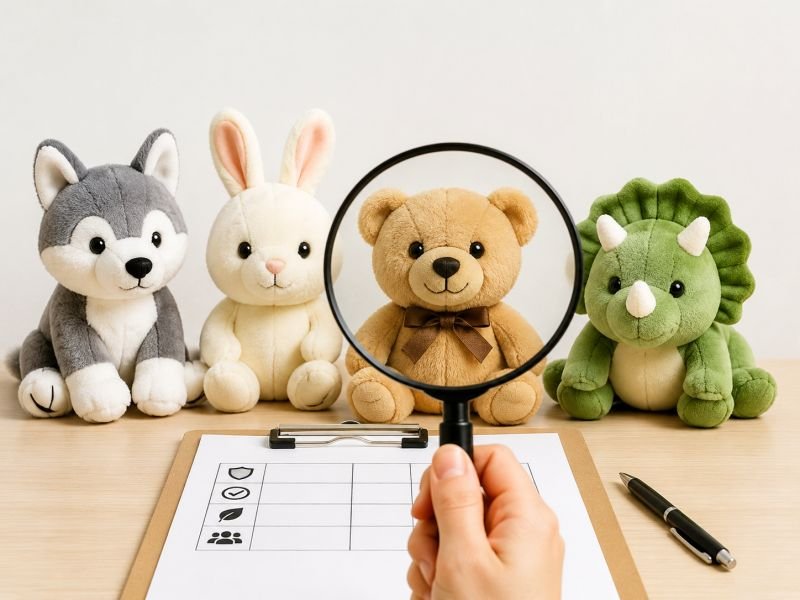
A low quote can look attractive on the first day. A cute sample photo can make a project feel safe. A fast promised timeline can make everyone relax. But custom plush projects rarely fail because of one big obvious problem. They usually fail because small details were not compared early: fabric quality, face accuracy, pattern skill, sample notes, MOQ logic, safety direction, packing rules, label control, QC steps, and repeat order records.
This is why comparing plush toy manufacturers should feel less like shopping and more like checking whether a team can protect your project from idea to delivery.
To compare plush toy manufacturers, review sample quality, pattern ability, fabric options, MOQ, sample fee, price details, QC process, safety support, packaging, delivery planning, IP protection, and repeat order records. A reliable plush toy factory should help turn artwork into a sample, a sample into bulk production, and bulk orders into repeatable product quality.
For brand mascot plush, IP character plush, retail plush, plush keychains, educational plush, event gifts, private label plush, or multi-SKU plush lines, the right factory is not always the one with the lowest price. It is the one that can explain the product clearly, find risks early, manage samples carefully, check production details, and help your team avoid expensive surprises.
How Do You Compare Plush Toy Manufacturers?
Compare plush toy manufacturers by checking how they handle artwork review, pattern development, sample making, fabric selection, MOQ, sample fee, price structure, QC, safety planning, packing, labels, delivery, IP protection, and repeat orders. A strong factory does not only say “we can make it.” It explains how your plush design will be reviewed, sampled, produced, checked, packed, and repeated.
A good comparison begins before you ask for the price. Price is important, but it is only one part of the decision. Plush toys are soft products with many variables: pile direction, embroidery size, filling pressure, seam shape, accessory strength, packing recovery, and handfeel. Two factories may quote the same character very differently because they are not building the same product.
The best comparison asks the following: Which team understands the product? Which team asks the right? Which team can turn a flat design into a 3D plush sample? Which team has a clear process for bulk production? Which team can handle labels, barcodes, carton marks, and repeat orders without chaos?
A plush project should not be judged only by what is promised before sampling. It should be judged by how the factory reduces uncertainty.
What Should You Check Before Choosing A Plush Toy Factory?
Start with the basics: company type, factory capability, sample process, MOQ, sample fee, production experience, quality control, testing support, packaging options, delivery planning, and communication style.
Then go deeper. Ask whether the team can review your artwork before sampling. Ask how they control face embroidery. Ask how they handle fabric color differences. Ask whether they keep records for repeat orders. Ask how they manage multi-SKU packaging.
These details reveal more than a brochure ever will.
Why Price Alone Is A Weak Comparison Method
A low price may hide missing details. It may exclude special fabric, embroidery density, stuffing level, hangtags, warning labels, retail boxes, safety tests, inspection steps, or packing requirements.
For example, one quote may include embroidered face details, weighted filling, hangtags, barcode labels, and carton marks. Another quote may only include a basic plush body with simple packing. On paper, the second quote looks cheaper. In reality, it may not be comparable.
A fair price comparison needs the same product specification.
Which Factory Details Matter Most For Brand And IP Projects?
Brand and IP projects need more than basic sewing. They need character accuracy, color control, confidentiality, sample revision, production records, packaging detail, and stable repeat orders.
For IP plush, the face can decide whether fans love or reject the product. For brand mascot plush, the logo, colors, and personality must feel right. For retail plush, tags, barcodes, cartons, and shelf presentation matter. For private label plush, repeatability and records are essential.
Plush Toy Factory Vs Trading Company

A plush toy factory usually controls pattern development, sampling, production, QC, needle detection, packing, and project records directly. A trading company or platform may help with sourcing and communication but may not control the full production process. For complex custom plush projects, direct factory capability matters because small sample, material, QC, and packing decisions can affect the entire order.
This does not mean every trading partner is poor. Some are helpful for simple sourcing or small product searches. But custom plush development is different from choosing ready-made goods. You are not only selecting a product. You are creating one.
When a project includes original artwork, character likeness, custom fabric, embroidery, retail packaging, safety direction, multiple SKUs, or repeat orders, direct factory control becomes more important.
What Is The Difference Between A Real Factory And A Trading Company?
A real plush factory should have direct involvement in pattern making, sample development, material review, sewing production, filling, shaping, QC, packing, and shipment preparation.
A trading company may coordinate between the client and factories. This can work when the project is simple. But when revisions become detailed, communication can slow down. Technical decisions may pass through too many hands.
For plush products, the person who understands the pattern, fabric, embroidery, and sewing often needs to be close to the production floor.
Who Controls Sampling, Production, QC, And Packing?
This is one of the most useful to ask.
If the same team controls sampling, production, QC, and packing, problems can be found earlier and solved faster. If different parties control each stage, details may be lost. A sample note may not reach the sewing team. A packing rule may not reach the carton team. A label change may not reach final inspection.
Control does not mean everything is perfect. It means responsibility is clearer.
When Is A Trading Partner Not Enough For A Custom Plush Project?
A trading partner may not be enough when the project needs detailed sample revision, IP confidentiality, strict face accuracy, child-related safety planning, retail packaging, multi-SKU control, or repeat order records.
If your plush project will represent a brand, character, campaign, store shelf, or long-term product line, you need more than a quick sourcing contact. You need a team that can manage development details from sample to shipment.
What Should A Custom Plush Manufacturer Checklist Include?

A custom plush manufacturer checklist should include factory type, project experience, artwork review, pattern ability, sample process, MOQ, sample fee, material options, embroidery and printing skill, QC steps, needle detection, safety support, packaging, labeling, delivery planning, confidentiality, and repeat order records. The checklist should help you compare real project capability, not just company claims.
A useful checklist is not a long list of nice words. It should help your team make a safer decision.
For example, “good quality” is too vague. A better checklist asks: Do they inspect incoming fabric? Do they check embroidery position? Do they perform in-line checks? Do they review the finished plush shape? Do they check labels and carton marks? Do they support needle detection when needed?
That kind of checklist shows whether the factory has a real process.
What Factory Information Should Verify First?
Verify the factory location, company type, production experience, team structure, sample capability, MOQ policy, payment expectations, sample fee rules, QC process, and contact clarity.
For Heyzizi, the confirmed facts include Guangdong location, custom plush product factory positioning, 20+ years of OEM / ODM plush project experience, 600+ staff, around 18,000㎡ factory space, 35+ pattern makers, 300+ pieces of equipment, 80 QC inspectors, and 30+ production lines.
Numbers should not be used as decoration. They should support real project handling.
Which Reveal Real Plush Development Ability?
Ask that force technical thinking:
| Ask This | What It Reveals |
|---|---|
| Can you review the character before sampling? | Structure and development ability |
| What face method do you suggest? | Embroidery, printing, applique knowledge |
| What fabric fits this design? | Material judgment |
| How do you handle sample revisions? | Project control |
| What QC steps apply before shipment? | Quality process |
| What packing fits this sales channel? | Delivery thinking |
| Can you keep records for repeat orders? | Long-term support |
A factory that can explain trade-offs is often more useful than one that says yes to everything.
What Red Flags Should You Notice Before Sampling?
Be careful when a factory avoids basic projects, promises every test will pass, says all samples are free, offers no MOQ for every project, gives a price without asking for size or quantity, ignores target sales region, refuses to discuss safety, or cannot explain packing and labels.
Another red flag: they say the bulk order will be “100% exactly the same” as the sample. Plush products should follow the approved sample as closely as possible, but fabric, filling, sewing, and hand shaping can create reasonable tolerance. A professional team explains this clearly.
How Do You Compare Custom Plush Samples?
Compare custom plush samples by checking character accuracy, size, proportion, face expression, fabric, handfeel, filling, sewing, accessory strength, labels, packing, and whether the sample can guide bulk production. A good sample should prove more than cuteness. It should show whether the factory can turn artwork into a stable, repeatable plush product.
Samples are where promises become visible.
A polished website can look good. A smooth email can sound professional. A low quote can feel tempting. But the sample shows the real translation from design to product.
Do not approve a sample only because it looks nice in one front-facing photo. Ask for side, back, detail, and packing views. Check hand feel if you can. Compare embroidery positions. Review body balance. Look at seam strength. Confirm whether the sample matches the intended sales channel.
What Does A Good Plush Toy Sample Prove?
A good plush toy sample proves that the factory understands the design, not just the order.
It should show strong character recognition, balanced shape, suitable fabric, clear face details, stable filling, clean sewing, secure accessories, correct labels, and practical packing.
For a plush keychain, check the hanging balance and hardware strength. For a mascot plush, check face expression and brand color direction. For a retail plush, check shelf appearance, tag placement, barcode planning, and carton quantity.
How Should You Check Character Accuracy, Fabric, And Face Details?
Check the face first. Eyes, mouth, eyebrows, nose, cheeks, and embroidery line color can change the entire personality of a plush toy.
Then check fabric. Short plush may show details better. A longer pile may feel warmer but can hide fine embroidery. Minky, velboa, fleece, faux fur, sherpa, and other materials each create a different look and touch.
Finally, check proportions from more than one angle. A plush toy may look good from the front but weak from the side.
Can The Sample Become A Reliable Bulk Production Standard?
A sample becomes useful for bulk production when it includes clear approval notes: size, fabric, color, embroidery, filling, accessories, labels, packaging, and any accepted tolerance.
An approved sample, sometimes called a golden sample, helps guide production and inspection. It should not sit in a drawer after approval. It should be used as a working reference for pattern, material, sewing, QC, packing, and future repeat orders.
Who Owns The Rights To Plush Prototypes And Custom Artwork?
Rights should be clear before sampling starts. Original character artwork, brand logos, licensed IP, and private design files should belong to the client or authorized owner. A factory should not use or display private artwork without permission.
Prototype ownership can depend on project terms, sample payment, and agreement details. For sensitive IP projects, NDA support can be discussed. The safest approach is to clarify artwork ownership, sample use, photo sharing, and confidentiality before files are sent.
How Do You Compare Plush Toy Prices?
Compare plush toy prices by checking what each quote includes. A proper quote should consider size, fabric, filling, embroidery, printing, accessories, labels, packaging, testing needs, sample revisions, quantity, and delivery requirements. The lowest number is not always the lowest real cost. A missing label, weak packing, or unclear safety plan can create larger costs later.
Plush pricing is rarely one simple number. It is the result of many product choices.
A 20 cm plush with simple embroidery and polybag packing cannot be compared with a 20 cm plush using custom fabric, dense embroidery, clothing, a hangtag, a barcode sticker, a retail box, and third-party testing support. Both may be called “20cm custom plush,” but they are not the same product.
Why Do Custom Plush Quotes Differ So Much?
Quotes differ because factories may assume different materials, different filling levels, different embroidery density, different labor time, different packing, and different QC expectations.
Some quotes are low because they leave things out. Some are higher because they include the details your project actually needs.
Before comparing prices, compare the specifications.
What Should Be Included In A Proper Plush Toy Quote?
A useful quote should mention product size, quantity, material direction, face method, craft details, accessory needs, packaging, label requirements, sample fee, bulk price basis, testing direction if needed, lead time review, and shipping terms if discussed.
It should also explain what is not included. A quote that looks detailed gives your team fewer surprises.
How Do Fabric, Embroidery, Filling, Packaging, And Testing Affect Price?
| Cost Area | How It Affects Price |
|---|---|
| Fabric | Premium fabric, special color, or eco material may cost more |
| Embroidery | Dense stitches and small details increase setup and labor |
| Filling | Softer, fuller, or weighted filling changes cost and structure |
| Accessories | Keyrings, magnets, zippers, sound modules, and clothing add work |
| Packaging | Retail boxes, blind boxes, hangtags, labels, and cartons add cost |
| Testing | Third-party testing may require planning, samples, and fees |
A good factory helps you decide where to invest and where to simplify.
How Much Does A Plush Toy Prototype Cost?
A plush prototype cost depends on size, complexity, fabric, embroidery, printing, accessories, clothing, filling, packaging, and revision difficulty. A simple design and a detailed IP character plush will not cost the same.
Custom samples usually require a sample fee because pattern work, material preparation, embroidery setup, sewing, filling, shaping, and review all take time. At Heyzizi, the sample fee can be refunded or deducted when the single-style bulk order reaches 2,000pcs.
How Do You Compare MOQ And Sample Fees?
Compare MOQ and sample fees by checking how they relate to the project plan. MOQ should be reviewed per design or SKU, while sample fees should reflect development work such as pattern making, material preparation, embroidery setup, sewing, filling, shaping, and revisions. Low MOQ can help testing, but it may increase unit cost or limit material and packaging options.
MOQ is one of the most misunderstood parts of custom plush work.
Many teams want the lowest possible number. That is understandable when a new product is being tested. But MOQ is not only a barrier. It also affects material purchase, production efficiency, unit price, packing setup, and project stability.
The real goal is not “lowest MOQ at any cost.” The real goal is a quantity that makes sense for your launch plan, sales channel, and product complexity.
What Is The Typical MOQ For Custom Plush Toys?
MOQ varies by factory and project type. For Heyzizi, the standard MOQ starts from 500 pcs per design. This fits brand projects, IP plush, retail plush, plush keychains, educational plush, promotional projects, private label plush, and repeat programs.
If a project includes several characters, sizes, or colorways, MOQ should be reviewed per design or SKU. This helps avoid confusion later.
Why Is MOQ Usually Set Per Design Or Per SKU?
Each design may require its own fabric, pattern, embroidery file, label, packaging rule, and inspection reference. Even if two plush toys look similar, a different face, outfit, color, or accessory can create a different production path.
For multi-SKU plush lines, MOQ planning is especially important. A series with ten characters and low quantity per character may be harder to manage than one style with a larger run.
Is Low MOQ Always Better For Brand Projects?
Not always. Low MOQ reduces first investment, but it can raise unit cost, limit fabric choices, reduce production efficiency, and make custom packaging harder.
Low MOQ is useful when testing a design. A higher, well-planned quantity may be better when the product has retail, event, or repeat order goals.
Choose MOQ based on project purpose, not fear alone.
How Should Sample Fees Be Compared Fairly?
Compare sample fees by looking at what work is included. Does the fee include pattern making? Embroidery setup? Material preparation? One sample only? Revision support? Packaging review?
A cheaper sample fee may not include revision or may use easier materials. A higher sample fee may include more development work. The fairest comparison is not only the fee amount. It is the value of the sample as a production reference.
How Do You Compare Plush Toy Materials And Filling?

Compare plush toy materials and filling by reviewing look, handfeel, durability, safety direction, cost, packing recovery, and repeat order availability. Fabric affects character style and perceived value. Filling affects shape, softness, posture, and touch. A good factory should explain material trade-offs instead of using the same fabric and stuffing for every project.
Material is where the product becomes emotional.
A plush toy is not only seen but also felt. It is held. The fabric must match the character, brand tone, age group, price level, and sales channel. A tourism plush may need durability. A baby plush may need extra safety planning. A collectible plush may need a premium touch and photo-friendly texture.
Which Fabric Options Affect Look, Handfeel, And Cost?
Common plush fabric choices may include short plush, long plush, minky, velboa, fleece, sherpa, faux fur, and other soft textiles. Each has a different look and use.
Short plush can help show embroidery clearly. A longer pile may feel softer but can cover small details. Minky often feels smooth and premium. Faux fur can work for animal plush but may need careful pattern planning.
A useful factory explains the trade-off, not just the fabric name.
What Filling Choices Affect Shape, Softness, And Safety?
Filling choices may include PP cotton, high-resilience fiber, weighted beads, or special filling depending on product need.
Filling affects how the plush sits, stands, squeezes, recovers, and feels. Too little filling can make the plush look tired. Too much can distort the face or body. Weighted filling needs review for distribution, seam strength, and leakage control.
Can Plush Manufacturers Use Eco-Friendly Materials?
Yes, eco-friendly materials may be possible depending on project needs, availability, safety direction, cost, and order quantity. Options may include RPET fabric, recycled filling, organic cotton blends, lower-impact packaging, or reduced plastic packing.
However, eco claims should be handled carefully. Material source, test needs, color matching, MOQ, and cost should be reviewed before promises are made. For brand programs with sustainability goals, ask for material options early.
Why Material Records Matter For Repeat Orders
Repeat order consistency depends on records. Fabric name, color reference, pile direction, filling type, supplier notes, and approved sample photos should be kept.
Even with records, fabric batches can vary. But without records, every reorder starts from memory. That is risky for brand colors, plush texture, and product feel.
How Do You Compare Plush Toy Quality Control?
Compare plush toy quality control by checking whether the factory has clear steps for material inspection, in-line checks, finished product inspection, needle detection, label review, packing review, and shipment preparation. Plush QC should not happen only at the end. It should follow the product from fabric arrival to sewing, filling, shaping, packing, and carton review.
Quality control sounds like a final step, but in plush work, final inspection alone is too late. If embroidery placement is wrong, it should be caught before sewing. If the filling level is unstable, it should be adjusted during production. If the carton mark is wrong, it should be fixed before shipment preparation.
The best QC process is not dramatic. It is steady, boring, and repeated. That is exactly what makes it valuable.
What QC Steps Should A Plush Toy Factory Have?
A useful QC process may include incoming material inspection, cutting review, embroidery or printing check, sewing review, filling balance check, shape review, accessory attachment check, final inspection, needle detection when needed, label review, packing review, and carton mark review.
For plush projects, QC should cover both appearance and function. A beautiful plush with weak seams is not ready. A strong plush with the wrong barcode is still a problem. A good factory understands both product quality and delivery details.
Why Needle Detection Matters In Plush Production
Needle detection matters because plush toys are sewn products. Needles are used throughout cutting, sewing, attaching parts, and finishing. A broken needle risk must be controlled before shipment, especially for children’s products, education plush, retail plush, and brand programs with strict safety expectations.
Needle detection is not a decorative claim. It should fit the product type, order requirement, and target sales region. If needle detection is important to your project, ask how it is handled and recorded.
How Should Final Inspection And Packing Review Be Handled?
Final inspection should compare bulk pieces with the approved sample and project notes. Inspectors should check shape, size, face placement, sewing, filling, accessories, labels, and overall appearance.
Packing review should check polybags, hangtags, care labels, warning labels, barcode labels, SKU labels, FNSKU labels, retail boxes, gift boxes, display boxes, carton marks, and packing quantities.
This is where many small mistakes can be avoided. A plush toy that passes appearance inspection can still fail a retail program if labels or cartons are wrong.
How Do You Compare Safety And Testing Support?
Compare safety and testing support by asking which standards may apply to your product, target sales region, age group, materials, accessories, and use scene. Custom plush toys may need safety review for small parts, seam strength, filling leakage, flammability, labels, and third-party testing. A responsible factory should discuss testing support with project boundaries, not make automatic promises.
Safety should be discussed early, not after the sample is approved.
A plush toy for adult collectors may need a different review from a baby plush, school plush, retail plush, or toy sold in North America or Europe. The same character design can require different materials, labels, accessories, or testing direction depending on age group and sales channel.
A good factory will not simply say, “All certificates are fine.” It should ask where the product will be sold, who will use it, what materials and parts are planned, and whether third-party testing is required.
Which Safety Certificates Do Custom Plushies Need?
Custom plushies may involve standards or regulations such as ASTM F963, CPSIA, EN71, CE, REACH, Prop 65, and flammability-related requirements, depending on target sales region, age group, materials, accessories, and sales channel.
Not every plush product automatically needs the same certificate. A retail plush for children has different expectations from a decorative adult collectible. A sound module, plastic eyes, magnets, or weighted filling may also change the safety review.
Ask for project-based guidance, not generic certificate claims.
Which Safety Standards May Apply To Plush Toys?
Safety standards may cover physical and mechanical safety, small parts, pull strength, fabric safety, filling safety, flammability, chemical limits, warning labels, and age grading.
For children’s plush products, small accessories should be reviewed carefully. Embroidered eyes may be safer for some designs than hard plastic eyes. Removable parts, long cords, zippers, buttons, magnets, and sound modules may need extra review.
The earlier these details are discussed, the fewer surprises appear later.
What Should Be Reviewed For Children’s Plush Products?
Children’s plush products should be reviewed for material safety, seam strength, filling leakage, small parts, pull strength, needle detection, care labels, warning labels, age direction, and third-party testing needs.
A cute product is not enough. For child-related plush, design choices should support safe use. Tiny accessories may look good in artwork but create risk in real use. A factory that understands this can help adjust the design before problems become expensive.
How Can Third-Party Testing Support Reduce Project Risk?
Third-party testing support helps clarify whether the product meets required safety expectations for the planned sales region. It can reduce uncertainty for retail programs, education products, children’s toys, and larger brand projects.
However, testing should be based on the actual product, materials, accessories, and age group. It should not be promised blindly. A serious team will help prepare samples and project information for testing based on the product requirements.
How Do You Compare Packaging And Labeling Support?
Compare packaging and labeling support by checking whether the factory can handle polybags, hangtags, care labels, warning labels, barcode labels, SKU labels, FNSKU labels, retail boxes, gift boxes, display boxes, carton marks, packing lists, and mixed carton rules. Packaging is not only about appearance. It affects retail display, warehouse handling, shipping, sorting, and repeat orders.
Many plush projects spend months on product design and only days thinking about packaging. That is a mistake.
Packaging affects how the plush looks when it arrives, how it is scanned, how it is stored, how it is displayed, and how it is reordered. For e-commerce, poor packing can flatten the product. For retail, missing barcodes can delay receiving. For multi-SKU projects, wrong carton marks can create warehouse confusion.
What Packing Options Matter For Retail, E-Commerce, And Gifts?
Common packing options include individual polybags, hangtags, care labels, warning labels, barcode stickers, SKU stickers, FNSKU labels, retail boxes, gift boxes, blind boxes, display boxes, and carton marks.
Retail plush may need strong shelf presentation. E-commerce plush may need packing recovery and barcode control. A gift plush may need a better unboxing experience. Event plush may need easy sorting and fast distribution.
The right packing depends on where the plush goes after it leaves the factory.
Why Are Hangtags, Care Labels, Barcodes, SKU Labels, And Carton Marks Important?
These details keep the order moving correctly.
Hangtags help retail presentation. Care labels support product information. Warning labels may be needed depending on age group and sales region. Barcodes and SKU labels support inventory. FNSKU labels help certain e-commerce warehouse workflows. Carton marks help identify style, quantity, destination, PO number, SKU, carton number, weight, and shipping details.
A missing label can create more trouble than a small sewing imperfection.
How Can Poor Packing Create Costly Delivery Problems?
Poor packing can flatten plush shape, crush ears or accessories, mix SKUs, damage gift boxes, hide labels, create carton confusion, or slow warehouse receiving.
For plush products, packing should protect the product and support the sales channel. The best packaging is not always the most expensive. It is the one that fits the product, order size, warehouse rule, display need, and shipping plan.
How Do You Compare Lead Time And Production Capacity?

Compare lead time and production capacity by reviewing sampling time, revision rounds, material sourcing, order quantity, SKU count, product size, craft complexity, testing needs, packaging, QC workload, and factory schedule. Capacity should not be judged only by a monthly number. A factory’s real delivery ability depends on whether it can manage your product type, order mix, and timeline responsibly.
Fast promises are easy. Responsible timelines are better.
A simple plush keychain and a detailed mascot plush do not take the same time. A one-SKU order and a 20-character blind box series do not have the same production control. A plush with retail boxes and barcode labels requires different planning from a plush packed in simple polybags.
A good factory explains what affects the timeline instead of giving one fixed number for every project.
How Long Does Plush Toy Manufacturing Take?
Plush toy production time depends on design complexity, sample approval, material readiness, order quantity, SKU count, craft details, packaging, testing needs, and production schedule.
A simple project can move faster. A detailed IP plush with clothing, special materials, retail packaging, safety review, and multiple SKUs needs more time. Rush projects may be reviewed, but not every product can be safely rushed.
How Long Does Sampling Usually Take?
Sampling time depends on artwork clarity, pattern difficulty, fabric preparation, embroidery or printing, accessories, packing sample needs, and revision rounds.
If your team has front, side, back views, target size, fabric direction, quantity, packaging needs, and deadline, the review can be more efficient. If important details are missing, the first sample may need more assumptions and later revisions.
What Affects Bulk Production Lead Time?
Bulk production lead time can be affected by fabric availability, cutting, embroidery, printing, sewing, filling, shaping, QC, needle detection, packing, label preparation, carton rules, and shipping schedule.
Delays often happen when changes are made late. For example, adding a new barcode rule after packing begins or changing embroidery after bulk fabric is cut can slow the project.
Why Capacity Should Be Judged By Product Type, SKU Count, And Schedule
A factory may have strong capacity, but capacity is not the same for every product. A large simple plush may move differently from a small detailed plush keychain. A single mascot plush may be easier to manage than a multi-SKU character series with mixed cartons and different labels.
Heyzizi has 600+ staff, around 18,000 m² of factory space, 30+ production lines, and monthly capacity up to 500,000+ pcs depending on product size, structure, material, packaging, order mix, and production schedule. This is why project review matters before confirming timing.
How Do You Compare Factories For Multi-SKU Plush Projects?
Compare factories for multi-SKU plush projects by checking how they manage artwork versions, approved samples, material records, embroidery files, SKU labels, barcodes, packaging rules, carton marks, mixed cartons, packing lists, and repeat order notes. Multi-SKU projects need stronger organization because one small label or carton mistake can affect many styles.
Multi-SKU plush is where weak systems show quickly.
A series may include different characters, sizes, colors, outfits, expressions, tags, and cartons. If records are poor, mistakes multiply. A wrong label on one style can spread through inventory. A missing carton mark can slow warehouse sorting. A forgotten revision note can make one character look different from the approved sample.
What Makes Multi-SKU Plush Orders Harder To Manage?
More SKUs mean more files, samples, labels, materials, cartons, and inspection details.
A single plush order may only need one approved sample and one label rule. A 12-character series may need 12 approved samples, 12 embroidery files, 12 barcodes, possibly different hangtags, and a clear mixed carton plan.
The challenge is not only production. It is information control.
How Should Factories Control Artwork, Labels, Packaging, And Cartons?
A factory should keep organized records for artwork, pattern files, embroidery files, material notes, label files, barcode files, packaging rules, carton marks, and packing lists.
For multi-SKU orders, final packing should be checked against the SKU list. Carton marks should match the product, quantity, destination, and PO details. Mixed cartons should be clearly planned before packing begins.
Why Project Records Matter For Series, Seasonal, And Repeat Orders
Series and seasonal plush programs often continue beyond the first order. Records help when the client adds new characters, changes packaging, reorders bestsellers, adjusts labels, or expands into another sales region.
Good records reduce repeat discussion and help protect product consistency. Without them, every new order feels like starting over.
OEM Vs ODM Plush Toys: Which Factory Type Fits Your Project?
OEM plush development fits projects where the client owns or provides the artwork, mascot, character, or product idea. ODM plush development fits projects where the factory helps adapt or develop a product direction based on existing structures or design experience. The better choice depends on IP ownership, design control, timeline, budget, customization depth, and sales plan.
OEM and ODM are often used casually, but the difference matters.
If you have a licensed character or original mascot, you likely need OEM support. You want the factory to turn your design into a plush product while respecting your artwork and brand requirements.
If you need help developing a general plush style, gift line, or private label product based on a direction, ODM may be more suitable.
What Is OEM Custom Plush Development?
OEM custom plush development means the client provides the design, character, logo, or product concept, and the factory supports structure review, material selection, sampling, revision, and bulk production.
This is common for brand mascot plush, IP character plush, artist plush dolls, school mascot plush, retail plush, event plush, and licensed projects.
For OEM work, artwork ownership and confidentiality should be clear.
What Is ODM Plush Product Development?
ODM plush development means the factory may help create or adapt product styles based on existing development experience, product structures, or category ideas.
This can work for private label plush lines, gift programs, general animal plush, seasonal plush, or product categories where the client wants a faster development path without creating every detail from zero.
ODM still needs sample review, packaging planning, and quantity confirmation.
Which Option Fits Brand Mascots, Licensed IP, Retail Lines, And Private Label Plush?
Brand mascots and licensed IP usually fit OEM because the design identity already belongs to the client. Retail lines and private label plush may use OEM or ODM depending on whether the client has original artwork or wants category-development support.
The right option is the one that protects design ownership, supports the sales channel, and gives the team enough control over final product quality.
What Should You Ask Before Sampling?
Before sampling, ask about MOQ, sample fee, sample revisions, prototype cost, artwork review, face method, fabric options, QC steps, needle detection, safety support, packaging, labels, lead time, IP rights, NDA, and repeat order records. Good help reveal whether the factory can manage your project before time and money are spent on the first sample.
The best time to ask seriously is before the sample starts.
Once a sample is underway, changes cost time. Once bulk production begins, changes cost even more. A short preparation conversation can prevent many later problems.
What Should You Ask About MOQ, Sample Fee, And Revision?
Ask:
| Topic | Useful |
|---|---|
| MOQ | Is MOQ counted per design, per SKU, or total order? |
| Sample fee | What does the sample fee include? |
| Refund or deduction | Can the sample fee be deducted from bulk order? |
| Revision | How are sample revisions handled? |
| Prototype cost | What affects prototype cost? |
| Bulk price | What details are included in the unit price? |
At Heyzizi, standard MOQ starts from 500pcs per design, and the sample fee can be refunded or deducted when the single-style bulk order reaches 2,000pcs.
What Should You Ask About QC, Safety, And Packaging?
Ask what QC steps are used during production. Ask whether needle detection is available when needed. Ask how labels and carton marks are checked. Ask whether the factory can support third-party testing based on target sales region and product requirements.
For packaging, ask whether they can support polybags, hangtags, retail boxes, gift boxes, blind boxes, display boxes, barcode labels, SKU labels, FNSKU labels, and carton marks.
What Should You Ask About IP Rights, NDA, And Prototype Ownership?
Ask whether your artwork and character files will be kept confidential. Ask whether sample photos will be shared publicly. Ask who owns the prototype and related development files. Ask whether NDA support can be discussed if required.
For original IP, licensed characters, unreleased brand mascots, and creator projects, this conversation is not optional. It protects the project before it becomes visible.
What Project Details Should You Send For A More Useful Review?
Send product type, artwork, front-side-back views, target size, quantity per design, fabric preference, filling needs, craft details, accessories, packaging, labels, target sales region, sales channel, deadline, and repeat order plan.
A factory can give better feedback when it sees the real project. A short message asking “how much?” rarely gives enough information for a useful review.
Why Compare Heyzizi For Custom Plush Projects?
Heyzizi is a Guangdong-based custom plush products factory serving brand projects, IP programs, retailers, e-commerce plush lines, promotional projects, educational product teams, private label plans, and long-term plush collections. Heyzizi supports OEM, ODM, private label, sampling, bulk production, QC, needle detection, packaging, labeling, shipment preparation, and repeat order support.
Heyzizi is not positioned as a one-piece personal gift shop or ready-stock toy seller. Its strength is custom plush development for projects that need real sampling, production planning, quality control, packing details, and long-term records.
With 600+ staff, around 18,000㎡ factory space, 20+ years of OEM / ODM plush project experience, 35+ pattern makers, 300+ pieces of equipment, 80 QC inspectors, and 30+ production lines, Heyzizi can support custom plush projects from early review to shipment preparation.
What Type Of Plush Projects Fit Heyzizi Best?
Heyzizi is suitable for brand mascot plush, IP character plush, plush keychains, plush bag charms, collectible plush, educational plush, baby cloth books, plush backpacks, weighted plush, retail plush, promotional plush, private label plush, and multi-SKU plush series.
Projects with artwork, quantity planning, packaging needs, target sales regions, and repeat order potential are a better fit than one-off personal gifts.
How Heyzizi Supports Sampling, Bulk Production, QC, Packing, And Repeat Orders
Heyzizi can review artwork, structure, size, materials, face method, filling, accessories, packaging, labels, target sales region, and schedule before sampling.
After sample approval, the team can support bulk production, QC, needle detection, packing review, label control, carton mark review, shipment preparation, and repeat order records.
This helps clients turn plush ideas into sample-ready, bulk-ready, shipment-ready, and repeat-order-ready products.
What Should You Send To Start A Project Review?
To start a project review, send your artwork, front-side-back views if available, target size, quantity per design, fabric preference, craft details, packaging needs, label requirements, target sales region, deadline, and shipping plan.
If your team is comparing plush toy factories for a brand, IP, retail, e-commerce, education, promotional, or private label project, you can send your project details to info@heyzizi.com for review.
A good plush factory comparison should not end with the cheapest quote. It should end with a clearer project path.
FAQs About Comparing Plush Toy Factories
1. What is the best way to compare plush toy factories?
Absolutely, the best way is to compare real project ability, not only price. A reliable plush toy factory should show how it reviews artwork, makes patterns, develops samples, controls materials, checks sewing, manages filling, handles labels, prepares packaging, and supports shipment. For brand and IP projects, also compare confidentiality, sample revision, safety support, and repeat order records. A cheap quote is useful only when the product details are the same. If one quote includes embroidery, retail packing, QC, needle detection, and carton marks while another does not, they are not equal offers.
2. Should I choose the lowest custom plush toy price?
Not always. The lowest plush toy quote can be risky if it skips fabric quality, embroidery density, filling level, safety review, packaging, labels, or inspection steps. A good quote should clearly state size, material, craft, quantity, packing, label needs, sample fee, and lead time. Plush projects often fail when teams compare numbers without comparing specifications. A slightly higher quote may protect the product better if it includes proper sampling, QC, packing review, and shipment preparation. The smarter choice is not the lowest price; it is the clearest price.
3. What MOQ should I expect for custom plush toys?
For Heyzizi, the standard MOQ starts from 500pcs per design. This fits brand mascot plush, IP character plush, plush keychains, retail plush, educational plush, promotional plush, private label plush, and multi-SKU plush projects. MOQ is usually reviewed per design or SKU because each style may need its own pattern, fabric, embroidery file, labels, packing rules, and inspection reference. Low MOQ can be useful for testing, but it may increase unit cost or limit material and packaging choices. The right MOQ should match your product goal, not only your first budget.
4. How much does a plush toy prototype cost?
Certainly, plush toy prototype cost depends on size, structure, fabric, embroidery, printing, accessories, clothing, filling, packaging, and revision difficulty. A simple animal plush and a detailed licensed character plush will not cost the same. Prototype work may include artwork review, pattern making, material preparation, embroidery setup, sample sewing, shaping, and checking. At Heyzizi, custom plush samples usually require a sample fee, and the fee can be refunded or deducted when the single-style bulk order reaches 2,000pcs. Clear artwork, size, quantity, and packing details help the team review cost more accurately.
5. How can I compare plush toy sample quality?
A good plush sample should prove character accuracy, body proportion, face expression, fabric quality, handfeel, filling balance, sewing strength, accessory attachment, label placement, and packing suitability. Do not approve a sample from one front photo only. Check front, side, back, detail views, and packing condition. For IP plush, the face and character mood matter most. For retail plush, hangtags, barcodes, and display effect also matter. A strong sample should not only look cute; it should be clear enough to become a reference for bulk production and final inspection.
6. Which safety certificates do custom plushies need?
Of course, safety needs depend on target sales region, age group, material, accessories, and product structure. Custom plushies may involve standards or regulations such as ASTM F963, CPSIA, EN71, CE, REACH, Prop 65, or flammability-related requirements. Not every plush product needs the same certificate automatically. A children’s plush with small parts has different review needs from an adult collectible plush. A responsible factory should discuss safety early, review materials and accessories, support third-party testing when needed, and avoid blanket promises such as “all tests will pass.”
7. How long does custom plush toy production take?
Definitely, timing depends on artwork readiness, sample difficulty, revision rounds, material sourcing, order quantity, SKU count, craft complexity, packaging, testing needs, QC workload, and production schedule. Simple plush projects can move faster, while detailed mascot plush, IP character plush, retail packing projects, or multi-SKU collections need more planning. The best factory will not give one fixed timeline for every design. It will review your product type, launch date, packing needs, target region, and quantity first. If you have a fixed event or retail window, start sampling early.
8. Can plush toy factories use eco-friendly materials?
Sure, eco-friendly material options may be possible depending on the project. Choices can include RPET fabric, recycled filling, organic cotton blends, reduced plastic packaging, or paper-based retail packaging. However, eco-friendly material selection should be reviewed together with color matching, softness, safety needs, MOQ, cost, and availability. A sustainability claim should be supported by real material information, not casual wording. If your brand has sustainability goals, discuss fabric and packaging direction before sampling so the sample can reflect the correct material path from the beginning.
9. Who owns the rights to custom plush prototypes?
Original artwork, brand logos, licensed IP, and private character files should belong to the client or the authorized rights holder. Prototype ownership may depend on the project terms, sample payment, development agreement, and confidentiality arrangement. For unreleased characters, IP projects, creator plush, and brand mascot plush, clarify file use, sample photo sharing, prototype ownership, and NDA needs before sampling starts. A trustworthy plush factory should not publicly share client artwork or sample photos without permission. Rights clarity protects both the design and the future product plan.
10. What should I send when comparing plush toy factories?
Please send more than a short “how much” message. Useful project details include product type, artwork, front-side-back views, target size, quantity per design, fabric preference, filling needs, embroidery or printing details, accessories, packaging, labels, target sales region, sales channel, deadline, and repeat order plan. These details help factories compare the same product instead of guessing. If your team is comparing factories for a brand, IP, retail, e-commerce, education, promotional, or private label plush project, you can send your details to info@heyzizi.com for a project review.