 Skip to content
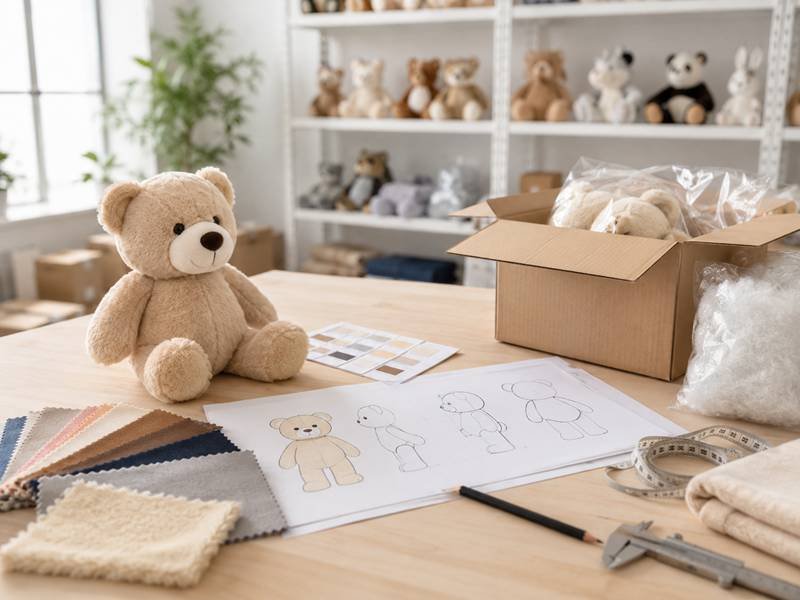
A quotation can look simple from the outside: send an image, state a quantity, and wait for a unit price. Inside a plush factory, however, that request immediately becomes a series of production questions. Someone must judge the finished dimensions, fabric consumption, number of pattern pieces, embroidery or printing, stuffing, accessories, packaging, material sourcing, testing expectations, and how many individual designs are hidden inside the total quantity. When those answers are missing, the factory is not really calculating a product yet; it is calculating assumptions.
A plush factory can quote faster when the RFQ clearly includes artwork, finished size, expected quantity, SKU breakdown, material direction, important decoration and accessories, packaging requirements, target market, and delivery timing. These details do not all need to be final. What matters is separating confirmed requirements from preferences and open decisions, so the factory knows which specifications to cost and which areas still need technical recommendations.
The difference becomes obvious when two companies request prices for the same “20 cm character plush.” One provides three views, quantity by SKU, embroidery locations, packaging direction, and a warehouse deadline. The other sends one image and asks for the “best price.” Both may receive an answer, but only one quotation is likely to survive artwork review, sampling, packaging development, and commercial approval without being repeatedly rebuilt. A faster quote usually starts with a clearer project, not with a faster calculator.
What Information Does a Plush Factory Need First?
A plush factory can usually prepare a more useful preliminary quotation when it understands the design, finished size, expected production quantity, number of SKUs, material level, important decoration or accessories, packaging direction, target market, and timing. Every specification does not need to be final, but missing information should be identified as open rather than quietly left for the factory to guess during costing.
What Is the Minimum Brief for a Preliminary Quote?
The minimum useful brief should allow a product manager or costing engineer to understand what physical product is being discussed. A design image alone identifies the character, but it says almost nothing about commercial scale or production structure. Adding finished size, expected quantity, number of designs, material direction, major processes, packaging, market, and delivery timing gives the factory enough context to begin a practical costing conversation.
A request such as “Please quote 5,000 plush toys” still leaves most cost drivers unknown. The factory does not know whether the product is 8 cm or 80 cm, whether those 5,000 units represent one pattern or ten, whether the face is embroidered, whether clothing is removable, whether a box is required, or whether additional components are hidden behind the front artwork. Each unanswered question increases the number of assumptions in the first price.
A compact RFQ can still contain substantial manufacturing information:
| RFQ Item | Practical Example | What the Factory Learns |
| Product | Seated character plush | General construction |
| Finished size | 22 cm seated height | Pattern and material scale |
| Quantity | 6,000 pcs | Production volume |
| SKUs | 3 characters × 2,000 pcs | Real volume per design |
| Main fabric | Soft short-pile plush | Material positioning |
| Face | Embroidered eyes and mouth | Decoration process |
| Accessory | Sewn-on scarf | Additional sewing and material |
| Packaging | Individual bag + hangtag | Packaging scope |
| Market | United States | Compliance review direction |
| Timing | Warehouse arrival in October | Schedule feasibility |
Heyzizi’s documented quotation rule follows the same basic principle: a preliminary quotation can be provided more quickly when artwork, size, quantity, and material requirements are supplied, while an immediate final and accurate price should not be promised for every project. That distinction matters because a preliminary quotation supports commercial evaluation, while the final production price should reflect the product that is actually developed and approved.
Which Project Details Should Be Confirmed First?
The first details to confirm are the ones that change the physical construction or commercial scale of the product. Size, quantity, SKU count, major character structure, important visual features, core materials, accessories, and packaging usually deserve attention before smaller decorative details. These elements influence fabric consumption, stuffing, cutting, sewing, embroidery, sourcing, packing, and production planning, so uncertainty in any one of them can affect several cost categories at once.
A common sourcing mistake is to spend time finalizing secondary details while large cost drivers remain open. A team may spend several emails discussing the finish of a hangtag while the plush is still described as “around 20 to 30 cm.” That ten-centimeter range can matter far more to pattern dimensions, fabric consumption, stuffing volume, carton configuration, and transportation volume than the difference between two tag finishes.
For character products, the project brief should also identify which features cannot be freely changed. The shape of the eyes, head-to-body proportion, signature ears, costume silhouette, color blocking, or a recognizable accessory may define the character identity. Seam placement, internal support, some hidden construction, or certain fabric specifications may have more room for factory engineering.
A structured internal brief is especially useful when several departments are involved. Heyzizi’s project-development documentation can include size, quantity, SKU, age grade, destination market, materials, processes, accessories, packaging, testing, target cost, launch timing, project risks, and approval responsibility. The practical advantage is not paperwork for its own sake; it is making sure design, sourcing, sampling, costing, packaging, and production teams are reviewing the same project.
Do You Need a Complete Tech Pack?
A complete tech pack is helpful, but it is not a requirement for every first quotation. Many commercially successful custom plush products begin with a character sheet, mascot illustration, licensing guide, sketch, concept render, reference sample, or a small collection of images. A factory experienced in product development can often start with these materials if the commercial basics are clear and the project does not pretend to be more finalized than it actually is.
What matters is whether the available files answer enough practical questions. The factory should understand the approximate finished size, order volume, number of designs, intended product type, important visual features, material positioning, key accessories, packaging expectation, market, and schedule. The remaining technical decisions can then be listed as open points instead of being filled with invented specifications.
For example, a sourcing team may know that the product needs a soft, short-pile surface that supports detailed embroidery, but it may not know the preferred pile length, backing structure, fabric weight, or exact supplier code. In that situation, specifying an arbitrary material simply to complete a spreadsheet can make the RFQ less accurate rather than more professional. Describing the expected result gives the factory room to recommend suitable options.
Technical documentation should become more precise as the project advances. Once sampling confirms the structure, production files can control patterns, dimensions, material references, embroidery files, BOM items, stuffing, accessories, labels, packaging, quality points, and approved sample standards. The first RFQ helps decide whether the project makes commercial sense; the final specification helps the factory reproduce it consistently.
Which Details Can Stay Open for Factory Recommendation?
Some specifications are better left open until the factory has reviewed the artwork, scale, use case, and product positioning. Exact fabric construction, stuffing firmness, seam placement, hidden reinforcement, certain embroidery methods, packaging structure, and alternative attachment solutions often benefit from manufacturing input. The important step is to label these items clearly rather than leaving blank fields that force the costing team to create invisible assumptions.
An early-stage RFQ can use simple language such as:
- Confirmed: 20 cm seated height.
- Confirmed: embroidered facial details.
- Preferred: soft short-pile surface.
- Open: exact fabric construction.
- Required: product must sit steadily.
- Open: internal support method.
- Preferred: retail-ready packaging.
- Open: bag versus window-box option.
This approach gives the factory room to solve technical problems without giving it permission to redesign the brand. Character identity, important color areas, logos, signature accessories, facial features, and commercially critical dimensions should remain controlled. The factory may suggest a different seam line, filling method, fabric backing, or carton arrangement, but material changes that alter appearance or adjustments that affect brand identity should be reviewed before becoming production decisions.
A useful RFQ is therefore not a document that contains an answer for every possible technical field. It is a document that makes the boundary between requirement and recommendation easy to understand. That clarity allows technical staff to contribute experience without turning a commercial concept into a different product.
Which Artwork Details Make a Quote More Accurate?

Artwork supports a more accurate quotation when it explains the character from enough angles to reveal shape, proportions, color areas, clothing, decoration, attachments, and hidden features. Front, side, and back references are particularly useful because they help the factory estimate pattern complexity, sewing operations, embroidery, printing, material changes, and accessories that may not be visible from a single promotional illustration.
What Artwork and Reference Files Should You Send?
Send the clearest files available and organize them so that a person who has never seen the character before can understand what should become physical. Suitable inputs may include character turnarounds, vector artwork, layered design files, high-resolution PNG or JPG references, brand guidelines, color standards, packaging art, photos of an existing sample, or detailed sketches. The value of the file lies less in its format than in the manufacturing information it communicates.
A plush factory does not simply look at the artwork as an image. The development team begins breaking it into physical components. A face may require several pattern panels and embroidery zones. A coat may need separate front, back, sleeves, collar, and attachment details. A tail may require its own pattern and support. A logo may become embroidery, printing, appliqué, or a woven label depending on scale and desired appearance.
For this reason, hidden details matter. A character may look straightforward from the front while the back contains a printed graphic, large wings, a stuffed tail, a backpack, a cape, or additional embroidery. If these items are introduced only after the first quotation, the original cost basis may no longer describe the same product.
More files do not automatically create more certainty. Six conflicting illustrations can be harder to interpret than three controlled views. If references disagree, identify which artwork is the master version and mark older images as supplementary. That simple form of version control can prevent the costing team from pricing features that have already been removed.
Which Product Views Help the Factory Most?
Front, side, and back views provide a strong foundation for most character plush because each one exposes different construction information. The front usually shows the facial expression, body proportion, front color blocks, clothing, and signature visual features. The side reveals muzzle depth, head profile, belly volume, limb thickness, wing angle, ear construction, and tail position. The back may reveal closures, graphics, hair, tails, wings, logos, or accessories that are invisible from the front.
A three-quarter view is also useful when the character has an unusual pose, asymmetrical features, or a shape that cannot be understood through flat orthographic views alone. Photos of an existing sculpture or 3D model can provide additional clues, but they should not replace clear dimensional instructions when the finished plush must hit a particular size or proportion.
For licensed or character-sensitive projects, mark high-priority areas directly on the artwork. Notes such as “eye spacing is critical,” “do not reduce eyebrow thickness,” “keep the ear angle,” or “tail shape must remain recognizable” help the development team understand which details should survive engineering adjustments.
Other areas may be deliberately flexible. Hidden seam locations, internal reinforcement, stuffing method, or the exact construction of a small underside panel can often be optimized without changing the character. Separating visual priorities from engineering freedom helps the factory invest effort where it matters instead of treating every drawn line as equally important.
How Should Colors and Key Features Be Marked?
Important colors should be tied to stable references whenever possible. Pantone references, approved physical swatches, established brand color standards, or an identified master artwork file give the factory a stronger basis than screenshots viewed on different monitors. Screen brightness, file conversion, display settings, and even surrounding colors can change how a digital color appears, so screen images alone are rarely a reliable production reference.
Material also changes the appearance of color. A shade on short plush may look different from the same nominal shade on long faux fur, embroidery thread, felt, plastic, printed fabric, or metal hardware because texture and light reflection are different. The practical target should therefore be an approved visual match within the characteristics of the selected material rather than an assumption that every surface can look perfectly identical.
Heyzizi’s documented color-control method uses Pantone references or physical color cards for important colors, confirms material color samples before bulk production, and does not treat screen images as the sole color-acceptance standard. It also recognizes that different fabric constructions may look visually close without being perfectly identical.
Key features deserve the same clarity. Short artwork notes such as “hat is removable,” “back graphic required,” “cream tail tip,” “do not simplify logo without approval,” or “keep head-to-body ratio” tell the costing and development teams which details create separate operations or stronger approval requirements.
Can a Factory Quote From One Image?
A factory can often prepare an early estimate from one image, particularly when the product is structurally simple and the RFQ also gives size, quantity, materials, packaging direction, market, and timing. The limitation is that one view naturally creates more assumptions. The quotation may be fast, but its reliability depends on whether the unseen parts of the product later remain close to those assumptions.
A single front illustration may not reveal whether the back is plain or embroidered, whether a tail is flat or fully stuffed, whether clothing is removable, whether the rear of the ears uses a second color, or whether a hidden accessory sits behind the body. If the factory assumes the simplest reasonable construction and later receives artwork showing several additional operations, the product being costed has changed.
The best solution is to state the assumptions directly. A note might read: “Please quote from the attached front artwork. Assume a plain back with no additional embroidery, a fully stuffed tail, and permanently attached clothing. Final back artwork will be provided during sampling.” That sentence gives the quotation a defined basis.
A one-image RFQ is therefore not automatically poor. It becomes risky when missing information is allowed to disappear into the quotation without being acknowledged. Visible assumptions can be reviewed and revised. Invisible assumptions tend to surface only when someone notices the price has changed.
How Do Size, Quantity, and SKUs Affect the Quote?
Size influences fabric use, stuffing, pattern geometry, embroidery proportions, carton volume, and the ability to reproduce small details. Quantity influences purchasing and production efficiency, while SKU count determines how that quantity is divided across patterns, colors, artwork, labels, and packaging. A 10,000-piece order containing one design can be operationally much simpler than 10,000 pieces divided across ten distinct characters.
Which Size Measurements Should You Provide?
A size should explain exactly what is being measured. The phrase “20 cm plush” sounds precise but can describe very different products. For a standing character, 20 cm may mean foot-to-head height, or it may include ears, horns, hair, or a hat. For a seated product, it may refer to seated height rather than total body length. For a keychain, it may or may not include the metal hardware.
A stronger specification might state that the product has a 20 cm seated height, approximately 17 cm excluding ears, a maximum body width of 13 cm, and a 9 cm tail, with the metal chain excluded from finished dimensions. Those measurements help the pattern maker understand the physical envelope rather than interpreting one isolated number.
Size also determines whether artwork details remain manufacturable. A layered eye design that works on a 30 cm plush may become too crowded on an 8 cm version. Individual fingers that look natural at a larger scale may need to become stitched lines or simplified shapes on a mini product. Very small logos may require a different embroidery or printing approach.
Cost does not increase in a perfectly linear relationship with height. Doubling a product dimension does not simply double every cost because fabric area, filling volume, labor, embroidery, accessory cost, packaging, and production efficiency respond differently. This is another reason exact target dimensions are more useful than a broad statement such as “medium size.”
How Should Quantity Be Split by SKU?
Show both total order quantity and quantity for each individual SKU. Total volume tells the factory the overall commercial scale, while per-SKU volume reveals how production is actually divided. A 12,000-piece program with one character and a 12,000-piece program with six different patterns may require very different amounts of setup, material planning, embroidery files, packaging control, inspection references, and production coordination.
A simple SKU table can remove that ambiguity:
| SKU | Product | Quantity | Main Difference |
| A01 | Bear Character | 3,000 pcs | Brown body |
| A02 | Bear Character | 2,000 pcs | Pink body |
| B01 | Rabbit Character | 2,500 pcs | Unique pattern |
| B02 | Rabbit Character | 1,500 pcs | Different costume |
| C01 | Cat Character | 1,500 pcs | New pattern |
| C02 | Cat Character | 1,500 pcs | New pattern |
| Total | 12,000 pcs |
The table also helps reveal which SKUs share materials or structures. Two color versions of the same bear may share patterns and embroidery files but use different fabric colors. Two completely different characters may share little beyond the packaging size. Costing becomes more meaningful when those relationships are visible.
For Heyzizi, the standard stated MOQ for regular projects is 500 pieces per design, but that number is not a universal promise that every special material, structure, accessory, or packaging configuration will be practical at exactly 500 pieces. This distinction is useful for any sourcing team: MOQ should be understood in relation to the actual product rather than treated as an isolated marketing number.
Do Color and Character Variants Affect Pricing?
Variants affect quotation depending on how much they truly share. A simple color change using the same pattern, embroidery, accessories, and packaging structure may create relatively modest additional complexity. A new character with a different head, limbs, costume, embroidery, accessories, and box artwork may behave almost like a separate product even when the height and total volume are identical.
The RFQ should therefore identify shared and unique elements. A collection may use one body pattern with three fabric colors, one character with two costumes, four characters that share the same clasp, or multiple designs that use one common packaging structure with different printed graphics. These details help purchasing and production teams see where materials, setup, or processes can be consolidated.
Variants also increase the need for control later in manufacturing. Similar-looking products can receive the wrong hangtag, barcode, costume, or carton. Fabric colors can be mixed between SKUs. Packaging ratios can be reversed. The more variants a program contains, the more useful clear SKU codes, approved references, packing plans, and material records become.
This is particularly important for collectible series and long-term character programs. A hero SKU that is expected to reorder several times may justify stronger material continuity planning than a one-time seasonal variation. Telling the factory which designs are core and which are temporary can improve sourcing decisions from the first quotation onward.
Do Quantity Tiers Help Compare Costs?
Quantity tiers are useful when they represent real commercial scenarios rather than an attempt to collect every possible unit price. A sourcing team that is deciding between an initial launch, a normal forecast, and a larger rollout can ask for two or three clearly defined volume levels. This shows how material purchasing, setup, packaging, and production efficiency may change as the order expands.
A practical request might ask for pricing at 1,000, 2,500, and 5,000 pieces per SKU across four designs. Those three levels can represent launch, expected base volume, and scale volume. Asking for ten closely spaced quantities often creates more work without creating more useful information, particularly when the product specification itself is still changing.
Quantity tiers also improve supplier comparison. A price at 20,000 pieces should not be compared directly with another supplier’s price at 2,000 pieces as though they describe the same manufacturing economics. The quotation should make the volume, SKU allocation, packaging, and material assumptions easy to see.
The goal is not simply to identify the lowest number. It is to understand how the product behaves commercially at different volumes. That information can help merchandising, finance, sourcing, and production teams decide whether to simplify the specification, increase the launch quantity, or keep a more premium product position at a smaller initial volume.
Which Materials and Product Features Should Be Specified?

Materials and product features should be specified whenever they materially affect appearance, function, safety, durability, or positioning. Fabric type, filling feel, embroidery, printing, appliqué, clothing, hardware, molded parts, sound, LEDs, magnets, and weighting can all change the manufacturing route. When exact technical materials are still open, describe the performance or visual result expected and ask the factory to recommend appropriate options.
Which Fabrics and Fillings Matter?
“Plush fabric” is not one material. Minky, velboa, short plush, faux fur, fleece, sherpa, velvet-like materials, felt, and other constructions can differ in pile length, density, backing, stretch, hand feel, visual direction, cutting behavior, and sewing performance. Those differences influence both the appearance of the character and the amount of work required to manufacture it consistently.
A dense short-pile fabric may be suitable for small facial embroidery because the thread remains visible and the surface is easier to control. Long faux fur can create a richer visual effect but requires more attention to pile direction, seam concealment, cutting, and grooming. Felt works well for flat decorative shapes but may not be suitable for large areas intended to feel soft and plush.
A useful RFQ can describe the result rather than pretending the fabric has already been engineered. Phrases such as “premium soft hand feel,” “short pile suitable for detailed embroidery,” “long pile only on the mane,” or “recycled option requested if commercially suitable” give the sourcing team a clear product target without locking the factory into an arbitrary material code.
Filling should also be described by function. Some characters need enough firmness to maintain a stable seated shape. Others should feel soft and relaxed. Weighted products need a separate internal containment strategy because weight distribution becomes part of the product design. If tactile quality is central to the product position, physical swatches and sample approval are usually more reliable than making the final material decision from photographs.
How Do Embroidery and Printing Affect Cost?
Embroidery, printing, and appliqué should be identified separately because they create different visual results and different production steps. Embroidery is widely used for eyes, mouths, logos, paw details, facial expressions, and small graphic areas. The amount of stitching, coverage, number of colors, size, thread changes, and placement can all affect both appearance and production time.
Printing can be more appropriate for gradients, complex illustrations, repeated surface patterns, or fine graphic detail that would be difficult to reproduce through thread. Appliqué uses separate material pieces to create shapes and color blocks, adding cutting, positioning, and sewing operations. A design may use all three methods within the same product.
The RFQ should mark each decorated zone rather than simply stating “custom embroidery.” For example, the eyes and mouth may be embroidered, a back graphic printed, paw pads appliquéd, and a jacket logo supplied as a woven label. This lets the factory estimate the real process combination.
Heyzizi’s development rules allow production-oriented adjustments such as vector redrawing, embroidery simplification, line-width changes, color-block consolidation, appliqué layering, and print-file preparation where an original graphic cannot be manufactured directly. Brand-sensitive changes require customer approval. That principle is useful throughout plush development: production engineering should help preserve the intended visual result rather than silently replacing it with an easier design.
Which Accessories Need Early Review?
Accessories should be disclosed early because even a small component can create separate material sourcing, tooling, assembly, testing, or packaging requirements. Common examples include key rings, lobster clasps, chains, zippers, ribbon, plastic eyes, molded parts, vinyl faces, removable clothing, buttons, metal badges, charms, shoes, bags, hats, and decorative components that combine soft and hard materials.
The quotation becomes more reliable when each important accessory is described by material, approximate size, finish, attachment method, and whether it is custom or standard. “Gold clasp” may not be enough if the product requires matte gold, antique gold, a custom logo shape, or a specific attachment arrangement. Those differences can lead to different suppliers and production steps.
Clothing deserves particular attention. A removable jacket is not the same product as a jacket permanently sewn onto the body. Removable clothing may require finished internal seams, closures, better fit control, and more assembly work. Permanently attached clothing may allow some hidden areas to be simplified because they will not be visible or handled separately.
If an accessory is still conceptual, send a clear reference and ask the factory to recommend a workable construction. The objective is to make the component visible in the cost discussion early. The worst time to discover that a signature accessory requires a custom process is after the main plush price has already been approved internally.
How Do Sound, LED, Magnets, or Weighted Filling Affect the Quote?
Functional features move the project beyond standard fabric, filling, and sewing. Sound modules, LEDs, batteries, magnets, weighted filling, vibration components, molded parts, or other interactive features can affect internal construction, component sourcing, assembly, testing, inspection, and packaging. These features should therefore be disclosed during the first quotation rather than added after the base plush has already been priced.
A sound product should identify the approximate audio duration, number of sounds, activation method, module position, battery concept, intended user age, and whether the audio file already exists. An LED product may need information about light location, switch access, wiring, battery housing, and how the light should appear through or outside the fabric.
For magnets, explain the function rather than simply writing “magnet inside.” A magnet used to join two hands creates different structural and safety questions from a removable magnetic accessory. For weighted products, the approximate finished weight and desired distribution matter because lower-body weighting, full-body weighting, or localized pressure creates different internal arrangements.
These features can also change the applicable testing review. Heyzizi’s compliance framework states that test planning depends on product type, age grading, materials, and target market, and it permits support for applicable third-party testing rather than claiming that one standard or report automatically covers every product. Functional components therefore belong in both costing and compliance discussions from the beginning.
How Do Packaging, Compliance, and Delivery Affect the Quote?
Packaging, compliance, and delivery requirements can materially change the total project cost even when the plush body itself remains unchanged. The factory should know how the product will be packed, where it will be sold, the intended age or use, what testing or labeling expectations may apply, and when the goods must arrive. These inputs influence packaging materials, documentation, testing, production planning, and logistics.
What Packaging Details Should You Provide?
Packaging should enter the quotation before the project reaches final production approval. A plush sold in a basic protective bag has a different cost and shipping profile from the same plush presented in a window box, gift box, blind box, or multi-piece retail set. Packaging can also change how the product must be shaped, protected, compressed, labeled, packed into cartons, and presented at the point of sale.
Common formats include individual protective bags, printed bags, hangtags, header cards, belly bands, window boxes, gift boxes, blind boxes, display trays, and e-commerce protection. If the final format has not been selected, describe the sales channel and ask for practical options rather than leaving packaging completely undefined.
A request might state that the plush will be sold through museum gift shops and ask the factory to quote a basic protective bag with branded hangtag as the base option, plus a separate window-box option. This gives the packaging team enough commercial context to recommend an appropriate structure.
Packaging also affects transportation volume. A flexible bag may allow a higher carton count than a rigid retail box. Compression can reduce volume but may not suit products with structured ears, delicate accessories, vinyl parts, tall hats, or shapes that recover poorly. Heyzizi’s packaging-engineering scope includes box structure, barcode placement, carton dimensions, carton quantity, transport-volume optimization, compression assessment, deformation risk, and multi-SKU packing arrangements. These details show why packaging should be treated as part of product engineering rather than a graphic layer added at the end.
Which Labels and Retail Requirements Matter?
Labels may be physically small, but they often carry important commercial, tracking, and compliance information. Depending on the program, the product may require a sewn-in brand label, care label, woven label, hangtag, barcode, SKU code, country-of-origin information, warning text, tracking information, multi-language content, retailer carton marks, or warehouse-specific labels.
If a retailer, marketplace, distributor, licensing partner, or internal logistics team has a packaging manual, relevant requirements should be shared before production materials are ordered. Large retail programs may control barcode location, carton size, pack ratio, display orientation, carton markings, label language, and warehouse preparation. Discovering those instructions after packaging has been printed creates avoidable cost and schedule pressure.
Multi-SKU programs need particularly clear label control. Five similar characters may use the same box structure but different barcodes, character names, artwork, and carton assortments. Without clear SKU codes and packaging references, mixing becomes a practical production risk rather than a theoretical possibility.
Responsibility should also be defined. A brand may provide approved label artwork and legal text, while the factory confirms material, size, attachment, placement, print method, and production feasibility. Separating content ownership from manufacturing execution makes review faster and reduces the chance that a factory is expected to make legal or branding decisions it was never authorized to make.
Which Target Market and Age Grade Should Be Stated?
The RFQ should state where the product will be sold and, where relevant, the intended age group. “Export quality” is too vague to guide product development because markets can apply different testing, documentation, labeling, and responsible-party requirements. The customer’s office location is also not a reliable substitute for the sales market; a company based in one country may be developing the product for several others.
Age grade can affect the compliance review just as much as geography. A decorative collectible intended for adults and a children’s toy with the same appearance may follow different product considerations depending on how the item is marketed, designed, labeled, and used. The factory should not be expected to infer this information from the artwork alone.
A practical RFQ could say: “Target market: United States. Intended age: 3+. Product uses embroidered facial features and one sewn-on fabric accessory. Please review applicable testing and labeling requirements for quotation planning.” Another project might identify the European market and ask for a review based on the actual product configuration.
Heyzizi’s approved compliance language states that test plans are determined according to product type, age grading, materials, and target market. The same fact library also prohibits broad claims such as stating that every product automatically meets all global regulations. This is a useful commercial principle: compliance should be treated as a defined project requirement rather than a generic factory slogan.
How Should You Share the Delivery Deadline?
Give an actual required date whenever the schedule matters commercially. Words such as “urgent” or “ASAP” do not tell a production team whether the deadline refers to sample approval, bulk completion, vessel departure, port arrival, or warehouse receipt. Those milestones can be separated by weeks, so the RFQ should make the final commercial requirement clear.
A useful project timeline might identify when final artwork will be ready, when the first sample is expected, when the approved sample is needed, when bulk production should finish, when the goods must arrive at the warehouse, and when the product launches. The factory can then work backward through sampling, material procurement, production, inspection, packaging, and transportation.
The commercial reason for the deadline also matters. Merchandise for a permanent online range can sometimes tolerate a schedule adjustment. Merchandise for a trade show, sports event, film release, holiday campaign, retail reset, or promotional activation may have almost no value if it arrives after the event date.
Timing can also influence the product specification. Available materials may be more realistic than custom-dyed fabric for a compressed schedule. Standard hardware may be more practical than a custom molded part. Simple packaging may be faster than a complex gift box requiring several approval rounds. A delivery deadline is therefore not only a logistics input; it can shape development choices from the beginning.
What Causes Plush Quotes to Be Delayed or Revised?

Plush quotations are commonly delayed or revised when the first RFQ leaves major assumptions undefined. Missing dimensions, unclear SKU allocation, late artwork, new accessories, changed materials, revised packaging, additional markets, or tighter delivery dates can all change the product being costed. The most stable quotations clearly separate confirmed specifications, preferences, and open decisions so later changes can be traced to a specific requirement.
Which Missing Details Trigger More Questions?
The missing information that creates the most delay is usually information that prevents the factory from choosing a realistic manufacturing route. A message asking for “3,000 custom bears” immediately raises questions about finished size, number of designs, fabric, embroidery, clothing, packaging, target market, accessories, and delivery date. None of these questions is administrative busywork; each one can affect material, labor, sourcing, inspection, or production planning.
The strongest RFQs answer ten practical questions early:
- What product is being made?
- What are the finished dimensions?
- What is the total quantity?
- How many SKUs are included?
- Which visual features are essential?
- What material level is expected?
- Are there accessories or functional components?
- How should the product be packaged?
- Where will it be sold?
- When must it arrive?
When those answers appear in one project document, design, purchasing, costing, packaging, testing, and production teams can review the same information. When they are spread across email threads, messaging apps, spreadsheets, and old artwork versions, the factory spends time reconstructing the RFQ before it can even begin to cost the product.
The purpose of a structured quotation request is therefore not to make procurement look more formal. It is to remove preventable interpretation work from the manufacturing process. Every question answered before costing reduces the number of assumptions that may later become a price revision.
How Can Unclear Specifications Change the Price?
Every unclear specification eventually becomes an assumption, and assumptions have a cost consequence. If the factory assumes a simple construction and the final requirement becomes more complex, the quotation rises. If the factory assumes a premium specification when the brand would have accepted a simpler solution, the first price may appear unnecessarily high and the supplier may be rejected for a product it was never actually asked to make.
Consider three products that are all described as a “20 cm character plush.” The first uses one short-pile fabric, straightforward embroidery, and a basic protective bag. The second uses long faux fur, removable clothing, multiple embroidered areas, and custom hardware. The third includes a sound module, rigid retail packaging, and additional testing. The nominal height is the same, but the manufacturing scope is not remotely identical.
A useful quotation therefore shows important assumptions or separates genuine options. A project can compare standard versus premium fabric, embroidery versus printing, protective bag versus retail box, stock hardware versus custom hardware, or one production quantity versus another.
This turns cost reduction into a controlled engineering discussion. Instead of repeatedly asking the factory to “make it cheaper,” the team can decide which requirement is flexible and evaluate the effect of changing it. That creates a better commercial decision because everyone can see what value is being removed in exchange for the lower price.
How Can an Initial Quote Change After Sampling?
Sampling reveals physical behavior that artwork cannot fully predict. A drawing cannot prove exactly how fabric will stretch around a curved head, whether stuffing will distort an embroidered face, whether an ear will hold its intended angle, whether clothing will fit after the body is filled, whether a small accessory will remain stable, or whether the finished product will fit the package originally imagined.
During sample development, the factory may discover that the product needs additional pattern pieces, a different fabric, more or less filling, stronger reinforcement, larger embroidery, a revised accessory, additional internal support, a different sewing sequence, or a larger package. Each of those changes can alter material consumption or labor.
This is why a preliminary quotation should be treated as a commercial estimate based on the information available at that stage. Heyzizi’s quotation policy explicitly separates a faster preliminary quote from an immediate guaranteed final price for every project. Once the sample, BOM, pattern, decoration, labels, packaging, and production standards are confirmed, the cost basis becomes much stronger.
A price adjustment after sampling is not automatically evidence of poor quoting. The more useful question is whether the factory clearly explains which physical requirement changed and how that change affects cost. Transparent revision is far easier to manage than a quotation that appears fixed until unexpected charges emerge immediately before production.
What Should You Check Before Sending an RFQ?
Before sending the RFQ, review the project as though the recipient has never seen your brand, artwork, previous emails, or internal discussions. The information should allow a product manager to identify what is confirmed, what is preferred, and what still requires a factory recommendation without searching through multiple communication channels.
A simple status table is particularly effective:
| Item | Status | Example |
| Finished size | Confirmed | 20 cm seated |
| Total quantity | Confirmed | 8,000 pcs |
| SKU count | Confirmed | 4 designs |
| Face method | Confirmed | Embroidery |
| Main fabric | Preferred | Soft short pile |
| Exact fabric | Open | Factory to recommend |
| Packaging | Preferred | Bag + hangtag |
| Gift box | Open | Quote separately |
| Target market | Confirmed | United States |
| Launch date | Confirmed | October 10 |
| Testing route | Open | Review after product assessment |
| Freight | Open | Compare practical options |
The final check should confirm that artwork is attached, dimensions are defined, total and per-SKU quantities agree, important visual features are marked, materials and accessories are described, packaging is mentioned, target market and use are stated, and timing is visible. Contradictions should be resolved before the request goes out.
Version control matters as well. One spreadsheet may say 18 cm while an older email says 20 cm. Artwork may show removable clothing while the quotation sheet says permanently attached. A packaging file may include four SKUs while the quantity plan lists five. These inconsistencies can cause more delay than a genuinely open decision because the factory has no reliable way to know which version is current.
A faster quotation usually begins with a simple discipline: make the product easy to understand. When requirements, assumptions, and open questions are visible in one place, the factory can spend less time reconstructing the inquiry and more time evaluating the actual manufacturing solution.
Final Thoughts
The best custom plush RFQ is not necessarily the longest one. It is the one that gives the factory enough reliable information to understand the product, identify the major cost drivers, recognize what is still undecided, and explain the assumptions behind the preliminary price. Artwork, size, quantity, SKU allocation, materials, decoration, accessories, packaging, market, testing expectations, and timing create the commercial foundation that makes a quotation useful rather than merely fast.
For established brands, retailers, licensing teams, promotional programs, and multi-SKU projects, that clarity becomes even more valuable because a quotation will eventually be reviewed by more than one person. Product development, sourcing, finance, quality, packaging, logistics, and management may all make decisions from the same number. If that number was built on unclear assumptions, the problems surface later when changes are more expensive.
A factory with strong product-development capability can help close technical gaps, recommend materials, review construction, and identify issues that artwork alone cannot answer. The customer does not need to arrive with every engineering decision finished. What helps most is knowing which requirements are fixed, which are preferences, and which questions still need professional input. That is the point where quotation stops being a price request and becomes the first useful manufacturing review of the project.
Frequently Asked Questions
What information should I send a plush factory for a quote?
Send your clearest artwork or reference images together with the intended finished size, estimated quantity, number of SKUs, material direction, embroidery or printing requirements, accessories, packaging expectation, target market, and timing. If some details are not finalized, mark them as open and ask the factory to recommend suitable options. A clear list of known requirements and open decisions is usually more useful than an incomplete technical pack presented as final.
Can a plush factory quote from just a picture?
A factory can often provide an early estimate from one picture if size, quantity, material level, product type, packaging, and other basic information are also supplied. The quotation will contain more assumptions because hidden surfaces and construction details cannot be seen. If only one image is available, state assumptions about the back, clothing, accessories, and decoration so later artwork does not unexpectedly redefine the product being quoted.
Do I need a tech pack before requesting a custom plush quote?
A complete tech pack is not always necessary for an initial quotation. Character artwork, a mascot sheet, reference images, a sketch, or a concept render can often provide enough design direction when combined with commercial information such as size, quantity, SKU count, materials, packaging, market, and timing. More detailed technical files become increasingly important during sampling and before bulk production, when dimensions, BOM items, embroidery, labels, and packaging must be controlled consistently.
How does order quantity affect a custom plush quotation?
Quantity affects material purchasing, production planning, setup efficiency, and the way fixed development or packaging work is spread across the order. The number of SKUs matters just as much as total volume because 10,000 pieces of one character can be much simpler to organize than 10,000 pieces divided across many designs. For meaningful comparison, provide both the total quantity and the quantity of every individual SKU.
Does custom packaging affect the plush toy price?
Yes. Protective bags, hangtags, printed cards, retail boxes, gift boxes, blind boxes, display trays, and e-commerce packaging all create different material and assembly costs. Packaging can also affect carton quantity, transport volume, deformation risk, labeling, and warehouse preparation. If the final format is undecided, ask the factory to quote a practical base option and one or two relevant alternatives rather than excluding packaging completely from the first cost discussion.
Why can the final plush price change after sampling?
Sampling can reveal construction requirements that artwork cannot fully predict, including additional pattern pieces, different fabric behavior, revised embroidery sizes, extra reinforcement, increased filling, accessory changes, or larger packaging. A preliminary quotation is therefore based on the information and assumptions available before physical development. Once the approved sample, materials, patterns, BOM, decoration, labels, and packaging are confirmed, the factory has a much stronger basis for final production pricing.