 Skip to content
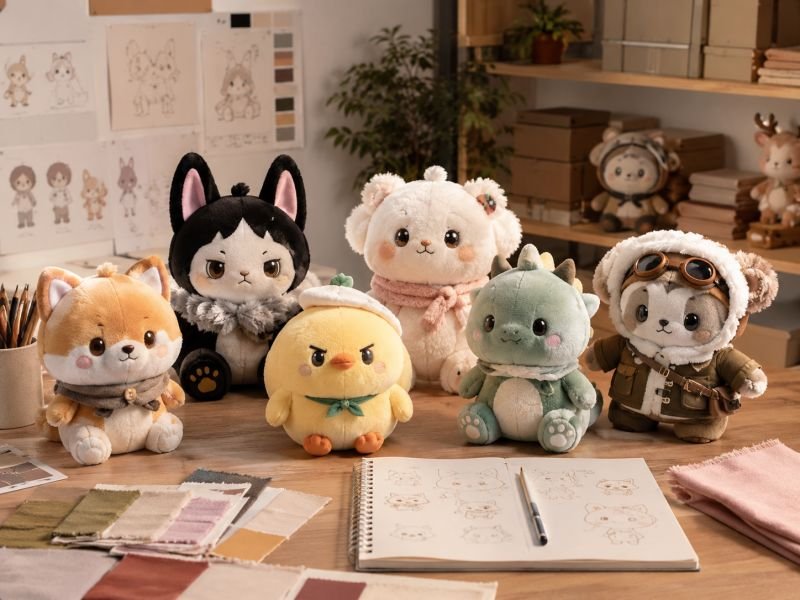
A Factory Guide for IP Brands
A plush toy is no longer just a soft gift placed on a shelf. In fandom culture, it can become a character badge, a desk companion, a limited drop, a collector’s trophy, a convention item, a retail display piece, or a small charm carried on a bag every day. The strongest plush programs are not built only around cuteness. They are built around recognition, emotion, scarcity, series planning, tactile quality, and the small details that fans notice faster than anyone else.
Custom collectible plush toys for fandom merchandise are soft character products developed from original IP, licensed characters, game figures, anime mascots, creator avatars, or community symbols. A strong launch usually connects accurate character translation, size planning, fabric selection, embroidery detail, packaging, MOQ planning, QC, and future restock structure so the plush can work as both merchandise and a collectible object.
The real test happens when fans see the face. If the eyes sit slightly too far apart, the character feels wrong. If the fabric looks flat, the product loses charm. If the secret style feels lazy, the collection loses energy. A successful fandom plush may look effortless in a fan photo, but behind that photo sits a careful chain of design review, sample correction, production control, and packing discipline.
What Are Collectible Plush Toys?
Collectible plush toys are soft character products created for fans to keep, display, carry, trade, gift, or complete as part of a set. They are different from ordinary plush because their value does not come only from softness. It comes from character recognition, emotional attachment, rarity, packaging, release timing, and whether the item feels worth keeping after the first excitement fades.
A collectible plush needs three things working together: the character must be recognisable, the product must feel good in hand, and the release must give fans a reason to care. A soft toy without identity is easy to replace. A plush that carries a beloved expression, outfit, pose, colour, or story moment can stay meaningful for years.
For fandom merchandise, collectible plush often falls into several formats: character plush, mascot plush, mini plush, plush keychains, bag charms, blind box plush, limited editions, event versions, and premium gift-box styles. Each format has a different job. A mini charm is easy to carry. A 20 cm character plush feels stronger for display. A blind box plush creates surprise and repeat interest. A boxed edition can feel more premium for collectors.
The biggest misunderstanding is thinking collectible plush is only a cute product. It is actually a product system. The face, fabric, size, stuffing, accessories, tag, box, SKU, carton plan, and repeat order record all affect the final result. Fans see the cute side. Behind it, every successful plush release needs disciplined product choices.
A useful way to define collectible plush is this:
| Collectible Plush Element | What It Means In Real Projects | Why Fans Care |
|---|---|---|
| Character Identity | The plush clearly represents a known character, mascot, or original IP | Recognition creates desire |
| Expression Accuracy | Eyes, mouth, face shape, and attitude feel right | Fans connect through the face |
| Series Logic | Multiple styles, characters, outfits, or versions can exist together | Collectors want completion |
| Release Reason | Anniversary, event, season, launch, secret style, or limited edition | Timing creates urgency |
| Packaging Value | Hangtag, blind box, retail box, gift box, or collector card | Unboxing feels intentional |
| Quality Stability | Shape, stitching, stuffing, and face placement stay consistent | Trust supports restocks |
| Future Potential | The first plush can grow into new styles or repeat orders | The line can continue |
A strong collectible plush should make fans feel, “This belongs to the character world I already love.” That feeling is what separates a real fandom item from a generic soft toy.
Custom Plush Meaning
Custom plush means a soft product developed from a specific character, mascot, artwork, sketch, pet photo, digital file, or brand-owned design. It is not the same as taking a ready-made plush and adding a logo. Real custom plush development starts from the character itself: its shape, expression, colour, personality, size, fabric feel, and final use.
For fandom merchandise, this matters because fans usually know the original design very well. They notice whether the eyes are too high, the ears are too narrow, the hair shape is flat, the colours feel wrong, or the body does not match the character’s personality. Custom plush has to translate emotion, not just outline.
A serious custom plush project usually needs these details before sampling:
| Project Detail | Why It Matters |
|---|---|
| Front View | Confirms face, main shape, colour blocks, and first impression |
| Side View | Helps build head depth, body thickness, nose shape, tail, or hair volume |
| Back View | Confirms back details, clothing, hair, tail, label area, and colour placement |
| Target Size | Affects detail clarity, cost, packing volume, and perceived value |
| Quantity Per Design | Helps review MOQ, material planning, and production efficiency |
| Fabric Preference | Controls hand feel, surface texture, and visual softness |
| Face Craft | Embroidery, printing, applique, or mixed craft affects expression accuracy |
| Accessories | Hooks, chains, outfits, props, magnets, or sound modules affect structure |
| Packaging | Hangtag, polybag, box, blind box, or gift pack changes cost and timeline |
| Sales Region | Label and testing review may vary by destination and age grade |
A custom plush sample usually needs pattern making, fabric preparation, embroidery or printing, cutting, sewing, stuffing, shaping, detail finishing, and review. If the project is a character plush, the first sample is often a starting version, not the final version. Adjustments may be needed to improve face, head shape, body balance, fabric choice, or accessory position.
For larger plush programs, standard MOQ often starts from 500pcs per design. This is practical because each design needs its own setup work: pattern, material, face craft, cutting, sewing, stuffing, inspection, packaging, and shipment preparation. For single-style bulk orders reaching 2,000pcs, sample fee refund or deduction can be reviewed according to the project terms.
Custom plush is best understood as a bridge between artwork and physical merchandise. The artwork gives the character. The sample proves the character can work in fabric. The approved sample protects bulk consistency.
Collectible Plush Vs Regular Plush
Regular plush and collectible plush may both feel soft, but they are created with different goals. A regular plush is often made for broad appeal. A collectible plush is made for emotional recognition, display value, fandom identity, and repeat release potential.
A regular plush can be cute without a story. A collectible plush usually needs a story, a character, a release reason, or a set structure. Fans do not judge it only by softness. They look at whether the plush feels “official,” whether the expression matches the character, whether the packaging feels worth keeping, and whether the item fits into a larger collection.
| Area | Regular Plush | Collectible Plush |
|---|---|---|
| Main Purpose | Gift, comfort item, decoration | Character item, limited release, fan object, collection piece |
| Design Base | General animal or cute shape | Character, mascot, IP, creator avatar, fandom symbol |
| Detail Priority | Softness and simple appearance | Face accuracy, outfit cues, colour match, silhouette |
| Size Logic | Chosen mainly for gift use | Chosen for display, carry, blind box, or series planning |
| Packaging | Often simple polybag or tag | Hangtag, retail box, blind box, gift box, collector card |
| Release Style | Often open-ended | Seasonal, limited, event-based, series-based |
| Repeat Value | Depends on general demand | Built through characters, variants, restocks, secret styles |
| Main Risk | Feels too ordinary | Face feels wrong or set feels weak |
The production priorities are also different. For regular plush, a slight expression change may not matter much. For collectible plush, it can change everything. If the character looks sleepy instead of mischievous, shy instead of confident, or flat instead of lively, fans may reject it even if the sewing quality is clean.
This is why collectible plush needs closer control over:
- Eye spacing
- Mouth shape
- Face embroidery
- Head proportion
- Fabric pile direction
- Colour matching
- Stuffing density
- Accessory placement
- Packaging fit
- SKU separation
- Batch consistency
A collectible plush should be designed with future comparison in mind. Fans may place all characters together on a shelf. They may compare the first drop with a restock. They may photograph several pieces side by side. If the line feels inconsistent, the collection loses trust.
The best collectible plush does not simply look cute. It feels intentional.
Why Fans Collect Plush
Fans collect plush because plush makes a character physically present. A digital character can appear on a screen. A poster can decorate a wall. A plush can sit beside a laptop, hang from a bag, rest on a shelf, travel to an event, appear in photos, or become part of daily routine. It turns fandom into something touchable.
The emotional reason is simple: plush feels close. It has softness, weight, shape, texture, and warmth. For many fans, a plush is not only merchandise. It can represent comfort, memory, humour, loyalty, nostalgia, or belonging.
Fans often collect plush for several reasons at the same time:
| Fan Motivation | What It Looks Like | Product Detail That Supports It |
|---|---|---|
| Character Love | “This is my favourite character.” | Accurate face and signature details |
| Completion | “I want the full set.” | Clear series structure |
| Identity | “This shows what I love.” | Bag charm, keychain, visible design |
| Comfort | “This feels soft and familiar.” | Fabric quality and stuffing balance |
| Memory | “This reminds me of an event or launch.” | Limited tag, date, special outfit |
| Display | “This looks good on my shelf.” | Stable shape and strong silhouette |
| Social Sharing | “This looks cute in photos.” | Clear face, bold colour, photogenic packaging |
| Gift Value | “This is perfect for another fan.” | Nice box, tag, or small card |
The face is usually the strongest emotional trigger. Fans may not know the technical reason, but they instantly feel when the character is right. The eyes may need to be slightly lower. The cheeks may need more fullness. The mouth may need a softer curve. The head may need more width. These tiny changes can turn a flat sample into something fans want to keep.
Another reason fans collect plush is scale. A small plush charm is easy to carry, while a larger plush can feel like a display piece or comfort object. Different sizes serve different emotional needs. This is why many successful character lines eventually create a size ladder: small charms, mini plush, main plush, and premium editions.
Fans also enjoy controlled surprise. Blind box plush, secret styles, and limited colours create the feeling of discovery. But surprise only works when the base designs are already appealing. If regular styles feel weak, the secret style alone cannot carry the whole release.
A collectible plush becomes powerful when fans see themselves in it. It reflects their taste, community, story, and emotional world.
History Of Fandom Plush
Fandom plush has grown from traditional character toys into a wider cultural product. Earlier plush programs were often tied to animation studios, theme parks, sports mascots, comic characters, and large entertainment licenses. The plush usually appeared after the character had already become widely known through shows, films, games, or retail channels.
That path still exists, but it is no longer the only path. Today, a plush character can begin from a webcomic, indie game, livestream avatar, creator mascot, café character, museum mascot, meme creature, fan club symbol, or original IP project. A smaller audience can still support a strong plush release if the emotional connection is deep enough.
This shift changed how plush is planned. In the past, a plush often followed an established character. Now, a plush can help build the character’s physical identity earlier. It can appear in launch photos, campaign boxes, fan events, creator streams, retail displays, and pre-order reveals.
A simple timeline shows the shift:
| Period | Plush Role | Common Examples |
|---|---|---|
| Early Character Merch | Soft version of famous characters | Animation, theme parks, sports mascots |
| Retail Expansion | Gift and shelf item | Gift shops, toy aisles, souvenir stores |
| Online Fan Culture | Physical fandom symbol | Webcomics, games, creators, fan clubs |
| Collectible Era | Set-based, limited, portable, social-friendly | Blind boxes, bag charms, secret styles |
| Current Plush Programs | Character system with repeat potential | IP lines, creator drops, retail plush sets |
The rise of adult collectors also changed the category. Plush is no longer locked inside a child-only space. It appears in workspaces, fashion styling, cars, livestream rooms, gaming setups, convention outfits, and home décor. Many fans now treat plush as a small emotional design object.
This history matters because it shows why collectible plush needs more than softness. The product is part of a bigger culture of characters, personal identity, limited releases, and visual sharing. A plush line that understands this culture can feel fresh even when the basic material is simple.
Are Plush Toys Still Popular?
Yes, plush toys remain popular, but the reason has changed. Plush is still loved for softness and comfort, yet modern demand is also driven by character identity, adult collecting, creator merchandise, anime and game communities, blind boxes, bag charms, limited editions, premium gifting, and social sharing.
A better way to judge plush potential is to look at the strength of the character and the release structure. A generic soft animal may depend heavily on price and broad cuteness. A fandom plush can carry story, identity, scarcity, display value, and repeat potential.
Several plush directions continue to perform strongly in fandom merchandise:
| Plush Direction | Why It Works | Best Use |
|---|---|---|
| Character Plush | Fans already know the figure | Main IP product, hero item |
| Mini Plush | Easy to collect and ship | Online store, event table, series release |
| Plush Keychain | Lower entry price and daily carry | Creator merch, anime, game drops |
| Bag Charm | Visible, stylish, photo-friendly | Fashion-led fandom and limited drops |
| Blind Box Plush | Surprise and repeat interest | Multi-character lines |
| Mascot Plush | Clear symbol and broad appeal | Campaigns, events, brand gifts |
| Boxed Plush | Premium presentation | Retail shelves and collector editions |
For product planning, size often decides how fans interact with the plush:
| Size | Fan Behaviour | Product Advantage |
|---|---|---|
| 8–10 cm | Carry, trade, collect | Good for charms and blind boxes |
| 12–15 cm | Display, gift, collect | Good balance between detail and cost |
| 18–25 cm | Main character display | Better face and outfit expression |
| 30 cm+ | Premium gift, comfort, shelf impact | Strong emotional presence |
Popularity does not remove risk. A plush can still fail if the face does not match the character, the fabric feels low grade, the shape collapses after shipping, or the packaging feels careless. The category may be strong, but fans choose details.
For serious fandom plush, the safest product thinking is:
- Keep the character recognisable in one second
- Protect the face above all else
- Choose size based on use, not only cost
- Use fabric that matches the character’s personality
- Plan packaging before bulk production
- Keep records for repeat orders
- Avoid too many styles before demand is clear
- Make every style in the set desirable
Collectible plush stays popular because it gives fans something digital products cannot fully replace: a soft, physical connection to a character they already care about.
Why Fandom Plush Is Growing

Fandom plush is growing because it gives fans something digital products cannot fully replace: a soft, physical connection to a character they already care about. It works across anime, games, creator communities, retail drops, pop culture events, lifestyle accessories, and collector shelves because it combines comfort, identity, display value, scarcity, and daily visibility.
The growth is not just about “cute toys.” It is about how people now use character products in everyday life. A plush can sit beside a laptop, hang from a bag, appear in a short video, travel to a convention, complete a shelf display, or mark a special event. That flexibility makes plush useful for both emotional connection and commercial release planning.
Recent industry data shows why this category keeps attracting attention. The global stuffed animals and plush toys sector was estimated at USD 13.68 billion in 2025 and projected to reach USD 25.94 billion by 2033, with growth linked to licensed characters, emotional gifting, e-commerce, premium plush, adult collectors, and character-led products. In the United States, adult toy spending also showed strong movement in early 2025, with adults aged 18+ becoming the fastest-growing age group in toy sales during Q1.
For fandom plush, this means the opportunity is broader than children’s toys. Many plush releases now speak to teens, students, young professionals, collectors, gamers, anime fans, creators, and lifestyle shoppers. The product may be soft, but the purchase reason is often serious: identity, nostalgia, comfort, belonging, rarity, or pride in a favourite character.
The strongest growth comes from five forces working together:
| Growth Driver | What It Means | Plush Opportunity |
|---|---|---|
| Adult Collecting | More adults openly collect toys and character goods | Premium plush, display plush, limited editions |
| Gen Z Culture | Cute, emotional, ironic, and fandom-coded items feel normal | Bag charms, mini plush, creator mascots |
| Blind Box Excitement | Surprise creates repeat interest and trading behaviour | Mini plush sets, secret styles, rare versions |
| Social Sharing | Plush is easy to photograph, carry, and display | Strong face, bold silhouette, camera-friendly packaging |
| Creator Commerce | Online characters need physical products | Mascot plush, avatar plush, pre-order drops |
This growth also raises the quality bar. Fans have seen many plush products. They can tell when a character has been handled with care and when it has been rushed. A low-effort plush may still get attention once, but it rarely builds a lasting line. The projects that grow are the ones where character accuracy, fabric choice, sample correction, packaging, and release timing work together.
What Plush Toys Are Trending Now?
The plush products gaining the most attention are not random soft toys. They usually have a clear identity, portable size, collectible structure, or strong photo appeal. Character plush, mini plush, blind box plush, plush keychains, plush bag charms, mascot plush, creator avatar plush, and limited edition plush are all strong directions because they fit the way fans now discover and share products.
The most useful trend is portability. A plush that stays on a shelf is seen by one person. A plush that hangs from a bag, phone strap, camera case, backpack, or luggage becomes part of daily style. That is why plush bag charms and keychain plush have become so attractive for fandom merchandise. They are small enough to carry, visible enough to start conversations, and affordable enough for repeat releases.
Blind box plush is another strong direction because it adds suspense. Fans do not only receive a product; they open a moment. The reveal, the possible secret style, the chance to trade duplicates, and the desire to complete the set all help turn one order into a larger collection habit.
A practical way to compare current plush directions:
| Trending Plush Type | Best Size Reference | Why Fans Like It | What To Watch |
|---|---|---|---|
| Mini Character Plush | 8–12 cm | Easy to collect, gift, and display | Small face details must stay readable |
| Plush Keychain | 8–12 cm | Portable and lower entry price | Loop strength and seam reinforcement |
| Plush Bag Charm | 10–15 cm | Works as fashion and fandom signal | Weight balance and hanging angle |
| Blind Box Plush | 8–10 cm | Surprise and set completion | Style ratio and packaging control |
| Main Character Plush | 18–25 cm | Strong display and emotional value | Face, stuffing, and carton volume |
| Premium Plush | 30 cm+ | Gift value and shelf impact | Packing recovery and freight cost |
| Mascot Plush | 15–25 cm | Strong brand or event memory | Shape must be clear without text |
| Creator Avatar Plush | 12–20 cm | Community connection | Artwork needs side/back views |
The safest trend choice depends on the character. A simple mascot may work beautifully as a charm. A detailed anime character may need 18–25 cm to keep the face and outfit clean. A multi-character universe may be better suited to a blind box set. A premium fan reward may need stronger packaging and a larger size.
The trend is not “small is always better” or “blind boxes always work.” The stronger rule is this: the product type should match the fan behaviour. If fans carry the character daily, choose a charm. If fans like collecting groups, plan a series. If fans want a hero item, build a stronger display plush. If fans love surprise, consider blind packaging only when every regular style is still desirable.
What Is The New Plush Toy Craze?
The new plush craze is built around collectability, scarcity, and visible ownership. Fans do not only want a soft product. They want something that feels rare, recognisable, shareable, and connected to a world they already follow. This is why blind boxes, secret styles, limited drops, bag charms, and character families are growing so quickly.
A plush craze usually has three layers. First, there is the character: fans must recognise it or quickly feel attached to it. Second, there is the release structure: the product needs a reason to appear now, such as an event, milestone, holiday, collaboration, or limited run. Third, there is the social loop: fans need a reason to show it, trade it, post it, or compare it.
This is why some plush products move faster than expected. The item may be small, but the emotional system around it is large. A charm can carry a whole fandom signal. A blind box can turn opening into entertainment. A secret style can create conversation. A limited edition can make fans act before the release disappears.
The craze is strongest when these details are planned together:
| Craze Element | How It Works | Product Detail That Supports It |
|---|---|---|
| Surprise | Fans enjoy not knowing which style they will receive | Blind box, sealed bag, mystery style |
| Scarcity | Fans feel the timing matters | Limited edition, event-only style, dated tag |
| Recognition | The product is understood instantly | Strong face, clear silhouette, signature colours |
| Portability | Fans can show it in daily life | Keychain, charm, light stuffing |
| Completion | Fans want the full set | Balanced character lineup |
| Social Proof | People see others sharing it | Photogenic packaging and unboxing moment |
| Emotional Comfort | The product feels soft and personal | Fabric hand feel and huggable shape |
The risk is copying the outer shape of a craze without understanding why it worked. A blind box without good characters feels empty. A secret style that looks too similar to the normal style feels disappointing. A bag charm with a weak loop may create complaints. A limited drop with poor quality can damage future releases.
The new plush craze rewards careful planning. It is playful on the surface, but the strongest projects control character identity, product structure, packaging, style count, and delivery timing from the beginning.
Why Gen Z Loves Plush
Gen Z loves plush because plush fits the way younger fans express identity, comfort, humour, and online culture. A plush can be cute without being childish, emotional without being too serious, stylish without being expensive, and fandom-coded without needing a big logo. It can sit in a bedroom, appear in a mirror photo, hang from a bag, or become part of a desk setup.
For this audience, plush often works as a soft identity signal. It may represent a game, anime, creator, music fandom, meme, friend group, emotional phase, or personal aesthetic. The item does not need to explain itself to everyone. It only needs to be recognised by the people who understand that world.
Several Gen Z behaviours make plush especially suitable:
| Gen Z Behaviour | How Plush Fits |
|---|---|
| Personal Aesthetics | Plush can match outfits, room style, bags, and desk setups |
| Character Attachment | Digital characters can become physical companions |
| Comfort Culture | Soft objects feel calming during study, work, or travel |
| Social Posting | Plush is easy to photograph in daily scenes |
| Micro-Collecting | Small items make collecting easier and less expensive |
| Community Signals | Fans recognise shared symbols without long explanations |
| Drop Culture | Limited releases create urgency and participation |
Gen Z also tends to reject lazy merchandise quickly. A flat logo on a generic plush may not be enough. They often look for expression, texture, personality, and thoughtful packaging. They may not use technical words, but they can feel when the face is wrong, when fabric looks cheap, or when the product does not match the character’s energy.
This makes sample development very important. For Gen Z-focused plush, the face should be reviewed carefully from several angles. The product should photograph well in natural light. The size should fit the intended use. A bag charm should not feel too heavy. A mini plush should still be readable on camera. A boxed edition should feel worth showing during an unboxing.
The strongest Gen Z plush products feel personal. They do not shout for attention; they create recognition among the right people.
How Social Media Drives Plush
Social media drives plush because plush is naturally visual, portable, and easy to place into real life. It can appear in unboxing videos, shelf tours, convention outfits, café photos, gaming setups, desk photos, travel shots, bag styling, and creator livestream backgrounds. Few merchandise formats can move across so many scenes without feeling forced.
A plush performs well visually when it is readable in one second. The face should not be too small. The colours should not disappear in poor lighting. The silhouette should be clear even when the product is partly covered by a hand, bag, or box. A charm should hang nicely. A blind box should look good before and after opening.
For social sharing, the product should be tested beyond the flat product photo. It helps to check:
- How it looks in a hand
- How it sits on a shelf
- How it hangs from a bag
- How the face reads from 1 meter away
- How colours appear in phone photos
- How the packaging looks in an unboxing video
- Whether the product has one memorable feature
Social platforms reward details that are easy to recognise and repeat. A strange ear shape, funny expression, oversized bow, special colour, tiny accessory, rare tag, or strong box design can become the thing people remember.
Plush also has a strong “soft proof” effect. When people see others holding, squeezing, carrying, or displaying it, the product feels more real. Fans can imagine owning it. This is different from flat printed products, where texture and touch are harder to communicate.
Product teams can plan around this by creating photo-friendly design choices:
| Photo-Friendly Detail | Why It Helps |
|---|---|
| Large Eyes | Reads clearly on small screens |
| Strong Colour Blocks | Helps recognition in fast scrolling |
| Clear Silhouette | Makes the character identifiable from a distance |
| Expressive Mouth | Adds emotion and personality |
| Portable Size | Encourages daily photos |
| Attractive Hangtag | Makes product feel finished |
| Box Front Design | Supports reveal videos |
| Rare Version | Gives fans something to post about |
Social sharing should not replace product quality. It should reveal it. If the plush looks good online but disappoints in hand, the excitement fades quickly. The best plush products look cute in photos and feel better when touched.
Why Limited Drops Sell
Limited drops sell because they give fans a reason to act now. A plush tied to an anniversary, game update, concert, convention, holiday, creator milestone, retail opening, or collaboration feels more meaningful than a product released without context. The release becomes part of a moment.
Scarcity works because fans do not want to miss something that may not return. But scarcity must feel honest. If every product is called limited, the word loses power. The strongest limited plush has a clear reason for being limited.
| Limited Drop Type | Strong Reason | Plush Example |
|---|---|---|
| Anniversary Edition | Tied to a date fans recognise | Year-one mascot plush |
| Convention Exclusive | Linked to a physical event | Badge-style plush charm |
| Seasonal Style | Fits a holiday or weather mood | Winter outfit character plush |
| Creator Milestone | Celebrates community growth | Subscriber celebration plush |
| Game Update Release | Connected to a story or new level | New creature plush |
| Collaboration Drop | Linked to another brand or artist | Co-designed boxed plush |
| Pre-Order Window | Controls quantity before production | Made-for-release plush |
| Secret Style | Creates rarity inside a set | Hidden blind box plush |
Limited drops also help manage demand when used carefully. A pre-order window can reduce guessing. A small first run can test the character. A numbered hangtag can increase collector value. A seasonal edition can create a clear reason to change outfit, colour, accessory, or packaging without confusing the main product line.
The practical side matters. Limited drops often have fixed dates, so development must be realistic. A six-style blind box set with printed boxes, barcode labels, and secret styles needs more planning than a single plush with a hangtag. If the release date is close, simplifying the structure may protect quality better than forcing every idea into the first drop.
A strong limited release plan usually confirms:
- Final artwork
- Style count
- Quantity per style
- Sample approval date
- Packaging artwork deadline
- Label and barcode needs
- Bulk production window
- Inspection plan
- Packing method
- Shipping method
- Arrival buffer
Fans see the excitement. The release team needs the calendar. Limited plush works best when emotion and timing are planned together.
Is Fandom Merch Changing?
Fandom merchandise is changing from simple logo products into character-led product systems. Printed items still matter, but plush adds a stronger emotional layer because it gives a character body, softness, expression, and presence. Fans are not only collecting images. They are collecting physical symbols of the worlds they care about.
The old merchandise model often focused on putting artwork onto existing products. The newer model asks a deeper product: What object would fans actually want to live with, carry, display, or collect? Plush fits this shift because it can be playful, personal, premium, or portable depending on the format.
A fandom plush line can now serve several fan levels at once:
| Fan Level | Better Plush Format | Why It Works |
|---|---|---|
| Casual Fan | Mini plush or keychain | Easy entry and lower cost |
| Core Fan | 18–25 cm character plush | Stronger emotional value |
| Collector | Blind box set or secret style | Completion and rarity |
| Event Fan | Limited charm or mascot plush | Memory of the moment |
| Gift Shopper | Boxed plush | Better presentation |
| Lifestyle Fan | Bag charm | Daily carry and visual identity |
This shift also changes product planning. Instead of one product for everyone, many IP teams now build a plush ladder. A small charm introduces the character at a lower price. A medium plush becomes the core item. A blind box set creates collection energy. A limited edition creates urgency. A premium box version serves gift and collector needs.
The risk is over-expansion. Too many styles can create inventory pressure, quality control difficulty, and confusing release structure. A strong plush line grows step by step. It starts with the clearest character or format, learns from fan response, then expands into new sizes, outfits, styles, or packaging.
Fandom merchandise is becoming more emotional, more visual, more collectible, and more lifestyle-driven. Plush fits that future because it is one of the few formats that can be held, displayed, carried, photographed, and loved at the same time.
Which Types Work Best?

The strongest fandom plush types are not chosen only by shape. They are chosen by how fans will use them. A shelf display plush, a daily bag charm, a blind box mini, and a premium mascot plush all serve different moments. The right format depends on character detail, release channel, size, packaging, quantity per design, and whether the plush will become a one-time drop or a repeatable collection.
A good plush type should match three things at the same time: the character, the fan habit, and the sales plan. If the character has a simple face and strong silhouette, it may work well as a small charm. If the character has detailed hair, layered clothes, props, or facial colour gradients, it usually needs a larger size to keep the details clean. If the project has several characters, a blind box or mini set may create more collecting energy than one single plush.
The biggest mistake is choosing the format too early. Many projects begin with “we want a 10 cm plush” or “we want a blind box,” before checking whether the character can survive at that size. A 10 cm plush sounds cute, but tiny embroidery, small clothing layers, and narrow accessories can become unclear. A 25 cm plush can show more detail, but it needs more fabric, more filling, more carton space, and a stronger retail value to justify its size.
A useful first filter is this:
| Plush Type | Strongest Use | Common Size | Works Well When | Main Risk |
|---|---|---|---|---|
| Character Plush | Hero item, display, fan gift | 18–25 cm | Character has strong face and story | Face accuracy must be high |
| Mascot Plush | Campaigns, events, brand programs | 15–30 cm | Shape is simple and memorable | Too many small logo details weaken it |
| Plush Keychain | Entry item, add-on, small merch | 8–12 cm | Design is simple and readable | Tiny details may disappear |
| Blind Box Plush | Collection sets, surprise drops | 8–10 cm | Several styles have equal appeal | Style mix and box control are harder |
| Plush Bag Charm | Daily carry, fashion-led fandom | 10–15 cm | Silhouette is bold and cute | Loop strength and weight balance matter |
| Mini Plush | Sets, desk display, lower entry cost | 8–15 cm | Character can be simplified well | Low detail space |
| Large Plush | Premium gift, shelf impact | 30 cm+ | Character has strong emotional value | Carton volume and shipping need review |
For serious fandom merchandise, product type should be chosen after reviewing artwork, target size, quantity per design, fabric, craft detail, packaging, sales region, and launch timing. This is especially important when the plush line includes several styles, labels, boxes, barcode needs, or future restocks.
A simple way to plan is to match the plush type with the fan behaviour:
| Fan Behaviour | Better Plush Format | Why It Works |
|---|---|---|
| “I want to carry it every day.” | Plush bag charm or keychain | Light, visible, easy to attach |
| “I want the whole set.” | Blind box plush or mini series | Supports collecting and trading |
| “I want my favourite character on my shelf.” | 18–25 cm character plush | Better face, outfit, and display value |
| “I want a memorable event item.” | Mascot plush or limited charm | Strong date, theme, and keepsake value |
| “I want a premium gift.” | Boxed plush or larger plush | Stronger presentation and emotional weight |
| “I want a first test release.” | One hero plush or two core styles | Easier to control before expanding |
A strong plush line rarely needs every type at once. It usually starts with the format that gives the clearest fan reaction, then expands. For example, a game character may begin as a 20 cm hero plush, then later become a keychain. A creator mascot may begin as a small plush charm, then grow into a larger display plush after the audience reacts well. An anime cast may begin with three core characters before moving into a full blind box set.
Character Plush Toys
Character plush toys work best when the design already carries emotional value. This can be a game creature, anime character, comic figure, mascot friend, creator avatar, original IP character, or story-based animal. The main goal is not simply to make a soft version of the artwork. The goal is to keep the character’s personality clear in fabric.
The face is the first decision area. Fans usually judge character plush through the eyes before they notice anything else. Eye size, eye height, mouth curve, eyebrow angle, cheek shape, blush position, head width, and stuffing balance can all change the character’s mood. A cute character can become dull if the eyes are too high. A mischievous character can look sleepy if the brow angle is wrong. A shy character can look strange if the mouth is too large.
Character plush is usually stronger at 18–25 cm when the design includes hair, clothing, accessories, or face details. This size gives more space for embroidery, applique, fabric changes, and body shaping. Smaller versions can still work, but the design may need simplification.
| Character Detail | Better Craft Choice | Why |
|---|---|---|
| Simple eyes and mouth | Embroidery | Clean, durable, stable in bulk |
| Gradient anime eyes | Printing or mixed craft | Better colour transitions |
| Blush or cheek marks | Embroidery or print | Depends on softness and colour depth |
| Hair shape | Pattern pieces or applique | Creates silhouette |
| Outfit edges | Fabric layering or applique | Adds depth without too much bulk |
| Tiny symbols | Embroidery, print, or woven label | Depends on size |
| Props | Sewn plush parts or soft accessories | Safer and easier to pack |
For character plush, the most useful artwork pack includes front, side, back, and close-up views. If only a front view is available, the side and back shape must be interpreted. That can work, but it usually increases revision risk.
A character plush should also be reviewed for posture. Will it sit? Stand with support? Hang from a chain? Stay flat in a box? Lean against a shelf? These decisions affect pattern making and stuffing. A plush meant to sit needs a stable bottom and weight balance. A plush meant to hang needs a loop position that keeps the face facing forward.
For a first character plush release, avoid forcing every artwork detail into the sample. Fans care about the details that define the character. These usually include face, colour, silhouette, hair, ears, outfit signature, and one or two iconic features. Tiny decorative lines that add cost but do not improve recognition can often be simplified.
A strong character plush feels like this: even if the logo and tag are removed, fans still know who it is.
Mascot Plush Toys
Mascot plush toys work best for characters that need broad recognition. They are widely used for campaigns, sports teams, retail programs, cafés, museums, schools, product launches, corporate gifts, anniversary events, and offline activities. A mascot plush usually needs to be friendly, durable, clear, and easy to understand within seconds.
The main difference between a mascot plush and a detailed IP character plush is how the identity works. A mascot often needs to appeal to a wider group of people. It may be used by children, staff, fans, visitors, event guests, retail shoppers, or gift recipients. Because of that, the design should not rely on tiny details. The shape and expression should carry the identity quickly.
A mascot plush should be recognisable without reading text. If the plush only works when a printed logo is visible, the design may be too weak. The strongest mascots usually have one or more of these features:
- Distinct head shape
- Signature ears, horns, hair, or hat
- Clear facial expression
- Strong colour combination
- Simple outfit detail
- Memorable body shape
- Friendly posture
- Easy-to-photograph silhouette
Mascot plush also needs more practical planning than many teams expect. If it will be handed out at an event, individual polybags may help distribution. If it will sit on a retail shelf, hangtags or boxes may be needed. If it will be included in gift packs, size and carton volume matter. If it will be used for young audiences, label and safety review should happen early.
| Mascot Plush Use | Better Format | Detail Priority |
|---|---|---|
| Corporate campaign | 15–20 cm plush | Logo placement, clean face, simple packing |
| Sports fan item | 20–30 cm plush | Strong colours, durable seams, bold expression |
| Museum or zoo program | Animal mascot plush | Educational tag, species detail, soft fabric |
| Café or lifestyle brand | Cute mascot plush or charm | Photo appeal and packaging |
| School event | Safe and simple plush | Seam strength, label review, soft filling |
| Anniversary gift | Boxed mascot plush | Date tag, premium feel, keepsake value |
The biggest risk with mascot plush is over-decoration. Too many logos, badges, tiny words, separate props, or stitched accessories can make the plush expensive and visually messy. It can also slow sampling and bulk production. A better approach is to keep the mascot itself strong, then use the hangtag, box, or card to tell the extra story.
For mascot plush, the best design is usually not the most complicated one. It is the one people remember after seeing it once.
Plush Keychains
Plush keychains work best when a project needs a small, portable, lower-entry product that fans can carry every day. They are useful for anime, games, creators, mascots, event programs, retail add-ons, café characters, museum shops, pop-up stores, and fan bundles.
The strength of a plush keychain is visibility. A larger plush may stay at home, but a keychain can travel on a bag, pouch, zipper, phone strap, camera case, suitcase, or key ring. It becomes part of daily style. For fandom merchandise, that daily exposure can be more valuable than a product that only sits on a shelf.
Most plush keychains work well around 8–12 cm. This size is small enough to carry but large enough to hold a clear face. Below this size, details can become difficult. Above this size, the plush may feel too bulky for daily use.
| Keychain Size | Better Use | Detail Space | Handling Risk |
|---|---|---|---|
| 6–8 cm | Very simple mascot or icon | Low | Easy to carry, but details are limited |
| 8–10 cm | Mini character keychain | Medium | Good balance |
| 10–12 cm | Character charm with face detail | Medium to high | Slightly more visible |
| 12–15 cm | Larger bag charm | High | Weight and loop strength need review |
The loop is one of the most important parts of a plush keychain. It should not be treated as an afterthought. The loop position affects how the plush hangs. If the loop is too far back, the face may tilt down. If the loop is too high, the plush may swing awkwardly. If the loop stitching is weak, the product may fail during daily use.
A good plush keychain review includes:
- Hanging angle
- Loop seam strength
- Chain or hook weight
- Fabric resistance to friction
- Face visibility when hanging
- Stuffing density
- Accessory attachment
- Packaging card or hangtag
- Carton packing to avoid deformation
Small plush products also require smart detail control. A full character outfit may look wonderful on a 25 cm plush, but at 9 cm it may become messy. Instead of keeping every part, it is often better to keep the face, main colours, signature hair, ears, or one iconic accessory.
Plush keychains are also a good format for multi-style releases. Fans may collect several characters at once because the size is small and the cost per piece is usually lower than a medium plush. For a character group, three to six keychain styles can feel more complete than one large plush.
The strongest plush keychains look simple, hang well, and stay recognisable from a distance.
Blind Box Plush
Blind box plush works best when a character world has enough variety to create surprise. It is especially suitable for mini character sets, animal mascots, game creatures, anime chibi styles, emotion-based designs, seasonal outfits, food characters, and creator communities that enjoy collecting and trading.
A blind box plush is not just a small plush hidden inside a box. It needs a full product structure. Each style should feel desirable. The set should have a clear theme. The packaging should create curiosity. The secret style should feel special but not make the regular styles look weak.
A strong blind box plush release usually includes:
- 6 to 8 regular styles for a first controlled set
- 1 secret style or rare variation if the audience is ready
- Consistent size across all styles
- Clear style differences
- Balanced character appeal
- Sealed inner packing
- Outer box artwork
- SKU or internal style tracking
- Carton control
- Packing accuracy review
Blind box plush has stronger operational needs than a normal plush item. The product is hidden, so packing accuracy matters more. If style ratios are wrong, if secret styles are overpacked or underpacked, or if boxes are mixed incorrectly, the release can create complaints.
| Blind Box Element | Why It Matters |
|---|---|
| Set Theme | Helps fans understand why styles belong together |
| Style Count | Controls variety and production complexity |
| Secret Style | Adds excitement and share value |
| Inner Bag | Keeps mystery before opening |
| Box Design | Builds shelf and unboxing appeal |
| Ratio Control | Protects release fairness |
| Carton Mark | Helps warehouse and channel sorting |
| Record Keeping | Supports restocks or second waves |
The best blind box sets avoid weak filler designs. Every regular style should be something a fan would be happy to receive. If half the set feels like filler, the blind box loses trust. The secret style should be a reward, not the only attractive item.
Blind box plush also needs size discipline. Most blind box plush stays around 8–10 cm because the box must remain compact and shipping-friendly. If the plush is too large, the box becomes expensive and takes more shelf space. If the plush is too small, character detail may suffer.
For first-time blind box projects, a controlled set is safer than an oversized release. A six-style set with clear differences is often stronger than a twelve-style set that becomes hard to manage. After fan response is proven, the second wave can add new expressions, outfits, colours, or rare versions.
A blind box plush line succeeds when surprise, design quality, packing control, and fan trust move together.
Plush Bag Charms
Plush bag charms work best when the product needs to be seen in everyday life. They sit between plush toy, fashion accessory, fandom signal, and collectible item. This makes them especially useful for anime, game characters, creator mascots, lifestyle IP, limited drops, pop-up stores, and gift-with-purchase programs.
A bag charm must look good while hanging. That sounds simple, but it affects many design choices. The face should forward. The loop should be placed at the right balance. The body should not twist too much. The charm should not be so heavy that it pulls on the bag. Long ears, tails, hair, or accessories should not bend awkwardly during use.
The most common size for plush bag charms is 10–15 cm. This gives enough space for a clear face while still feeling portable. A 6–8 cm charm can work for very simple icons, but it may not show enough character detail. A charm larger than 15 cm can look strong, but the weight and swinging movement need review.
| Bag Charm Detail | Better Choice |
|---|---|
| Size | 10–15 cm for most character charms |
| Loop Position | Slightly balanced above head or back, based on shape |
| Hook Type | Metal hook, chain, keyring, or custom connector |
| Face Scale | Larger than normal mini plush for visibility |
| Fabric | Soft but not too loose for daily friction |
| Stuffing | Light, balanced, not too hard |
| Packaging | Hanging card, polybag, or small box |
| Main Risk | Loop weakness, awkward hanging, fabric wear |
A strong plush bag charm should be recognisable even when seen from a side angle or in motion. This is why bold features matter: large eyes, unique ears, bright hair, special mouth shape, signature colour blocks, or one memorable accessory.
Bag charms also work well in limited releases. A seasonal charm, convention charm, anniversary charm, or creator drop charm can feel more accessible than a full plush while still carrying emotional value. They can also pair with larger plush as a second product tier.
For retail or event use, packaging can change perceived value. A charm in a simple polybag feels practical. A charm on a printed hanging card feels more retail-ready. A charm in a small window box feels more premium. The packaging decision should match the release position.
The strongest plush bag charms pass a simple test: fans should want to attach them immediately, not keep them hidden in a drawer.
Mini Plush Vs Large Plush
Mini plush and large plush do not compete with each other. They serve different fan moments. Mini plush is easier to collect, carry, ship, and release in sets. Large plush has stronger emotional presence, better display value, and more room for detail.
The right choice depends on how the product should behave. A mini plush works well for surprise, impulse orders, charm collections, desk displays, and lower entry cost. A large plush works better when the character is meant to feel important, comforting, premium, or giftable.
| Size Type | Common Size | Strongest Role | Best Fit |
|---|---|---|---|
| Micro Plush | 5–8 cm | Tiny charm or icon | Simple mascot shapes |
| Mini Plush | 8–12 cm | Blind boxes, keychains, sets | Chibi characters, small mascots |
| Small Plush | 12–15 cm | Creator merch, compact display | Simple character plush |
| Medium Plush | 18–25 cm | Main character item | Anime, game, mascot, IP plush |
| Large Plush | 30–45 cm | Premium gift or shelf impact | Hero characters and comfort plush |
| Oversized Plush | 50 cm+ | Statement piece | Special events, photo props, premium drops |
Mini plush has strong commercial advantages. It reduces storage pressure, supports multi-style planning, and works well for fans who want several designs. It also allows a character line to test demand before moving into larger plush.
But mini plush has limits. Embroidery space is smaller. Hair and outfit details need simplification. Thin arms, tails, and accessories can become fragile. The face must be designed for small scale, not simply shrunk from a larger artwork.
Large plush gives more room for personality. The face can be softer. The body can be more huggable. Clothing and accessories can be more visible. It also feels stronger as a gift. However, large plush needs more careful planning for fabric use, filling, carton volume, compression, shipping, and retail shelf space.
A useful planning table:
| Goal | Better Size Choice | Reason |
|---|---|---|
| First fandom test | 12–15 cm or 18 cm | Balanced detail and cost |
| Blind box set | 8–10 cm | Compact and collectible |
| Bag charm line | 10–15 cm | Visible but portable |
| Main hero character | 20–25 cm | Stronger display value |
| Premium gift | 30 cm+ | More emotional weight |
| Event giveaway | 10–18 cm | Easier to distribute |
| Shelf retail | 15–25 cm | Good display balance |
| Collector edition | 20–30 cm with box | Better perceived value |
Many successful plush lines use more than one size over time. A first release may start with a 20 cm hero plush. The next release may add 10 cm charms. A later release may introduce blind box minis or a premium boxed edition. This size ladder allows the character world to serve different fans without forcing one product to do everything.
The best size is not the cheapest size. It is the size where the character still feels alive, the details remain clear, the packaging makes sense, and the release plan can be handled with stable quality.
Who Needs Custom Plush?
Custom plush is most valuable when a character, mascot, story, event, or fan community already has emotional weight. It suits IP owners, game studios, anime teams, VTubers, creators, retail merch teams, event groups, education projects, museums, sports clubs, cafés, tourism shops, and lifestyle brands that want to turn a visual identity into something fans can hold, display, carry, gift, or collect.
A custom plush project usually begins with a simple signal: people already recognise the character, or they are ready to connect with it. The character may come from a game, an animation, a comic, a mascot, a livestream avatar, a café figure, a museum animal, a sports symbol, or a creator community. When that connection exists, plush can do something flat products cannot do. It makes the character soft, physical, emotional, and present in daily life.
The need is not the same for every group. A game studio may care most about accurate character shape and launch timing. An anime team may focus on face expression, outfit detail, and multi-style consistency. A creator may need a first plush drop with clear MOQ planning. A retail team may need barcode labels, carton marks, and shelf-ready packaging. An event team may need a simple structure that can arrive before a fixed date.
The stronger the emotional connection, the more carefully the plush should be developed. Fans notice small details quickly. They may not say “the pattern is wrong,” but they will feel when the head shape is too flat. They may not mention “pile direction,” but they will notice when the colour looks off. They may not understand embroidery limits, but they will see when the eyes do not match the character’s personality.
A useful way to judge whether custom plush fits a project:
| Project Situation | Why Plush Fits | Best Plush Direction |
|---|---|---|
| Character already has fans | Physical product strengthens emotional attachment | 18–25 cm character plush |
| Several characters exist | Fans may want to collect a full set | Mini plush series or blind box plush |
| Mascot appears at events | Plush turns the mascot into a keepsake | Mascot plush or plush charm |
| Online creator has a loyal community | Plush becomes a shared identity item | Avatar plush or limited plush drop |
| Retail program needs shelf appeal | Soft character products create visual warmth | Boxed plush or hangtag plush |
| Event needs memorable gifts | Plush has stronger staying power than paper items | Event mascot plush |
| Brand wants daily visibility | Small plush can travel with the fan | Bag charm or keychain |
| New IP needs testing | Small controlled run reduces early risk | One hero plush or two core styles |
A custom plush line does not need to start large. One strong design can introduce the character. Two or three core designs can test fan preference. A six-style mini set can create collecting energy. A larger plush can become the emotional centre of the release. The format should grow from the character and the audience habit, not from trend pressure alone.
For serious projects, custom plush also needs realistic planning. A plush style normally requires artwork review, pattern making, fabric selection, embroidery or printing setup, sample work, revision, approved sample control, bulk production, inspection, packing, and shipment preparation. This is why MOQ planning matters. For many custom plush programs, 500pcs per design is a more practical starting quantity because the setup work is shared across enough units to support stable production.
IP Owners
IP owners need custom plush when a character is ready to move from screen, story, or artwork into physical merchandise. The plush becomes part of the character’s official world. If it looks right, fans feel the IP has been respected. If it looks wrong, the product can weaken trust quickly.
For IP projects, the key task is not simply making the character soft. It is deciding which visual traits must survive the move into fabric. A 2D illustration may have sharp lines, gradients, tiny ornaments, thin accessories, complex clothing, or dramatic hair. Some of these details may need to be simplified, enlarged, embroidered, printed, layered, or moved into packaging artwork.
A strong IP plush review usually separates design details into three levels:
| Detail Level | Meaning | Example |
|---|---|---|
| Must Keep | Without it, fans may not recognise the character | Eye shape, head silhouette, signature colour |
| Should Keep | Adds personality but can be adjusted | Outfit trim, blush, small accessory |
| Can Simplify | Nice in artwork but risky or costly in plush | Tiny lines, thin decorations, small text |
This prevents two common problems. The first problem is over-simplifying the character until it feels generic. The second problem is forcing too many small artwork details into the plush until it becomes expensive, fragile, or visually messy.
IP owners should prepare clear artwork before sampling:
| File Needed | Why It Helps |
|---|---|
| Front View | Confirms first impression, face, and body shape |
| Side View | Helps build depth, nose, tail, ears, and posture |
| Back View | Confirms hair, clothing, tail, colour blocks, and label area |
| Close-Up Details | Supports accessories, special marks, symbols, and outfit parts |
| Colour Reference | Helps fabric and thread matching |
| Approval Notes | Clarifies what cannot change |
| Packaging Direction | Helps plan box, hangtag, collector card, or blind format |
The approved sample is especially important for IP plush. It becomes the physical reference for bulk production. Once the face, fabric, stuffing, size, and packaging are approved, those details should be protected. Late changes after approval can affect cost, timing, and consistency.
IP owners also need privacy control. Unreleased characters, future campaigns, packaging artwork, sample photos, and secret styles should not be shown publicly without permission. When the plush is linked to a new game, animation, collaboration, or retail launch, confidentiality is part of the product value.
Game Studios
Game studios need custom plush when a digital character has enough emotional pull to live outside the screen. This may be a hero character, pet companion, creature, boss, sidekick, weapon mascot, game logo figure, NPC, or limited event character. Plush gives players a way to keep the game world near them after they stop playing.
Game plush often has strong potential because players spend time with characters. They do not only see them once. They fight with them, care for them, follow them, upgrade them, laugh at them, or remember certain moments. That repeated emotional contact makes plush feel natural.
The challenge is that game characters are not always designed for sewing. Many have details that look great in 3D rendering but need careful adjustment for plush:
| Game Design Detail | Plush Development Review |
|---|---|
| Large head, tiny body | Check neck support and stuffing balance |
| Floating or glowing parts | Use colour, print, fabric layers, or simplified shapes |
| Armour or hard edges | Translate into soft fabric panels |
| Spikes, horns, claws | Review safety, softness, and seam strength |
| Long tail or wings | Check shape support and carton packing |
| Small symbols | Test embroidery or printing readability |
| Creature posture | Decide sitting, standing, or hanging form |
| Strong facial mood | Fine-tune eyes, brows, and mouth carefully |
Timing is usually a major factor for game plush. Releases may connect with a game update, crowdfunding reward, new season, anniversary, convention, digital item drop, or fan event. A plush project tied to a fixed launch should start early enough for sample correction. The first sample may need face adjustment, colour correction, stuffing changes, or accessory simplification.
For a first game plush release, one hero character is often safer than a large cast. If the first plush performs well, the line can later expand into side characters, enemy creatures, mini charms, blind box versions, seasonal skins, or collector editions.
Game plush also works well in several sizes:
| Plush Size | Game Use |
|---|---|
| 8–10 cm | Blind box creatures, mini companions |
| 10–15 cm | Keychains, bag charms, small rewards |
| 18–25 cm | Main character plush, fan shop item |
| 30 cm+ | Premium reward, collector plush, display item |
The best game plush keeps the feeling of the character, not every digital detail. Players want the emotional memory to be right.
Anime Brands
Anime brands need custom plush because character emotion is often at the centre of the fan relationship. Fans care about eye shape, hair style, expression, outfit, colour, and even tiny symbols. A plush that gets the expression wrong can feel unofficial, even if the sewing is clean.
Anime plush usually needs strong face control. Many anime characters are recognised through eyes, hair, and expression. The difference between cheerful, shy, proud, sleepy, angry, or mischievous can come from a few millimetres. Eye height, eyebrow angle, mouth thickness, blush placement, and head fullness should be reviewed carefully.
Anime plush can take several directions:
| Anime Plush Format | Best Use | Main Detail Focus |
|---|---|---|
| Chibi Plush | Cute display and collection | Head ratio, face, hair silhouette |
| Sitting Plush | Shelf display | Bottom balance and body shape |
| Mini Plush | Collectible sets | Simplified details |
| Plush Keychain | Event sales and add-ons | Face readability and loop strength |
| Bag Charm | Daily carry and fashion use | Bold silhouette and light weight |
| Blind Box Plush | Multi-character collection | Style mix and packaging control |
| Premium Boxed Plush | Collector editions | Packaging, fabric, and finish |
For anime-style characters, size matters. Very detailed characters may not work well at 8 cm unless the design is simplified. Hair layers, outfit trim, weapons, ribbons, and small symbols need enough space. If the plush is too small, details may blur together or become too thick.
Consistency across styles is also important. If a plush series includes several characters, shared rules should be defined before sampling:
| Shared Rule | Why It Matters |
|---|---|
| Same Height | Makes the set look balanced |
| Similar Head Ratio | Keeps collection style consistent |
| Face Craft Method | Avoids uneven quality between styles |
| Fabric Level | Keeps hand feel aligned |
| Tag Placement | Makes packaging and display cleaner |
| Box Size | Supports retail and carton planning |
| SKU System | Prevents style mix-ups |
Anime plush fans are often collectors. They may place several characters together, compare details, photograph the set, and share close-ups. This means a series should not feel like each style came from a different production logic. The full set needs visual unity.
VTubers And Creators
VTubers, streamers, illustrators, comic artists, musicians, podcasters, indie creators, and online communities need custom plush when their avatar or mascot has become part of fan identity. A plush can make an online character feel real, and for creator-led communities, that emotional closeness can be very powerful.
Creator plush often starts from a profile image, avatar, emote, sticker, livestream character, or simple mascot drawing. These files may look great online, but they are not always ready for plush production. A flat icon may need side and back details. A chibi avatar may need body thickness. A simple face may need embroidery planning. A costume may need fabric layering.
Before sampling, creators should prepare:
| Detail | Why It Helps |
|---|---|
| Avatar Artwork | Gives main character direction |
| Full Body View | Helps define plush shape |
| Side And Back Notes | Reduces guessing |
| Colour References | Helps fabric and thread choice |
| Personality Words | Helps face expression decisions |
| Signature Details | Shows what fans must recognise |
| Quantity Plan | Supports MOQ and cost review |
| Launch Method | Pre-order, limited drop, event, or store release |
| Packaging Idea | Adds community value |
Creator plush often works best when connected to a moment. It may celebrate a subscriber milestone, debut anniversary, tour, album, livestream event, crowdfunding campaign, or convention appearance. The plush becomes a memory item, not just merchandise.
For creators, a first plush project should avoid too many styles. One strong mascot plush or one plush charm can test demand. If fan response is strong, the line can expand into new expressions, colour variants, mini keychains, seasonal outfits, or larger plush.
Packaging can also carry community emotion. A hangtag with character art, a thank-you card, a collector card, a launch date, or a small message can make the plush feel personal. Fans often care about these touches because they feel close to the creator’s story.
Creator plush should feel like a shared object from the community, not a random product added to a store.
Retail Merch Teams
Retail merch teams need custom plush when a character product must work beyond the sample stage. It needs to look good on a shelf, scan properly, pack safely, meet label needs, separate SKUs clearly, and stay consistent across repeated production.
Retail plush has more practical pressure than many teams expect. A beautiful sample is only the beginning. The finished product must survive carton packing, warehouse receiving, store display, handling, scanning, and restocks. Packaging and labeling are not small details. They can decide whether the plush moves smoothly through the sales channel.
Retail plush planning often includes:
| Retail Detail | Why It Matters |
|---|---|
| Hangtag | Adds story and shelf identity |
| Barcode Label | Supports checkout and inventory |
| SKU Label | Separates styles, sizes, or colours |
| Care Label | Gives product information |
| Warning Label | Supports age and region review |
| Retail Box | Improves display and gift value |
| Inner Packing | Protects shape and cleanliness |
| Carton Mark | Helps warehouse receiving |
| Packing List | Reduces sorting errors |
| Style Records | Supports future restock |
For collectible plush, the retail setup may involve several styles. A blind box set may need outer box artwork, inner bags, rare style ratio control, and carton separation. A character plush line may need different barcodes per style. A bag charm series may need hanging cards or small boxes. These details should be planned before bulk packing begins.
Shelf presence also matters. A plush must read clearly from a distance. The face should be visible. The silhouette should be strong. The packaging should not hide the most attractive part. If the plush is packed in a box, the window size or product photo should show enough detail to create desire.
Retail merch teams also benefit from repeat records. If a style sells well, restocking should not start from zero. Fabric notes, embroidery files, approved sample photos, box artwork, labels, carton rules, and previous inspection notes should be saved. Good records make repeat production more stable.
Event And Campaign Teams
Event and campaign teams need custom plush when a product must carry memory. Plush is often kept longer than paper gifts, simple giveaways, or low-value promotional items. A mascot plush, event charm, anniversary plush, or limited character item can remind people of the event long after it ends.
The most important event detail is timing. Many event plush projects have fixed dates: convention opening, sports match, school activity, museum event, product launch, company anniversary, fan meeting, festival, or retail pop-up. If the plush is late, the product loses much of its purpose.
Event plush should be planned backward from the required arrival date. The schedule should include artwork review, sample work, revision, approval, material preparation, production, inspection, packing, shipping, and arrival buffer.
A practical event plush planning table:
| Event Need | Plush Planning Choice |
|---|---|
| Fixed date | Start artwork and sample review early |
| Large quantity | Use stable structure and common fabric when possible |
| Fast distribution | Individual polybag or simple carton sorting |
| Premium guests | Add gift box, hangtag, or date card |
| Outdoor event | Avoid fragile accessories |
| Children’s activity | Review label and safety needs early |
| Multi-location shipping | Confirm carton marks and address plan |
| Photo opportunity | Choose bold face and clear silhouette |
Event plush does not always need complex detail. In fact, simple structures often work better for tight deadlines. A clean mascot face, soft fabric, strong stitching, and a clear event tag can feel more successful than a complicated design that becomes risky to finish on time.
For campaign use, the plush should connect directly to the event story. A special colour, limited date tag, themed outfit, event logo on a hangtag, or small collector card can make the product feel tied to the moment. This helps people keep it instead of treating it as a throwaway gift.
A good event plush should be easy to understand, easy to distribute, easy to photograph, and meaningful enough to keep.
How To Plan A Plush Series

A plush series should be planned like a small character world, not like separate soft toys placed together. Each style needs its own reason to exist, while the full set must feel connected through size, face style, fabric level, packaging, and release rhythm. A strong series is easy for fans to understand, easy to collect, and realistic enough to produce with stable quality.
The best plush series usually starts with one clear decision: what should fans feel when they see the full lineup? Some collections are built around friendship, such as a main character and side characters. Some are built around rarity, such as regular styles plus a secret style. Some are built around lifestyle use, such as plush bag charms in different character poses. Some are built around events, such as seasonal outfits or anniversary editions.
A series should not become bigger just because more characters exist. More styles mean more samples, more fabric colours, more embroidery files, more accessories, more packaging versions, more SKU control, and more inspection work. If the first release is too large, the project may become harder to approve, pack, ship, and restock.
For many custom plush projects, 500pcs per design is a more practical starting quantity because each style needs its own development and production setup. Even when several styles share the same body, each face, colour, outfit, accessory, label, or box can create extra work. This is why a small, well-planned first series often performs better than a large but uneven lineup.
A good plush series plan should define these details before sampling:
| Planning Item | Why It Matters |
|---|---|
| Main Character Priority | Decides which styles should launch first |
| Style Count | Controls sample work, production risk, and inventory pressure |
| Size Standard | Keeps the full collection visually balanced |
| Face Style | Creates a consistent look across characters |
| Fabric Level | Keeps touch and finish aligned |
| Craft Method | Controls embroidery, printing, applique, and detail quality |
| Packaging Type | Decides shelf value, unboxing feel, and carton volume |
| Quantity Per Design | Affects MOQ, cost structure, and production rhythm |
| Label Rules | Supports retail, online sales, and warehouse sorting |
| Restock Plan | Helps save pattern, fabric, embroidery, and packing records |
A plush series should have a strong first release, but it should also leave space for the next one. If every idea is used at once, there may be no natural reason for fans to come back. A better plan builds momentum: core characters first, then seasonal styles, then rare versions, then charms, then a boxed edition or blind box wave.
How Many Designs?
The right number of designs depends on character strength, fan awareness, sales channel, budget, launch timing, and production readiness. A new IP may only need one hero plush to test reaction. A known character group may need three to six styles to feel complete. A blind box collection may need six to eight styles so the surprise feels worthwhile.
The most common mistake is launching too many styles too early. It feels exciting during planning, but each added style creates real work. One extra character may need a separate pattern, new embroidery file, different fabric colour, new sample review, new packaging layout, new barcode, and separate carton control. When the first release contains too many weak styles, the whole collection can feel diluted.
A smarter first release usually chooses the characters that fans already care about most. These may include the main hero, the most loved side character, the cutest creature, the mascot, or the character with the strongest visual shape. If those styles perform well, later releases can add deeper characters or more experimental versions.
A practical style-count guide:
| Project Stage | Suggested Design Count | Better Format | Why It Works |
|---|---|---|---|
| New Original IP | 1–2 styles | Hero plush or mascot plush | Easier to control and test |
| Creator Community | 1–3 styles | Avatar plush, charm, or mascot | Fits milestone drops |
| Small Game Project | 1 hero + 1 creature | Character plush | Builds story without overload |
| Anime Character Group | 3–6 styles | Mini plush or sitting plush | Shows cast connection |
| Retail Collectible Set | 4–8 styles | Mini series | Gives enough shelf variety |
| Blind Box Launch | 6–8 regular styles | Blind box plush | Supports surprise and completion |
| Mature IP Line | 8+ styles across waves | Staged releases | Better for long-term collection |
For a first plush series, three styles can be stronger than ten if each one is meaningful. A compact launch also makes fan feedback clearer. If one style sells faster, gets more photos, or receives more comments, that result can guide the next wave.
A useful internal test is simple: would fans feel happy receiving every style in the set? If the answer is no, the weaker styles should be improved, delayed, or removed.
Which Size Is Best?
The best size depends on how fans will use the plush. A blind box mini must be compact. A bag charm must be light and visible. A main character plush needs enough surface area for face and outfit detail. A premium edition needs presence, softness, and packaging that feels worth keeping.
Size affects more than appearance. It changes embroidery clarity, fabric use, filling volume, packing size, freight cost, shelf display, photo effect, and perceived value. A 10 cm plush is easier to ship, but it has less space for tiny face details. A 25 cm plush can show more personality, but it needs more carton space. A 30 cm plush can feel premium, but it must justify the higher material and shipping cost.
A practical size guide:
| Size | Best Use | Detail Capacity | Packing Concern |
|---|---|---|---|
| 6–8 cm | Simple icons, tiny charms | Very limited | Easy to carry, hard to show detail |
| 8–10 cm | Blind box plush, mini keychains | Low to medium | Compact box control |
| 10–15 cm | Bag charms, creator plush, small sets | Medium | Loop position and carton protection |
| 18–25 cm | Main character plush, mascot plush | Medium to high | Better face detail, more carton volume |
| 30–45 cm | Premium gifts, hero plush | High | Compression and freight review |
| 50 cm+ | Display pieces, special events | High | Storage, packing, and freight pressure |
Character detail should guide size. A simple round mascot can work at 10 cm. A character with layered hair, cape, hat, tail, shoes, or printed eye detail may need 18–25 cm. If the design must include clothing layers or accessories, too small a size can make the plush look crowded.
Size also affects how fans judge price. A small plush with refined packaging and clean embroidery can still feel valuable. A large plush with weak stuffing or rough fabric can feel disappointing. The size must match the product’s emotional role.
A strong plush series may use a size ladder:
| Product Tier | Example Size | Purpose |
|---|---|---|
| Entry Collectible | 8–10 cm | Blind box or mini set |
| Daily Carry | 10–15 cm | Keychain or bag charm |
| Core Plush | 18–25 cm | Main character release |
| Premium Edition | 30 cm+ | Gift, collector item, hero drop |
This lets a character line serve different fan habits without forcing one plush size to do everything.
How To Choose Fabric
Fabric choice decides how the plush feels, photographs, wears, and supports the character’s personality. A fandom plush should not use fabric randomly. A sleepy animal, a bright anime character, a game creature, a cozy mascot, and a premium gift plush may need different textures.
The fabric should match four things: the character, the size, the craft method, and the sales position. Short plush gives a cleaner surface for embroidery and printed details. Softer minky-style fabric creates a premium touch. Faux fur works for fluffy animals and creatures but may hide small face details. Sherpa creates a cozy look but can reduce sharp shape definition. Felt and applique work well for bold patches, ears, clothing details, and symbols.
A practical fabric guide:
| Fabric Direction | Best Use | Strength | Watch Carefully |
|---|---|---|---|
| Short Plush | Character faces, clean mascots | Smooth surface, clear embroidery | Pile direction and colour shift |
| Minky-Like Soft Fabric | Premium plush, comfort items | Soft hand feel, refined look | Stretch and seam control |
| Faux Fur | Animals, creatures, fluffy mascots | Strong texture and volume | Small details may disappear |
| Sherpa | Cozy lifestyle plush | Warm, soft, relaxed feel | Less sharp shape definition |
| Crystal Soft Fabric | Gift plush, cute characters | Gentle touch and soft shine | Colour review under light |
| Felt | Ears, patches, flat details | Firm shape and low bulk | Edge finish |
| Printed Fabric | Patterns, gradients, special marks | Handles complex artwork | Print clarity and wear review |
Colour matching is one of the most common friction areas in plush development. A digital colour may look different on fabric because plush has pile direction, texture, light reflection, and batch variation. A cream body, pink blush, blue hair, or purple outfit may shift under different lighting. Physical fabric swatches are more reliable than screen colours alone.
For a plush series, fabric consistency matters. If one character uses a rich soft fabric and another uses a thinner fabric, the set may feel uneven. If one batch uses longer pile and a restock uses shorter pile, fans may notice. Keeping fabric records helps repeat production stay closer to the approved sample.
A good fabric decision should consider:
- Does the fabric match the character’s mood?
- Can the face craft stay clear on this surface?
- Will the fabric colour work under real lighting?
- Does the fabric recover after packing?
- Is it stable enough for future restocks?
- Does it fit the price level fans expect?
- Does it suit the target size?
The right fabric should make the character feel more alive, not just softer.
How To Match Expressions
Expression matching is often the difference between a plush fans love and a plush they ignore. The face carries personality. Eyes, brows, mouth, cheeks, nose, head shape, and stuffing level all work together. A tiny shift can change the whole mood.
Fans usually react to expression before they analyze anything else. If the character is meant to look shy, the eyes may need to sit lower and the mouth may need to be smaller. If the character is playful, eyebrow angle and mouth curve matter. If the character is sleepy, eyelid shape and face spacing are important. If the character is proud, head angle and body posture can support the feeling.
Common expression details to review:
| Expression Detail | What It Changes |
|---|---|
| Eye Size | Cute, serious, bold, or gentle feeling |
| Eye Distance | Baby-like, mature, funny, or strange mood |
| Eye Height | Cuteness and head proportion |
| Brow Angle | Mischievous, angry, calm, or confident mood |
| Mouth Curve | Happy, shy, sleepy, or playful expression |
| Blush Position | Softness and emotional warmth |
| Nose Size | Animal identity and face balance |
| Cheek Fullness | Cuteness and softness |
| Head Width | Character likeness and shelf appeal |
| Stuffing Density | Face shape and body stability |
Embroidery is often strong for plush faces because it is durable, clean, and repeatable. Printing can work for complex eyes, gradients, blush, or fine marks. Applique can create bold facial shapes. Some characters need a mix of methods.
Expression matching should be checked from multiple angles. A front view may look good, but the side view may reveal a flat head or odd nose depth. A three-quarter view can show whether the eyes and cheeks feel natural. A hand-held photo can show whether the face reads clearly at real scale.
Sample comments should be specific. “Make it cuter” is too vague. Better comments include:
- Lower the eyes slightly.
- Make the mouth shorter.
- Increase cheek fullness.
- Move the nose 2 mm higher.
- Make the eyebrows less sharp.
- Reduce the blush size.
- Make the head wider.
- Add more filling to the upper face.
For a plush series, all expressions should belong to the same visual family. One character can be angry and another sleepy, but the embroidery thickness, eye scale, head ratio, and face placement should still feel related. This is what makes a collection look intentional.
How To Plan Packaging
Packaging decides how the plush is received before it is touched. A simple polybag protects the product. A hangtag adds identity. A blind box creates mystery. A window box supports retail display. A gift box raises perceived value. For collectible plush, packaging is part of the product experience.
Packaging should be chosen according to sales channel and release style:
| Packaging Type | Best Use | Main Value |
|---|---|---|
| Polybag | Basic shipping and cleanliness | Cost-efficient protection |
| Hangtag | Character story and retail identity | Adds art, care info, and branding |
| Hanging Card | Keychains and bag charms | Easy shelf display |
| Blind Box | Mystery and collecting | Creates reveal experience |
| Window Box | Retail plush | Shows product while protecting it |
| Gift Box | Premium editions | Stronger emotional value |
| Display Box | Mini sets or counters | Supports group presentation |
| Collector Card | Fandom drops | Adds story and keepsake value |
Packaging also affects carton size, freight cost, lead time, and storage. A plush in a loose polybag uses less space. A plush in a rigid box looks more premium but increases carton volume. A blind box improves surprise but requires box printing, inner packing, style control, and carton accuracy.
For a plush series, packaging consistency is important. If the first character has a beautiful hangtag and the second has a plain label, the collection feels uneven. If blind box artwork changes too much between waves, fans may not feel the series connection. A shared visual system helps the line feel complete.
Packaging should also protect shape. A plush with ears, horns, wings, hair, or a structured accessory may need more space inside the box. If the product is compressed too tightly, it may arrive flattened. If the box is too loose, the plush may move during shipping and look messy when opened.
Useful packaging checks before bulk production:
- Does the plush fit without crushing?
- Is the face visible if retail display matters?
- Are barcode and SKU labels placed clearly?
- Does the box match the series style?
- Does the carton quantity make sense?
- Can the packaging handle shipping pressure?
- Is there room for care labels or warning labels?
- Does the packaging match the expected price level?
A collectible plush should feel complete when fans open it. The packaging should not feel like an afterthought.
When To Add Secret Styles
Secret styles can make a plush series more exciting, but they should be added only when the collection already has enough appeal. A secret style works best when fans enjoy surprise, trading, set completion, and limited releases. It should increase energy, not cover weakness in the regular lineup.
A secret style can be created through:
| Secret Style Type | Example |
|---|---|
| Rare Colour | Different fur, outfit, or accent colour |
| Special Expression | Sleepy, angry, smiling, crying, or wink face |
| Event Outfit | Convention, anniversary, holiday, or stage costume |
| Material Change | Shiny fabric, fluffy fabric, special texture |
| Mini Accessory | Small prop, bow, badge, or themed item |
| Hidden Character | A surprise side character |
| Pose Change | Sitting, holding item, or different hand gesture |
| Packaging Detail | Rare card, sticker, or marked box insert |
The secret style should be different enough to feel rewarding. If it looks almost the same as a regular style, fans may feel disappointed. If it looks completely unrelated, it may weaken the collection. The strongest secret styles feel like a special version fans can understand immediately.
Secret styles add extra production control. The team must confirm ratio, style separation, inner packing, outer box rules, carton marks, and inspection process. If the rare style is packed incorrectly, the release may lose trust.
A first plush series does not always need a secret style. If the audience is still being tested, it may be better to launch core styles first. Once fan behaviour is clearer, secret styles can be added in the second wave.
A useful decision table:
| Situation | Add Secret Style? | Reason |
|---|---|---|
| New IP with untested demand | Usually wait | Core character response matters first |
| Strong fan community | Yes, if style control is ready | Fans may enjoy chase and sharing |
| Blind box release | Often yes | Secret style supports surprise |
| Tight launch deadline | Be careful | Extra packing control needs time |
| Very small style count | Not always | Secret may feel forced |
| Mature collectible line | Strong option | Fans already expect rarity |
Secret styles are powerful when used with care. They should feel like a reward for collectors, not a trick.
How Does The Factory Process Work?

A custom plush project usually moves from artwork review to pattern making, sample development, sample correction, approved sample confirmation, bulk production, inspection, packing, and shipment preparation. Each step protects a different part of the final product: character likeness, fabric feel, shape stability, safety, packaging, SKU control, and repeat consistency.
For fandom plush, the workflow matters because fans judge tiny details. A face that looks 5% wrong can feel completely wrong. A plush charm that hangs at the wrong angle may not be used. A blind box set with mixed labels can create serious release trouble. A retail plush with weak packaging can arrive crushed before fans ever touch it.
The factory workflow is not only about sewing. It is a chain of decisions:
| Step | What Happens | What It Protects |
|---|---|---|
| Artwork Review | Design, size, fabric, craft, packaging, quantity, and sales region are checked | Feasibility and cost clarity |
| Pattern Making | Flat artwork becomes fabric pieces and 3D shape | Character proportion and structure |
| Sample Process | First physical plush is made for review | Face, fabric, size, filling, and detail accuracy |
| Approved Sample | Final sample is confirmed as production reference | Bulk consistency |
| Bulk Production | Materials, cutting, embroidery, sewing, stuffing, shaping, and packing begin | Quantity and schedule control |
| QC And Needle Detection | Product, packing, labels, and safety checks are completed | Finish, cleanliness, and shipment readiness |
For serious collectible plush, skipping steps is risky. Moving straight from artwork to bulk production may look faster at first, but it can create bigger delays later. The sample stage is where the character becomes real. It is where the team can see whether the head is too flat, whether the eyes need to move, whether the fabric colour feels right, whether the body can sit, whether the charm hangs well, and whether the box fits.
A strong workflow also supports future releases. If the first plush sells well, the next order should not start from zero. Pattern versions, material notes, embroidery files, packaging rules, carton marks, sample photos, and inspection notes should be kept so the next batch can stay closer to the approved style.
Artwork Review
Artwork review is the first serious step in a custom plush project. It turns a creative idea into a product that can be sampled, quoted, produced, packed, and shipped. At this stage, the factory checks the design from several angles: shape, size, fabric, face craft, accessories, packaging, quantity, sales region, and deadline.
A front image alone is rarely enough for a detailed collectible plush. It may show the face clearly, but it does not show body depth, side posture, tail position, back details, hair volume, or label placement. When side and back views are missing, the factory has to interpret those areas, which may increase revision time.
A clean artwork review usually needs:
| Project Detail | Why It Matters |
|---|---|
| Front View | Confirms face, body shape, main colours, and first impression |
| Side View | Helps build head depth, nose, belly, tail, wings, or sitting shape |
| Back View | Confirms hair, outfit, tail, colour blocks, and label area |
| Detail Views | Shows props, embroidery areas, small marks, accessories, or outfit layers |
| Target Size | Affects detail clarity, unit cost, packing volume, and perceived value |
| Quantity Per Design | Helps plan MOQ, material use, and production rhythm |
| Fabric Direction | Controls hand feel, surface look, and photo effect |
| Face Craft | Decides embroidery, printing, applique, or mixed craft |
| Packaging Plan | Affects box size, hangtag, barcode, SKU label, and carton rules |
| Sales Region | Helps review label, testing, and warning needs |
| Deadline | Helps judge whether the structure is realistic for the launch date |
This stage also identifies hidden risks. A character may have thin horns, long ears, tiny shoes, small buttons, sharp-looking props, complex hair layers, or a floating accessory in the artwork. These details may need to become softer, larger, sewn differently, printed instead of embroidered, or moved into packaging artwork.
Artwork review should not remove the character’s soul. It should protect it. The goal is to decide what must stay, what can be simplified, and what needs a different craft method. For example, an anime eye with colour gradients may need printing or a mixed craft. A simple mascot mouth may work better with embroidery. A tiny symbol may look clearer on a woven tag than on the plush body.
For fandom plush, the most useful review is honest and practical. If a detail is too small for the target size, it should be discussed before sampling. If a fabric colour may be difficult to match, swatches should be reviewed early. If the launch date is tight, the structure should avoid unnecessary complexity.
Pattern Making
Pattern making is where the plush starts to become three-dimensional. The artwork may be flat, but the finished product needs volume, balance, softness, and a stable shape. Pattern makers turn the character into fabric pieces that can be cut, sewn, filled, shaped, and repeated.
This step decides many things fans later notice but may not know how to explain. A head can look round, flat, wide, narrow, cute, serious, sleepy, or strange depending on the pattern. An ear can stand, droop, twist, or collapse depending on the seam shape. A sitting plush can lean backward if the body and filling are not planned correctly. A bag charm can tilt down if the loop position does not match the weight balance.
Pattern making affects:
| Pattern Area | Final Effect |
|---|---|
| Head Shape | Controls character likeness and cuteness |
| Body Width | Affects posture and shelf stability |
| Arm And Leg Placement | Changes personality and balance |
| Ear Shape | Affects silhouette and recognition |
| Tail Or Wing Position | Affects side and back view |
| Seam Direction | Affects shape, strength, and appearance |
| Bottom Structure | Helps sitting plush stay stable |
| Loop Position | Helps charms hang correctly |
| Clothing Pieces | Controls outfit fit and bulk |
A more complex pattern can create a better shape, but it also adds cutting and sewing time. More fabric pieces mean more alignment work, more seams, more inspection, and more chance of variation. A simpler pattern may be easier to produce, but it must still keep the character recognisable.
The smartest pattern is not always the most complicated one. It is the one that keeps the character’s key features clear while staying stable for bulk production.
For multi-style plush, pattern planning becomes even more important. If six characters share one body pattern but use different faces and accessories, production becomes easier to control. If every character uses a completely different pattern, the series may look more detailed, but sample time, production control, and cost can increase.
Before sampling, the pattern direction should match the product role:
| Plush Type | Pattern Focus |
|---|---|
| Main Character Plush | Face, head shape, body proportion, outfit structure |
| Mascot Plush | Strong silhouette, stable body, clean logo area |
| Plush Keychain | Compact shape, loop balance, simple seams |
| Bag Charm | Hanging angle, weight balance, visible front face |
| Blind Box Plush | Consistent size, simplified structure, style control |
| Large Plush | Stuffing support, carton recovery, seam strength |
Good pattern making gives the plush its body language. It is the difference between a character that feels alive and one that only looks soft.
Sample Process
The sample process is where the design becomes a real object. It brings together pattern pieces, fabric, embroidery, printing, filling, accessories, shaping, and finishing. This is the first time the team can judge the plush by hand feel, face emotion, size, weight, posture, and overall charm.
A first sample should be reviewed carefully, not rushed. For collectible plush, the first sample is often close but not final. The face may need adjustment. The fabric may need changing. The stuffing may feel too soft or too hard. The ears may need more support. The charm may not hang correctly. The box may be too tight.
A proper sample review should include:
| Review Item | What To Check |
|---|---|
| Front View | Face, body shape, main expression |
| Side View | Head depth, nose, posture, belly, tail |
| Back View | Hair, outfit, back seam, label area |
| Three-Quarter View | Natural character feeling |
| Close-Up Face | Eye, mouth, brow, blush, nose, stitch clarity |
| Hand-Held Photo | Real scale and proportion |
| Sitting Or Hanging Test | Stability or charm angle |
| Fabric Close-Up | Texture, colour, pile direction |
| Accessory Detail | Strength, position, and visual balance |
| Packaging Fit | Whether the plush is squeezed, loose, or protected |
For character plush, the face should receive the most attention. A good sample comment should be specific. “Make it cuter” is not enough. Clear comments help the revised sample improve faster.
Useful sample comments include:
- Lower the eyes slightly.
- Make the mouth shorter.
- Increase cheek fullness.
- Make the head wider.
- Change the blush to a smaller oval.
- Add more filling to the upper head.
- Shorten the ears.
- Move the loop slightly forward.
- Use shorter-pile fabric for the face.
- Reduce the thickness of the clothing edge.
Sample development also shows whether the chosen size is suitable. If a 10 cm plush cannot carry the needed detail, the design may need simplification or a larger size. If a 25 cm plush feels too empty, more shape detail, accessory detail, or premium packaging may be needed.
For custom plush, samples usually require a sample fee because they involve pattern development, material preparation, embroidery or printing setup, cutting, sewing, stuffing, shaping, and revision work. The sample is not only a preview. It is the main tool for reducing bulk production risk.
Approved Sample
The approved sample is the physical standard for bulk production. Once confirmed, it should represent the agreed face, size, fabric, colour, filling, stitching, accessories, labels, and packaging. Bulk production should follow this approved sample as closely as possible.
This stage is important because plush products are soft and handmade in many steps. Without a physical reference, small changes can happen across production. The eye position may drift. The stuffing may become weaker. The ears may sit differently. The fabric pile may face another direction. The hangtag may be placed in a different spot. The approved sample helps prevent this.
Before approving a plush sample, it is useful to check:
| Approval Check | Why It Matters |
|---|---|
| Face Expression | Fans judge this first |
| Size | Affects price, packing, shelf space, and perception |
| Fabric | Controls touch, colour, and photo effect |
| Filling | Affects softness, body shape, and recovery |
| Stitching | Affects durability and finish |
| Accessories | Affects appearance and safety |
| Loop Or Hook | Important for charms and keychains |
| Label Position | Helps retail and region needs |
| Packaging | Protects shape and supports release value |
| Carton Plan | Affects shipping and receiving |
Approval should not be based only on one front photo. The sample should be checked from multiple angles. If the plush will be sold with a box, the sample should be placed inside the box to check whether the face is visible and whether the shape is compressed. If the plush is a charm, it should be hung to see whether it faces forward. If the plush will sit, it should be tested on a flat surface.
For multi-style collections, each style should have its own approved reference. If all styles share one body pattern, the shared pattern should be recorded. If each style has different fabric, face, or accessory details, those differences should be recorded clearly.
Late changes after approval should be treated carefully. Changing fabric, embroidery, filling, size, box structure, or label rules can affect cost and timing. If changes are necessary, they should be confirmed before production materials are fully prepared.
The approved sample is not just a nice-looking plush. It is the anchor for production consistency.
Bulk Production
Bulk production begins after the approved sample, quantity, material plan, packaging rules, and schedule are confirmed. This is where the plush moves from one confirmed sample to hundreds or thousands of pieces. For fandom merchandise, consistency becomes the main challenge.
The typical production flow includes material preparation, cutting, embroidery or printing, sewing, stuffing, shaping, finishing, inspection, packing, and shipment preparation. Each stage can affect the final look.
A practical bulk flow:
| Stage | Main Work | Common Control Need |
|---|---|---|
| Material Preparation | Fabric, filling, thread, accessories, labels, packaging | Colour, texture, quantity |
| Cutting | Fabric is cut by pattern | Pile direction, piece accuracy |
| Embroidery Or Printing | Face, logo, symbols, outfit details | Position, colour, clarity |
| Sewing | Body, limbs, ears, clothing, accessories | Seam strength, shape |
| Stuffing | Filling added to body parts | Softness, fullness, balance |
| Shaping | Product is adjusted by hand | Head shape, posture, expression |
| Finishing | Threads, surface cleaning, detail correction | Clean appearance |
| Inspection | Product and details checked | Defects and consistency |
| Packing | Polybag, hangtag, box, labels, carton | SKU and carton accuracy |
| Shipment Preparation | Photos, carton info, documents, handover | Delivery readiness |
Multi-style projects need stronger control than single-style plush. A blind box set may include 6–8 styles. A character line may include different faces, colours, outfits, and packaging. A retail order may need barcode labels and carton marks. If these details are not controlled, styles can be mixed, tags can be wrong, and carton records can become confusing.
A simple production control table can reduce errors:
| Control Field | Example |
|---|---|
| Style Name | Blue Fox, Pink Rabbit, Secret Bear |
| SKU Code | CF-01, PR-02, SB-S |
| Quantity | 500pcs per design |
| Fabric Colour | Blue short plush, pink minky-style fabric |
| Face File | Embroidery file version |
| Accessory | Hook, bow, tail, outfit |
| Packaging | Blind box, hangtag, polybag |
| Label | Care label, warning label, barcode |
| Carton Rule | Style-separated or mixed set |
| QC Focus | Face position, loop strength, box condition |
Bulk production is not the time for guesswork. Every detail that matters to fans should already be clear from the approved sample and project records.
For collectible plush, production teams should pay special attention to face consistency. If the expression varies too much, fans may feel the plush line is unstable. Stuffing balance also matters. One piece should not look full and lively while another looks flat.
A smooth bulk run depends on clear sample approval, stable materials, well-prepared craft files, trained production steps, and careful checking before packing.
QC And Needle Detection
QC and needle detection protect the final product before it reaches fans. For custom plush, checking should not happen only at the end. It should begin with materials, continue during production, and finish with product, packaging, and shipment review.
A plush may pass a simple appearance check but still have problems. The face may be slightly off-centre. The loop may be weak. The stuffing may be uneven. The fabric may have stains. A label may be missing. A box may be crushed. A carton may carry the wrong mark. These are the kinds of problems QC should catch before shipment.
A useful inspection structure:
| QC Stage | What Is Checked |
|---|---|
| Incoming Material Check | Fabric colour, texture, filling, accessories, labels, packaging |
| Cutting Check | Pattern pieces, pile direction, quantity, colour separation |
| Embroidery/Printing Check | Face position, thread colour, print clarity, logo or mark accuracy |
| Sewing Check | Seam strength, body shape, accessory attachment |
| Stuffing Check | Softness, fullness, weight balance, shape recovery |
| Shaping Check | Head form, sitting balance, charm hanging angle |
| Final Product Check | Face, size, stains, threads, loose parts, overall look |
| Needle Detection | Metal safety control before final packing when required |
| Packing Review | Polybag, hangtag, box, barcode, SKU, carton mark |
| Shipment Review | Carton photos, packing list, product photos, handover details |
Needle detection is especially important because plush production involves sewing. Finished plush products should go through needle detection according to project and production requirements, especially before final packing and shipment. This step helps reduce metal-related risk from broken needles or metal fragments.
For fandom plush, QC should also protect character identity. The product may be technically sewn well, but if the eyes are not aligned, the character feels wrong. If the ears are shaped differently across pieces, the series looks unstable. If one batch is stuffed harder than another, fans may notice in photos and reviews.
Important QC focus areas for collectible plush include:
| Detail | Why It Matters |
|---|---|
| Eye Position | Controls character emotion |
| Mouth Shape | Affects personality |
| Head Width | Controls likeness and cuteness |
| Fabric Direction | Affects colour appearance |
| Stuffing Level | Affects shape and hand feel |
| Loop Strength | Important for charms and keychains |
| Accessory Safety | Reduces use-related risk |
| Label Accuracy | Supports sales region and retail needs |
| Box Condition | Protects collector value |
| Carton Mark | Helps receiving and sorting |
For boxed plush or blind box plush, packing review becomes very important. The plush should fit without being crushed. The correct style should go into the correct box. Barcode labels should match SKU records. Secret styles should follow the planned packing rules. Cartons should be marked clearly.
Good QC does not make the product less playful. It protects the fun. Fans should open the package and feel the character is exactly what they hoped for.
What Affects Price And MOQ?
Custom plush price and MOQ are shaped by product size, structure, fabric, filling, face craft, accessories, packaging, labels, testing needs, style count, quantity per design, and delivery timing. A simple 15 cm mascot plush with one fabric and basic embroidery is very different from a six-style blind box plush line with custom boxes, barcode labels, secret styles, and several fabric colours.
Price should never be judged by size alone. A small plush can be expensive if it has complex embroidery, layered clothing, special fabric, metal hooks, retail packaging, and strict SKU separation. A larger plush can be more cost-efficient if the shape is simple, fabric is common, and packing is straightforward.
MOQ exists because custom plush requires setup work before bulk production begins. Pattern making, fabric sourcing, cutting, embroidery or printing, sewing, stuffing, shaping, inspection, packing, and shipment preparation all take time. When the quantity is too low, these fixed development and setup costs are shared across too few pieces, so the unit cost becomes less stable.
For Heyzizi custom plush projects, standard MOQ starts from 500pcs per design. This quantity is more suitable for most custom plush styles because each design needs its own pattern, materials, craft setup, production arrangement, inspection, packing, and shipment preparation. If a series includes six designs, MOQ is usually reviewed per design, not only by total quantity.
A useful way to understand plush cost is to split it into visible and hidden parts:
| Cost Area | Visible To Fans | Hidden Work Behind It |
|---|---|---|
| Size | How big the plush looks and feels | Fabric use, filling amount, carton volume |
| Face Detail | Eyes, mouth, expression, blush | Embroidery file, thread colour, placement control |
| Structure | Ears, tail, hair, wings, outfit | Pattern pieces, sewing time, shape control |
| Fabric | Softness, colour, texture | Material sourcing, pile direction, batch review |
| Filling | Softness, fullness, recovery | Filling weight, shaping, consistency checks |
| Accessories | Hook, chain, bow, prop, tag | Attachment strength, safety review, extra labour |
| Packaging | Box, hangtag, blind box, gift pack | Printing, packing labour, carton size, SKU control |
| Testing | Safety and region needs | Third-party testing support and document preparation |
| Quantity | Per-style order volume | Setup cost sharing and production efficiency |
| Timeline | Standard or urgent schedule | Material pressure, production slot, freight choice |
The smartest cost control does not mean removing everything. It means keeping the details fans will notice most and simplifying the details that do not add enough value. For fandom plush, the face, silhouette, fabric feel, and packaging usually matter more than tiny decoration that fans barely see.
Size And Structure
Size affects fabric use, filling volume, packing space, shipping volume, perceived value, and how much detail the plush can carry. Structure affects pattern complexity, sewing time, shaping work, and consistency during bulk production. Together, size and structure are often the first major price drivers.
A 10 cm plush sounds cheaper than a 20 cm plush, but that is not always true. If the 10 cm plush has tiny hands, layered hair, four fabric colours, printed eyes, a metal hook, and a small retail box, it may require more careful work than a simple 20 cm round mascot. Smaller products can also be harder to sew cleanly because there is less working space.
A good size decision starts with the product role:
| Plush Role | Common Size | Cost Logic | Risk To Watch |
|---|---|---|---|
| Blind Box Plush | 8–10 cm | Compact, set-friendly, efficient packing | Small details may become unclear |
| Plush Keychain | 8–12 cm | Lower fabric use, portable | Loop strength and face clarity |
| Bag Charm | 10–15 cm | Good visibility, daily carry | Weight balance and hanging angle |
| Small Character Plush | 12–15 cm | Balanced cost and display value | Complex outfits may look crowded |
| Main Character Plush | 18–25 cm | Better detail and emotional value | More carton volume |
| Premium Plush | 30 cm+ | Strong gift and shelf presence | Higher material use and freight space |
Structure can change price even more than size. Every extra part needs cutting, sewing, placement, and inspection. A plush with ears, horns, tail, hair layers, clothing, shoes, wings, or props may need many more fabric pieces than a simple animal shape.
Common structure details that add work:
| Structure Detail | Why It Adds Cost |
|---|---|
| Long Ears | Need shape support and seam control |
| Horns Or Spikes | Need safe soft structure and accurate placement |
| Tail | Adds pattern, sewing, stuffing, and back-view review |
| Layered Hair | Increases cutting and alignment work |
| Clothing | Requires extra fabric, seams, and fitting |
| Shoes Or Feet Pads | Adds detail sewing and symmetry checks |
| Wings | Need shape balance and packing review |
| Removable Parts | Add safety and attachment checks |
| Standing Shape | May need stronger structure than sitting style |
| Bag Charm Loop | Needs reinforced seam and balance testing |
The best way to control price is to rank structure details before sampling. Some details are essential because they define the character. Others may be decorative but not worth the added cost.
A practical review can divide details into three groups:
| Detail Type | Action |
|---|---|
| Must Keep | Keep because fans need it for recognition |
| Can Simplify | Adjust size, shape, or craft method |
| Can Move To Packaging | Use artwork on hangtag, card, or box instead of sewing it |
For example, if a character has a signature horn, the horn should stay. If the same character has five tiny buttons on the sleeve, those buttons may be simplified into embroidery, print, or removed if they do not affect recognition. This keeps the character strong while making production more stable.
Fabric And Filling
Fabric and filling decide how the plush feels, photographs, holds shape, and matches the character’s personality. They also affect cost, production time, repeat consistency, and packing recovery. For fandom plush, fabric is not just a soft surface. It is part of the character’s emotional value.
Different fabrics behave differently during cutting, embroidery, sewing, stuffing, and shipping. Short plush gives a clean face surface. Minky-style soft fabric gives a smoother premium touch. Faux fur creates volume and creature texture, but it may hide small details. Sherpa gives a cozy look, but it may reduce sharp shape definition. Felt is useful for ears, patches, clothing edges, and flat details.
| Fabric Direction | Better Use | Cost / Production Note |
|---|---|---|
| Short Plush | Character faces, mascots, clean shapes | Good for embroidery clarity |
| Minky-Like Soft Fabric | Premium plush and comfort items | Softer touch, needs stretch control |
| Faux Fur | Animals, monsters, fluffy creatures | Higher trimming and detail risk |
| Sherpa | Cozy mascots and lifestyle plush | Less sharp shape edge |
| Crystal Soft Fabric | Cute gift plush and soft characters | Needs light and colour review |
| Felt / Applique | Ears, patches, clothing details | Edge finishing matters |
| Printed Fabric | Patterns, gradients, special marks | Print test may be needed |
Fabric colour can be harder than expected. Digital artwork may show a perfect colour, but plush fabric has pile height, pile direction, reflection, and batch variation. A blue character may look different under daylight, office lighting, and camera flash. Pink blush may look soft in artwork but too strong in fabric. Cream, beige, grey, and pastel shades need careful review because small differences are visible.
Filling also affects price and quality perception. A plush that is underfilled may look flat and cheap. A plush that is overfilled may lose softness or distort the face. Different product types need different filling balance:
| Plush Type | Filling Goal | What To Watch |
|---|---|---|
| Display Plush | Stable shape | Avoid flat head or weak posture |
| Comfort Plush | Soft hand feel | Avoid over-hard stuffing |
| Plush Keychain | Light and compact | Avoid heavy pull on loop |
| Bag Charm | Balanced hanging | Keep face forward |
| Large Plush | Recovery after packing | Avoid deformation after compression |
| Sitting Plush | Stable bottom | Weight and stuffing balance |
For repeat plush lines, material records are important. If the first batch uses one fabric and a later batch uses a different pile height, fans may notice. Fabric names, colour references, swatches, filling notes, and approved sample photos help keep future orders closer to the original.
The right fabric and filling should support the character, not just reduce cost. A cute creature may need a soft rounded feel. A premium mascot may need cleaner fabric and tighter shaping. A tiny charm may need firmer filling to keep the face visible. Each product has its own balance.
Embroidery And Printing
Embroidery and printing affect face accuracy, logo clarity, character detail, durability, and cost. For collectible plush, the face is often the most important craft area. Fans may forgive a simplified outfit, but they rarely forgive eyes or mouth that feel wrong.
Embroidery is common for eyes, mouths, brows, simple blush, symbols, and logos because it is durable and stable. It creates texture and usually holds up well in normal use. But embroidery has limits. Very small shapes can become thick. Very detailed artwork can lose clarity. Large embroidery areas can affect softness.
Printing is useful when the design needs gradients, complex colours, tiny lines, anime eye details, patterned fabric, or soft blush effects. Printing can carry more visual complexity, but it should be reviewed based on fabric surface, pile, stretch, and expected use.
| Craft Method | Better For | Watch Carefully |
|---|---|---|
| Embroidery | Eyes, mouth, brows, simple logos | Tiny details may thicken |
| Printing | Gradients, complex eyes, patterns | Fabric surface and colour accuracy |
| Applique | Bold shapes, patches, clothing details | Edge finish and seam thickness |
| Woven Label | Small brand marks or series tags | Placement and softness |
| Rubber / PVC Patch | Strong identity mark | Weight and attachment method |
| Heat Transfer | Flat graphic detail | Fabric compatibility |
Face craft has a direct effect on cost because it involves file preparation, thread or colour setup, positioning, testing, and inspection. A simple embroidered eye is easier than a multi-colour printed anime eye. A small smile is easier than a full embroidered facial expression with brows, blush, nose, and cheek marks.
For multi-style plush, craft consistency matters. If one character uses embroidery and another uses printing without a clear design reason, the series may feel uneven. A collection should usually keep a shared craft language unless a special character needs a different method.
Typical face detail review:
| Face Detail | Cost / Quality Concern |
|---|---|
| Eye Size | Larger eyes need more stitch or print area |
| Eye Colour Count | More colours can increase craft setup |
| Eye Placement | Needs accurate positioning during sewing |
| Mouth Shape | Small curves need clean embroidery control |
| Blush | Can be embroidered, printed, or fabric applique |
| Brow Angle | Small shift changes personality |
| Nose | May be embroidered, plastic, fabric, or applique |
| Facial Symmetry | Needs inspection during production |
A smart cost decision does not mean choosing the cheapest face craft. It means choosing the method that keeps the character alive and can be repeated consistently. If the eyes are the soul of the character, they deserve more attention than hidden back details.
Packaging And Labels
Packaging and labels can change both price and perceived value. A plush in a simple polybag is efficient and practical. A plush with hangtag, retail box, blind box, gift box, barcode label, care label, warning label, collector card, or display tray requires more design, printing, packing, and carton planning.
For collectible plush, packaging is often part of the product. Fans may keep the box, hangtag, card, or insert. A small plush can feel more valuable when the packaging feels intentional. A poorly fitted box can make even a good plush feel unfinished.
| Packaging Type | Best Use | Cost / Planning Effect |
|---|---|---|
| Polybag | Basic protection | Lower cost and smaller carton volume |
| Hangtag | Character story and retail identity | Needs artwork and tag attachment |
| Hanging Card | Keychains and charms | Good for display, adds packing step |
| Blind Box | Mystery series | Needs box printing and style control |
| Window Box | Retail plush | Higher packaging volume |
| Gift Box | Premium plush | Better presentation, higher cost |
| Collector Card | Fandom drops | Adds emotional value and printing work |
| Display Box | Retail counter sets | Requires size and carton planning |
Labels may seem small, but they matter for retail and online channels. Care labels, warning labels, barcode labels, SKU labels, FNSKU labels, and carton marks should be reviewed before production packing begins.
| Label Type | Why It Matters |
|---|---|
| Care Label | Product information and care guidance |
| Warning Label | Important for age and region review |
| Barcode Label | Retail scan and inventory handling |
| SKU Label | Style and size separation |
| FNSKU Label | Fulfilment channel needs |
| Hangtag | Story, branding, character identity |
| Carton Mark | Warehouse receiving and sorting |
| Packing List | Reduces shipment confusion |
Packaging affects carton volume. A 12 cm plush in a polybag may pack efficiently. The same plush in a rigid box may require much more space. This can affect freight cost, warehouse storage, and shelf planning. Blind boxes and gift boxes increase presentation value, but they also add printing time and packing work.
For blind box plush, packaging cost includes more than the box. It also includes style ratio control, inner bag, outer box, carton separation, and sometimes rare style handling. If barcode or SKU tracking is needed, the packing process must be even more careful.
Packaging should be planned early. Adding a printed box after the sample is approved may delay the project because box size, artwork, printing proof, and carton rules all need time. A good plush release treats packaging as part of the product plan, not a last-minute decoration.
Testing Requirements
Testing requirements can affect price, sample timing, material choice, accessory design, labels, and launch schedule. Plush products sold in different regions may need different safety reviews based on age group, material, filling, small parts, accessories, flammability, and sales channel.
Common testing references may include EN71, CE, ASTM F963, CPSIA, 16 CFR 1610, REACH, Prop 65, ISO 8124, or UKCA, depending on destination and product use. Requirements should be confirmed by project because they vary by country, age grade, structure, material, and distribution channel.
Testing should be discussed early if the plush is intended for children, retail stores, schools, museums, educational programs, major marketplaces, or licensed channels. It is easier to design with safety in mind than to revise the product after the sample is nearly finished.
Design details that may affect testing or safety review:
| Detail | Why It Needs Review |
|---|---|
| Plastic Eyes Or Nose | Small part and attachment concern |
| Buttons | Possible pull strength review |
| Long Cords | Length and safety concern |
| Magnets | Special safety review may be needed |
| Sound Module | Battery and electronic review |
| LED Parts | Electrical and structure review |
| Weighted Beads | Leakage and seam strength concern |
| Removable Accessories | Small parts and choking review |
| Metal Hooks | Attachment and sharp edge review |
| Printed Surface | Material and chemical review may apply |
For fandom plush aimed mainly at adult collectors, testing needs may differ from children’s toys, but labels and sales channel rules still need review. If the plush will be sold through retail stores or online platforms, documentation and warning labels may still be requested.
Testing can affect cost in several ways:
| Testing-Related Factor | Cost Effect |
|---|---|
| Third-Party Lab Test | Adds testing fee and time |
| Material Change | May require new sample or review |
| Accessory Removal | May change design and pattern |
| Label Requirement | Adds label design and packing control |
| Age Grade Review | May affect structure and warning text |
| Region-Specific Rules | May require different labels or documents |
Safety planning should not be treated as a burden. It helps prevent late-stage redesign and protects the product after launch. For collectible plush, this is especially important when the same character may later expand into children’s retail, gift shops, school programs, or wider distribution.
MOQ Per Design
MOQ per design matters because each plush style has its own setup work. Even if several styles look similar, differences in face, colour, fabric, outfit, accessories, packaging, label, or box can create separate production needs. This is why total order quantity alone does not tell the whole story.
For Heyzizi custom plush projects, standard MOQ starts from 500pcs per design. This quantity is more suitable for most custom plush styles because pattern making, material preparation, cutting, embroidery or printing, sewing, stuffing, inspection, packing, and shipment preparation all require a complete workflow.
If one design reaches 500pcs, the production setup is clearer. If a project has six designs, each design usually needs its own quantity review. A total of 3,000pcs split across six designs may be reasonable. A total of 500pcs split across ten designs would be much harder because each style would only have 50pcs, while still requiring separate setup.
| Series Plan | Quantity Structure | Production Stability |
|---|---|---|
| 1 style x 500pcs | Simple first launch | Stronger stability |
| 2 styles x 500pcs | Pair release | Good control |
| 3 styles x 500pcs | Small collection | Manageable |
| 6 styles x 500pcs | Full mini set | Needs stronger SKU control |
| 8 styles x 500pcs | Blind box collection | Higher packing complexity |
| 10 styles x small quantity | Many setups, low per-style volume | Higher cost and risk |
MOQ also affects cost sharing. Pattern work, sample development, material sourcing, embroidery setup, packaging setup, and production management do not disappear when quantity is small. They are simply divided across fewer pieces.
A practical MOQ decision should consider:
| Decision Area | Why It Matters |
|---|---|
| Number Of Designs | More styles need more setup |
| Quantity Per Design | Affects unit cost and production rhythm |
| Fabric Variety | More colours and textures increase preparation work |
| Face Craft | Different embroidery files require control |
| Packaging Versions | Different boxes or tags add packing steps |
| Sales Plan | Helps avoid overstock or understock |
| Restock Potential | Stronger if records are saved from the first run |
| Deadline | Too many styles can slow approval and packing |
For a first launch, fewer stronger styles are often safer than many weak styles. A single hero plush, a two-character pair, or a three-style core set can provide clearer fan feedback. After the first release, future waves can add secret styles, charms, seasonal versions, or larger plush.
MOQ should not be seen only as a hurdle. It helps support stable material preparation, efficient production, better QC control, and more consistent packing. For collectible plush, consistency is part of the value.
How Long Does Custom Plush Take?
Custom plush timing depends on artwork clarity, character complexity, sample revisions, fabric preparation, craft details, packaging, testing needs, order quantity, style count, and shipping method. A simple mascot plush with one fabric and basic embroidery may move much faster than a six-style blind box plush line with special fabric, printed boxes, barcode labels, and secret styles.
For fandom merchandise, timing should not be planned from the sewing stage only. The most important time is often spent before bulk production: checking artwork, turning a 2D character into a 3D plush shape, making the first sample, adjusting the face, confirming fabric, testing packaging fit, and approving the final sample. If these steps are rushed, the plush may arrive on time but fail where fans care most: expression, softness, shape, and finish.
A realistic custom plush calendar usually works backward from the launch date. If the plush is tied to a game update, anime event, convention, creator milestone, retail season, crowdfunding reward, or holiday drop, the development path should include enough buffer for sample changes and logistics. A few days saved during sampling can become expensive later if the face needs correction after bulk materials are prepared.
A practical timing view:
| Project Stage | What Happens | Common Time Risk |
|---|---|---|
| Artwork Review | Design, size, fabric, craft, packaging, quantity, and destination are checked | Missing side/back views or unclear size |
| Pattern Work | Artwork becomes fabric structure | Complex hair, horns, ears, wings, tails, or outfits |
| First Sample | Real plush sample is made | Face, fabric, size, or stuffing may need changes |
| Revised Sample | Corrections are made after comments | Vague comments slow the next version |
| Approved Sample | Final sample becomes bulk reference | Late changes affect schedule |
| Material Preparation | Fabric, thread, filling, accessories, labels, and packaging are prepared | Special colours or custom boxes take longer |
| Bulk Production | Cutting, embroidery, sewing, stuffing, finishing, and packing | Multi-style lines need stronger control |
| Shipping | Goods move by express, air, sea, or forwarder | Carton volume and delivery deadline matter |
The safest schedule is not the fastest-looking one. It is the one that leaves enough space for the character to become right before bulk production starts.
Sampling Timeline
Sampling is the stage where the character becomes a real plush for the first time. It includes artwork review, pattern making, fabric matching, embroidery or printing setup, cutting, sewing, stuffing, shaping, finishing, and photo review. For collectible plush, sampling is where the emotional value of the product is tested.
A simple plush sample may move faster when the design has a round body, common fabric, basic embroidery, and clear artwork. A more detailed plush needs more time. Hair layers, small accessories, gradient eyes, special fabric, a sitting posture, a bag charm loop, or a printed box can all add review steps.
The first sample should not be judged only by whether it looks “close.” It should be checked as a future product:
| Sample Check | Why It Matters |
|---|---|
| Front View | Confirms first impression and face emotion |
| Side View | Shows head depth, posture, nose, belly, or tail |
| Back View | Checks hair, clothing, tail, seams, and label area |
| Face Close-Up | Reviews eyes, mouth, brow, blush, and stitch clarity |
| Hand-Held Photo | Shows real scale and proportion |
| Sitting Test | Confirms shelf stability |
| Hanging Test | Important for keychains and bag charms |
| Packaging Fit | Checks whether the plush is squeezed or loose |
| Fabric Close-Up | Shows texture, colour, and pile direction |
For many character plush projects, the first sample is not the final version. This is normal. A plush sample often needs one round of face, shape, or fabric adjustment before approval. The face is especially important because fans decide quickly whether the character feels right.
Useful sample comments are specific. Instead of “make it cuter,” stronger comments are:
Move the eyes slightly lower.
Make the mouth shorter.
Increase cheek fullness.
Make the head wider.
Reduce the blush size.
Change to shorter-pile fabric for the face.
Move the loop slightly forward.
Add more filling to the upper head.
Good sample feedback saves time because it gives the sample team a clear target. Vague feedback creates guessing, and guessing creates more revisions.
Revision Time
Revision time depends on what needs to change. Some changes are small and can be adjusted quickly. Others affect the pattern, fabric, embroidery file, accessory position, box size, or full sample structure.
Small revisions may include eye position, mouth size, thread colour, blush shape, stuffing level, tag placement, or surface cleaning. Larger revisions may require changing the head shape, widening the body, replacing fabric, rebuilding hair pieces, adjusting outfit layers, changing the loop position, or resizing packaging.
A practical revision table:
| Revision Type | Example | Timing Impact |
|---|---|---|
| Face Position | Move eyes, mouth, blush, brows | Usually moderate |
| Embroidery File | Change eye size or thread colour | May need new setup |
| Pattern Shape | Change head, body, ears, tail | Larger impact |
| Fabric Change | Switch pile, colour, texture | Depends on material availability |
| Accessory Change | Hook, bow, prop, clothing part | May affect safety and sewing |
| Packaging Change | Box size, hangtag, blind box | Can affect printing schedule |
| Size Change | 15 cm to 20 cm, or similar | May require new pattern |
The most important rule is to separate “must fix” from “nice to improve.” If the face does not match the character, it should be corrected before approval. If a tiny hidden detail is slightly different but does not affect fan recognition, it may be better saved for a future version.
For a plush series, revision control becomes even more important. If six styles are being developed at once, comments should be organized by style. Style names, sample version numbers, and clear photo markings help avoid confusion. A simple comment file with arrows and short notes often works better than long paragraphs.
Revision is not a failure. It is how a flat character becomes a soft product that fans will accept. The goal is not endless adjustment. The goal is focused improvement until the plush carries the right expression, shape, and feel.
Material Preparation
Material preparation can affect timing more than many teams expect. Plush fabric is not always available in every colour, pile length, texture, or finish. Embroidery thread, printed fabric, keychain hardware, stuffing, care labels, barcode labels, hangtags, and boxes all need preparation before bulk production can run smoothly.
For collectible plush, material preparation may include:
Main plush fabric
Contrast fabric
Hair or fur fabric
Outfit fabric
Felt or applique pieces
Embroidery thread
Printed fabric panels
Filling material
Keychain rings or hooks
Hangtags
Care labels
Warning labels
Barcode or SKU labels
Blind boxes, window boxes, or gift boxes
Colour matching is often the slowest material issue. A character’s official colour may look simple on screen, but fabric can look different because of pile direction, lighting, batch variation, and surface texture. Pastel shades, cream tones, grey, blue, purple, and blush colours often need careful review.
A useful material planning view:
| Material Detail | Why It Affects Timing |
|---|---|
| Special Fabric | May need sourcing or dye review |
| Multiple Colours | More fabric matching and cutting control |
| Long Pile Fur | Needs trimming and shape review |
| Printed Fabric | Requires artwork setup and print test |
| Embroidery Thread | Needs colour confirmation |
| Metal Hooks | Needs size and finish confirmation |
| Custom Labels | Need artwork and printing time |
| Retail Boxes | Need dieline, proofing, printing, and folding |
| Blind Boxes | Need style control and packing rules |
Packaging materials should not be left until the end. A plush may be ready, but if the box, hangtag, barcode label, or carton mark is delayed, shipment may still wait. Box size also affects product shape. If a plush with long ears or a large head is placed into a tight box, it may arrive flattened.
For repeat plush lines, material records are very useful. Fabric names, colour notes, thread colours, box files, label files, and approved sample photos help future restocks stay close to the first release. Without records, a second batch may feel slightly different, and fans may notice.
Bulk Lead Time
Bulk lead time starts after the approved sample, quantity, materials, packaging, and schedule are confirmed. The time needed depends on order size, number of styles, fabric availability, embroidery or printing workload, sewing difficulty, inspection needs, packaging type, and shipment preparation.
A single 20 cm mascot plush with basic embroidery is easier to manage than a six-style blind box set with different faces, colours, inner bags, boxes, and rare styles. The more styles involved, the more control is needed.
A normal bulk path includes:
Material checking
Fabric cutting
Embroidery or printing
Sewing
Accessory attachment
Stuffing
Shaping
Thread trimming
Surface cleaning
In-line checks
Final checks
Needle detection when required
Individual packing
Carton packing
Shipment preparation
For multi-style plush, a style control table is very helpful:
| Control Item | Example |
|---|---|
| Style Name | Blue Cat, Pink Fox, Secret Rabbit |
| Quantity | 500pcs per design |
| Fabric | Short plush, minky-style fabric, faux fur |
| Face File | Embroidery version A/B/C |
| Accessory | Bow, hook, tail, hat |
| Packaging | Polybag, hangtag, blind box |
| Label | Care label, barcode, SKU label |
| Carton Rule | One style per carton or mixed set |
| QC Focus | Face placement, loop strength, box condition |
Bulk production is where consistency becomes more important than creativity. The approved sample may look great, but bulk goods need to stay close to that sample across hundreds or thousands of pieces. Face placement, stuffing level, fabric direction, accessory position, and packing rules should be controlled during production, not only at the end.
For fandom plush, the face is still the most sensitive area. If the expression varies too much between pieces, fans may feel the product is unstable. If a bag charm loop is attached inconsistently, some pieces may hang badly. If blind box packing is not controlled, the release can create complaints.
Shipping Planning
Shipping planning should begin before goods are finished. Plush is soft, but it takes space. A 20 cm plush may seem small in hand, yet bulk cartons can become large because stuffing creates volume. Packaging choice also changes freight volume. A plush in a polybag uses less space than the same plush in a rigid gift box.
Common shipping options include express, air freight, sea freight, and shipping through an appointed forwarder. The right choice depends on destination, carton volume, launch date, storage plan, and budget.
| Shipping Method | Better Use | Main Advantage | Main Concern |
|---|---|---|---|
| Express | Samples, urgent small shipments | Fast arrival | Higher cost |
| Air Freight | Time-sensitive launch stock | Faster than sea freight | Cost rises with volume |
| Sea Freight | Larger bulk orders | Better for volume | Longer transit time |
| Appointed Forwarder | Existing logistics setup | Easier internal coordination | Needs clear handover files |
Plush packing should match the shipping method. If a product is compressed too tightly to save space, it may need time to recover after arrival. Some products recover well. Others, especially plush with long ears, horns, wings, hats, structured hair, or gift boxes, need more protection.
Packing also affects unboxing. A collector plush may lose value if the box arrives crushed. A blind box set may create problems if cartons are not clearly marked. A retail plush may need barcode and SKU labels placed correctly before warehouse receiving.
Good shipping preparation usually includes:
Carton size and weight
Carton quantity
Packing list
Commercial invoice
Carton marks
Product photos
Packed carton photos
Forwarder handover details
Warehouse or event address
Required arrival date
Shipping is not only about transportation. It is the final step that protects the product’s first impression.
Launch Deadline Review
A launch deadline should be planned backward from the real arrival need, not only the public release date. If the plush is needed for a convention, game update, retail launch, anniversary, creator event, holiday campaign, or crowdfunding reward, the goods may need to arrive days or weeks before the public date for sorting, photography, storage, or distribution.
A practical deadline review should confirm:
| Deadline Detail | What To Check Early |
|---|---|
| Public Launch Date | When fans will see or order the plush |
| Needed Arrival Date | When goods must reach warehouse or event site |
| Artwork Status | Final or still changing |
| Style Count | Number of designs and quantity per design |
| Sample Approval Date | Latest safe date to approve |
| Packaging Deadline | Box, tag, label, barcode artwork |
| Testing Need | Target region and age group |
| Shipping Method | Express, air, sea, or forwarder |
| Buffer Time | Time for receiving, sorting, or reshipping |
The biggest schedule risk is late decision-making. If artwork changes after sampling, if packaging is redesigned after sample approval, if a new label is added after packing, or if shipping method changes at the last minute, the whole timeline becomes tighter.
For urgent launches, the product should be simplified with care. A clean character plush with common fabric, strong embroidery, simple packaging, and fewer styles is often safer than a complicated design with many materials and custom boxes. Simpler does not mean cheap. It means the most important features are protected first.
A strong deadline plan keeps three things clear: what must be perfect, what can be simplified, and what should wait for the next release. This keeps the plush on schedule without losing the character’s heart.
Do Brands Need IP Protection?
Yes. Any plush project based on a character, mascot, creator avatar, game creature, animation figure, campaign symbol, or unreleased product should include IP protection from the beginning. For fandom merchandise, IP protection is not only about legal ownership. It also protects launch timing, fan trust, artwork value, sample privacy, packaging plans, secret styles, and future product rights.
A plush product turns a visual identity into a physical object. Once the character becomes a sample, more people may see it: design teams, pattern makers, sample workers, packaging teams, photographers, sales teams, warehouse staff, freight partners, and retail reviewers. Without clear file control, approval rules, and confidentiality expectations, sensitive details can spread too early or be misunderstood.
For collectible plush, early exposure can reduce the excitement of a launch. A leaked secret style can weaken a blind box release. A sample photo shown too early can reveal an unreleased character. A packaging file shared without permission can expose a collaboration before the campaign begins. Even when no serious legal issue happens, poor control can still damage trust.
IP protection should be planned around several real project areas:
| Project Area | What Needs Protection | Why It Matters |
|---|---|---|
| Character Artwork | Front, side, back, colour files, details | Protects creative ownership |
| Sample Photos | First sample, revised sample, approved sample | Prevents early reveal |
| Packaging Files | Box, hangtag, card, barcode layout | Protects launch concept |
| Secret Styles | Rare colour, hidden character, special version | Keeps collecting excitement |
| Product Plan | Style count, release timing, quantity | Protects sales strategy |
| Licensed Assets | Official artwork, legal text, usage rules | Protects rights agreement |
| Approval Files | Sample notes, revision records, final decisions | Protects consistency |
| Restock Records | Pattern, fabric, embroidery, box files | Protects future production |
For serious custom plush projects, IP protection should be practical, not dramatic. The most useful steps are simple: use licensed or owned artwork, limit file sharing, keep sample photos private, confirm approval rights, name files clearly, discuss NDA needs early, and avoid public use of project materials without written permission.
Licensed Characters
Licensed character plush needs extra care because the character is already controlled by a rights holder. The plush must follow the approved character style, allowed sales region, product type, packaging rules, legal text, and approval process. If any of these details are unclear, the project can face delays later.
A licensed character should not be treated like a normal cute design. It usually has visual rules. The eyes may need to keep a certain shape. The colour may need to match an official reference. The logo may need a fixed placement. The character may not be allowed to wear certain outfits. The packaging may need required copyright text or warning details.
Before sampling a licensed character, these details should be checked:
| Check Item | Why It Matters |
|---|---|
| Product Permission | Confirms plush is allowed under the license |
| Sales Region | Some licenses allow only certain countries |
| Sales Channel | Retail, event, online store, or promotion may differ |
| Character Version | Confirms outfit, pose, expression, or season version |
| Logo Use | Controls placement, size, and colour |
| Packaging Text | May need legal lines, age marks, or approval text |
| Approval Person | Confirms who signs off on samples |
| Sample Ownership | Clarifies who keeps physical samples |
| Photo Use | Confirms whether sample photos can be shown publicly |
Licensed plush often needs more review time than original IP because several people may need to approve the sample. The rights holder may review face, proportion, colours, hangtag, box artwork, warning label, and final packing. A small change that seems harmless in production may still require approval if it affects the official character image.
The safest approach is to keep one clear approval trail. Each sample version should be dated. Revision comments should be recorded. The final approved sample should be photographed and saved. If the plush is restocked later, these files help protect the official look.
A licensed character plush should feel like it belongs to the official world. That is why IP control and product quality must move together.
Original IP Projects
Original IP projects may feel more flexible than licensed projects, but they still need protection. Many original characters start small: a creator mascot, indie game creature, comic figure, café character, sports mascot, toy concept, or campaign symbol. Once the character gains fans, the original files and plush samples become valuable assets.
The first step is to define ownership and usage. Who owns the character? Who owns the artwork? Who can approve changes? Can the plush be sold in all regions? Can future versions be made? Can the factory keep sample photos for internal reference only? These details should be clear before large development work begins.
Original IP plush should also define the character’s protected traits:
| Protected Trait | Example |
|---|---|
| Face Identity | Eye shape, mouth curve, blush, eyebrow angle |
| Body Shape | Round body, long ears, short limbs, tail |
| Signature Colour | Specific blue, pink, cream, black, or contrast colour |
| Outfit | Hoodie, cape, scarf, uniform, hat |
| Symbol | Chest mark, badge, small icon, stitched detail |
| Personality | Sleepy, shy, bold, playful, angry, calm |
| Accessory | Mini bag, star, weapon, food prop, book |
| Packaging Style | Card design, box artwork, collector note |
These traits help the plush stay true to the original design while allowing practical changes. For example, a tiny symbol may be moved from the plush body to a hangtag if it is too small to sew clearly. A sharp-looking horn may be softened for plush safety. A gradient colour may be translated into printed fabric or simplified into a close fabric colour.
Original IP projects should keep records from the first sample onward. Useful records include artwork versions, pattern version, fabric notes, embroidery files, sample photos, revision comments, approved sample details, packaging files, label rules, and order details. If the first plush becomes popular, these records make the second release easier and more consistent.
Original IP becomes stronger when it is handled like something valuable from the start.
NDA Support
NDA support can be useful when a plush project includes unreleased characters, confidential artwork, new game content, secret blind box styles, creator milestone drops, retail exclusives, collaboration products, or campaign materials that should not be seen before launch.
An NDA should be discussed before sensitive files are widely shared. It helps define what information is confidential and how it should be handled. It may cover artwork, sample photos, physical samples, packaging files, launch dates, quantity plans, price details, style lists, secret versions, and communication records.
Sensitive projects often include:
| Project Type | Why NDA May Matter |
|---|---|
| New Game Character | Prevents story or character reveal |
| Blind Box Secret Style | Protects surprise value |
| Creator Plush Drop | Keeps reveal moment special |
| Retail Exclusive | Protects channel agreement |
| Collaboration Plush | Protects partner timing |
| Anniversary Edition | Protects campaign planning |
| Unreleased Mascot | Protects new visual identity |
| Premium Gift Set | Protects product concept before launch |
NDA support is useful, but it should not replace practical file discipline. Sensitive projects still need controlled communication, clear folders, limited photo sharing, and careful sample handling. The fewer unnecessary people who see unreleased materials, the lower the risk.
A practical NDA workflow may include:
- Discuss confidentiality needs before file sharing.
- Mark sensitive files clearly.
- Limit public sample photography.
- Avoid showing project photos in portfolios without permission.
- Confirm who can receive samples.
- Use clear approval contacts.
- Keep project files organized by version.
- Confirm when the product can be shown publicly.
For fandom merchandise, surprise often has commercial value. A secret style, collaboration plush, or first character sample can lose energy if people see it too early. Good confidentiality protects the reveal.
Artwork Confidentiality
Artwork confidentiality protects the creative heart of the plush project. Artwork files may include character sketches, final illustrations, colour references, turnaround views, outfit details, packaging concepts, hidden styles, and future release plans. These files are more than design references. They often represent months or years of creative work.
For custom plush development, enough artwork must be shared to make the sample accurate. But it should be shared in an organized and controlled way. Clear file names, version dates, and approval notes reduce mistakes and protect the design.
A well-prepared artwork folder may include:
| File Type | Purpose |
|---|---|
| Main Character File | Shows the approved design |
| Front View | Guides face and body shape |
| Side View | Guides head depth and posture |
| Back View | Guides hair, tail, outfit, and label area |
| Detail Sheet | Shows accessories, symbols, props, small marks |
| Colour Sheet | Supports fabric and thread matching |
| Packaging File | Guides tag, box, card, or blind box design |
| Approval Notes | Shows what cannot be changed |
| Version Log | Prevents old files being used by mistake |
File naming matters more than it seems. Names such as “final design,” “final 2,” and “new final” can cause confusion. Better file names include character name, version number, date, and view type. For example: “BlueFox_V03_Front_2026-06” is clearer than “fox final.”
Artwork confidentiality also applies to sample photos. During development, sample photos should be shared with only the people who need to review them. If a sample is not approved yet, showing it publicly may create the wrong impression. Fans may judge an unfinished version as if it were final.
The safest rule is simple: artwork, sample photos, packaging, and character files should not be shown publicly without permission.
Unreleased Merch
Unreleased merchandise needs tighter control because timing is part of its value. A plush linked to a new character, game update, anime release, convention, creator milestone, holiday launch, collaboration, or blind box secret style should stay private until the planned reveal.
The most common risk is not always theft. Often, the bigger problem is early exposure. A photo taken during sampling may appear too soon. A box layout may reveal a secret character. A physical sample may be seen by the wrong person. A style list may expose future waves. These small leaks can weaken the launch story.
Unreleased plush projects should control:
| Item | Risk If Leaked |
|---|---|
| First Sample Photo | Fans may judge unfinished work |
| Secret Style | Blind box excitement drops |
| Character Turnaround | New character design becomes public |
| Packaging Artwork | Collaboration or event theme is revealed |
| Quantity Plan | Release strategy becomes visible |
| Launch Date | Campaign timing may be affected |
| Retail Label | Channel or region may be exposed |
| Style List | Future product waves become known |
For secret blind box plush, handling should be especially careful. Style names, internal codes, packing ratios, and rare versions should be kept clear but private. The team should avoid using obvious carton marks that reveal the rare style too early if the products are moving through several hands.
Physical sample shipment also needs attention. The receiving person, address, phone number, and delivery note should be correct. If the project is highly confidential, sample packaging should avoid unnecessary exposure.
Unreleased merch works best when the product is ready before the story is revealed. The plush should arrive with confidence, but the surprise should still feel fresh.
Brand Approval Files
Brand approval files keep plush development controlled from first sample to future restock. They are especially important for licensed characters, original IP plush, multi-style collections, retail programs, blind box sets, and limited drops.
Approval files prevent confusion. Without them, teams may forget which sample version was approved, which fabric was chosen, which embroidery file was final, or which packaging layout should be used. This can create quality drift in bulk production or future restocks.
A strong approval record may include:
| Approval File | What It Protects |
|---|---|
| Final Artwork | Confirms design direction |
| Approved Sample Photos | Confirms face, body, size, and details |
| Physical Approved Sample | Serves as bulk production reference |
| Fabric Notes | Records texture, colour, and material choice |
| Embroidery File | Controls eyes, mouth, logo, and symbols |
| Printing File | Controls gradients, patterns, or special marks |
| Accessory List | Confirms hooks, bows, props, clothing, parts |
| Packaging File | Confirms box, hangtag, card, or blind box |
| Label File | Confirms care label, warning label, barcode, SKU |
| Carton Rule | Supports warehouse receiving and style sorting |
| Revision Notes | Explains why changes were made |
| Restock Notes | Helps future repeat production stay consistent |
For collectible plush, approval files also protect the fan experience. If the first drop becomes popular, fans may expect the restock to feel almost the same. If the fabric changes too much, the eyes move, or the stuffing becomes weaker, people may notice. Good records help reduce these differences.
Approval files also help with multi-style releases. If a series has six characters, each style should have its own sample photos, face file, fabric list, packaging file, and SKU information. Shared parts, such as body pattern or box size, should also be recorded.
A plush project does not end when the first shipment leaves. If the character has long-term value, the files created during the first project become the foundation for future styles, restocks, seasonal versions, and collector editions.
How To Choose A Plush Manufacturer?
Choosing a plush manufacturer for fandom merchandise is not only about finding someone who can sew soft toys. The real choice is whether the team can protect the character from artwork to sample, from sample to bulk goods, and from the first release to future restocks. For collectible plush, a nice photo is not enough. The face must feel right, the fabric must match the character, the sample must be controlled, packaging must support the release, and every style must stay clear during production.
A strong plush factory should understand character translation, pattern making, fabric selection, embroidery, printing, stuffing balance, accessory strength, packaging, labels, QC, needle detection, and shipment preparation. For fandom plush, the factory also needs to understand why fans care about tiny details. A 2 mm change in eye height can change the whole expression. A weak bag charm loop can ruin daily use. A box that squeezes the ears can make the unboxing feel careless.
The first sign of a serious factory is the type of information it asks for. If a team gives a fixed final price from one image, without reviewing size, structure, fabric, craft, quantity, packaging, labels, sales region, and deadline, the quote may change later. A careful review may take longer at the beginning, but it usually prevents bigger trouble after sampling.
A reliable plush factory should ask for:
| Project Detail | Why It Matters |
|---|---|
| Product Type | Character plush, mascot plush, keychain, charm, blind box, plush bag |
| Artwork Views | Front, side, back, and detail views reduce guessing |
| Target Size | Affects pattern, detail clarity, packing, and cost |
| Quantity Per Design | Helps review MOQ and production setup |
| Fabric Preference | Controls touch, appearance, and repeat consistency |
| Face Craft | Embroidery, printing, applique, or mixed method affects expression |
| Accessories | Hooks, bows, props, magnets, zippers, or sound modules affect structure |
| Packaging | Polybag, hangtag, retail box, blind box, gift box, display box |
| Labels | Care label, warning label, barcode, SKU, FNSKU, carton mark |
| Sales Region | Helps review testing and label needs |
| Deadline | Affects sample, production, packing, and shipping plan |
| Future Plan | One-time drop, restock, seasonal line, or long-term series |
A plush project becomes much safer when the factory can explain what happens next: artwork review, pattern work, sample development, revision, approved sample, material preparation, bulk production, QC, packing, and shipment support. The process should feel clear, not mysterious.
What Website Makes Custom Plushies?
Many websites can make custom plushies, but they do not all fit the same kind of project. Some are made for one personal gift. Some help creators sell merch through online storefronts. Some only coordinate orders. Some are direct plush factories that handle sampling, bulk production, packaging, labels, QC, and repeat orders.
For fandom merchandise, the right website depends on the goal. A one-piece gift needs convenience. A creator drop needs small product planning and launch support. A licensed character line needs sample control, confidentiality, packaging, and production consistency. A retail plush program needs labels, barcodes, carton marks, and repeat records.
A practical comparison:
| Project Need | Better Choice | Why |
|---|---|---|
| One personal plush | Personal custom plush site | Simple gift use, not bulk-focused |
| Simple creator merch | Creator merch platform | Easy storefront and campaign setup |
| Original IP plush | Direct plush factory | Better control over character and sample |
| Licensed character plush | Direct plush factory | Stronger file control and approval process |
| Blind box plush | Factory with multi-style packing ability | Needs style ratio, box, and carton control |
| Retail plush line | Factory with packaging and label support | Needs barcode, SKU, care label, carton rules |
| Long-term plush series | Factory with repeat-order records | Helps future batches stay consistent |
For serious custom plush development, a direct plush factory is often stronger because communication goes closer to the sample and production team. When the face needs changing, the comment can be handled with pattern and embroidery in mind. When a fabric feels wrong, the material choice can be reviewed. When packaging needs a barcode, hangtag, or blind box, it can be planned before bulk packing begins.
Heyzizi is a Guangdong-based custom plush products factory focused on custom plush development and bulk production. Standard MOQ starts from 500pcs per design, which suits projects that need real sample work, material preparation, production planning, QC, packaging, and shipment support.
A good website should not only show cute plush photos. It should help turn artwork into a sample, help turn the sample into bulk goods, and help keep records for the next release.
Factory Vs Online Platform
An online platform may be useful when the goal is quick store setup, creator campaign management, or simple merch testing. A direct factory is usually stronger when the plush itself needs deeper product control: face accuracy, material selection, sample revisions, multi-style management, packaging, labels, confidentiality, and repeat production.
The choice depends on how much control the project needs.
| Option | Strong For | Limitation |
|---|---|---|
| Online Platform | Simple creator launches, storefront handling, pre-order flow | Less direct control over plush structure and production details |
| One-Piece Custom Site | Personal gifts, small emotional orders | Not suitable for bulk fandom programs |
| Direct Plush Factory | Sampling, fabric, craft, QC, packaging, labels, repeat runs | Needs clearer project files and quantity plan |
| Middle-Layer Trading Team | General sourcing coordination | Technical comments may travel more slowly |
For collectible plush, direct technical communication matters. Fans judge the face and character feeling first. If the sample’s eyes are too high, the revision needs to reach the team that handles pattern and embroidery. If the bag charm hangs forward badly, the loop position and stuffing balance need to be reviewed. If a blind box set has several styles, packing rules must be exact.
A factory also becomes more important after the first release. If the plush sells well, the next step may be a restock, a new character, a secret style, a charm version, or a seasonal outfit. For that, records matter. Pattern files, fabric notes, embroidery files, packaging files, label rules, carton marks, approved sample photos, and QC notes should not disappear after one shipment.
An online platform may help with selling. A factory helps with making the plush itself more accurate, stable, and repeatable.
Best Factory Checks
A plush factory should be checked by real development ability, not only by attractive product photos. Fandom plush needs a team that can understand character identity, simplify difficult details without losing personality, control face craft, manage soft structure, support packaging, and keep production consistent.
Good factory checks include:
| Check Area | What To Look For | Why It Matters |
|---|---|---|
| Character Experience | Character plush, mascot plush, charms, blind boxes, multi-style sets | Shows whether the team understands fandom products |
| Pattern Ability | Can turn 2D artwork into 3D plush shape | Controls head, body, posture, and silhouette |
| Face Craft | Embroidery, printing, applique, mixed craft | Protects character emotion |
| Fabric Review | Can suggest fabric by touch, colour, pile, and use | Affects look, feel, and restock consistency |
| Sample Revision | Can explain what can be changed and why | Saves time during development |
| MOQ Clarity | Gives quantity logic per design | Prevents unrealistic planning |
| Packaging Support | Hangtags, boxes, blind boxes, labels, carton marks | Supports retail, gift, and collection value |
| QC Process | Checks materials, sewing, stuffing, face, labels, packing | Protects final goods |
| Confidentiality | Respects artwork, samples, and unreleased products | Protects IP and launch timing |
| Repeat Records | Keeps files for restocks and new waves | Supports long-term plush lines |
A strong factory will not say every design is easy. Some details may be too small. Some colours may need fabric swatch review. Some accessories may affect safety or structure. Some timelines may be too tight for complex packaging. This kind of honesty is useful because it helps avoid trouble before money and time are spent.
A practical way to test factory thinking is to send one character design and ask:
- Which details should stay?
- Which details may need simplification?
- Which size fits the design best?
- Which face craft is better?
- Which fabric would make the character feel right?
- What may affect price?
- What may affect timing?
- What packaging would suit the release?
- What files are needed before sampling?
A good factory will discuss the product, not only the price.
Sample Control
Sample control is one of the clearest signs of a capable plush factory. A sample is not just a photo for approval. It is the physical bridge between artwork and bulk production. If sample control is weak, the final goods may drift away from the character.
Good sample control starts before the first sample is made. The artwork should be reviewed. The size should be confirmed. Fabric direction should be discussed. Face craft should be chosen. Key details should be separated into must-keep, can-adjust, and can-simplify groups.
A strong sample control process includes:
| Step | What Should Be Controlled |
|---|---|
| Artwork Review | Front, side, back, colour, details, packaging |
| Pattern Version | Shape and size record |
| Fabric Notes | Material name, colour reference, pile direction |
| Face File | Embroidery or printing version |
| Sample Photos | Front, side, back, close-up, hand-held view |
| Revision Notes | Clear comments with arrows or measurements |
| Approved Sample | Final physical standard |
| Packing Fit | Box or tag position check |
| Bulk Reference | Sample stored or photographed for production |
The approved sample should be treated as the production standard. Bulk goods should follow it as closely as possible in face, shape, size, fabric, filling, accessories, labels, and packaging. Plush is a soft product, so small handmade variation may exist, but clear sample control reduces unnecessary differences.
For fandom plush, sample control protects the character’s soul. If the first approved sample has the right smile, the bulk pieces should not lose that smile. If the head shape makes the character cute, the body should not become flat in production. If a charm hangs well, the loop position should be kept stable.
A sample should be reviewed from real-life angles, not only from a clean front photo. It should be held, turned, placed on a shelf, hung from a loop if needed, and tested inside its packaging. Fans will see the plush in daily life, not only in product photos.
Multi-SKU Ability
Multi-SKU ability is essential for collectible plush. Fandom projects often include several characters, sizes, colours, outfits, charms, blind box styles, packaging versions, or regional label differences. Without clear control, a multi-style plush project can become confusing very quickly.
Common problems in weak multi-SKU management include wrong tags, mixed styles, incorrect barcode labels, mismatched boxes, wrong carton marks, missing accessories, or unclear rare style packing. These issues can create warehouse trouble, retail complaints, and fan disappointment.
A strong multi-SKU system should control:
| Control Item | Why It Matters |
|---|---|
| Style Name | Prevents design confusion |
| Style Code | Supports packing and warehouse sorting |
| Quantity Per Style | Controls production count |
| Fabric List | Avoids wrong colour or texture |
| Face File | Keeps each expression correct |
| Accessory List | Prevents missing bows, hooks, tails, props |
| Packaging Type | Matches box, card, bag, or blind box |
| Label File | Keeps barcode, SKU, care label, warning label correct |
| Carton Rule | Helps receiving and distribution |
| QC Focus | Highlights risk details per style |
Blind box plush needs even more care because the outside box may hide the product. Style ratio, inner bag, secret style packing, outer box, carton mark, and shipment list must be handled carefully. If the wrong ratio reaches retail, or if rare styles are accidentally exposed, the release can lose trust.
A multi-SKU control table can be simple but powerful:
| Style Code | Style Name | Quantity | Packaging | Special Check |
|---|---|---|---|---|
| A01 | Blue Cat | 500pcs | Blind Box | Eye position |
| A02 | Pink Fox | 500pcs | Blind Box | Tail shape |
| A03 | Yellow Bear | 500pcs | Blind Box | Ear symmetry |
| A04 | Green Rabbit | 500pcs | Blind Box | Loop strength |
| A05 | Secret Panda | Ratio Based | Sealed Pack | Private handling |
For a growing plush line, multi-SKU control should start from the first release. It is much easier to build clean records early than to fix messy records later.
Repeat Order Records
Repeat order records help future plush releases stay consistent. If the first drop performs well, the next batch should not feel like a different product. Fans may notice if the fabric changes, the face shifts, the stuffing becomes weaker, the charm loop moves, or the box colour looks different.
A good plush factory should keep useful project records, especially for character plush, licensed IP, blind box sets, retail programs, and long-term collections.
Important repeat records include:
| Record Type | Why It Helps |
|---|---|
| Approved Sample Photos | Confirms final look from multiple angles |
| Physical Sample | Serves as production reference |
| Pattern Version | Keeps shape consistent |
| Fabric Notes | Supports material matching |
| Embroidery File | Controls face and logo details |
| Printing File | Controls gradients and graphics |
| Filling Notes | Helps maintain softness and shape |
| Accessory List | Confirms hooks, bows, props, and trims |
| Packaging Artwork | Supports box, tag, card, and blind packaging |
| Label Files | Keeps barcode, SKU, care, and warning labels consistent |
| Carton Rules | Helps future warehouse handling |
| QC Notes | Reminds production of risk details |
| Past Feedback | Helps improve the next batch |
Repeat records are especially useful when there is a gap between orders. Fabric batches may change. Packaging paper may need reprinting. Thread colours may need confirmation. A physical approved sample and clear notes help review differences before production starts.
For collectible plush, repeat consistency supports trust. A second batch should feel close to the first. A new character in the same line should look like it belongs to the same world. A seasonal version should feel fresh but still connected to the original.
A plush factory with good records does more than finish one order. It helps protect the future of the character line.
Start With The Right Project Details
The fastest way to choose the right plush factory is to prepare the right project details before asking for a quote. A clear project file makes the review faster, the sample more accurate, and the production plan more realistic.
Prepare these details:
| Detail | What To Send |
|---|---|
| Product Type | Character plush, mascot, charm, keychain, blind box, plush bag |
| Artwork | Sketch, digital file, front, side, back, close-up views |
| Size | Target height, width, thickness, or reference product size |
| Quantity | Quantity per design and total quantity |
| Fabric Feel | Soft, fluffy, short plush, premium, textured, or reference sample |
| Craft | Embroidery, printing, applique, woven label, patch |
| Accessories | Hook, keyring, bow, clothing, prop, zipper, sound module |
| Packaging | Polybag, hangtag, retail box, gift box, blind box, display box |
| Labels | Care label, warning label, barcode, SKU, FNSKU, carton mark |
| Sales Region | USA, EU, UK, Canada, Australia, Asia, or other destination |
| Deadline | Launch date, event date, warehouse date, or shipping plan |
| Future Plan | One-time release, restock, seasonal line, or long-term collection |
A strong plush release begins with clear files and realistic planning. The right factory will not only ask what the plush looks like. It will ask how the plush should be used, packed, shipped, displayed, and repeated.