 Skip to content
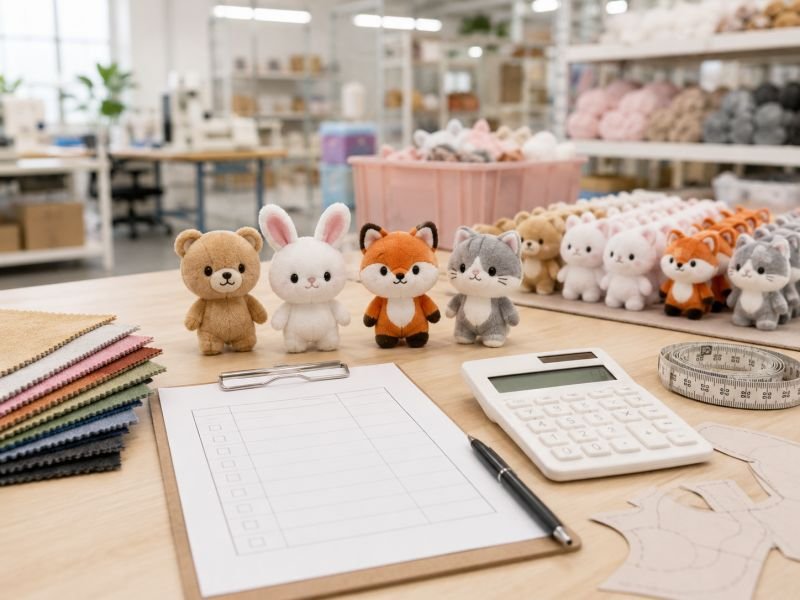
A mini plush can look simple in a design file, but its real cost starts long before sewing begins. A 10cm mascot charm, small plush keychain, blind box animal, or character plush may involve pattern work, fabric matching, embroidery setup, cutting, sewing, filling, shaping, accessories, care labels, hangtags, packaging, inspection, carton planning, and shipment preparation. That is why two plush toys with the same height can land at very different cost levels.
For large orders, custom mini plush cost should be planned by structure, size, material, filling, craft, quantity per design, packaging, labels, testing needs, and shipping method. Small size alone does not guarantee a lower price. A better plan separates sample work from bulk work, then adjusts detail level, SKU count, and packing style before the first sample is made.
Think about two 10cm plush toys. One is a round bear with one fabric color and simple embroidered eyes. The other is a full-body character with shoes, jacket, tail, keyring, custom hangtag, and blind box packaging. Both are mini plush toys, but they are not the same cost project. The useful is not only “How much is one plush?” The stronger is: “Which details are worth keeping, and which details quietly weaken the budget?”
What Drives Mini Plush Cost?
Mini plush cost is driven by the full product structure, not only by height. Size, body thickness, fabric type, filling, face craft, sewing difficulty, accessories, packaging, labels, quantity per design, testing needs, and delivery timing all shape the final budget. A small plush can be cost-efficient when the design is clean, but it can become expensive when tiny details require extra handling.
A mini plush often looks simple in a design file. In real production, that same plush must become a physical object with fabric pieces, seam allowance, embroidery placement, stuffing space, label position, accessory attachment, and package fit. A 10cm round bear with one fabric color and a simple face is not the same cost project as a 10cm character with shoes, scarf, tail, keyring, printed hangtag, and blind box packaging.
Small size can create a cost trap because there is less room for detail. A face that looks clear on screen may become crowded when embroidered at 8cm. A tiny arm may be difficult to turn and fill. A small logo may not read clearly on plush fabric. A narrow tail may twist after stuffing. When these issues appear during sampling, the design may need revision, and revision takes time.
Large orders make every small choice more important. One extra fabric color, one extra sewing piece, one extra label, or one extra packing step may look minor in one sample. Across 500, 1,000, 3,000, or 5,000 pieces, that extra step becomes a real cost item. The best cost plan does not remove everything. It protects the details people notice first: face, softness, shape, main color, clean stitching, and package presentation.
A useful cost review should separate visible value from hidden work. Visible value includes expression, hand feel, body shape, color harmony, and gift-ready presentation. Hidden work includes tiny pieces, difficult sewing curves, dense embroidery, extra attachments, label handling, SKU separation, and carton control. When these two sides are reviewed together, the plush can stay attractive without becoming unnecessarily expensive.
| Cost Driver | What It Changes | What To Review Before Sampling |
|---|---|---|
| Finished size | Fabric use, filling, box fit | Height, width, and depth together |
| Body thickness | Hand feel, shape recovery, carton space | Stuffed depth after filling |
| Fabric type | Touch, color, look, recovery | Material level and repeat availability |
| Fabric colors | Cutting, sorting, sewing joins | Keep color zones clear and necessary |
| Face craft | Expression, stitch time, detail clarity | Eye size, mouth line, logo readability |
| Structure | Ears, limbs, tail, clothing, pose | Thin parts and difficult curves |
| Accessories | Function, weight, packing risk | Ring, clasp, ribbon, magnet, zipper |
| Packaging | Protection, presentation, carton volume | Polybag, hangtag, box, insert card |
| Labels | Care info, barcode, SKU control | Label size and position |
| Quantity per design | Unit cost pressure and setup sharing | MOQ and style count |
| Testing needs | Material, small parts, labels | Target region, age group, product use |
| Delivery timing | Material sourcing and revision space | Launch date and shipping method |
The strongest plush cost plan is not the lowest-looking version. It is the version that can be sampled clearly, produced steadily, checked efficiently, packed neatly, and repeated later with less risk.
What Cost Parts Should Brands Plan?
A mini plush budget should include more than the plush body. The full cost may include sample work, pattern development, fabric, filling, embroidery or printing, cutting, sewing, accessories, labels, packaging, inspection, carton marks, testing support, and shipping. Some parts are visible in the final plush. Others stay behind the product but still affect the budget.
A clean budget view can be divided into four groups: development, product, packaging, and delivery. Development covers pattern work, first sample, revisions, and approved sample records. Product cost covers fabric, filling, craft, sewing, shaping, and accessories. Packaging covers polybags, hangtags, cards, boxes, barcode labels, SKU labels, and display cartons. Delivery covers carton size, packing list, shipping method, and warehouse requirements.
| Budget Group | Common Items | Why It Matters |
|---|---|---|
| Development | Pattern, sample, revision, approved sample record | Confirms the product before bulk work |
| Plush body | Fabric, filling, sewing, shaping | Decides softness, look, and structure |
| Surface craft | Embroidery, printing, applique, patch | Creates face, logo, clothing effect |
| Functional parts | Keyring, clasp, hook, zipper, magnet | Adds use but also handling work |
| Labels | Care label, warning label, barcode, SKU label | Supports sorting and sales-channel needs |
| Packaging | Polybag, hangtag, blind box, gift box | Changes presentation and carton volume |
| Checking | Material review, in-line check, final check | Reduces rework and rejects |
| Delivery | Carton, packing list, route, warehouse labels | Affects landed cost and timing |
When these parts are not separated, quotes become hard to compare. One price may include hangtags and barcode labels. Another may only include the plush in a plain bag. A clear cost sheet makes it easier to adjust the right part instead of weakening the whole design.
How Much Does It Cost To Make A Small Plush?
The cost to make a small plush depends on structure, fabric, filling, craft, accessories, packaging, and quantity per design. A small plush head with one fabric color is usually easier to produce than a small full-body character with clothing, tail, keyring hardware, and custom packaging. Height alone cannot decide the cost.
A small plush still goes through many steps: artwork review, pattern planning, fabric selection, embroidery setup, cutting, sewing, turning, filling, shaping, label attachment, accessory attachment, packing, and inspection. Even when material use is low, the labor process remains real. This is why a 7cm plush with tiny shoes and a bow may cost more than a clean 10cm round animal.
| Small Plush Idea | Cost Sensitivity | Main Reason |
|---|---|---|
| 8cm plush head, one color | Lower | Fewer parts and simpler sewing |
| 10cm round animal, two colors | Medium | Good balance of shape and detail |
| 10cm plush keychain | Medium to higher | Adds loop, ring, and strength checks |
| 8cm full-body character | Higher | Small limbs and clothing details |
| 10cm blind box plush | Higher | Adds printed box, card, and SKU control |
| 12cm gift plush | Higher | More filling, richer presentation |
For many projects, 9–12cm is more practical than very tiny sizes. It gives more space for clear eyes, softer body volume, stable seams, and cleaner label placement. A very small plush can work well when the design is simple, but complex characters often need slightly more size to protect quality.
Why Is Mini Plush Not Always Cheaper?
Mini plush is not always cheaper because small details can be harder to control. Tiny ears, thin arms, narrow tails, small shoes, mini clothes, dense embroidery, and small accessories require careful cutting, sewing, turning, filling, and checking. Less fabric does not automatically mean less work.
The main challenge is space. A small face has limited room for eyes, mouth, nose, blush, eyebrows, and logo marks. If everything is squeezed into a few centimeters, embroidery can become crowded or stiff. Thin limbs may not fill smoothly. A small tail may twist. A heavy keyring may pull the plush forward. A small package may press the face or ears.
| Small-Size Issue | What Can Happen | Better Choice |
|---|---|---|
| Tiny eyes | Expression becomes unclear | Enlarge eyes or simplify the face |
| Thin limbs | Hard to turn and fill evenly | Make limbs shorter or thicker |
| Small clothing | Bulky seams or uneven fit | Use print, embroidery, or applique effect |
| Narrow tail | Twisting or weak fullness | Widen, shorten, or attach closer to body |
| Too many colors | More cutting and sewing joins | Reduce color zones |
| Tiny logo | Hard to read on fabric | Move it to tag, label, or card |
| Heavy hardware | Poor hanging balance | Use lighter parts or reinforced loop |
| Tight packing | Flattened face or bent ears | Adjust body thickness or package size |
A slightly larger mini plush can sometimes offer better value. Moving from 7cm to 10cm may improve face clarity, sewing stability, and hand feel, while reducing repeated sample revisions. The goal is not to make the plush as small as possible. The goal is to make the size support the design.
Which Materials Affect Price Most?
Materials affect cost through fabric type, softness, pile height, stretch, color count, cutting loss, sourcing difficulty, and repeat consistency. Short-pile plush is often stable for mini animals and mascot shapes. Minky-style fabric can feel soft and smooth. Velboa-style fabric supports clean shape and printed detail. Faux fur can look richer, but it often needs more trimming and pile-direction control.
Material choice should match the product role. A small event charm may need clean, durable fabric. A gift plush may need a softer touch. A collectible plush may need fabric that photographs well and holds color clearly. A child-related plush may need closer review of material safety, seam strength, labels, and testing needs.
| Material Choice | Cost Effect | Better Use | Watch Area |
|---|---|---|---|
| Short-pile plush | Stable and efficient | Mini animals, mascot plush | May feel basic if quality is low |
| Minky-style fabric | Softer hand feel | Character plush, gift plush | Stretch and color should be checked |
| Velboa-style fabric | Clean surface | Small plush and printed areas | Hand feel varies by grade |
| Faux fur | Richer texture | Premium animals, special effects | Trimming and pile direction |
| Sherpa-like fabric | Cozy texture | Winter, wellness, gift themes | Thickness affects body size |
| Printed fabric | Adds pattern detail | Clothing effects, markings | Color clarity and surface feel |
| Specialty fabric | Strong visual difference | Limited releases | Sourcing time and repeat supply |
Color count matters as much as fabric type. More colors mean more material preparation, more cutting separation, more sewing joins, and more checking. A mini plush with six fabric colors may cost more than a larger plush with two colors. For large orders, using shared fabric families across several styles can help control cost and consistency.
What Type Of Mini Plush Costs More?
Mini plush costs more when it has more parts, tighter craft control, functional accessories, custom packaging, or multi-SKU sorting. A simple mini animal is easier to plan than a plush keychain with metal hardware, a blind box plush with printed packaging, or a character plush with clothing and several fabric colors.
The product type should be matched to the expected value. If the plush needs to be carried daily, keychain hardware can be worth the cost. If the product is a mystery set, blind box packaging may be necessary. If the plush is a gift item, soft fabric and clean presentation may matter more than extra tiny details.
| Plush Type | Why Cost May Rise | Better Planning Choice |
|---|---|---|
| Plush keychain | Ring, clasp, loop strength, hanging angle | Keep the body compact and hardware light |
| Bag charm plush | Larger clasp and visible finish | Match clasp size to plush weight |
| Blind box plush | Printed box, card, style control | Keep size consistent across styles |
| Full-body character | More pattern pieces and proportion work | Simplify tiny limbs and clothing |
| Plush with clothes | Extra sewing and material matching | Use fixed clothing effects at small size |
| Plush with sound or magnet | Functional part and safety review | Confirm structure early |
| Multi-SKU collectible plush | Separate samples, labels, packing rules | Use shared size and package rules |
| Long-fur animal plush | Cutting, pile direction, trimming | Use only where texture adds value |
A lower-cost plush is usually not the one with the fewest centimeters. It is the one with a clear shape, efficient pattern, controlled fabric colors, readable face, suitable packing, and stable production path. Good cost planning protects the plush’s main purpose: a mascot should keep its face, a keychain should hang well, a blind box plush should feel collectible, and a gift plush should feel soft and worth keeping.
Which Details Raise Large-Order Cost?

Large-order cost rises when a mini plush has complex craft, dense embroidery, many fabric colors, tiny sewn parts, metal hardware, special packaging, label requirements, testing needs, or difficult SKU control. These details may look small in one sample, but they multiply across every piece once the order moves into full production.
A mini plush is often judged by height, but height is only one part of the cost. The real cost is shaped by repeated work. If a detail needs extra cutting, sewing, positioning, trimming, labeling, packing, or checking on every piece, that detail becomes part of the full budget. One tiny bow may look simple. Across 5,000 pieces, it becomes 5,000 bows to prepare, attach, check, protect, and pack. One extra fabric color may look harmless. Across a full run, it means more material separation, more cutting control, more seam joins, and more inspection.
Large orders also make small risks more expensive. A weak keyring loop, crowded embroidery, unclear logo, wrong label position, or tight package may not look serious in one sample photo. But once cartons are packed, these issues can create sorting, rework, delay, or complaints. Cost planning should therefore focus not only on the quoted unit price, but also on whether the design can be repeated cleanly.
Cost-raising details usually fall into five areas:
| Detail Area | Common Examples | Why Cost Rises | Better Planning Choice |
|---|---|---|---|
| Craft details | Embroidery, printing, applique, woven labels, patches | Setup, alignment, checking, stitch time | Use each craft where it is clearly visible |
| Structure details | Ears, wings, tail, limbs, clothes, sitting pose | More pattern pieces and sewing steps | Keep small parts thick enough to fill |
| Accessories | Keyring, clasp, hook, ribbon, magnet, zipper, sound part | Extra material, attachment, strength checks | Add only when it improves use or value |
| Packaging | Hangtag, header card, blind box, gift box, display box | Printing, assembly, label work, carton volume | Match package level to product role |
| Records and labels | Care label, warning label, barcode, SKU label, carton mark | More sorting, scanning, and packing control | Set label rules before sample approval |
A strong cost plan does not remove every detail. It protects what people notice first: face expression, hand feel, body shape, clean color, safe stitching, and neat presentation. Details that are too small to see, too fragile to repeat, or too expensive for their value should be simplified before sampling.
Which Crafts Add Hidden Cost?
Hidden cost often comes from craft details that look small but require separate setup, hand alignment, repeated checking, or careful placement. Embroidery, printing, applique, patches, woven labels, and heat-transfer details can all improve a plush, but each craft adds its own cost logic.
A single craft detail may feel minor during sample discussion. The real impact appears when that craft must be repeated across every unit. A small embroidered cheek mark needs the same position on every face. A tiny applique badge needs fabric cutting, placement, sewing, and edge control. A printed clothing pattern needs artwork approval, color checking, and placement review. If several small crafts are stacked on one mini plush, the cost can rise quickly.
| Craft Detail | Cost Driver | Better Use |
|---|---|---|
| Embroidery | Stitch count, thread colors, setup, alignment | Eyes, mouth, nose, paw pads, simple logo |
| Printing | Artwork setup, color approval, placement | Flat clothing effects, patterns, tiny graphics |
| Applique | Extra fabric cutting, placement, sewing | Larger shapes needing texture |
| Woven label | Label setup and attachment | Small logos or identity marks |
| Patch | Separate material and attachment work | Mascot badges, limited icons |
| Heat transfer | Surface prep and placement | Clean graphic effects on suitable panels |
For mini plush, craft should be chosen by visibility. If a detail is too small to read, it may not deserve embroidery. If a logo becomes unclear on a 7cm plush, a hangtag or woven label may work better. If tiny clothes create bulky seams, printed or embroidered lines may look cleaner.
A good craft plan should ask:
- Can this detail be seen clearly at the final size?
- Does it improve the character or only copy the drawing?
- Will it remain neat after stuffing and shaping?
- Does it need hand alignment on every piece?
- Can it be moved to a tag, card, or package without losing value?
- Will it slow down inspection or packing?
Hidden cost is easiest to control before the first sample. Once the sample is approved with too many tiny craft steps, each step becomes part of the bulk order.
How Does Embroidery Affect Price?
Embroidery affects price through stitch count, embroidery area, thread color count, file setup, placement accuracy, and production time. On mini plush toys, embroidery is often used for eyes, mouth, nose, eyebrows, blush, paw pads, small logos, clothing lines, and character markings. It gives a clean finish, but it must be practical at the target size.
Small plush faces need extra care. A 10cm plush may only have a few centimeters of face space. If the eyes, nose, mouth, blush, eyebrows, and logo are all packed into that area, embroidery can become crowded. Dense stitch areas may stiffen the fabric. Fine lines may disappear. Tiny color blocks may shift slightly during sewing and stuffing.
A stronger embroidery plan protects clarity:
- Keep eyes large enough to carry expression.
- Avoid too many thread colors in a small face.
- Use bold mouth lines instead of thin curves.
- Test embroidery on the real fabric, not only on screen.
- Avoid placing important embroidery across curved seams.
- Leave enough space between eyes, nose, and mouth.
- Move tiny logos to hangtags, woven labels, or package cards when needed.
| Embroidery Choice | Cost Impact | Visual Effect | Risk At Small Size |
|---|---|---|---|
| Simple eyes and mouth | Lower | Clean expression | May feel too plain if the character needs more detail |
| Large filled eyes | Medium | Strong character feeling | Dense stitches may stiffen the face |
| Many thread colors | Higher | Richer expression | More setup and checking |
| Detailed logo | Higher | Strong identity mark | May lose readability |
| Outfit embroidery | Higher | Adds clothing effect | Can become crowded |
| Tiny line details | Risky | Close to original artwork | May disappear or shift |
Embroidery should earn its space. Face embroidery is usually worth protecting because it defines the plush. Tiny clothing buttons, sleeve marks, or micro logos may not add enough value if they are barely visible. A simple, readable face often does more for the plush than many small decorative lines.
In large orders, embroidery consistency matters. If eye placement shifts by only a few millimeters, the expression can change. This is why embroidery files, face position, thread colors, and sample records should be confirmed before bulk work begins.
When Do Accessories Raise Cost?
Accessories raise cost when they add material, attachment work, strength checks, safety review, packing separation, or extra SKU control. On mini plush toys, common accessories include keyrings, lobster clasps, ball chains, hooks, ribbons, bows, small hats, scarves, magnets, zippers, sound parts, and plastic components.
Accessories can add real value when they improve how the plush is used. A keyring turns a mini plush into a bag charm. A ribbon can make a holiday plush feel gift-ready. A scarf can support a winter theme. A magnet can create display function. The problem appears when accessories are added only because they look nice in a drawing, but they do not improve the final product enough to justify the cost.
| Accessory | Value Added | Cost Or Risk Area | Planning Tip |
|---|---|---|---|
| Keyring | Carry function | Loop strength, metal weight | Reinforce attachment area |
| Lobster clasp | Better bag attachment | Cost, scratch risk | Match clasp size to plush weight |
| Ball chain | Light hanging option | Durability and small-part review | Use for lightweight charms |
| Ribbon | Gift feeling | Hand tying or sewing | Keep size suitable for plush height |
| Hat or scarf | Seasonal character value | Extra sewing and fit control | Avoid tiny removable parts |
| Magnet | Display function | Placement and safety review | Confirm body space early |
| Zipper | Functional detail | More sewing difficulty | Use only when function matters |
| Sound part | Interactive value | Space, safety, testing needs | Review structure before sampling |
Accessories also affect packing. A metal ring can scratch printed cards, coated boxes, or window packaging. A bow may flatten inside a tight package. A hat may bend during shipment. A sound module may change body thickness. These issues should be checked inside the actual package, not only on a sample table.
For large orders, accessories should pass three tests:
- Does the accessory improve use after opening?
- Does it support the theme strongly enough?
- Can it be attached, checked, packed, and shipped consistently?
If the accessory fails these tests, it may be better replaced with a printed card, a hangtag story, a stitched detail, or a cleaner body design.
How Does Packaging Change Total Budget?
Packaging changes the total budget because it adds material, printing, folding, labeling, assembly, carton volume, and sometimes style separation. For mini plush toys, packaging may include polybags, stickers, hangtags, header cards, blind boxes, gift boxes, window boxes, display boxes, barcode labels, SKU labels, inner cartons, and outer carton marks.
A plush in a simple polybag has a different cost structure from a blind box plush with printed box, insert card, barcode, and display carton. The plush body may be similar, but the package work is completely different. Packaging also affects shipping volume. A compact polybag allows more pieces per carton. A gift box or window box may reduce carton quantity and increase storage space.
| Packaging Type | Better Use | Budget Effect | Space Impact |
|---|---|---|---|
| Polybag | Basic protection and clean handling | Lower | Very compact |
| Polybag + sticker | Simple SKU or theme mark | Low to medium | Compact |
| Hangtag | Gift, retail, character identity | Medium | Minimal |
| Header card | Keychains and hanging display | Medium | Flat but wider |
| Insert card | Story, care note, collection list | Medium | Thin and useful |
| Blind box | Mystery plush and collectibles | Higher | Needs fixed box size |
| Gift box | Premium gift sets | Higher | Larger carton volume |
| Window box | Shelf display | Higher | Needs scratch and fit review |
| Display box | Multi-style presentation | Higher | Useful for grouped sets |
Packaging should match the product role. A small event plush may not need a printed gift box. A mystery plush usually needs stronger box design. A keychain may need a header card. A premium gift plush may need a hangtag, tissue, sleeve, or gift box. The package should protect the plush and support the product’s value without adding unnecessary volume.
Packaging cost should be reviewed with the plush size. A 10cm plush keychain may need space for hardware. A 12cm sitting plush may need more depth than a flat 14cm plush. A plush with ears may need extra height. A plush with a bow or hat may need shape protection. If the package is too tight, the plush may arrive bent or flattened. If it is too large, the plush may move around and look poorly arranged.
A complete package review should include:
- Individual packing size
- Label placement
- Face visibility after opening
- Protection for ears, tail, bow, or hardware
- Whether the plush can recover after packing
- How many pieces fit in one carton
- Whether carton marks match SKU and quantity
- Whether warehouse or retail labels are required
The cheapest package is not always the best cost choice. A poorly fitted package can create product damage, messy presentation, or higher shipping volume. The right package protects the plush, keeps the layout clean, and supports efficient carton planning.
Are Testing And Labels Part Of Cost?
Testing and labels should be treated as part of the real project budget when the plush will be sold through retail, e-commerce, children’s channels, promotional programs, or international distribution. Label needs may include care labels, warning labels, barcode labels, SKU labels, FNSKU labels, hangtags, carton marks, and packing lists.
Testing needs vary by target region, age group, product structure, material, accessories, and sales channel. A plush made for young children needs closer review of seams, small parts, fabric, filling, labels, and third-party testing support. A plush keychain with metal hardware may need a different review from a soft mini plush without accessories. A baby-related plush needs stricter planning than a decorative desk plush.
Labels also affect appearance and packing. A care label needs a clean position. A barcode label needs readable placement. A blind box set needs SKU control without ruining the surprise. A retail display needs correct carton marks. An e-commerce warehouse may require specific labels.
| Item | Why It Matters | When To Plan |
|---|---|---|
| Care label | Material and care information | Before sample approval |
| Warning label | Age or safety-related notice when required | During product review |
| Barcode label | Retail or warehouse scanning | Before package artwork |
| SKU label | Style separation and packing control | Before bulk packing |
| FNSKU label | E-commerce warehouse handling when needed | Before carton planning |
| Carton mark | Outer carton identification | Before shipment prep |
| Packing list | Quantity and style confirmation | Before loading |
| Third-party testing support | Region and channel requirements | Before final material lock |
Labels should not be left until the end. A tiny plush with an oversized label may look messy. A label near a keychain loop may affect hanging balance. A wrong SKU label can cause packing confusion. A warning label added too late may conflict with package artwork. These issues are cheaper to solve before sampling than after cartons are packed.
For large orders, testing and label planning protect both compliance and cost control. They reduce last-minute corrections, repacking, relabeling, and delivery delays. They also make the final product easier to sort, scan, store, and ship.
How Do MOQ, Samples, And Quotes Work?

MOQ, samples, and quotes work together as one cost-control system. MOQ sets the practical starting quantity for each design, the sample proves whether the plush can be made well, and the quote becomes more accurate after size, fabric, craft, packaging, labels, testing needs, quantity, and timing are reviewed together.
A custom mini plush project should not move from one picture straight into bulk cost approval. A drawing may show a cute animal, mascot, or character, but the real product still needs to pass several practical checks. Can the face stay clear at 8cm or 10cm? Can the tail be filled properly? Will the keyring pull the plush forward? Does the care label look too large? Will the plush fit inside a blind box, retail card, or gift bundle? These details decide whether the early price direction is realistic.
For Heyzizi custom plush projects, standard MOQ starts from 500pcs per design. This is more suitable for most custom plush work because each design needs pattern work, material preparation, cutting, embroidery or printing, sewing, stuffing, shaping, checking, packing, and shipment preparation. Custom plush samples usually require a sample fee because the first sample may involve pattern making, material matching, craft setup, accessories, revision work, and package fit review. When a single-style bulk order reaches 2,000pcs, the sample fee can be refunded or deducted.
A quote should be treated as a project review, not just a number. A low price without clear product details may look attractive at first, but it may exclude packaging, labels, barcode work, testing support, or real structure complexity. A stronger quote explains what is included, what still needs confirmation, and which choices may change the final cost.
| Review Item | Why It Matters For Cost |
|---|---|
| MOQ per design | Each design carries its own pattern, material, craft, and packing work |
| Sample fee | Covers physical development before bulk work begins |
| Size | Affects fabric use, filling, face clarity, and packing volume |
| Structure | Ears, limbs, tails, clothing, and poses change sewing difficulty |
| Fabric | Changes touch, look, sourcing, and repeat consistency |
| Craft | Embroidery, print, applique, and patches affect setup and labor |
| Accessories | Rings, hooks, ribbons, magnets, zippers, and sound parts add steps |
| Packaging | Polybag, hangtag, blind box, gift box, and display box change total cost |
| Labels | Care label, warning label, barcode, SKU label, and FNSKU affect packing |
| Testing needs | Region, age group, materials, and accessories affect review work |
| Schedule | Tight timing may limit material choices and revision space |
A well-prepared project does not chase the lowest number first. It builds a product plan that can be sampled, approved, produced, packed, checked, and shipped with fewer surprises.
How Much Do Custom Made Plushies Cost?
Custom made plushies cost different amounts because each project has its own size, shape, fabric, filling, face craft, body structure, accessories, packaging, labels, quantity, testing needs, and delivery timing. A 10cm plush can be simple, medium-complexity, or highly detailed depending on how it is built.
A small round plush with one fabric color and a simple embroidered face is usually easier to control. A 10cm full-body character with shoes, jacket, tail, keyring, printed tag, and blind box packaging needs more development work and more production steps. Both may be called “mini plush,” but the cost structure is completely different.
A cost review should look at these practical details:
| Cost Factor | Simple Version | Higher-Cost Version |
|---|---|---|
| Shape | Round body, few parts | Full body, limbs, tail, clothing |
| Fabric | One main fabric | Several fabric colors or specialty texture |
| Face | Simple embroidery | Dense embroidery with many colors |
| Logo | Hangtag or woven label | Tiny embroidered logo on plush body |
| Accessories | None or simple loop | Metal clasp, zipper, magnet, sound part |
| Packaging | Polybag | Blind box, gift box, display box |
| SKU count | One design | Multi-style collection |
| Labels | Basic care label | Barcode, SKU, FNSKU, warning labels |
The most practical way to think about custom plush cost is by product level. A basic mini plush focuses on simple shape and clean face. A retail-ready plush adds better fabric, labels, hangtags, or packaging. A collectible plush may add multi-SKU planning, blind box packaging, insert cards, and stronger style control. A premium gift plush may require softer hand feel, better presentation, and stricter package review.
A final cost should not be judged by height alone. The real is whether the plush design, package, and quantity match the value expected from the final product.
What Is A Reasonable Price For A Plushie?
A reasonable plush price should match the design difficulty, material level, order quantity, package format, label needs, safety review, and final product value. A very low price is not reasonable if it removes the face detail, weakens fabric quality, ignores labels, excludes packaging, or creates unstable bulk results.
A reasonable price should make sense when compared with what the product needs to do. A giveaway charm can be simpler. A retail plush needs better finishing. A blind box plush needs package and SKU control. A plush keychain needs stronger loop attachment and hardware review. A mascot plush needs the face and main shape to stay recognizable.
Use this checklist to judge whether a price is realistic:
| Price Check | What To Look For |
|---|---|
| Design match | Does the price reflect the actual structure and parts? |
| Material clarity | Is the fabric type clear, or only described vaguely? |
| Face craft | Are embroidery or print details included? |
| Accessories | Are rings, clasps, ribbons, or other parts included? |
| Packaging | Is the real packing method included? |
| Labels | Are care labels, barcode labels, or SKU labels included? |
| Sample path | Is sampling separate or included in the project plan? |
| Testing support | Are region and age-related needs considered? |
| Bulk standard | Will production follow the approved sample closely? |
| Delivery | Are carton and shipping needs considered? |
A price can be too low for several reasons. It may be based only on a picture. It may assume plain packaging. It may ignore label work. It may use a simpler fabric than expected. It may exclude accessories. It may not include testing support when needed. It may also assume a larger quantity per design than the actual order plan.
A reasonable price protects the parts people notice most: face clarity, softness, body shape, stitching, label placement, clean packaging, and consistent bulk quality. Saving cost is useful only when the final plush still feels worth keeping.
What Details Help An Accurate Quote?
An accurate quote needs clear project details. A single front-view picture can start early discussion, but it cannot confirm the final cost. The same character may have very different pricing depending on size, fabric, embroidery, accessories, packaging, labels, quantity per design, and delivery timing.
A strong quote request should include these details:
| Detail Needed | What To Provide |
|---|---|
| Product type | Mini plush, plush keychain, bag charm, mascot, blind box plush, gift plush |
| Artwork | Front view, side view, back view, detail views if available |
| Size | Height, width, thickness, or reference size |
| Quantity | Quantity per design, per SKU, and total quantity |
| SKU list | Style names, colors, versions, hidden styles if included |
| Fabric direction | Plush, minky-style, velboa-style, faux fur, or reference fabric |
| Filling | Soft filling, firmer body, weighted filling, or special need |
| Craft details | Embroidery, printing, applique, patch, woven label |
| Accessories | Keyring, hook, clasp, ribbon, magnet, zipper, sound part |
| Packaging | Polybag, hangtag, header card, blind box, gift box, display box |
| Labels | Care label, warning label, barcode, SKU label, FNSKU label |
| Use scene | Retail, gift set, event, subscription box, fan item, education, e-commerce |
| Region | USA, EU, UK, Canada, Australia, Asia, or other destination |
| Timing | Launch date, event date, warehouse deadline, shipment plan |
A clear quote request should also share priorities. For example, “the face must stay close to the artwork,” “the plush must fit a 10 × 10 × 6cm box,” “the keyring must be strong enough for bag use,” or “the package needs barcode labels for warehouse handling.” These details help the review focus on the right cost areas.
If the project has a target budget, sharing it early can help. The plush can often be adjusted by size, fabric, embroidery area, accessory choice, package type, or SKU count. It is easier to build a cost-fit design before sampling than to create a complex sample first and then remove details later.
How Long Does A Sample Take?
Sample timing depends on design complexity, material preparation, pattern work, embroidery or print setup, accessory selection, package needs, and revision rounds. A simple plush head charm can usually move faster than a full-body character with clothing, hardware, custom tag, and package fit review.
A sample is not only a preview. It is the first physical test of the plush. It shows whether the design works in real fabric, whether the face is clear, whether the body has enough fullness, whether the ears or tail hold shape, whether the label position is clean, and whether the package fits properly.
A sample review should cover:
| Sample Check | What To Review |
|---|---|
| Finished size | Height, width, depth, and body proportion |
| Face | Eye position, mouth shape, embroidery clarity |
| Body | Head size, belly fullness, limb balance |
| Fabric | Touch, color, pile direction, stretch |
| Filling | Softness, recovery, lump control |
| Details | Ears, tail, paws, clothing, bow, patch |
| Accessories | Keyring, clasp, hook, ribbon, zipper, magnet |
| Labels | Care label, hangtag, barcode position |
| Packaging | Polybag, box fit, insert card, opening view |
| Cleanliness | Loose threads, marks, stains, odor |
Revision is normal in custom plush work. A first sample may need changes to eye size, mouth position, fabric color, body thickness, tail length, stuffing level, label position, or accessory placement. These changes should be made before bulk approval because fixing them later is much more expensive.
For retail sets, gift boxes, blind box plush, and subscription packs, the sample should be checked inside the real package or a close mockup. A plush may look good on a table but sit poorly inside the box. The face may be hidden. The ears may bend. The body may press against the lid. The metal ring may scratch a printed card. Package testing helps avoid these issues early.
Useful feedback should be specific. Instead of saying “make it cuter,” it is better to say “make the eyes 10% larger,” “move the mouth 3mm lower,” “increase body thickness by 1cm,” “shorten the tail,” or “move the care label to the back seam.” Specific comments lead to cleaner revisions.
When Can Sample Fee Be Deducted?
Custom plush samples usually require a sample fee because sample work may include pattern development, material preparation, embroidery or printing, cutting, sewing, stuffing, shaping, accessories, package testing, and revision work. For Heyzizi projects, the sample fee can be refunded or deducted when the single-style bulk order reaches 2,000pcs.
The sample fee should be understood as development protection. It gives the project team a physical product to review before bulk work begins. This is where costly problems can be found early: unclear face embroidery, weak loop attachment, wrong body thickness, label conflict, poor fabric choice, tight box fit, or unstable accessory placement.
Sample fee value is especially clear when the design includes:
- Custom character shape
- Several fabric colors
- Embroidered face
- Printed markings
- Plush keyring hardware
- Small clothing details
- Special packaging
- Multi-SKU series
- Retail or e-commerce labels
- Testing-related review
| Sample Stage | What It Protects |
|---|---|
| First sample | Confirms shape, size, fabric, and face direction |
| Revision sample | Corrects details before bulk work |
| Approved sample | Becomes the reference for production |
| Package test | Confirms plush fit, label placement, and opening view |
| Record keeping | Supports repeat orders and future styles |
A sample can prevent a small design issue from becoming a bulk cost issue. A 3mm eye shift, a loose ring loop, a tail that bends badly, a label in the wrong place, or a package that presses the face may look minor in a drawing. Across a large order, it becomes serious. Sampling gives the project a safer path before large quantities are produced.
How Can A Factory Control Bulk Cost?

Bulk cost is controlled through early design review, sample approval, material planning, stable production records, clear SKU rules, QC checkpoints, packing accuracy, carton planning, and shipping review. The biggest savings often come from preventing errors before they repeat across hundreds or thousands of pieces.
Cost control in bulk plush work is not only about lowering the unit price. It is about protecting the approved design while avoiding waste, rework, delays, packaging problems, and shipment surprises. A mini plush order can lose money through small issues: wrong label position, weak keyring loop, unclear embroidery, fabric color variation, over-tight packaging, mixed SKUs, carton mark errors, or a package that increases volume more than expected.
A strong bulk plan should connect design, sampling, material, production, inspection, packing, and shipping into one workflow. If each step is handled separately, hidden costs appear later. A plush may look fine at sample stage but fail in the box. A low-cost package may save money per piece but increase carton volume. A complex embroidery file may look beautiful, but if it causes frequent defects, the real cost becomes higher than expected.
The most useful bulk cost controls include:
| Control Area | How It Protects Cost |
|---|---|
| Approved sample | Sets the physical reference for size, shape, face, fabric, filling, and labels |
| Material record | Supports color, touch, and repeat consistency |
| Embroidery file | Keeps face and logo details stable |
| SKU list | Prevents style mix-ups in multi-design orders |
| Packing file | Confirms bag, tag, box, label, and insert rules |
| In-line checking | Finds problems before the full batch is finished |
| Needle detection | Supports safety control before packing and shipment |
| Carton plan | Controls quantity per carton, marks, and freight volume |
| Shipment review | Connects packing size, route, timing, and delivery needs |
| Reorder records | Helps future runs stay closer to the approved version |
Bulk cost control works best when the project team treats every detail as repeatable. If a detail must be done 5,000 times, it should be simple enough, clear enough, and stable enough to repeat.
What Is The Bulk Plush Process?
The bulk plush process starts after the approved sample is confirmed. A strong process usually includes order review, material preparation, cutting, embroidery or printing, sewing, stuffing, shaping, in-line checking, final inspection, needle detection, packing review, carton preparation, and shipment support.
A simple process view can look like this:
| Stage | Main Work | Cost Control Focus |
|---|---|---|
| Order review | Confirm design, size, quantity, SKU, package | Prevent missing details |
| Material prep | Prepare fabric, filling, thread, accessories | Control color, touch, and availability |
| Cutting | Cut fabric parts by pattern | Reduce waste and size deviation |
| Embroidery / print | Create face, logo, markings, outfit effects | Keep placement and clarity stable |
| Sewing | Join fabric pieces and details | Control seam quality and shape |
| Stuffing | Fill body, head, limbs, tail, or charm shape | Keep hand feel and body volume |
| Shaping | Adjust face, ears, body, sitting balance | Protect final appearance |
| In-line check | Review work during production | Catch problems early |
| Final check | Review finished plush before packing | Reduce defects entering package |
| Needle detection | Safety-related check before final packing | Support shipment readiness |
| Packing | Polybag, tag, box, label, carton | Prevent SKU and package mistakes |
| Shipment prep | Carton marks, packing list, photos, forwarder support | Avoid delivery confusion |
For mini plush, cutting and sewing control are especially important. Small parts are less forgiving. A 2–3mm shift in face embroidery may be visible. A thin arm may become uneven. A small tail may twist if the pattern is not stable. A keyring loop may pull at the seam if it is not reinforced correctly.
The approved sample should guide the full process. The goal is not to make each bulk piece “mechanically identical” in an unrealistic way, because plush fabric, filling, and sewing naturally have small tolerances. The real goal is to keep the batch close to the approved look, feel, and function so the final order feels consistent.
How Does QC Prevent Cost Loss?
QC prevents cost loss by finding issues before they become large-scale problems. For mini plush toys, checking should cover fabric, color, embroidery, stitching, stuffing, shape, accessories, labels, cleanliness, packing, SKU accuracy, carton marks, and shipment preparation.
Cost loss often comes from preventable defects. A loose thread may seem small, but if it appears across many pieces, sorting and rework take time. A face embroidery shift can weaken the whole product value. A wrong care label may affect retail handling. A weak keyring loop can create complaints after distribution. A mixed SKU carton can create warehouse confusion.
Important QC checkpoints include:
| QC Check | What To Look For |
|---|---|
| Fabric check | Color, pile direction, stains, damage, hand feel |
| Embroidery check | Eye position, mouth shape, logo clarity, thread color |
| Sewing check | Open seams, skipped stitches, uneven curves |
| Stuffing check | Softness, body fullness, lump control |
| Shape check | Head balance, ears, tail, limbs, sitting or hanging angle |
| Accessory check | Ring, clasp, ribbon, zipper, magnet, loop strength |
| Label check | Care label, warning label, barcode, SKU label position |
| Cleanliness check | Loose thread, dust, stains, odor |
| Packing check | Correct bag, tag, box, insert, label, carton |
| Needle detection | Product safety control before final packing |
| Carton check | Quantity, style, carton mark, packing list match |
For large orders, QC should not wait until every piece is finished. In-line checking is more valuable because it catches issues while there is still time to correct the process. If embroidery is slightly off, it should be found early. If stuffing is too soft, it should be corrected before thousands of pieces are packed. If a label position looks messy, it should be fixed before the full batch follows the same placement.
Good QC protects three things at once: product appearance, delivery schedule, and total cost. It is much cheaper to stop one issue early than to open packed cartons later for rework.
Which Cost Risks Appear In Bulk Orders?
Large plush orders can face cost risks from design changes, unclear samples, material variation, complex embroidery, SKU mix-ups, label errors, package mismatch, carton volume changes, testing delays, and rushed timelines. Most of these risks can be reduced with clear records before bulk work begins.
Common bulk cost risks include:
| Cost Risk | What Can Happen | Better Prevention |
|---|---|---|
| Late design change | Pattern, embroidery, or material must be revised | Lock the approved sample before bulk work |
| Unclear color reference | Fabric color may not match expectations | Use physical material references when possible |
| Too many small parts | Sewing slows down and defects increase | Simplify tiny details at sample stage |
| Dense embroidery | Face area becomes stiff or unclear | Test embroidery on real fabric |
| Weak loop or hardware | Keychain may fail after use | Reinforce attachment and check strength |
| Mixed SKUs | Wrong style enters wrong package | Use clear SKU labels and packing photos |
| Wrong label position | Product looks messy or non-compliant | Confirm label placement before sample approval |
| Tight package | Plush arrives flattened or bent | Test plush inside real package |
| Oversized package | Carton volume increases | Check carton quantity early |
| Rushed schedule | Materials, revisions, and checks get squeezed | Share launch and delivery dates early |
Multi-SKU orders need extra attention. A blind box set with six characters may need separate embroidery files, fabric colors, labels, and packing rules. A hidden version may need stricter separation. A retail-ready program may need barcode labels and carton marks for each style. If these details are not organized, the cost of sorting and correction can rise quickly.
One practical rule is useful: every detail should be checked at the scale of the full order. A small accessory may seem harmless on one sample. Across 5,000 pieces, it becomes 5,000 attachments to prepare, sew, check, pack, and protect during shipment. A good cost plan looks at repetition before it becomes cost pressure.
How Much Does It Cost To Ship A Small Plushie?
Shipping a small plushie depends on packed size, weight, carton quantity, shipping method, destination region, warehouse requirements, and whether the plush ships alone or inside a complete set. The plush body may be light, but packaging and carton volume can change the delivered cost.
For small plush toys, volume often matters as much as weight. A 10cm plush in a polybag may pack compactly. A 10cm blind box plush may take more carton space because of the printed box. A 12cm plush with long ears may need extra height. A 15cm sitting plush may reduce carton quantity because of body depth. If the plush is part of a subscription box or gift bundle, the full set size matters more than the plush alone.
Shipping review should include:
| Shipping Factor | Why It Matters |
|---|---|
| Plush size | Affects carton count and package fit |
| Plush thickness | Impacts carton volume more than height alone |
| Individual packing | Polybag, hangtag, box, blind box, gift box |
| Carton size | Decides how many pieces fit per carton |
| Gross weight | Affects shipping charge and handling |
| Destination region | Affects route, document needs, and cost |
| Shipping method | Express, air, sea, or forwarder arrangement |
| Warehouse labels | Barcode, FNSKU, carton mark, pallet needs |
| Delivery deadline | Faster routes usually cost more |
Common shipping choices include:
| Shipping Method | Better For | Cost And Timing Direction |
|---|---|---|
| Express | Samples, urgent small shipments | Faster, usually higher cost |
| Air freight | Time-sensitive larger shipments | Faster than sea, cost depends on volume |
| Sea freight | Larger orders with more flexible timing | Better for volume cost control |
| Forwarder pickup | Teams with existing logistics partners | Needs clear carton and document preparation |
| Warehouse delivery | Retail or e-commerce programs | Labels and carton rules must be accurate |
The best way to control shipping cost is to review packing early. A plush that is cheap to produce but packed in a bulky box may lose its cost advantage. A compact package with good shape recovery can often work better for large orders. If the plush must arrive gift-ready, a box may be worth it. If it is placed inside another bundle box, a polybag plus hangtag may be enough.
Shipping cost should be planned after sample size and packing style are confirmed. Before that, any number is only an estimate.
How To Prepare A Cost-Ready RFQ?
A cost-ready RFQ should give enough information to review the real product, not just the idea. The most useful request includes artwork, views, size, quantity per design, fabric direction, craft details, accessories, packaging, labels, destination region, delivery deadline, and shipping plan.
A strong RFQ can include:
| RFQ Detail | What To Provide |
|---|---|
| Product type | Mini plush, plush keychain, bag charm, blind box plush, mascot plush |
| Artwork | Front, side, back, and detail views if available |
| Size | Height, width, depth, or reference size |
| Quantity | Quantity per design, per SKU, and total quantity |
| SKU list | Style name, color, version, hidden style if any |
| Fabric direction | Soft plush, minky-style, velboa-style, faux fur, reference material |
| Filling | Standard soft filling, firmer body, weighted filling if needed |
| Craft | Embroidery, printing, applique, patch, woven label |
| Accessories | Ring, clasp, hook, ribbon, magnet, zipper, sound part |
| Packaging | Polybag, hangtag, header card, blind box, gift box, display box |
| Labels | Care label, warning label, barcode label, SKU label, FNSKU label |
| Destination region | USA, EU, UK, Canada, Australia, Asia, or other region |
| Use scene | Retail, gift set, event, subscription box, fan item, educational product |
| Timing | Launch date, event date, warehouse date, shipping schedule |
| Shipping plan | Express, air, sea, appointed forwarder, or logistics review |
The more complete the RFQ, the less guesswork is needed. A single picture and a quantity can start a discussion, but it cannot produce a reliable final cost. Size, fabric, craft, labels, package, and delivery needs all shape the budget.
A good RFQ also shares priorities. For example:
- “The plush must fit a 10 × 10 × 6cm blind box.”
- “The face detail is more important than clothing detail.”
- “The target is a soft gift item, not a keychain.”
- “The package must include barcode and SKU labels.”
- “The first order is 1,000pcs per design, with possible repeat orders.”
- “The launch date is fixed, so the design should avoid risky small parts.”
This kind of information helps the project move faster and makes cost discussion more practical.
Closing
Custom mini plush cost planning is not only about getting a low unit price. It is about choosing the right structure, size, material, craft, quantity, packaging, labels, inspection plan, and shipping method before bulk work begins. When these details are reviewed early, the plush is easier to sample, easier to produce, easier to pack, and easier to repeat.
A 5–8cm plush may work for small charms or lightweight add-ons. An 8–12cm plush is often practical for keychains, blind box sets, subscription boxes, and mini collectibles. A 10–15cm plush can create stronger gift value when the product needs more hand feel and visual presence. The best choice depends on what the plush needs to do, how much detail it carries, how it is packed, and how many pieces are needed per design.
For large orders, cost control should protect what people notice most: face clarity, softness, body shape, safe stitching, proper labels, clean packaging, and consistent bulk quality. Details that are too small to see, too fragile to repeat, or too expensive for their value should be adjusted before sampling.
Heyzizi can review custom mini plush toys, plush keychains, bag charms, blind box plush, mascot plush, character plush, and multi-SKU plush programs. To prepare a practical cost review, send your artwork, size target, quantity per design, fabric idea, craft details, packaging needs, labels, destination region, and delivery timing to info@heyzizi.com.