 Skip to content
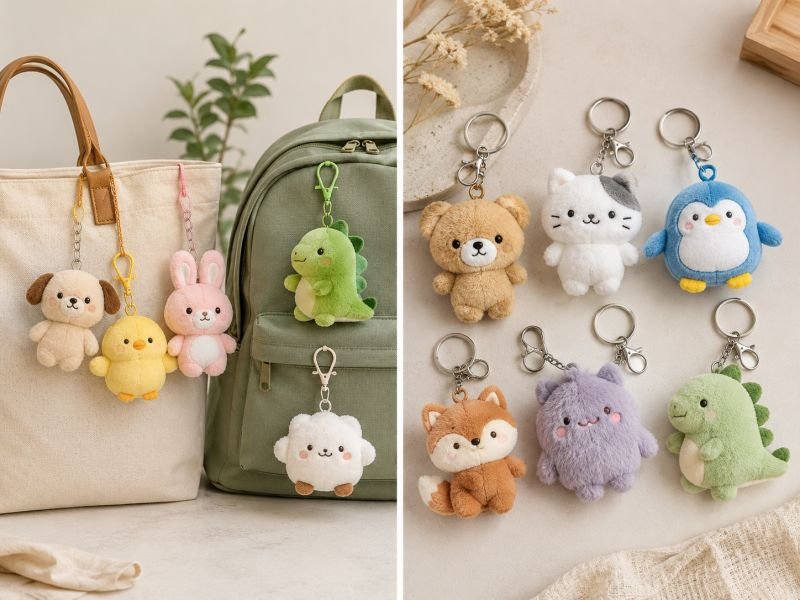
A small plush accessory can do more for a brand than many people expect. It can sit on a tote bag during a city commute. It can hang from a school backpack. It can travel with fans after a concert. It can become a low-cost mascot gift, a retail add-on, a theme park souvenir, or a soft little reminder of a campaign.
But here is where many brand teams get stuck.
Should the product be a plush bag charm, built more for style and display? Or should it be a plush keychain, built more for daily use, giveaway programs, and simple distribution?
These two products look close, but they do not always serve the same goal. A plush bag charm often works better when the product needs fashion value, character appeal, retail packaging, or a collectible feeling. A plush keychain often works better when the project needs function, brand exposure, lighter cost control, and easier bulk distribution. The right choice depends on size, artwork, attachment style, face detail, safety needs, packaging, quantity, sales channel, and delivery date.
For brand teams, this is not only a cute product decision. It is a project decision.
A good plush accessory should look right, hang right, feel right, pack well, pass checks, and stay consistent from approved sample to bulk goods. That is why the best choice is not always the trendiest one. It is the one that fits your users, your budget, your timeline, and your brand purpose.
What Is The Difference Between Plush Bag Charms And Plush Keychains?
Plush bag charms are soft decorative accessories made to hang on bags, backpacks, totes, purses, and retail displays. Plush keychains are soft mini plush products with a keyring, chain, hook, or clasp for keys, bags, zipper pulls, or giveaway use. They overlap often, but their project goals can be different. Bag charms lean toward style and retail appeal. Keychains lean toward practical use and wider distribution.
The easiest way to understand the difference is to look at the product’s “job.”
A plush bag charm is often designed to be seen. It needs a strong front view, good proportion, a pleasing silhouette, and enough personality to make a bag feel more personal. It may not be used for keys at all. Many plush bag charms are bought because they make a product, outfit, or character collection feel more complete.
A plush keychain is often designed to be carried. It can be used with keys, backpacks, pencil cases, gift bags, lanyards, or event kits. It still needs to look cute, but it also needs practical attachment strength and easy handling.
What Is A Custom Plush Bag Charm?
A custom plush bag charm is a soft branded accessory created from a mascot, logo, animal, character, icon, or product concept. It is usually clipped to a bag or displayed as part of a retail accessory line.
For brands, the biggest value is style. A good plush bag charm can make a plain tote, backpack, or handbag feel more personal. It can also turn an IP character into something fans can wear, show, photograph, and collect.
Bag charms are especially useful for:
| Project Type | Why Bag Charms Fit |
|---|---|
| IP merchandise | Strong character appeal and collectible value |
| Retail accessories | Better display and gift feel |
| Fashion campaigns | Easy to pair with bags and outfits |
| Theme shops | Good souvenir and impulse purchase item |
| Youth-focused brands | Strong personal expression and social sharing |
What Is A Custom Plush Keychain?
A custom plush keychain is a mini plush product with a keyring, ball chain, lobster clasp, hook, cord, or other attachment. It can be shaped as a mascot, animal, product icon, logo character, or mini plush doll.
The biggest value is reach. Plush keychains are small, light, easy to carry, and easier to distribute in volume. They are popular for brand events, school projects, company gifts, sports programs, fan items, and retail gift-with-purchase offers.
They are often used for:
- Event giveaways
- Mascot promotion
- Retail add-ons
- School souvenirs
- Museum gifts
- Theme park shops
- Online store accessories
- Club or team merchandise
Can You Turn A Plush Into A Keychain?
Yes, many plush characters can be turned into keychains, but the design usually needs adjustment. A 25cm plush doll cannot simply be reduced to 8cm without losing detail, balance, or shape. Small plush accessories need clearer facial details, simpler seams, stronger attachment, and stable stuffing.
For example, a large plush mascot may have a jacket, tail, tiny buttons, layered hair, printed shoes, and complex face details. In a keychain size, some of those details may need to become embroidery, applique, simplified fabric panels, or printed marks.
A good factory review should check:
- Whether the face still reads clearly at small size
- Whether the body shape can hold stuffing well
- Whether the hook position keeps the product facing forward
- Whether small parts create safety concerns
- Whether the design can stay stable in bulk sewing
Why Do These Two Products Often Overlap?
Because many plush keychains are used as bag charms.
A keychain can hang from keys, but it can also hang from a backpack, tote, purse, zipper, or gift package. A bag charm can have a keyring, but it may be designed mainly for decoration. In real projects, the same product may serve both roles.
The difference is not only the hardware. It is the purpose.
If the product is planned for events and bulk distribution, call it a plush keychain. If the product is planned for a retail accessory collection or fashion-led campaign, call it a plush bag charm. The name helps guide the design, packaging, price structure, and sales message.
What Should Brands Compare Before Choosing?
Brands should compare the product goal before comparing the product name.
Ask these early:
| What To Compare | Why It Matters |
|---|---|
| Use scene | Bag, keys, event kit, retail shelf, online store |
| Target user | Child, teen, adult fan, employee, tourist, student |
| Design detail | Face, body shape, costume, logo, tiny accessories |
| Attachment | Keyring, chain, hook, cord, carabiner, lobster clasp |
| Quantity | Affects unit cost, material planning, and production setup |
| Safety need | Small parts, pull strength, labels, target region |
| Packaging | Retail display, simple polybag, hangtag, barcode, gift box |
| Timeline | Sampling, revision, bulk work, packing, shipping |
Which Is Better For Brand Projects?
Plush bag charms are better when the product must look stylish, collectible, and retail-ready. Plush keychains are better when the product must be functional, portable, cost-controlled, and easy to distribute. For many brand projects, the smartest choice is not one or the other. It is matching each product to the right channel, user, and price level.
This is where many teams make the wrong call. They choose based on what looks cute in a reference photo.
That is risky.
A plush accessory should be chosen based on how it will be used after delivery. A product for a museum shop needs a different plan than a product for a marathon gift bag. A plush for fan collectors needs different detail control than a school giveaway. A retail item may need better packaging. An event item may need faster sorting and cleaner carton marks.
Which One Works Better For Promotional Gifts?
Plush keychains usually work better for promotional gifts because they are small, light, easy to hand out, and simple to pack. They can carry a mascot, logo tag, event name, or campaign message without making the project too heavy or expensive.
They are a strong fit for:
- Trade shows
- School events
- Sports events
- Brand launches
- Employee gifts
- Charity campaigns
- Theme event giveaways
If your team needs 1,000, 5,000, or more pieces for a fixed event date, plush keychains are often easier to manage than larger plush dolls or complex bag charms.
Which One Works Better For Retail Sales?
Plush bag charms often work better for retail sales because they can feel more like a product than a giveaway. A charm with a nice silhouette, soft handfeel, good hangtag, and clear character expression can sit well in a store display.
Retail teams should think about:
- Front view
- Shelf look
- Hangtag design
- Barcode position
- SKU control
- Gift packaging
- Color versions
- Character series
A bag charm can be small, but it should not feel random. It should feel designed.
Which One Works Better For IP Merchandise?
Both can work well for IP merchandise.
A plush bag charm can serve as a more emotional, collectible, or fashion-led item. A plush keychain can serve as a lower price item that reaches more fans. For an IP project, the best plan may be to create both:
| Product | Role In IP Line |
|---|---|
| Plush bag charm | Higher style value, stronger display appeal |
| Plush keychain | Wider reach, easier entry price |
| Mini plush doll | Stronger character presence |
| Plush pendant toy | Flexible for retail, gifts, and events |
If the character has a strong face, hairstyle, ears, tail, or costume, sample review becomes more important. A small change in embroidery position can change the whole expression.
Which One Works Better For Youth Fashion Campaigns?
Plush bag charms usually work better for youth fashion campaigns because they are closer to personal style. They become part of how the user decorates a bag, outfit, school backpack, or daily carry item.
This is one reason bag charms have gained so much attention in fashion and pop culture. A charm is not only an accessory. It can signal taste, fandom, humor, nostalgia, or personality.
For brands targeting younger users, a plush bag charm can create stronger social value than a standard keyring. It may appear in photos, short videos, outfit posts, or fan collections.
Why Are Plush Keychains So Popular?
Plush keychains are popular because they are small, soft, useful, and easy to share. They are affordable enough for bulk programs, but emotional enough to feel more personal than a pen or flat badge.
They also solve a simple problem for brands: how to make a mascot or character travel with the user.
A plush keychain can go on keys, backpacks, school bags, tote bags, lockers, pencil cases, or zipper pulls. That gives the brand many more daily touchpoints.
When Should Brands Choose Plush Bag Charms?

Brands should choose plush bag charms when the project needs stronger style value, better visual appeal, retail packaging, or collectible design. Bag charms are a strong fit for IP characters, fashion brands, gift shops, theme stores, limited editions, and youth-oriented campaigns where the accessory must feel personal, visible, and worth keeping.
A plush bag charm is not just a mini stuffed item. It is a styling object.
That means it needs more care in proportion, fabric direction, color, attachment placement, and packaging. If the charm hangs badly, twists too much, or hides the face when attached to a bag, it fails its main purpose.
When The Product Needs Strong Style Value
Choose a plush bag charm when the product must look good on a bag, in a photo, and in a retail display.
This matters for:
- Fashion labels
- Lifestyle brands
- IP owners
- Gift retailers
- Museum shops
- Theme parks
- Online stores
- Fan communities
The charm should have a clear front view. The colors should match the brand feeling. The face should be easy to read. The attachment should not block the design.
When The Charm Will Be Used On Bags
If the product is mainly for totes, backpacks, purses, handbags, or school bags, a bag charm format makes sense.
For this use, the factory should check:
- Hanging angle
- Product weight
- Hook position
- Chain length
- Body balance
- Fabric pile direction
- Whether the face turns outward
- Whether the attachment scratches the bag
This is a small product, but the details are not small.
When The Project Needs A Collectible Series
Bag charms are excellent for series planning.
A brand can develop:
- Four animal characters
- Three color versions
- Seasonal outfits
- Limited event editions
- Blind pack styles
- Mini mascot versions
- Matching plush bags or pouches
For series projects, version control matters. Each character should have a code, fabric record, embroidery file, attachment spec, hangtag rule, and packing method. Without that, reorder work becomes messy.
When Packaging And Display Matter More
Retail plush bag charms often need better packaging than simple giveaway keychains.
Useful options include:
| Packaging Option | Best Use |
|---|---|
| Hangtag | Simple retail display |
| Header card | Better shelf visibility |
| Clear polybag with barcode | Online and store handling |
| Small gift box | Premium campaigns |
| Display box | Multi-style retail sets |
| Backing card | Character story and brand details |
Packaging should protect the shape without making the product too bulky. A charm that looks flat or crushed after shipping may lose its retail appeal.
When Should Brands Choose Plush Keychains?
Brands should choose plush keychains when the project needs wide distribution, practical use, easier packing, and better cost control. Keychains are a strong fit for events, schools, company gifts, mascot promotions, sports programs, tourism souvenirs, and large-volume brand campaigns where the product must be easy to carry, sort, pack, and hand out.
A plush keychain is often the better choice when the project has a fixed date.
For example, if the item must arrive before a trade show, event opening, school season, team match, charity campaign, or store promotion, a simpler product path can reduce risk. That does not mean plain. It means the structure should be clean enough for stable sampling and repeatable bulk work.
When The Project Needs Bulk Giveaways
Plush keychains are one of the most practical soft products for bulk giveaways.
They are:
- Easy to pack
- Easy to count
- Easy to sort
- Easy to ship
- Easy to distribute
- Easy for users to keep
A keychain can also carry a hangtag, woven label, printed logo, small brand card, or event message.
When Function Matters More Than Decoration
If the item must work with keys, backpacks, lanyards, zipper pulls, or gift kits, a plush keychain is more direct.
Common attachment choices include:
| Attachment | Good For |
|---|---|
| Split keyring | Keys and everyday use |
| Ball chain | Light gift items |
| Lobster clasp | Bag clips and flexible use |
| Short cord | Soft look and lower metal exposure |
| Carabiner hook | Outdoor, school, and event themes |
Each option affects cost, safety, look, and durability.
When The Budget Needs Better Control
Plush keychains usually give teams more room to control cost because they can be made smaller and simpler than plush bag charms with premium retail details.
But the cost still depends on real production factors:
- Size
- Fabric
- Embroidery area
- Printed details
- Metal attachment
- Number of colors
- Quantity
- Packing
- Safety checks
- Number of styles
Cheap-looking products are easy to make. Useful, cute, stable products are harder. The goal should be good value, not the lowest possible piece price.
When The Product Must Be Easy To Distribute
For event use, the keychain format is hard to beat. It can be placed in event kits, welcome bags, school packs, brand boxes, employee gifts, or retail gift-with-purchase programs.
If the order includes several designs, carton sorting should be planned early. It is much easier to manage multi-style packing when style codes, barcode labels, carton marks, and quantity rules are confirmed before bulk packing.
Are Plush Keychains Considered Toys?
Plush keychains may be treated as toys, accessories, gifts, or children’s products depending on design, age claim, sales channel, target region, and packaging language.
This is why brands should not leave safety review until the end.
If the product is sold or promoted to children, safety requirements may become much stricter. Small parts, metal attachments, seams, stuffing access, labels, and pull strength should be reviewed early. If the product is for adults as a fashion accessory, the review may be different, but quality and labeling still matter.
How Do Design Details Change The Choice?
Design details can decide whether a plush concept should become a bag charm or a keychain. Character shape, face size, embroidery detail, hanging position, stuffing balance, fabric choice, and attachment type all affect the final look. A design that works well as a 25cm plush doll may need simplification before becoming a 10cm charm.
Small plush products are unforgiving. There is less space for error.
A 2mm shift in eye embroidery may not matter much on a large doll, but it can change the expression of a mini plush keychain. A tail that looks cute on a drawing may twist when sewn. A metal ring may pull the head forward. A thick fabric may hide small shapes.
How Does Character Shape Affect The Product Type?
Round, simple, high-recognition characters usually work well as plush keychains. Characters with strong silhouettes, outfits, or collectible appeal often work well as bag charms.
For example:
| Character Feature | Better Direction |
|---|---|
| Simple animal face | Plush keychain |
| Fashion outfit | Plush bag charm |
| Strong mascot head | Both |
| Long tail or ears | Bag charm, with structure review |
| Complex costume | Bag charm or larger keychain |
| Logo-based design | Plush keychain |
The cleaner the shape, the easier the product is to scale down.
How Do Face Details Affect Sampling?
Face details are often the hardest part of small plush development.
Eyes, mouth, eyebrows, cheeks, nose, and logo marks may need embroidery, applique, heat transfer, woven patch, or printing. The best method depends on size, safety, cost, and bulk consistency.
For small plush keychains, embroidery density should be reviewed before sampling. If stitches are too dense, the fabric may pucker. If the lines are too thin, the face may lose expression. If the face is printed on high-pile fabric, the result may not look clean.
How Does Attachment Position Affect Display?
The attachment position decides how the product hangs.
If the hook is too far back, the product may lean forward. If it is too high, the body may look stiff. If it is too low, the charm may twist. If the face does not show when hanging, the product loses much of its value.
For bag charms, this is critical. The product should face outward on the bag. For keychains, the attachment should also be strong enough for daily handling.
How Do Size And Filling Affect The Final Look?
Size affects everything: cost, facial detail, stuffing, packing, shipping, and perceived value.
Smaller items are easier to distribute but harder to detail. Larger charms look more premium but cost more, take more space, and may need stronger attachments.
Filling also matters. Too much filling can distort the face. Too little filling makes the product feel weak. For small plush charms, balanced stuffing is often more important than people expect.
What Types Of Custom Plush Charms Can Brands Make?

Brands can create many types of plush charms, including plush bag charms, plush keychains, mascot charms, animal charms, character keyrings, logo plush accessories, zipper pulls, pendant toys, mini dolls, seasonal charms, and retail gift charms. The best type depends on the brand purpose, target user, artwork detail, attachment method, packing style, and order plan.
This category is flexible, which is why it works for many brand uses.
But flexibility can also cause confusion. If every idea is treated the same, the product plan becomes weak. A school souvenir, retail collectible, and premium bag charm should not be developed with the same logic.
Type Of Plush Bag Charms For Brand Collections
Popular plush bag charm directions include:
- Mascot bag charms
- Animal bag charms
- Mini character charms
- Plush logo charms
- Fashion plush charms
- Holiday charms
- Blind pack charms
- Bag charm sets
These are especially useful when the item needs to feel more like a retail accessory.
Type Of Plush Keychains For Promotional Programs
Popular plush keychain directions include:
- Mini mascot keychains
- Animal plush keychains
- School plush keychains
- Sports team keychains
- Event plush keychains
- Tourism souvenir keychains
- Company logo plush keychains
- Brand character keyrings
These are usually easier to connect with bulk use.
Type Of Plush Mascot Charms For Events
Mascot charms are strong for events because they make the brand character portable. A mascot that appears on signage, social media, staff uniforms, and event gifts becomes easier to remember.
For this type, the face must be clear. If the mascot is not recognizable, the product loses value.
Type Of Plush Pendant Toys For Retail And IP Projects
Plush pendant toys sit between toys, accessories, and collectibles. They can be sold as fan goods, gift shop items, or add-ons for larger product lines.
They work well when the brand wants more emotional value than a flat acrylic charm but does not want the size or cost of a full plush doll.
How Much Do Custom Plush Bag Charms And Plush Keychains Cost?
The cost of custom plush bag charms and plush keychains depends on size, fabric, filling, embroidery, printing, applique, attachment, packaging, quantity, safety needs, and number of designs. Plush keychains are often easier to control for bulk giveaway budgets. Plush bag charms may cost more when they need stronger style value, retail packaging, or complex character detail.
Price should not be guessed from size alone.
Two 10cm plush accessories can have very different costs. One may use one fabric, simple embroidery, and a ball chain. Another may use four fabrics, dense embroidery, clothes, a metal clasp, hangtag, barcode, and retail box.
What Affects Plush Charm Price?
Main cost factors include:
| Cost Factor | What It Changes |
|---|---|
| Size | Fabric use, filling, packing volume |
| Fabric | Handfeel, color effect, cost, MOQ |
| Face method | Expression, safety, repeatability |
| Embroidery | Stitch time, detail, cost |
| Printing | Color detail and surface effect |
| Attachment | Strength, use, safety, price |
| Packaging | Retail look, barcode, protection |
| Quantity | Unit cost and production setup |
| Number of styles | Pattern, material, label, packing control |
| Safety checks | Testing and review needs |
Why Does Small Quantity Cost More?
Small quantity costs more because the process does not become small.
Even a 300-piece order may still need artwork review, pattern work, material sourcing, embroidery setup, cutting, sewing, filling, shaping, inspection, packing, and shipping preparation. Many materials and accessories also have their own minimum order needs.
That is why small runs are useful for testing, but they rarely give the best unit price.
How Does MOQ Affect Unit Price?
MOQ affects how material, labor, setup, and management costs are spread across the order.
For many custom plush projects, 500 pieces per style is a more workable starting quantity. Simpler styles may sometimes be reviewed at 200–300 pieces, depending on fabric, structure, accessories, and packing. Larger orders usually make the unit price more competitive because setup work is shared by more pieces.
What Cost Details Should Brands Confirm Early?
Before asking for price, prepare:
- Artwork or reference photo
- Target size
- Quantity
- Number of styles
- Fabric preference
- Face method
- Attachment type
- Packaging
- Target region
- Delivery date
If the idea is still early, send the concept, size direction, and expected quantity to info@heyzizi.com. Heyzizi can review whether the product is better planned as a bag charm, keychain, or both.
How Long Does Sampling And Bulk Production Take?
Sampling and bulk timing depend on design complexity, material sourcing, embroidery, attachment, revision rounds, packaging, quantity, and safety review. A simple plush keychain can move faster than a detailed bag charm with multiple fabrics, custom hardware, and retail packaging. The safest plan is to confirm artwork, size, quantity, packing, and delivery date before sampling starts.
Time risk is one of the biggest problems in plush accessory projects.
Many projects look simple because the product is small. But small does not always mean fast. If the face is detailed, the attachment is unusual, or the packaging has several labels, the schedule can become tight.
How Long Does A Custom Plush Sample Take?
A custom sample usually includes:
- Artwork review
- Structure review
- Pattern work
- Fabric selection
- Face method setup
- Cutting
- Sewing
- Filling
- Attachment placement
- Shape finishing
- Sample photos or sample shipment
Simple products may move faster. Complex characters, special colors, custom accessories, or retail packaging take more time.
How Long Does Revision Usually Take?
Revision time depends on what needs to change.
Small face adjustments may be faster than full structure changes. Changing fabric, size, hook position, or body shape may require new pattern work. If the product has several colorways or characters, each version should be checked separately.
Good revision records reduce mistakes. Notes should include what changed, why it changed, and which version is approved.
How Long Does Bulk Production Take?
Bulk production time depends on:
- Quantity
- Number of styles
- Material readiness
- Embroidery workload
- Sewing difficulty
- Packing complexity
- QC process
- Shipping method
A plush charm order with ten styles, retail tags, barcodes, and mixed cartons needs more planning than a single-style event keychain.
How Can Brands Avoid Schedule Risk?
The best way to protect timing is to confirm the core details early.
Do not wait until after sample approval to discuss barcode labels, carton marks, target region, packaging, or delivery deadline. Those details affect the real project path.
For event projects, share the fixed date at the beginning. A factory can only protect the schedule if it knows the real deadline early.
How Does A Plush Factory Review A Custom Project?

A plush factory reviews a custom project by checking artwork, size, fabric, face method, structure, attachment, filling, safety, packaging, MOQ, timeline, and bulk stability before sampling. This review helps turn a drawing or idea into a product that can be produced, checked, packed, shipped, and reordered with fewer surprises.
This is one of the biggest differences between a factory project and a simple catalog order.
A catalog platform may ask you to choose an item and place a logo. A factory review asks whether the product should be changed before sampling so it can work better in real use.
How Does The Factory Review Artwork?
Artwork review looks at the character as a physical object.
The team checks:
- Can the face work at small size?
- Are the ears, tail, hair, or limbs stable?
- Is the body too thin for stuffing?
- Can the logo be embroidered or printed cleanly?
- Will the product still look like the character after sewing?
- Does the design need front, side, and back review?
Flat artwork is only the start. Plush has thickness, fabric stretch, seam allowance, filling pressure, and gravity.
Can A Factory Turn A Plush Character Into A Keychain Product?
Yes, but the character often needs to be redesigned for small-size production.
The factory may suggest:
- Enlarging the face area
- Simplifying tiny costume parts
- Changing plastic parts to embroidery
- Adjusting body thickness
- Moving the hook position
- Shortening long limbs
- Choosing a softer or shorter fabric
- Using a lighter attachment
These changes are not shortcuts. They help the product look better in bulk.
How Does The Factory Check Structure?
Structure review checks whether the product can hold its shape and survive use.
Key areas include:
- Hanging balance
- Seam position
- Attachment strength
- Stuffing access
- Small part risk
- Fabric direction
- Body thickness
- Packing pressure
For bag charms and keychains, the attachment is not an afterthought. It is part of the product structure.
How Does The Factory Choose Fabric And Filling?
Fabric affects handfeel, color, detail, and final character style.
Common choices include short plush, long plush, velboa, minky, fleece, crystal super soft fabric, and other soft materials. Filling is often PP cotton, but the amount and balance need control.
A fabric that looks rich on a large doll may hide details on a small charm. A fabric that works for a keychain may not feel premium enough for a retail bag charm. This is why fabric choice should match the product goal.
How Does The Factory Turn A Sample Into A Bulk Standard?
An approved sample should become a production standard, not just a nice photo.
Useful records include:
- Pattern version
- Fabric name and color
- Embroidery file
- Print file
- Attachment spec
- Filling standard
- Size tolerance
- Label content
- Packing method
- Carton mark
- QC checklist
Heyzizi supports project review, pattern development, sampling, revision, approved sample control, inspection, needle detection, packing, and shipment preparation in one coordinated system. For projects with multiple characters or future reorder plans, this helps keep the work more stable.
Are Plush Bag Charms And Keychains Safe For Brand Use?
Plush bag charms and keychains can be safe for brand use when the design, attachments, fabric, filling, stitching, labels, and target users are reviewed early. If the product is intended for children, safety requirements may be stricter. Small parts, pull strength, sharp edges, stuffing access, age labeling, and testing needs should be checked before bulk production.
Safety is not only a children’s toy issue.
A plush keychain with a metal ring, small plastic eyes, loose bead, or long cord may still need careful review. A retail bag charm sold in a children’s section may face different expectations from an adult fashion accessory.
Are Plush Keychains Considered Toys Or Accessories?
They can be either, depending on how they are designed, labeled, sold, and used.
If a plush keychain is promoted to children or sold in a toy section, it may need toy-related review. If it is sold as an adult bag accessory, the review path may be different. Still, brand teams should be careful with small parts, sharp edges, attachment strength, and labels.
When in doubt, treat safety review early, not late.
Are Small Parts A Risk?
Small parts can be a risk, especially for children’s products.
Risk items may include:
- Plastic eyes
- Plastic noses
- Beads
- Bells
- Metal rings
- Loose charms
- Buttons
- Tiny decorative pieces
For young children, some small parts may need to be removed, replaced with embroidery, or redesigned into safer soft details.
Do Attachments Need Pull Strength Review?
Yes. Attachments should be checked because they are used repeatedly.
The keyring, clasp, chain, cord, or sewn loop should not detach too easily. The fabric around the attachment should also be strong enough. A strong metal part attached to weak fabric still creates a weak product.
Is Needle Detection Needed?
Needle detection is very important for plush products, especially items for children, retail programs, and brand projects that need stronger safety control.
A good process should include inspection during production and before shipment. Heyzizi pays attention to finished product needle detection and quality checks, including fabric, stitching, filling, shape, attachment, label, and packing review.
Are Safety Tests Needed For Children’s Markets?
If the product is aimed at children, safety testing may be needed based on the target region and sales channel. Requirements may involve small parts, flammability, chemical limits, mechanical safety, labeling, and age grading.
For the U.S. and European regions, standards and rules such as ASTM F963, CPSIA, EN71, and related label requirements may be considered depending on the product and sales plan. The exact route should be reviewed case by case.
What Packaging Works Best For Each Product?
Retail plush bag charms usually need hangtags, backing cards, barcode labels, display boxes, or gift packaging. Event plush keychains often work better with individual polybags, simple hangtags, carton marks, and clear sorting rules. The best packaging protects shape, supports the sales channel, reduces handling mistakes, and keeps SKU information clear.
Packaging is not decoration at the end. It affects how the product moves.
A product can look perfect at the factory and still disappoint after shipping if packaging is too tight, labels are wrong, or mixed cartons are unclear. For soft accessories, packing should protect shape while controlling volume.
What Packaging Works For Retail Plush Bag Charms?
Retail packaging should help the product sell.
Common options include:
- Hangtag
- Backing card
- Header card
- Barcode sticker
- SKU label
- Clear bag
- Small box
- Display tray
- Gift box
For retail, the product should look good before the user touches it. The face should not be hidden. The barcode should not cover the character. The hangtag should support the brand story without making the charm look crowded.
What Packaging Works For Event Plush Keychains?
Event packaging should be simple, clear, and easy to distribute.
Good choices include:
- Individual polybag
- Simple hangtag
- Event card
- Carton sorting by style
- Outer carton marks
- Quantity labels
- Multi-location packing plan
If a campaign has several destinations, carton marks and packing lists should be confirmed early.
How Do Hangtags, Barcodes, And SKU Labels Help?
Hangtags and labels help avoid confusion.
They support:
- Retail scanning
- Warehouse sorting
- SKU control
- Style separation
- Online listing
- Reorder records
- Regional labeling
- Gift set assembly
For multi-style plush charm projects, a label mistake can create bigger problems than a sewing mistake. The product may be correct, but the warehouse or store may not be able to handle it properly.
How Can Packaging Protect Shape During Shipping?
Plush products can be compressed during shipping. That is not always a problem, but it must be planned.
For small charms, packing pressure can flatten the face, bend ears, twist hooks, or hide the front view. Retail products may need more space or a protective card. Event products may accept simpler packing if the shape recovers well.
The right plan balances product look, carton volume, shipping cost, and user experience.
Why Work With A Plush Factory Instead Of A Promo Platform?
A plush factory is better for custom plush bag charms and keychains when the project needs character development, structure review, pattern work, sampling, attachment planning, QC, needle detection, packaging, labels, and repeat order control. A promo platform may be useful for simple catalog items, but a brand character project usually needs deeper product review.
This section matters because many teams start with a product catalog. Catalogs are useful for basic items, but custom plush accessories often need more than a logo on a ready-made shape.
If the product is based on a mascot, IP character, retail series, or youth fashion campaign, the design needs to be shaped into a real plush product.
Who Makes The Best Keychains For Brand Projects?
The best keychain partner for brand projects is not simply the one with the lowest price or the largest catalog.
Look for a team that can:
- Review artwork before sampling
- Suggest size and structure changes
- Create patterns
- Test face methods
- Choose safe attachments
- Manage fabric and color records
- Control bulk consistency
- Check labels and packing
- Support reorders
This is why factory experience matters for custom plush keychains.
Why Factory Review Matters Before Sampling
A good review before sampling saves time.
It can identify issues such as:
- Face detail too small
- Fabric too long for embroidery
- Hook position not stable
- Metal part too heavy
- Body too thin for filling
- Packaging likely to crush shape
- Small parts risk
It is better to solve these before the first sample than after three failed revisions.
Why Pattern And Version Control Matter
Pattern and version control protect consistency.
If a project has multiple samples, several characters, or future reorders, the factory needs clear records. Otherwise, a team may approve one version while production follows another.
Good records should include size, pattern, fabric, embroidery, filling, attachment, label, packing, and carton details.
Why QC And Needle Detection Matter
Quality is not one check at the end.
For plush charms and keychains, review should cover:
- Fabric color
- Cutting accuracy
- Embroidery position
- Sewing strength
- Stuffing balance
- Shape
- Attachment
- Label
- Barcode
- Packing
- Needle detection
This is how a cute sample becomes stable goods.
Why Long-Term Reorders Need Production Records
If the product sells well, the next order should not start from zero.
Production records help keep the same look, handfeel, attachment, packing, and label rules. They also help when a brand adds a new size, new character, new color, or new sales channel.
Heyzizi works with brand teams on plush projects that may grow from one idea into a broader product line. If your team is planning long-term plush accessories, you can send artwork, target size, quantity, packing needs, and delivery plan to info@heyzizi.com for review.
What Should Brands Send For A Custom Plush Charm Quote?

For a custom plush charm quote, send artwork or reference photos, target size, quantity, number of styles, fabric preference, face method, attachment type, packaging needs, target region, delivery date, and any safety or label requirements. If the idea is still early, send the concept and use scene first. A factory can help organize the missing details.
A clear request helps the factory review the project faster.
It also helps avoid wrong pricing. If the quote is based on a vague idea, the final cost may change after sample details are confirmed.
What Artwork Or Reference Files Are Needed?
Useful files include:
- Character artwork
- Logo file
- Front, side, and back views
- Color references
- Existing plush sample photos
- Brand style guide
- Packaging reference
- Similar product examples
Vector files are helpful for logos. Clear character images are helpful for plush shape review.
What Size, Quantity, And Budget Details Help?
Share the target size and expected quantity early.
Also mention if the product will be:
- A one-time event item
- A retail product
- An IP series
- A gift-with-purchase item
- A school or club souvenir
- A long-term reorder item
If there is a target budget, share it. A factory can then suggest where to simplify and where not to cut corners.
What Packaging And Details Should Be Included?
Packaging and region details can affect price, safety, and timing.
Share:
- Individual packing
- Hangtag needs
- Barcode or SKU label
- Retail box
- Gift box
- Carton mark
- Mixed style packing
- Destination country
- Safety review needs
- Delivery deadline
These details are not small. They often decide whether a project runs smoothly.
What If The Brand Only Has An Early Idea?
That is fine.
Many plush projects begin with a rough character, logo, event theme, or product idea. You do not need a complete technical file to start a review.
Send what you have: a sketch, reference photo, target size, expected quantity, use scene, and deadline. Heyzizi can help review the product direction and suggest whether a plush bag charm, plush keychain, or another plush accessory format fits better.
Final Choice: Plush Bag Charm Or Plush Keychain?
Choose plush bag charms if your project needs style, retail appeal, collectible value, and strong visual display. Choose plush keychains if your project needs function, portability, budget control, and easier bulk distribution. Choose both if your brand needs different price levels, sales channels, or user groups within one plush accessory line.
There is no universal winner.
The better choice is the one that fits the job.
Choose Plush Bag Charms If Your Goal Is Style And Retail Appeal
Choose this direction when the product needs to feel like an accessory.
It is best for:
- Fashion-led campaigns
- IP merchandise
- Retail gift shops
- Theme stores
- Premium event gifts
- Youth lifestyle brands
- Collectible series
Focus on proportion, face expression, fabric texture, hook placement, packaging, and display.
Choose Plush Keychains If Your Goal Is Function And Bulk Distribution
Choose this direction when the product needs to be carried, handed out, packed easily, and produced in larger quantities.
It is best for:
- Brand events
- School programs
- Trade shows
- Mascot promotions
- Tourism gifts
- Company gifts
- Sports events
- Campaign giveaways
Focus on attachment strength, clear logo or character view, simple packing, quantity control, and delivery timing.
Choose Both If Your Brand Needs A Tiered Product Line
Many brands can use both.
For example:
| Product Level | Product Type | Role |
|---|---|---|
| Entry item | Plush keychain | Wider reach and lower cost |
| Retail item | Plush bag charm | Stronger display and gift value |
| Limited item | Special charm edition | Higher fan interest |
| Event item | Mascot keychain | Easy distribution |
This creates more ways for users to interact with the same character.
Ask For A Factory Review Before Sampling
Before choosing the format, let the product be reviewed from design, cost, safety, packaging, and production angles.
Send your artwork, target size, quantity, attachment idea, packaging needs, target region, and delivery date to info@heyzizi.com. Heyzizi can help review whether your project is better suited for plush bag charms, plush keychains, or a coordinated plush accessory line.
FAQs About Custom Plush Bag Charms And Plush Keychains For Brands
1. Are plush bag charms or plush keychains better for brand promotion?
Plush keychains are usually better for large brand promotion programs, while plush bag charms are better when the product needs stronger style, retail appeal, or collectible value.
For event giveaways, school programs, trade shows, company gifts, mascot campaigns, and club souvenirs, plush keychains often make more sense. They are small, easy to pack, easy to count, and simple to distribute. They also give the user a practical way to carry the brand character every day on keys, bags, zipper pulls, or backpacks.
Plush bag charms work better when the goal is not only exposure, but also emotional value. If your brand wants a product that feels more like a fashion accessory, fan collectible, gift shop item, or retail add-on, a plush bag charm can create a stronger impression. It is more visible on bags and often has better photo value.
Here is a simple way to decide:
| Project Goal | Better Choice |
|---|---|
| Large event giveaway | Plush keychain |
| Retail accessory | Plush bag charm |
| School or club souvenir | Plush keychain |
| IP fan collectible | Plush bag charm or both |
| Mascot campaign gift | Plush keychain |
| Fashion-led campaign | Plush bag charm |
For many brands, the best plan is not choosing only one. A plush keychain can serve as the entry-level gift, while a plush bag charm can serve as the higher-value retail or fan version.
2. Can we turn our mascot or existing plush doll into a plush keychain?
Certainly, many mascots and plush dolls can be redesigned into plush keychains, but the design should be adjusted for small-size production.
A common mistake is treating a plush keychain as a smaller copy of a larger plush toy. That rarely works well. When a 25cm plush doll becomes an 8–12cm keychain, some face details, clothing parts, limbs, ears, tails, and accessories may become too small to sew cleanly or keep stable in bulk production.
A factory review should check the character from several angles:
| Review Item | Why It Matters |
|---|---|
| Face details | Small eyes and mouth may need embroidery adjustment |
| Body shape | Thin bodies may not hold filling well |
| Hanging | Poor placement can make the charm tilt |
| Accessories | Tiny parts may raise safety or durability concerns |
| Fabric choice | Long pile fabric may hide small details |
| Attachment | Keyring, clasp, or chain affects use and strength |
For example, a mascot with a detailed jacket may need simplified stitching. Plastic eyes may be changed to embroidery. A long tail may need a stronger sewing method. A large head may need a better hanging position so the product faces forward.
So yes, your mascot can often become a plush keychain. The real work is making it look good, hang properly, pass checks, and stay consistent in bulk orders.
3. What is the usual MOQ for custom plush bag charms and plush keychains?
Sure, for many custom plush charm projects, 500 pieces per style is a practical starting quantity, while simpler designs may sometimes be reviewed at 200–300 pieces depending on fabric, structure, accessories, and packaging.
MOQ is not just a sales rule. It is connected to real production work. Even a small plush keychain still needs artwork review, pattern making, fabric sourcing, embroidery or printing setup, cutting, sewing, filling, shaping, attachment assembly, inspection, packing, and shipment preparation.
Small orders can be useful for testing a new mascot, event idea, IP character, or retail concept. But the cost per piece will often be higher because the setup work is spread across fewer units. Materials and hardware may also have minimum order requirements from mills or accessory vendors.
A simple plush keychain with standard fabric, simple embroidery, and a common keyring may be easier to review at a lower quantity. A plush bag charm with several fabrics, dense embroidery, custom clasp, hangtag, barcode label, and retail packaging may need a higher starting quantity to keep the project stable.
The best way to check MOQ is to send the design, target size, quantity idea, attachment type, and packing plan together. Heyzizi can then review whether the product fits 500 pieces, whether 200–300 pieces is possible, or whether the structure needs adjustment before sampling.
4. How much do custom plush bag charms and keychains cost?
Definitely, the price depends on design, size, fabric, embroidery, printing, attachment, packaging, quantity, number of styles, and safety needs, so two similar-looking plush charms can have very different costs.
A simple 8cm plush keychain with one fabric, basic embroidery, and a standard ball chain will usually cost less than a 12cm plush bag charm with multiple fabrics, a detailed face, clothing parts, custom clasp, hangtag, barcode sticker, and retail card.
The main cost drivers include:
| Cost Factor | What It Changes |
|---|---|
| Size | Fabric use, filling, packing volume |
| Fabric | Handfeel, color look, unit cost |
| Face method | Expression, safety, production stability |
| Embroidery | Stitch time and detail level |
| Printing | Color effect and artwork flexibility |
| Hardware | Keyring, chain, clasp, hook, or cord |
| Packaging | Simple polybag, hangtag, card, box |
| Quantity | Setup cost per piece |
| Style count | More versions mean more control work |
| Safety needs | Testing and checking requirements |
If you want better cost control, simplify the shape, reduce tiny accessories, choose a common fabric, use a standard attachment, and confirm packaging early. If you want a stronger retail feel, allow more room for detail, display packaging, and better finishing.
The right price is not always the lowest one. A low-cost charm that looks weak, hangs badly, or has unclear facial details can hurt the campaign more than it saves.
5. How long does it take to sample and produce custom plush charms?
Generally, a custom plush charm project needs time for design review, pattern work, fabric matching, face method setup, sample sewing, revision, approval, bulk production, inspection, packing, and shipping preparation.
The exact schedule depends on product complexity. A simple plush keychain with standard fabric and basic embroidery can move faster. A plush bag charm with several fabrics, custom accessories, detailed embroidery, special packaging, and several color versions will take longer.
A typical project may include these stages:
| Stage | What Happens |
|---|---|
| Project review | Artwork, size, use scene, quantity, packing |
| Pattern work | Turn flat design into plush structure |
| Sample making | Fabric, face, sewing, filling, attachment |
| Revision | Adjust shape, face, size, hanging angle |
| Approval | Confirm final sample and production details |
| Bulk production | Cutting, embroidery, sewing, filling, finishing |
| Inspection | Shape, stitching, attachment, label, packing |
| Packing | Individual packing, labels, carton marks |
To avoid timing risk, do not wait until the end to discuss packaging, barcode labels, carton marks, destination country, or safety needs. These details can affect production and shipment planning.
If your project has a fixed event date, tell the factory at the beginning. A clear deadline helps the team judge whether the design should be simplified, whether packaging should be adjusted, and whether the project schedule is realistic.
6. Are plush keychains considered toys or accessories?
Of course, plush keychains can be treated as toys, accessories, gifts, or promotional items depending on design, target age, sales channel, packaging wording, and the country where they will be sold.
This is an important issue for brand teams. A plush keychain sold as an adult bag accessory may have a different review path from a plush keychain sold in a toy store or given to children. If the product is intended for children, extra attention should be paid to small parts, metal hardware, loose accessories, seam strength, stuffing access, age labels, and testing needs.
For example:
| Situation | Review Focus |
|---|---|
| Adult fashion accessory | Appearance, attachment, label, durability |
| Event giveaway for all ages | Attachment strength, small parts, packing |
| Children’s product | Small parts, pull strength, fabric, filling, labels |
| Retail gift shop item | Barcode, warning label, display packaging |
| School souvenir | Safety, durability, simple packing |
The safest approach is to decide the intended user and sales channel early. If the product may reach children, it is better to review the structure more strictly from the start. Details such as plastic eyes, bells, beads, metal rings, and long cords may need redesign or extra checking.
Safety planning does not slow a good project down. It prevents expensive changes after the sample is already approved.
7. Which attachment is best for plush bag charms and plush keychains?
The best attachment depends on how the product will be used, how heavy it is, where it will hang, and whether it needs a premium, playful, practical, or simple look.
For plush keychains, split rings and ball chains are common. Split rings feel more practical for keys. Ball chains are lighter and often used for gifts or bag accessories. Lobster clasps and small hooks are flexible because users can clip them to backpacks, tote bags, purses, pencil cases, or zipper pulls. Soft cords can make the product feel more gentle and reduce metal exposure.
For plush bag charms, the attachment should support display. The charm should face forward when hanging. If the clasp is too heavy, too short, or placed in the wrong position, the product may tilt, twist, or hide the character face.
Common choices include:
| Attachment Type | Best Use |
|---|---|
| Split keyring | Daily key use |
| Ball chain | Light gifts and simple charms |
| Lobster clasp | Bags, pouches, flexible clipping |
| Short cord loop | Softer appearance |
| Carabiner hook | Outdoor, school, sports themes |
| Custom metal clasp | Retail or premium accessory projects |
The attachment should be reviewed during sampling, not after sample approval. It affects cost, safety, hanging balance, packaging, and user experience.
8. What packaging is best for custom plush bag charms and keychains?
For retail plush bag charms, hangtags, backing cards, barcode labels, header cards, display boxes, and small gift boxes usually work better. For event plush keychains, individual polybags, simple hangtags, event cards, carton marks, and clear sorting labels are often more practical.
Packaging should match the way the product will be used. A retail charm must look good before the user touches it. The face should not be hidden. The barcode should not cover the character. The hangtag should support the brand story without making the product look crowded.
For event or giveaway projects, packing should be simple and fast to distribute. If the order has several styles, each carton should be clearly marked by style, quantity, and destination. This is especially useful for events, schools, sports clubs, theme parks, and multi-location campaigns.
Useful packaging choices include:
| Product Use | Suggested Packaging |
|---|---|
| Retail bag charm | Hangtag, backing card, barcode, display box |
| Event keychain | Polybag, simple tag, carton mark |
| IP collectible | Character card, blind pack, display tray |
| Online store item | Barcode, SKU label, protective bag |
| Gift set | Small box, insert card, outer carton label |
Packaging also protects shape. Plush items can be squeezed during shipping. If packing is too tight, the face may flatten, ears may bend, and the product may lose its display value. Good packaging keeps the charm clean, organized, and ready for the channel where it will be used.
9. Who makes the best custom plush keychains for brand projects?
A strong custom plush keychain partner is not simply the one with the lowest price or the biggest catalog. The best choice is a factory team that can review artwork, develop patterns, make samples, adjust structure, control attachments, inspect quality, manage packaging, and keep records for reorders.
For brand projects, the product is rarely just a soft item with a ring. It may represent a mascot, IP character, campaign message, retail line, school identity, or event memory. That means the team behind it should understand product development, not only order handling.
A good factory should be able to help with:
- Artwork review before sampling
- Size and proportion suggestions
- Face embroidery or print method
- Fabric and filling selection
- Attachment strength review
- Small parts risk review
- Sample revision records
- Bulk consistency checks
- Needle detection
- Hangtag, label, barcode, and carton mark support
- Repeat order records
Heyzizi is a Guangdong-based plush product factory with 600+ employees, about 18,000㎡ factory space, 35+ professional pattern makers, 80 QC inspectors, 30+ production lines, 300+ pieces of equipment, and over 20 years of OEM/ODM plush project experience. This matters when a brand project needs more than a cute first sample. It needs repeatable bulk results, clear communication, and a product record that can support future orders.
10. What should we send to get an accurate custom plush charm quote?
To get a more accurate quote, send your artwork or reference photo, target size, quantity, number of styles, fabric preference, face method, attachment type, packaging needs, target country, delivery date, and any safety or label requirements.
If some details are not ready, that is fine. A rough idea can still start the first review. The key is to share enough information for the factory to understand the project purpose. A plush keychain for a 10,000-piece event giveaway and a plush bag charm for a retail IP collection may look similar in size, but they need different production and packaging plans.
Helpful starting materials include:
| What To Send | Why It Helps |
|---|---|
| Character artwork | Shows shape, face, color, and style |
| Logo file | Helps check embroidery or print method |
| Target size | Affects cost, detail, and packaging |
| Quantity | Affects MOQ and unit cost |
| Use scene | Helps choose bag charm or keychain format |
| Attachment idea | Affects function and safety |
| Packaging plan | Affects quote and production path |
| Destination country | Helps review label and safety direction |
| Deadline | Helps judge sampling and production schedule |
If you only have a mascot sketch, logo, event theme, or product reference, send it anyway. Heyzizi can help review whether the idea fits better as a plush bag charm, plush keychain, pendant toy, or a small plush accessory series. You can send project details to info@heyzizi.com for an early review.