 Skip to content
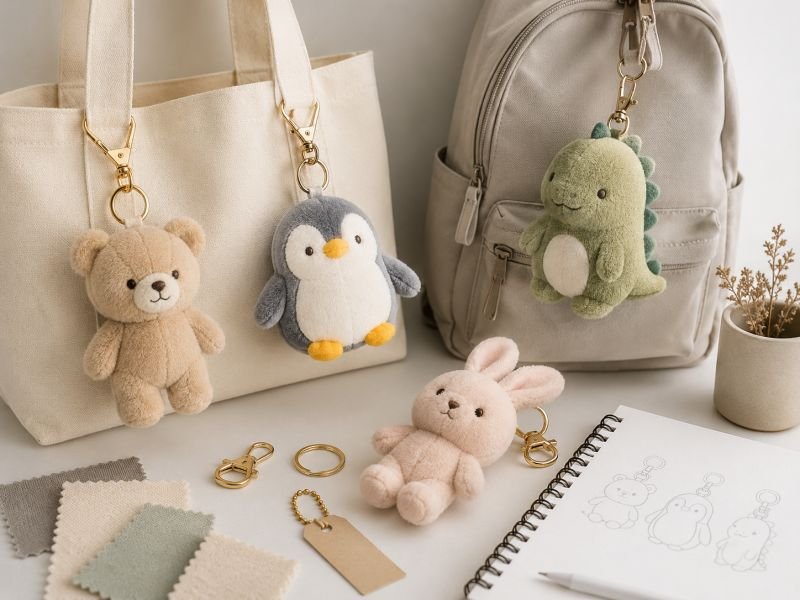
A plush bag charm looks like a small, simple product. That is why many brand teams underestimate it.
At first glance, it seems easy. Take a mascot, shrink it, add a metal clasp, pack it in a small bag, and send it out. But anyone who has worked with custom plush products knows the real work starts before the first sample. A small charm has less space for the face, less room for seam allowance, less tolerance for embroidery shift, and more stress on the hanging loop. It also has to work as a fashion accessory, retail item, event gift, IP collectible, or daily-use bag decoration.
A plush bag charm is ready when the character stays recognizable at a smaller size, hangs securely from a tote, backpack, handbag, or key set, keeps a clean shape after stuffing, uses suitable fabric and hardware, supports safe use, fits the packing plan, and can be repeated in bulk with stable quality. Before sampling, teams should review size, weight, face details, fabric, filling, hanging method, pull strength, labels, packing, SKU rules, and inspection standards.
This is the difference between “cute sample” and “ready product.”
A charm may be tiny, but it carries many business decisions. If the face looks wrong, fans notice. If the clasp is weak, users complain. If the barcode is mixed, retail teams lose time. If the packing crushes the shape, the product arrives looking tired. A good custom plush charm is not made by chance. It is built through clear structure review, practical sampling, and careful production control.
What Does “Plush Bag Charm-Ready” Mean?
A plush bag charm-ready design is a plush character or mini soft accessory that has been checked for small-size appearance, hanging stability, fabric choice, filling balance, hardware strength, safe use, packing method, and repeat production. It should not be treated as a standard plush toy with a ring added later. A ready charm must work on a real bag, not only in a product photo.
A standard plush toy can sit on a shelf. A plush bag charm moves with the user. It swings, rubs, twists, gets pulled, and travels with bags through daily life. That use pattern changes the way the product should be designed.
A charm-ready design should pass three simple tests before sampling:
Can people recognize the character quickly?
Can the charm hang in the right direction?
Can the same result be repeated in bulk?
If one of these fails, the project is not ready yet.
Is a Plush Bag Charm the Same as a Plush Keychain?
They overlap, but they are not always the same.
A plush keychain often focuses on keys, school bags, gift sets, or simple giveaways. A plush bag charm is more style-driven. It is meant to decorate a tote, backpack, handbag, travel bag, or lifestyle accessory. It may need a cleaner look, better clasp, stronger hanging loop, branded tag, or retail display card.
One character can become both versions, but the design should not be copied without review. A keychain may stay smaller and lighter. A bag charm may need better visual presence and a more polished attachment.
Why Can’t Every Plush Toy Become a Bag Charm?
Some plush toys lose their character when they become too small.
Tiny eyes may disappear. Thin eyebrows may not embroider clearly. Small logos may blur on plush fabric. Long hair, wide ears, tails, clothes, wings, or accessories may affect balance. If a metal hook is placed on a weak seam, the charm may pull out of shape.
The right approach is to redesign the plush for hanging use. Keep the details that make the character recognizable. Remove or adjust details that create risk, cost, or unstable production.
Who Usually Needs Custom Plush Bag Charms?
Custom plush bag charms are often used by:
- IP owners and character brands
- Retail gift shops
- Theme parks and museums
- Fashion and lifestyle brands
- Event and campaign teams
- School and club programs
- Fan merchandise teams
- Sports mascots
- Holiday gift programs
- E-commerce product lines
These projects are rarely about one cute item only. They often include style codes, color versions, hangtags, barcode labels, display cards, carton marks, and reorder standards.
Why Are Plush Bag Charms Popular for Brand Projects?

Plush bag charms are popular because they turn a character into something people can carry, display, collect, and photograph. They are smaller than standard plush toys, easier to ship, easier to sell as add-on items, and more visible in daily use. For brands, they work well because they combine emotional value, character identity, and practical accessory use.
A full-size plush toy may stay at home. A charm goes out with the user.
That is why this product works so well for IP projects, retail collections, fan goods, events, and lifestyle programs. It keeps the character visible after purchase or distribution. It can sit on a tote at school, a backpack during travel, a handbag in a café, or a luggage handle at an airport.
What Is the Plush Bag Charm Trend?
The plush bag charm trend is the move from plain metal or plastic accessories toward soft, character-led hanging pieces. People use them to personalize bags, show favorite characters, match outfits, or bring a playful detail into daily style.
For brand teams, this trend is useful only when the product feels intentional. A charm should not look like a random mini toy. It should match the brand mood, character style, target user, and sales channel.
A strong plush charm usually has one clear idea:
A face people remember.
A shape people recognize.
A detail people want to show.
Why Do Brands Use Plush Bag Charms for IP Merchandise?
IP projects often need more than one product type. A standard plush doll may be the main item, but a charm can be a lower-threshold collectible. It can support:
- Mini character series
- Seasonal outfits
- Limited drops
- Gift-with-purchase programs
- Retail counter displays
- Blind bag formats
- Event-exclusive versions
- Matching sets with larger plush dolls
A charm can also help test character demand before a larger plush program. If one mini character performs well, the same paper pattern logic, fabric direction, and face method can support later versions.
Why Is Gen Z Obsessed With Plushies?
Many younger shoppers like plush products because they feel personal, soft, expressive, and collectible. A plush charm lets them show taste without making a big statement. It can be cute, ironic, nostalgic, fandom-driven, or fashion-led.
For teams developing products for Gen Z or young adult audiences, the charm should feel easy to carry and easy to share. The face, color, shape, and clasp should look good in real daily settings, not only on a white background.
When Do Bag Charms Work Better Than Standard Plush Toys?
A plush bag charm often works better when the project needs:
- Lower shipping volume
- Visible daily use
- Easy event distribution
- Multi-character collection
- Lower retail entry price
- Bag, backpack, or tote attachment
- Fast gifting experience
- Series extension from one mascot
A standard plush toy is better for hugging, room display, gift boxes, premium shelf presence, or larger character storytelling. A bag charm is better for movement, identity, visibility, and collection.
Are Plush Bag Charms Good for Retail, Events, and Giveaways?
Yes, when the design matches the use scene.
Retail charms need clear display, barcode control, and good finishing. Event charms need simple packing, easy sorting, and strong delivery timing. IP charms need face accuracy and series consistency. School or club charms need safe structure and durable attachment.
A charm works best when the team defines its job before sampling.
Charm-Ready Review Checklist
Use this checklist before starting a custom plush bag charm project.
| Review Area | What to Check | Why It Matters |
|---|---|---|
| Character shape | Face, outline, ears, hair, signature detail | Keeps recognition after size reduction |
| Size | Height, width, thickness, weight | Affects hanging comfort, cost, and packing |
| Fabric | Pile length, softness, color, texture | Affects appearance, handfeel, and photo result |
| Face method | Embroidery, printing, applique, plastic detail | Affects expression, safety, and stability |
| Filling | Firmness, balance, recovery | Affects shape and hanging direction |
| Hardware | Keyring, clasp, ball chain, cord, strap | Affects use scene and perceived value |
| Hanging | Top, back, ear side, fabric tab | Affects balance and pull strength |
| Safety | Small parts, metal edge, seam strength, needle check | Reduces avoidable product risk |
| Packing | Polybag, hangtag, display card, box | Affects retail, shipping, and sorting |
| Labels | Barcode, SKU, warning, care label | Affects store and warehouse handling |
| Bulk control | Approved sample, files, photos, inspection | Keeps repeat orders consistent |
What Size Makes a Plush Bag Charm Practical?
A practical plush bag charm should be large enough to show the character clearly, but small and light enough to hang comfortably. The right size depends on the character detail, fabric thickness, hardware type, use scene, packing method, and cost target. Small charms need simplified features and strong structure review because tiny differences become easier to notice.
Size is one of the first decisions that affects everything else.
A small charm can be easy to carry and pack, but it may lose facial detail. A larger charm can show the character better, but it may feel heavy on a small handbag. A wide shape may look nice in artwork, yet sit awkwardly when hanging from a tote handle.
Which Size Works Best for Bags, Backpacks, and Keys?
There is no single perfect size, but the use scene gives a clear direction.
| Use Scene | Better Size Direction | What to Watch |
|---|---|---|
| Handbag charm | Small to medium | Should not overpower the bag |
| Tote bag charm | Medium and visible | Needs good balance near handle |
| Backpack charm | Medium with stronger hardware | More rubbing and pulling |
| Key charm | Smaller and lighter | Avoid bulky body |
| Retail display | Visible from shelf distance | Needs tag or display card |
| Event gift | Compact and easy to sort | Keep packing simple |
A charm for a cotton tote may use a different size from a charm for a premium handbag. A travel backpack charm may need stronger hardware than a charm used only as a desk accessory.
How Does Size Affect Character Detail?
Small size makes every detail more demanding.
A full plush doll can carry layered clothing, small cheeks, printed patterns, embroidery lines, and accessories. A mini charm cannot always keep all those details. Some lines need to become thicker. Some color blocks should be simplified. Some accessories should become flat embroidery or applique instead of separate pieces.
A good factory review should decide what to keep and what to adjust before the first sample.
How Does Size Affect Price and Packing?
Size affects material use, cutting time, sewing difficulty, filling amount, hardware choice, and carton quantity.
But smaller does not always mean cheaper. A tiny charm with seven fabric colors, detailed embroidery, small clothes, and metal accessories may cost more than a larger simple plush head. Labor, alignment, and inspection can carry more weight than fabric use.
Packing should be reviewed at the same time as size. A charm packed flat in a polybag is different from one placed on a display card or inside a gift box.
What Design Details Make a Character Charm-Ready?

A character becomes charm-ready when its most recognizable features can survive size reduction, hanging movement, fabric change, and repeat production. The face, silhouette, main color blocks, and signature accessories should remain clear. Details that are too tiny, too weak, too heavy, or too hard to repeat should be adjusted before sampling.
The goal is not to copy every line from artwork.
The goal is to keep the character alive in a smaller, softer, hanging format.
A mascot may be known for its eyes. A game character may be known for its hair. A museum character may be known for its hat. A sports mascot may be known for its ears, jersey, or team color. The charm should protect the details that create instant recognition.
Which Details Should Stay, Simplify, or Change?
Keep details that define the character:
- Eye shape
- Mouth curve
- Nose position
- Ear outline
- Main hair shape
- Key color blocks
- Mascot symbol
- Signature accessory
- Body silhouette
Simplify details that create trouble:
- Very thin lines
- Tiny printed logos
- Small separate accessories
- Narrow fabric strips
- Too many clothing layers
- Small loose parts
- Dense facial patterns
Change the method when needed. A printed mouth may become embroidery. A loose bow may become applique. A tiny jacket pocket may become a color block. A hard accessory may need a softer version.
How Should Eyes, Mouth, Ears, Hair, and Accessories Be Reviewed?
Start with the face.
Eyes and mouth create emotion. Even a slight shift can make the character look sleepy, angry, surprised, or unfamiliar. For small charms, embroidery density, stitch direction, and placement should be checked carefully.
Then review the silhouette. Ears, hair, tail, wings, horns, and hats often make a character recognizable from a distance. If these parts are too small, they may collapse. If they are too large, they may affect hanging balance.
Accessories should be reviewed for sewing strength and safe use. A cute small bell, bow, buckle, or plastic part may create more risk than value if the product is used by children or attached to school bags.
Why Does Small-Size Accuracy Need Factory Review?
A small plush charm is affected by many physical details:
- Fabric stretch
- Seam allowance
- Embroidery pull
- Filling pressure
- Pile direction
- Hand shaping
- Hanging balance
- Hardware weight
A face that looks correct in artwork may change after stuffing. A round head may become oval. A small mouth may disappear under plush pile. A loop placed on the wrong seam may tilt the product.
That is why paper pattern work and first sample review are not optional for character charms. They turn a flat image into a real hanging object.
Material Choice Table for Plush Bag Charms
| Material Direction | Best For | Watch Before Sampling |
|---|---|---|
| Short plush | Clean faces, mascot shapes, small charms | Good for visible embroidery |
| Velboa | Smooth character surfaces | May feel less fluffy |
| Minky | Soft retail charms, baby-like style | Color and stretch need review |
| Crystal super soft fabric | Cute animal or soft-touch projects | Long pile may hide details |
| Fleece | Simple shapes, casual style | Edge finish should be clean |
| PP cotton filling | Most soft charm bodies | Filling amount affects balance |
| Applique fabric | Color blocks and clothing details | Edge sewing must stay neat |
| Embroidery thread | Eyes, mouth, logo details | Small size needs density review |
| Printed fabric | Patterns and gradients | Plush texture may affect clarity |
Which Materials Work Best for Plush Bag Charms?
The best materials for plush bag charms are soft, stable, clean-looking, and suitable for small shapes. Fabric should match the character style, while filling should keep the charm light and balanced. The material plan should support color consistency, face clarity, handfeel, safe use, and repeat production.
A plush charm is touched often. It rubs against hands, keys, zippers, bag fabric, and clothing. A fabric that looks beautiful in a flat swatch may not work after cutting, sewing, stuffing, and hanging.
What Fabric Helps a Small Charm Look Clean?
Shorter pile fabrics often make small charms look cleaner because they do not cover tiny embroidery or seam lines. They are useful for mascots, logos, and characters with detailed faces.
Longer pile fabrics can feel warmer and cuter, but they may hide facial details. They work better when the charm is based on a simple animal, fuzzy creature, or soft shape.
For small IP characters, the fabric should be selected together with face size. The wrong fabric can make a correct embroidery file look unclear.
Which Filling Keeps the Shape Stable?
Filling should support the body without making it heavy.
Too little filling makes the charm flat. Too much filling makes it bulky and may distort the face. Uneven filling can make the charm twist when hanging.
A good sample should be checked from the front, side, back, and hanging view. The charm should sit naturally, not lean forward or turn backward.
How Do Color and Texture Affect Brand Style?
Color and texture affect how the charm feels to the end user.
A playful mascot may need bright colors and a soft surface. A museum or lifestyle brand may prefer cleaner fabric and more controlled stitching. A fan collectible may need close color matching to an approved character guide.
For repeat projects, fabric cards, thread colors, and approved sample photos should be kept as production references.
How Should Hanging Hardware Be Chosen?
Hanging hardware should match the charm size, weight, use scene, target age group, and brand style. Keyrings, lobster clasps, ball chains, cords, straps, and custom metal parts each create a different user experience. Good hardware should attach securely, hang naturally, avoid sharp edges, and protect the plush body from pulling damage.
Hardware can make a charm feel polished or cheap.
A good face with weak hardware is still a weak product. A nice clasp in the wrong position can make the charm hang sideways. A heavy metal part can pull a small plush head out of shape. A sharp edge can damage the fabric or the bag.
Keyring Vs Lobster Clasp Vs Ball Chain
| Hardware Type | Better For | Main Risk |
|---|---|---|
| Keyring | Keys, backpacks, simple gifts | Can feel stiff on soft plush |
| Lobster clasp | Totes, handbags, removable charms | Metal edge and closure need review |
| Ball chain | Light charms, display-friendly products | Closure may loosen |
| Cord loop | Soft look, simple attachment | Stitch strength matters |
| Branded strap | Retail and IP projects | Color and cost need control |
| Custom metal part | Premium programs | Weight and edge safety need review |
Where Should the Hanging Be Placed?
The hanging should be placed where the charm can stay balanced.
Common positions include:
- Top of head
- Back seam
- Between ears
- Side loop
- Hidden fabric tab
- Accessory loop
- Strap connection
A round character may hang well from the top. A long animal may need a back loop. A character with big ears may need a hidden tab between stronger seams. A plush pouch or mini bag charm may need a side loop or zipper-side attachment.
How to Keep Bag Charms in Place?
To keep a bag charm in place, match the clasp to the bag type and keep the loop length practical.
A long loop may swing too much. A very short loop may pull against the handle. A loose ball chain may shift around. A weak fabric tab may stretch after use.
For tote bags, a lobster clasp or short strap loop can keep the charm close to the handle. For backpacks, stronger hardware and reinforced stitching help reduce pulling risk. For handbags, the clasp should look clean and avoid scratching leather, coating, or hardware.
How to Attach Charms to a Tote Bag?
A plush charm can attach to a tote bag through the handle, D-ring, zipper pull, side tab, or strap loop. If the tote has no metal ring, the charm can use a lobster clasp, cord loop, or short strap that wraps around the handle.
For custom programs, this should be reviewed before sampling. A charm designed for canvas tote bags may need a different connection from one designed for leather handbags, travel bags, or school backpacks.
How Can Pulling Risk Be Reduced?
Pulling risk can be reduced through:
- Reinforced fabric tabs
- Stronger seam placement
- Proper stitch density
- Hidden webbing support
- Correct hardware weight
- Pull review for attachment areas
- Inspection during production
For children’s items, school bags, or family retail products, small parts and attachment strength need extra attention.
What Safety Checks Matter for Plush Bag Charms?

Safety checks for plush bag charms depend on use scene, target age, sales region, and product structure. Key areas include small parts, metal edges, pull strength, seam strength, fabric safety, needle control, label content, and warning wording. If the charm may be used by children, safety direction should be reviewed before sampling.
A plush bag charm may be sold as a style accessory, but it may still be touched by children.
This matters for school bags, toy shops, family retail stores, museum stores, theme parks, and event gifts. Metal parts, plastic clips, decorative accessories, bells, hard eyes, and small add-ons should be reviewed carefully.
Are Plush Bag Charms Toys or Accessories?
It depends on how the product is positioned and used.
A charm sold as an adult fashion accessory may follow a different review path from a charm sold as a children’s toy. A mascot charm for a school event may need more careful label and pull review than a lifestyle charm for adult bags.
The safest early step is to define:
- Target age
- Sales region
- Use scene
- Product category
- Packaging wording
- Label needs
- Testing direction
Do Small Parts and Metal Parts Need Review?
Yes.
Metal rings, plastic clips, small noses, button eyes, bells, buckles, beads, and decorative parts can create safety or durability risks. Even when they look attractive, they may not suit every project.
For many plush charm projects, embroidered eyes and soft fabric details are safer and more stable than hard small parts. This is especially true for younger age groups.
How Do Target Regions Affect Labels?
Different regions may require different safety labels, age information, fiber content, care labels, tracking information, or testing documents.
A retail plush charm for the United States, a children’s item for Europe, and an adult event gift may not need the same preparation. The project team should share the target region early so labels and tests can be reviewed before production.
Quality Check List for Plush Bag Charms
| Check Item | What To Review |
|---|---|
| Face position | Eyes, mouth, nose, cheeks, expression |
| Embroidery | Thread color, density, clarity, placement |
| Shape | Front, side, back, hanging view |
| Filling | Balance, firmness, weight, recovery |
| Hardware | Closure, edge, color, strength |
| Hanging loop | Placement, stitch strength, pull area |
| Seam | Clean sewing, no open seam, no weak area |
| Surface | No stains, loose threads, fabric defects |
| Needle control | Needle detection before packing |
| Label | Hangtag, care label, barcode, SKU |
| Packing | Correct bag, card, box, carton mark |
| Multi-style order | No mixed labels, colors, or cartons |
How Does Sampling Confirm the Project?
Sampling confirms whether the design, size, fabric, face method, filling, hardware, labels, and packing can work together. A strong sample should not only look cute. It should show whether the charm hangs correctly, keeps character identity, supports safe use, and can become a clear standard for bulk production.
Sampling is where a plush bag charm becomes real.
Before sampling, everything is still an idea. After sample approval, the factory needs to repeat that result. This is why the approved sample must be reviewed as a production standard, not just a pretty reference.
What Should Be Sent Before Sampling?
Useful starting details include:
- Character artwork or reference photo
- Target size
- Quantity plan
- Use scene
- Preferred fabric
- Face method
- Hardware idea
- Packing needs
- Label or barcode needs
- Target region
- Deadline
- Destination country
If the project is still early, send what you have. A reference image, size idea, quantity, and use scene are enough for an initial review.
How Long Does Sampling Usually Take?
Sampling time depends on complexity.
A simple plush charm with common fabric and embroidery may move faster. A character with clothing, several fabric colors, custom hardware, printing, accessories, or multiple styles needs more time.
For many custom plush projects, first sample development often takes about 7–14 days. Simple designs may be faster. Revision time depends on the change list.
What Should Be Checked Before Sample Approval?
Before approving the sample, check:
- Does the face look like the character?
- Does the charm hang in the right direction?
- Is the size suitable for the bag type?
- Is the body too heavy or too flat?
- Is the hardware strong enough?
- Are the colors acceptable?
- Is embroidery clear?
- Is the filling balanced?
- Does the packing protect the shape?
- Can the factory repeat this in bulk?
Do not approve a plush bag charm from one front photo only. Check it hanging, held in hand, viewed from the side, and packed in its intended format.
Sampling Process for Custom Plush Bag Charms
| Step | What Happens | Why It Helps |
|---|---|---|
| 1. Send reference | Artwork, size, quantity, use scene | Starts structure review |
| 2. Review charm direction | Size, fabric, face, hardware | Finds early risks |
| 3. Make paper pattern | Flat artwork becomes plush structure | Controls shape |
| 4. Prepare materials | Fabric, thread, filling, hardware | Confirms look and feel |
| 5. Create first sample | Full charm sample is made | Shows real result |
| 6. Review and revise | Face, shape, loop, packing | Improves accuracy |
| 7. Approve final sample | Standard is confirmed | Guides bulk production |
| 8. Prepare production file | Records all details | Supports repeat control |
What Makes Bulk Production Different From a Sample?
Bulk production is different from sampling because the same charm must be repeated many times with the approved face, shape, fabric, hardware position, label rule, packing method, and inspection standard. A good sample proves the design direction. Bulk work proves whether the factory can control every step again and again.
A sample can be made slowly by one skilled sample maker. Bulk production needs many people and many steps to follow the same standard.
This is where unclear details create problems.
Why Can a Good Sample Fail in Bulk?
A good sample may fail in bulk when records are incomplete.
Common causes include:
- No clear face placement standard
- No approved embroidery file record
- No fabric color reference
- No hardware placement guide
- No filling level control
- No label rule
- No packing sample
- No carton mark file
- No photo record
- No version history
For mini charms, small differences are easy to see. A tiny eye shift, uneven filling, or loose loop can change the whole product feel.
How Are Shape and Hardware Controlled?
Control starts before cutting.
The factory should prepare pattern files, embroidery files, material references, hardware samples, approved sample photos, label artwork, packing samples, and inspection notes.
During production, review should include:
- Cutting accuracy
- Embroidery placement
- Sewing strength
- Filling balance
- Shape consistency
- Loop position
- Hardware closure
- Surface cleanliness
- Needle detection
- Packing accuracy
What Records Help Repeat Orders?
Useful repeat records include:
- Approved sample photos
- Pattern version
- Fabric name and color
- Embroidery file
- Thread color
- Hardware type
- Filling level
- Hangtag file
- Barcode rule
- Packing photo
- Carton quantity
- Inspection notes
- Shipment records
These records make the second order easier, faster, and more consistent.
Common Mistakes in Plush Bag Charm Projects
| Mistake | What Can Happen | Better Practice |
|---|---|---|
| Shrinking artwork directly | Face becomes crowded | Review details for small size |
| Choosing hardware too late | Loop position may fail | Review clasp before sampling |
| Using too many small parts | Higher safety and sewing risk | Replace with embroidery or applique |
| Ignoring hanging balance | Charm turns sideways | Test while hanging |
| Approving only front photos | Side shape may be poor | Check all views |
| Packing after production | Product may be crushed or mislabeled | Confirm packing early |
| No SKU rule | Styles can be mixed | Create label and carton rules |
| No sample record | Reorder may change | Save photos, files, and specs |
What Packaging Makes Plush Bag Charms Retail-Ready?
Retail-ready packing helps plush bag charms move from factory production to store, online shop, event table, or warehouse with fewer mistakes. A charm may need a polybag, hangtag, display card, barcode sticker, SKU label, gift box, carton mark, mixed packing rule, or destination sorting. Packing should support display, scanning, shipping, and repeat orders.
Packing should not be treated as the last step.
For plush bag charms, packing affects how the product looks, how it is scanned, how it is stored, how it is distributed, and how it is reordered. A beautiful charm with wrong labels can still create a costly problem.
Which Packaging Works for Display?
Common packing options include:
- Individual polybag
- Hangtag
- Header card
- Display card
- Blind bag
- Gift box
- Retail box
- Set box
- Counter display pack
A premium IP charm may need a branded card or box. A simple event charm may only need a polybag and clear carton sorting. A retail wall display may need a strong card with a hanging hole.
Do Bag Charms Need Hangtags and Barcodes?
For retail and e-commerce use, usually yes.
Hangtags can show the brand, character name, series name, age note, care guidance, and story. Barcodes support scanning and inventory. SKU labels help separate characters, colors, regions, and packing versions.
If a project has several styles, label control should be discussed before bulk production.
How Should Multi-SKU Orders Be Packed?
Multi-SKU packing should follow clear rules:
- Style code
- Color code
- Barcode
- Inner quantity
- Carton quantity
- Mixed ratio
- Destination
- Carton mark
- Packing photo reference
For example, an IP series may need five characters mixed in one retail display. An event project may need cartons separated by city or venue. A retail chain may need each SKU packed separately.
Packing Confirmation Checklist
| Packing Detail | Confirm Before Bulk |
|---|---|
| Individual bag | Size, opening, warning print if needed |
| Hangtag | Artwork, hole position, string method |
| Barcode | Code, placement, scan test |
| SKU label | Style, color, region, version |
| Display card | Card size, hook hole, printed content |
| Gift box | Fit, insert, product protection |
| Mixed carton | Ratio and style list |
| Carton mark | PO, SKU, quantity, destination |
| Retail requirement | Hangable, scannable, shelf-ready |
| Photo record | Save for repeat orders |
Plush Bag Charm Vs Plush Keychain: Which Fits Your Project?

A plush bag charm fits projects focused on style, identity, IP expression, retail display, and bag decoration. A plush keychain fits projects focused on compact use, simple gifts, school packs, keys, or smaller accessory sets. The two products can share one character, but size, hardware, packing, and use scene should be reviewed separately.
The names are often mixed, but the project logic is not always the same.
If the product will hang from a tote, handbag, backpack, or travel bag, treat it as a bag charm. If it will mainly be used with keys, ID tags, zipper pulls, or compact giveaways, treat it closer to a keychain.
When Should a Brand Choose a Bag Charm?
Choose a plush bag charm when the project needs:
- Strong visual presence
- Bag decoration use
- Lifestyle styling
- IP collection value
- Retail display appeal
- Photo-friendly design
- Better hardware finish
- Series development
When Should a Brand Choose a Keychain?
Choose a plush keychain when the project needs:
- Smaller size
- Simple function
- Easy distribution
- Lower packing volume
- Basic gift use
- School or club use
- Compact accessory kits
Can One Character Become Both?
Yes.
One character can have a bag charm version and a keychain version. The bag charm may use a stronger clasp, larger shape, better display card, and more polished finishing. The keychain may stay smaller, lighter, and simpler.
This is also a good way to build a product family around one character.
How to Choose a Custom Plush Bag Charm Factory
Choose a custom plush bag charm factory by checking whether it can review character structure, develop small-size paper patterns, make samples, select fabric, control face placement, choose suitable hardware, review attachment strength, manage labels, support packing rules, and keep bulk quality stable. A strong factory should reduce risk before production starts.
A simple gift catalog can be useful for stock-style items. A character-based plush bag charm needs deeper development.
It needs structure review. It needs paper pattern work. It needs sampling. It needs face correction. It needs hardware review. It needs label planning. It needs inspection.
What Capabilities Should Teams Check?
Before starting, check whether the factory can support:
- Artwork review
- Structure evaluation
- Paper pattern development
- Sample making
- Embroidery and print review
- Fabric selection
- Hardware sourcing
- Attachment reinforcement
- Needle detection
- Quality inspection
- Label and barcode support
- Retail packing
- Multi-SKU sorting
- Repeat record keeping
A good factory does not only say it can make the product. It should help you find design and production risks early.
Which Should Teams Ask Before Ordering?
Useful checks include:
- Can the character stay recognizable at this size?
- Which details should be simplified?
- Which face method fits the design?
- Which fabric keeps the shape clean?
- Which hardware fits the bag type?
- Where should the hanging sit?
- How will pull strength be checked?
- What packing fits the sales channel?
- How will labels and SKUs be controlled?
- What records will be saved for reorder?
If these topics are not discussed, the project may look fine at sample stage but create trouble later.
Why Choose a Plush Factory Over a Promo Catalog?
A promo catalog may offer speed for simple gift items. A plush factory is better when the project needs custom character work, face accuracy, material selection, hardware review, sample revision, inspection, packing control, and reorder consistency.
Heyzizi is based in Guangdong and supports custom plush projects with in-house paper pattern and sampling work, production coordination, inspection, packing, and shipment preparation. The team works with plush dolls, mascot plush, plush keychains, plush bag charms, plush pillows, plush pouches, and other soft character products.
What Should You Send for Project Review?
For a plush bag charm review, send character artwork or reference photos, target size, quantity, use scene, fabric preference, face method, hardware needs, label and packing request, target region, delivery deadline, and destination. Clear starting details help the factory review structure, sampling path, cost direction, safety needs, and bulk production earlier.
A strong first message does not need every file.
It only needs enough direction to start a useful review.
Artwork, Size, Quantity, and Use Scene
Send the character image, mascot file, logo reference, or product photo. Add the target size if known. If not, describe the use scene:
- Tote bag charm
- Backpack charm
- Handbag charm
- Key accessory
- Retail display
- Event gift
- Fan collection
- Blind bag series
- School program
- Gift set
Also share the expected quantity. For many custom plush projects, 500 pcs per design is a practical starting direction. For simple structures and common materials, 200–300 pcs may be reviewed case by case.
Hardware, Packing, Label, and Region Needs
Share hardware preference if you have one:
- Keyring
- Lobster clasp
- Ball chain
- Cord loop
- Strap
- Custom metal part
Then share packing and label needs:
- Polybag
- Hangtag
- Display card
- Barcode
- SKU label
- Gift box
- Blind bag
- Carton mark
- Mixed carton
- Warehouse label
If the item may be used by children, mention target age and region early.
Deadline, Destination, and Sample Expectation
Timing affects the whole project.
A charm for a retail launch, holiday drop, event date, museum store, school program, or IP release should allow time for review, sample, revision, approval, production, inspection, packing, and shipping.
If your team is planning a custom plush bag charm, send artwork, size idea, quantity, hardware request, packing plan, destination, and deadline to info@heyzizi.com. Heyzizi can review whether the design is ready for sampling and which details should be confirmed first.
Quick Closing
A plush bag charm is small, but it should not be treated casually.
The strongest version is not only cute. It should look like the character, hang in the right direction, feel good in the hand, use suitable fabric, hold its hardware securely, pass the right checks, pack cleanly, and stay consistent in bulk.
When size, face, fabric, filling, hardware, safety, sample standard, packing, and SKU rules are reviewed early, a plush bag charm has a better chance to work as a retail product, IP collectible, event gift, or brand accessory.
That is what makes it truly charm-ready.
FAQs About Custom Plush Bag Charms
1. What size is best for a custom plush bag charm?
A practical custom plush bag charm is usually small enough to hang comfortably, but large enough to keep the character recognizable. For most brand projects, the best size depends on the character shape, face detail, hanging hardware, packing style, and final use. A tiny charm may control weight and packing volume, but it can lose facial expression. A larger charm may show the mascot better, but it may feel heavy on a handbag or look oversized on a tote.
Definitely, size should be reviewed before sampling, not after the first sample looks wrong. For a simple animal head, icon, food shape, or logo mascot, a smaller size can work well because the design has fewer details. For a full-body character with clothing, ears, hair, shoes, tail, or accessories, more space may be needed to keep the expression clear.
A useful way to choose size is to start with the use scene:
| Use Scene | Better Direction | What To Review |
|---|---|---|
| Handbag charm | Smaller, lighter body | Does it overpower the bag? |
| Tote bag charm | Medium visible size | Does it hang near the handle nicely? |
| Backpack charm | Stronger body and clasp | Can it handle more movement? |
| Key accessory | Compact and light | Is it too bulky for keys? |
| Retail display | More visible shape | Does it look attractive on a card? |
| Event gift | Easy to sort and pack | Can it ship and distribute smoothly? |
If the team is not sure about size, send the character artwork, intended bag type, and quantity plan to Heyzizi. A size review before sampling can reduce repeated revisions and help control cost, shape, and packing from the beginning.
2. Can any mascot or IP character be made into a plush bag charm?
Certainly, many mascots and IP characters can become plush bag charms, but not every artwork should be reduced directly without adjustment. A charm has limited space, so the most recognizable details must be protected first. This usually includes the eyes, mouth, ears, color blocks, hair shape, body outline, and one or two signature accessories.
The risk comes from trying to keep everything. A 30 cm plush doll can carry layered clothing, small badges, shoes, tiny printed symbols, and several fabric colors. A mini bag charm may not handle all those details cleanly. If the design is too crowded, the face may look messy, embroidery may lose clarity, and small accessories may create extra sewing or safety risk.
Before sampling, the design should be reviewed in three groups:
| Detail Type | Recommended Action |
|---|---|
| Key identity details | Keep and make clear |
| Small decorative details | Simplify or combine |
| Weak loose parts | Replace with embroidery, applique, or print |
| Very tiny logos | Enlarge, move, or place on hangtag |
| Thin facial lines | Thicken or adjust stitch method |
| Heavy accessories | Review weight and attachment |
For brand and IP teams, the goal is not to copy every line from the original drawing. The goal is to keep the character instantly recognizable after it becomes a soft, hanging product. Heyzizi can review character structure, face method, fabric direction, and hanging position before the first sample, so the charm starts with a more realistic development path.
3. Which hardware is better for plush bag charms: keyring, lobster clasp, ball chain, or cord loop?
Of course, the best hardware depends on how the charm will be used. A tote bag charm, backpack charm, handbag charm, key accessory, and retail display item may need different hanging methods. Hardware is not just a small add-on. It affects comfort, product value, pulling strength, display style, and long-term use.
A lobster clasp often works well for tote bags and handbags because it is easy to attach and remove. A keyring is familiar and practical for keys, school bags, and simple gift items. A ball chain can be light and display-friendly, but it should be checked carefully because some chains may loosen during use. A cord loop gives a softer look and may suit simpler or children-oriented products, but stitch strength must be reviewed. A branded strap can make the product feel more retail-ready, especially for IP programs.
| Hardware Type | Best For | Main Risk To Review |
|---|---|---|
| Keyring | Keys, school bags, compact gifts | May feel stiff on soft plush |
| Lobster clasp | Tote bags, handbags, removable charms | Metal edge and closure quality |
| Ball chain | Light charms and display cards | Chain closure may open |
| Cord loop | Soft look, simple attachment | Stitch strength and wear |
| Branded strap | IP and retail collections | Cost, color, and attachment control |
| Custom metal part | Premium projects | Weight, edge, and surface finish |
The hanging also matters. A strong clasp can still fail if it is connected to a weak seam. For larger charms, a hidden reinforced fabric tab or webbing loop may be better than attaching hardware directly to soft plush fabric.
4. How do you keep plush bag charms in place on tote bags, handbags, or backpacks?
Absolutely, keeping a plush bag charm in place starts with the right hardware, loop length, hanging , and body balance. A charm should not swing wildly, twist backward, pull the fabric out of shape, or slide into an awkward position. This is especially important for tote bags and backpacks because they move more during daily use.
For tote bags, the charm is often attached around the handle or to a side loop. A lobster clasp, short strap loop, or cord loop can help keep it close to the handle. For handbags, the metal finish and edge smoothness matter more because the charm may touch leather, coated fabric, or metal bag hardware. For backpacks, the attachment must be stronger because the product moves, rubs, and pulls more often.
A good charm should be tested in hanging view, not just flat view. During sample review, check:
- Does the face stay forward?
- Does the charm twist to the back?
- Is the loop too long?
- Does the hardware pull the head or ear?
- Does the clasp scratch the bag?
- Does the charm feel too heavy?
- Does the attachment area look weak?
If the charm keeps turning sideways, the hanging may need to move. If the body leans forward, the filling or loop placement may need adjustment. If the charm sits too low on a tote handle, a shorter strap or clasp may work better. These small changes can make the finished product feel much more professional.
5. What materials work best for custom plush bag charms?
Sure, the best material choice depends on the character style, target age group, use scene, cost direction, and desired handfeel. For small charms, the material should look clean after cutting and sewing. It should not hide facial embroidery, distort the shape, or make the charm too heavy.
Short plush, velboa, minky, fleece, crystal super soft fabric, and other soft fabrics can all work, but they do not behave the same way. Shorter pile fabrics usually help small character faces look cleaner because the fibers do not cover the eyes, mouth, or small stitch details. Longer plush can feel warmer and cuter, but it may make tiny features less visible. For IP characters, this can be risky if the face is the main recognition detail.
Filling also needs control. Too little filling makes the charm flat and cheap-looking. Too much filling makes it bulky, heavy, or uneven. A charm should keep its shape while hanging and still feel soft in hand.
| Material Choice | Works Well For | Watch Carefully |
|---|---|---|
| Short plush | Mascots, logos, detailed faces | Surface feel may be less fluffy |
| Velboa | Clean character shapes | Color and texture need approval |
| Minky | Soft retail charms | Stretch may affect shape |
| Long plush | Cute animal styles | Can hide small details |
| Fleece | Casual simple shapes | Edge finish must stay neat |
| PP cotton filling | Most plush charm bodies | Amount affects weight and balance |
| Embroidery | Eyes, mouth, small logo areas | Size and stitch density matter |
| Applique | Color blocks and clothes | Edge sewing must be clean |
For repeat programs, keep fabric swatches, thread colors, approved sample photos, and material names. These records help future orders stay closer to the first approved version.
6. How long does it take to make a custom plush bag charm sample?
In many custom plush projects, a first sample often takes about 7–14 days after key details are clear, while simple designs may move faster. Complex plush bag charms need more time because the factory must review artwork, paper pattern, fabric, face method, hardware, hanging balance, filling, and packing direction before the sample can show a reliable result.
Definitely, sampling time should not be judged only by product size. A small charm can still be time-consuming if it has several colors, tiny embroidery, custom clothing, accessories, special fabric, custom metal hardware, or multiple character versions. A simple round mascot head may be much faster than a full-body IP character with ears, tail, outfit, and printed details.
A practical sampling path usually looks like this:
| Step | What Happens |
|---|---|
| 1. Project review | Artwork, size, use scene, quantity, packing |
| 2. Structure check | Shape, face, hanging, hardware |
| 3. Paper pattern | Flat design becomes plush structure |
| 4. Material preparation | Fabric, thread, filling, clasp, tag |
| 5. First sample | Real charm is made |
| 6. Review | Face, shape, balance, hardware, packing |
| 7. Revision | Adjust details if needed |
| 8. Final sample approval | Bulk standard is confirmed |
A clear brief saves time. If the team sends artwork, target size, quantity, hardware idea, packing needs, and deadline at the beginning, the factory can review the project faster and avoid unnecessary back-and-forth.
7. What should be checked before approving a plush bag charm sample?
Certainly, a plush bag charm sample should be checked from more than one angle. Do not approve it only because the front photo looks cute. A bag charm must look good from the front, side, back, hanging view, and packed view. It should also feel right in hand and hold its shape after being attached to a bag.
The first thing to check is character accuracy. Does the face look like the mascot or IP character? Are the eyes in the right place? Is the mouth expression correct? Are the ears, hair, tail, or accessories recognizable? Then review size and weight. A charm that is too large may not work on smaller bags. A charm that is too light or flat may look weak.
Next, check the hardware. The clasp, ring, ball chain, cord loop, or strap should connect securely and hang naturally. The loop should not pull the face out of shape. The metal should not have sharp edges. If the item may be used by children, small parts and pull strength need extra attention.
Before approval, review this checklist:
- Front face accuracy
- Side and back shape
- Hanging direction
- Size and thickness
- Filling balance
- Embroidery clarity
- Fabric color
- Hardware strength
- Loop placement
- Seam quality
- Label position
- Packing fit
- Barcode or SKU placement if needed
A sample is not just a sample. Once approved, it becomes the reference for bulk work. That is why photos, material notes, embroidery files, hardware details, and packing rules should be saved.
8. What safety checks are important for plush bag charms?
Absolutely, safety checks depend on the target age group, sales region, product structure, and use scene. A plush bag charm may look like an accessory, but it can still be handled by children, attached to school bags, sold in family retail stores, or used in event gift programs. That means small parts, metal parts, seam strength, fabric safety, and needle control should be reviewed early.
Key safety areas include:
| Safety Area | What To Review |
|---|---|
| Small parts | Eyes, noses, clips, bells, beads, buckles |
| Metal hardware | Edge smoothness, closure strength, rust risk |
| Pull strength | Loop, clasp, accessories, attached parts |
| Seam strength | Open seams, weak stitch areas |
| Fabric and filling | Material suitability and cleanliness |
| Needle control | Broken needle prevention before packing |
| Labels | Age note, warning wording, care label |
| Target region | Different regions may need different preparation |
For younger age groups, embroidered or applique details are often more stable than hard plastic parts. If the charm includes metal rings, hard accessories, or small decorative add-ons, the project should be reviewed more carefully before the sample is approved.
Needle detection is also a serious part of plush production. Since the product goes through cutting, sewing, filling, finishing, and packing, broken needle control helps reduce avoidable risk before shipment.
9. What packaging is best for plush bag charms used in retail or events?
Of course, the best packaging depends on where the plush bag charm will be used. Retail programs may need hangtags, display cards, barcode stickers, SKU labels, or gift boxes. Event programs may need simple polybags, carton sorting, venue labels, and fast distribution packing. E-commerce programs may need protective bags, scannable labels, and warehouse-friendly carton marks.
Packaging should be planned before bulk work, not after the products are finished. A charm can look great, but wrong labels or poor packing can still create delays. For multi-style projects, packaging control is even more important because characters, colors, and barcodes can be mixed if the rules are not clear.
| Use Scene | Packing Direction | Why It Helps |
|---|---|---|
| Retail shelf | Hangtag, display card, barcode | Supports display and scanning |
| Gift shop | Branded card or small box | Improves perceived value |
| Event giveaway | Polybag and carton sorting | Speeds up distribution |
| IP series | SKU label and character code | Avoids mixed styles |
| Online store | Protective bag and barcode | Helps warehouse handling |
| Blind bag | Sealed bag with code control | Supports collectible format |
For retail-ready plush bag charms, confirm tag artwork, barcode placement, card size, packing quantity, mixed carton rule, and carton mark before production starts. These details may sound small, but they often decide whether the product enters the sales channel smoothly.
10. What information should we send to start a custom plush bag charm project?
A strong project brief should include artwork or reference photos, target size, estimated quantity, use scene, fabric preference, face method, hardware request, packing style, label needs, destination, target region, and deadline. You do not need every file ready on day one, but the clearer the starting details are, the faster the factory can review structure, cost direction, sampling path, safety needs, and bulk production risks.
Definitely, the most helpful starting materials are visual. Send a character drawing, mascot file, logo, product reference, or existing plush sample photo. Then explain how the charm will be used. A charm for a tote bag, school backpack, handbag, key set, gift shop, museum store, event table, or IP blind bag may need different size, hardware, and packing.
A useful project brief can follow this format:
| Information To Send | Example |
|---|---|
| Character artwork | Mascot drawing, IP guide, logo file |
| Target size | 8 cm, 10 cm, 12 cm, or open for review |
| Quantity | 300 pcs, 500 pcs, 2,000 pcs, etc. |
| Use scene | Tote charm, retail item, event gift |
| Fabric idea | Short plush, minky, soft touch, open suggestion |
| Face method | Embroidery, print, applique, open suggestion |
| Hardware | Lobster clasp, keyring, ball chain, cord loop |
| Packing | Polybag, hangtag, display card, barcode |
| Target region | US, EU, UK, Japan, etc. |
| Deadline | Event date, launch date, shipment window |
Heyzizi’s common custom plush MOQ is usually 500 pcs per design. For simple structures and common materials, 200–300 pcs can be reviewed case by case. If your team is preparing a custom plush bag charm project, send your artwork, size idea, quantity, hardware request, packing plan, destination, and timeline to info@heyzizi.com. The team can review whether the design is ready for sampling and which details should be confirmed first.