 Skip to content
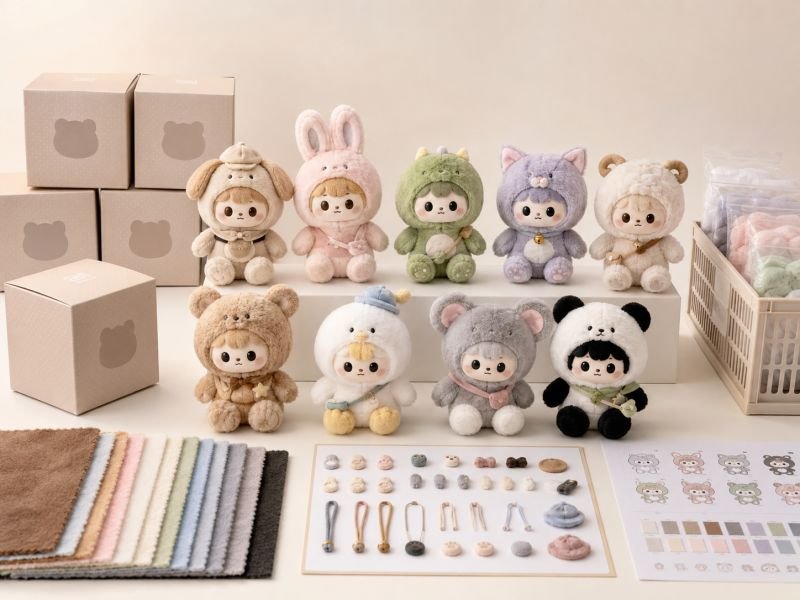
A blind box plush collection often begins with an exciting idea: several characters, one surprise experience, one launch story, and a product that feels collectible from the moment the box is opened. On the screen, the collection may look simple. In production, every character carries its own cost trail. A different face may require a new embroidery file. A new color may trigger fabric sourcing. A small hat may need its own pattern. A secret style may need separate packing control. A beautiful box may bring printing plates, barcode rules, and higher carton volume.
The cost of custom blind box plush toys is controlled by planning the whole collection as one connected product system. The most effective cost decisions are made before sampling: shared body shapes, shared fabrics, controlled craft areas, practical accessory rules, stable packaging size, clear SKU labels, and realistic quantity per style. The goal is not to remove charm. The goal is to spend on the details people notice and control the details that quietly raise production cost.
Many projects become expensive not because the design is big, but because the differences are scattered. One character has longer fur. One has a stitched coat. One has a special tail. One has a larger box. One uses another label. Each change looks small alone. Together, they can turn a cute blind box series into a complicated production puzzle. A stronger approach is simple: keep the collection rich in personality, but disciplined in structure.
What Drives Cost?
Custom blind box plush toy cost is shaped by more than size and quantity. The real cost comes from how the full collection is built: body structure, fabric plan, filling level, face craft, accessories, packaging, labels, carton loading, testing needs, and delivery schedule. In a multi-SKU order, a small change repeated across 6, 8, or 12 styles can become a major cost driver.
For a blind box plush collection, cost should be reviewed as a connected system. A 12 cm plush with simple embroidery, shared fabric, one box size, and clean SKU labels is very different from a 12 cm plush with special fur, layered clothing, removable accessories, dense embroidery, individual box artwork, and mixed carton rules. The finished size may look similar, but the production work is not similar at all.
A useful way to look at cost is to separate it into visible value and hidden workload.
Visible value includes the parts people notice immediately: face expression, softness, color, shape, packaging design, and the surprise experience.
Hidden workload includes the parts that quietly affect price: pattern pieces, cutting loss, stitch count, fabric sourcing, label files, packing ratio, carton volume, and quality checks.
The best cost plan does not remove the charm of the collection. It protects the charm while keeping the hidden workload under control.
| Cost Area | What Changes The Price | Why It Matters |
|---|---|---|
| Size | Height, width, thickness, head-body ratio | Affects fabric use, filling, box size, carton volume |
| Shape | Simple body or complex silhouette | More pattern pieces mean more sewing and checking |
| Fabric | Material type, pile height, color count, availability | Affects touch, color, cutting loss, repeat stability |
| Filling | Softness, shape support, recovery after packing | Affects hand feel, photo look, and box recovery |
| Face craft | Embroidery, printing, applique, stitch density | Controls expression, premium feel, and labor time |
| Accessories | Hats, bows, tails, charms, clothes, removable parts | Adds pattern work, sewing, attachment, inspection |
| Packaging | Blind box, display tray, insert, label, finish | Affects print setup, packing time, freight volume |
| Labels | Care label, warning label, barcode, SKU code | Needed for retail, warehouse, and regional use |
| Quantity split | Total pieces divided by number of styles | Lower quantity per style raises setup pressure |
| Schedule | Normal or urgent timing | Rush review may limit fabric and packing options |
Plush Size And Shape
Plush size is one of the first details people discuss, but it is often misunderstood. A larger plush is not only “more fabric.” It also uses more filling, needs more sewing time, takes up more box space, reduces carton loading, and may raise freight cost. A small plush can also become expensive if the design has many tiny parts that are hard to sew cleanly.
For blind box plush toys, size must be planned with packaging from the start. A plush that looks perfect on a desk may not work well inside a blind box. If the box is too tight, the ears, face, tail, or accessories may get pressed out of shape. If the box is too large, the product looks less refined inside the package and shipping becomes less efficient.
A practical early size check:
| Plush Size | Common Product Use | Cost Behavior | Packaging Concern |
|---|---|---|---|
| 8–10 cm | Mini plush, keychain plush, small collectibles | Less material, but tiny details are harder to sew | Needs very clean face craft |
| 11–15 cm | Standard blind box plush | Good balance between visual value and production efficiency | Works well with compact retail boxes |
| 16–20 cm | Premium blind box plush or limited release | Higher fabric, filling, sewing, and box cost | Requires stronger packaging |
| 20 cm+ | Feature plush, gift plush, display plush | Higher unit cost and freight pressure | Better for non-random premium releases |
For a multi-SKU plush series, the safest plan is usually to keep all main styles within one size family. For example, if the main styles are planned at about 12–15 cm, the secret style should not suddenly become 20 cm unless it is meant to be a premium version with a different price logic.
Shape also matters. A round body, simple arms, simple feet, and soft ears are easier to control. A character with horns, wings, long limbs, thin tail, shoes, removable coat, and tiny hands holding a prop needs more pattern pieces and more sewing time.
The most common cost-raising shape details include:
Large head with narrow neck.
Very thin arms or legs.
Long curved tail.
Tall ears that must stand.
Small shoes or separate feet.
Layered clothing.
Wings, horns, spikes, or hair tufts.
Removable or movable parts.
A good shape plan keeps the character recognizable without making every small detail three-dimensional. Some artwork details can be translated into embroidery, printing, or simple applique instead of full stuffed parts. This keeps the plush soft, cute, and easier to repeat.
For blind box collections, the strongest size strategy is often:
Use one shared height group.
Keep the body thickness close across styles.
Avoid one SKU needing a larger box.
Use shape changes where they are highly visible.
Simplify details that are hidden on the back or bottom.
Test whether the plush recovers after being boxed.
A plush collection should feel full of personality, but it should not force every style into a completely different production path.
Fabric And Filling
Fabric sets the first touch impression. It decides whether the plush feels soft, premium, playful, fluffy, clean, or flat. It also affects cost, cutting loss, color control, sample time, and repeat-order consistency. For blind box plush toys, fabric choice is especially important because the full collection should feel like one family when placed together.
A common mistake is choosing a different fabric for every character. This may look creative in artwork, but it can create material sourcing pressure. Different fabric types may have different thickness, stretch, pile direction, cutting behavior, and color stability. When too many fabrics are used across too many styles, production becomes harder to control.
A stronger plan is to build a fabric system.
For example:
One main body fabric for all styles.
One belly or face fabric used across several styles.
Two or three accent colors used repeatedly.
One special fabric reserved for the secret style.
One approved softness standard for the collection.
This method keeps the collection varied without letting material choices become chaotic.
| Fabric Plan | Cost Control Level | Best Use |
|---|---|---|
| One main fabric, limited colors | Strong | First launch, simple plush series |
| One main fabric, many colors | Balanced | Character collections |
| Shared body fabric + accent fabrics | Balanced | Animal, mascot, IP plush lines |
| Different fabric for each style | Harder to control | Premium or story-heavy releases |
| Special fabric for secret style only | Controlled premium effect | Limited or rare character |
Fabric colors also need realistic planning. Plush fabric can look different under lighting because of pile direction and surface texture. A dark navy, warm grey, or cream color may shift visually depending on fabric type. Color approval should be done with real swatches whenever possible, not only digital screens.
Filling affects cost and appearance in a quieter way. Too little filling makes the toy look weak and flat. Too much filling can make the plush hard, bulky, or difficult to fit into the blind box. Small blind box plush toys need careful filling because there is less space to hide uneven shaping.
Filling checks should include:
Does the head hold its shape?
Does the face stay smooth?
Do the ears recover after packing?
Does the body feel soft but not empty?
Can the plush sit or stand as designed?
Does every SKU feel similar in softness?
Does the box press any filled part too much?
For a 12–15 cm blind box plush, the difference between a good plush and a weak plush is often not the artwork. It is the fabric hand feel and filling balance. A cute drawing can lose value if the plush feels thin, stiff, or uneven.
A cost-friendly fabric and filling plan should do three things:
Protect softness.
Reduce unnecessary material variation.
Support repeat production.
Saving cost by using a poor fabric can hurt the opening experience. But using special fabric everywhere can also make the collection hard to price. The best choice is usually a stable soft material for the main body, then limited premium details where they bring visible value.
Printing Vs Embroidery Price Gap
Printing and embroidery both help turn a character into a plush product, but they create different cost behavior. Printing is useful for flat artwork, blush, patterns, clothing marks, gradients, small symbols, and color effects. Embroidery gives a raised stitched texture and is often used for eyes, mouth, eyebrows, noses, and signature facial details.
The price difference depends on how the craft is used. A small embroidered eye is usually manageable. A large dense embroidered outfit on every SKU can raise labor time. A simple printed cheek mark can be efficient. A complicated full-color print on curved plush fabric may need extra testing and careful placement.
The decision should be based on detail value, not habit. Some designs look better with embroidery. Some look cleaner with printing. Some need both.
| Craft Method | Best For | Cost Behavior | What To Watch |
|---|---|---|---|
| Printing | Blush, flat marks, outfit graphics, color patterns | Usually efficient for flat areas | Fabric surface, color accuracy, edge clarity |
| Embroidery | Eyes, mouth, premium expression details | Cost rises with stitch count and color count | Placement, density, thread colors |
| Applique | Belly patch, clothing layer, simple symbols | Medium to high | Cutting, alignment, edge stitching |
| Mixed craft | Rich collectible plush | Higher control needed | More files, more inspection steps |
Embroidery cost is often driven by:
Stitch area.
Stitch density.
Thread color count.
Number of embroidery positions.
Face placement precision.
Whether every SKU uses different artwork.
Printing cost is often driven by:
Print size.
Color complexity.
Fabric suitability.
Placement accuracy.
Color proofing.
Number of print versions.
For multi-SKU blind box plush toys, the smart approach is to create a craft rule for the whole collection. For example:
All eyes use embroidery.
All cheek blush uses printing.
All belly marks use simple applique or printing.
All accessories use the same attachment method.
No large dense embroidery unless it is a hero feature.
This keeps the collection visually polished and easier to control.
A practical face craft table:
| Face Detail | Suggested Craft | Reason |
|---|---|---|
| Eyes | Embroidery | Clear expression and durable finish |
| Mouth | Embroidery | Small detail, strong character value |
| Cheeks | Printing | Soft color, less stitch density |
| Eyebrows | Embroidery or print | Depends on size and expression |
| Nose | Embroidery or applique | Depends on character style |
| Small facial marks | Printing | Cleaner for tiny flat details |
| Premium logo detail | Embroidery | Better texture and perceived value |
For cost control, spend more craft effort on the face. The face is where people connect emotionally. Outfit patterns, back details, and tiny marks can often be simplified if they do not change the perceived value.
A useful rule is:
Use embroidery for emotion.
Use printing for color effects.
Use applique for clear layered shapes.
Use mixed craft only where the result is worth the extra control.
Accessories And Details
Accessories are often where a blind box plush collection gains personality. A bow can make one character sweet. A scarf can make another feel seasonal. A small charm can turn a secret style into something memorable. But accessories also bring pattern work, material sourcing, cutting, sewing, placement checks, attachment review, and packing concerns.
Accessory cost is not based only on size. A tiny hat can be more complicated than a larger flat belly patch. A small removable bag can need its own pattern, stitching, attachment, and safety review. A long tail can change box size even if it uses little fabric.
Accessories should be judged by production behavior:
Does it need a new pattern?
Does it use a different material?
Does it need stuffing?
Is it fixed or removable?
Does it affect box fit?
Does it create safety concerns?
Does it need its own inspection step?
Does every SKU use a different accessory?
Accessory cost comparison:
| Accessory Type | Cost Level | Example | Planning Tip |
|---|---|---|---|
| Printed accessory effect | Lower | Printed scarf, printed badge | Good for flat visual details |
| Flat sewn accessory | Medium | Bow, patch, flat scarf | Keep shape shared across SKUs |
| Stuffed accessory | Medium to high | Mini bag, plush horn, 3D tail | Use only for visible identity |
| Removable accessory | Higher | Removable scarf, outfit, charm | Review safety and packing carefully |
| Hard accessory | Higher | Keyring, magnet, plastic glasses | Needs stronger attachment review |
For a blind box plush line, one signature accessory per style is usually enough. Too many small parts can raise cost without improving the final impression. The end user may remember the cute face, soft feel, and unique color more than three tiny details hidden on the back.
A smart accessory plan may look like this:
All styles share one body.
Each style gets one identity feature.
Accessory shape is shared when possible.
Colors change more often than structure.
Removable pieces are limited.
Hard parts are avoided unless necessary.
The secret style gets one premium detail.
Example:
| SKU | Identity Detail | Cost-Control Choice |
|---|---|---|
| Bunny | Bow | Same bow pattern, different color |
| Bear | Scarf | Shared scarf shape |
| Cat | Tail mark | Printed or simple sewn mark |
| Puppy | Ear patch | Same patch size, different color |
| Fox | Belly symbol | Printed detail |
| Secret Fox | Small charm | One special feature only |
This keeps the collection fun without turning every style into a separate project.
Accessories should also be reviewed with the target age and sales region in mind. Small hard parts, loose parts, magnets, and removable pieces may require stronger safety review. If the plush is intended for younger users, simpler sewn details are often safer and easier to manage.
Packaging Price Factors
Blind box packaging does more than hold the plush. It creates surprise, protects the toy, carries artwork, supports retail display, controls SKU identity, and affects shipping cost. For many blind box plush collections, packaging is one of the biggest differences between a simple plush order and a collectible product launch.
Packaging cost is shaped by:
Box size.
Paper thickness.
Print colors.
Surface finish.
Printing setup.
Inner bag or insert.
Display tray.
Barcode or SKU label.
Secret style control.
Carton loading.
The most important packaging decision is box size. A box that is 1–2 cm larger in each direction can reduce the number of units per carton. That can raise shipping volume quickly, especially for thousands of pieces. A box that is too small can crush ears, flatten the face, or bend accessories.
A practical box planning table:
| Packaging Choice | Cost Level | Best Use | Hidden Cost |
|---|---|---|---|
| Polybag only | Lower | Simple plush or event gifts | Weak presentation |
| Polybag + hangtag | Low to medium | Gift programs, basic retail | Less surprise effect |
| Shared blind box | Medium | Standard collectible plush | Needs clear SKU packing control |
| Blind box + inner bag | Medium to high | Better hidden-style protection | Extra packing step |
| Blind box + display tray | Higher | Shelf display and retail launch | More carton volume |
| Gift box | Higher | Premium release | Larger freight volume |
For cost control, many collections use one shared blind box artwork for all styles. The box sells the whole collection, while internal records manage the SKU. This can reduce the need for separate print setups. If every character has its own printed box, the packaging may look richer, but files, printing setup, inventory control, and packing work all become heavier.
Packaging plates and setup costs depend on the printing method and artwork requirements. Instead of changing the full box artwork for every style, it may be more efficient to use:
One shared outer box design.
One shared display tray.
Barcode sticker if needed.
Internal SKU code.
Carton packing sheet.
Separate secret style control sheet.
This approach keeps the blind box experience clean while avoiding too many packaging versions.
Label needs should also be reviewed early. Depending on the sales channel and destination region, the product may need care labels, warning labels, barcode labels, SKU labels, FNSKU labels, carton marks, or retail stickers. These are small items, but wrong labels can delay receiving or create inventory trouble.
Packaging also affects perceived value. A soft plush in a weak box may feel less premium. A beautiful box with poor carton planning may become expensive to ship. The right choice sits between brand presentation and practical handling.
A good packaging plan should confirm:
Will all SKUs share one box size?
Will the box hide the style fully?
Will the plush recover after being boxed?
Will there be an inner bag?
Does the box need a display tray?
Does each unit need a barcode?
Will online warehouse labels be required?
How many pieces fit per carton?
How will secret styles be controlled?
Will carton marks show mixed assortment details?
A blind box package should make the product feel exciting when opened. But before that moment, it must survive printing, packing, carton loading, shipping, receiving, and storage.
How To Control Design Cost

Design cost is controlled before the first sample is made. A blind box plush collection becomes easier to price when the body shape, size group, fabric system, craft method, accessory rules, box size, labels, and SKU records are planned as one connected product line. The strongest cost control does not make the plush look plain. It keeps the expensive differences under control and puts budget into the details people can see, touch, and remember.
A good multi-SKU plush line usually has two layers.
The first layer is the shared structure:
Same or similar body size.
Same box size.
Same main fabric quality.
Same basic filling feel.
Same craft method for facial details.
Same label format.
Same carton logic.
The second layer is character variation:
Different color story.
Different face expression.
Different ear or tail shape.
One visible accessory.
Small printed or embroidered marks.
Secret-style detail.
This balance keeps the collection attractive without turning every style into a completely separate development project.
A simple design-cost map:
| Design Choice | Cost Behavior | Better Planning Method |
|---|---|---|
| Shared body size | Easier to control | Use one height group for all main styles |
| Unique body per style | Higher | Reserve for hero characters only |
| Shared fabric type | Easier to control | Change colors instead of material quality |
| New fabric per SKU | Higher | Use only when the texture is important |
| Controlled face craft | Easier to control | Keep eye and mouth position consistent |
| Large dense embroidery | Higher | Use only for key emotional features |
| One accessory per style | Balanced | Make the accessory easy to sew and pack |
| Many tiny accessories | Higher | Replace some details with print or embroidery |
| Shared blind box size | Easier to control | Lock plush size before packaging artwork |
| Different box per style | Higher | Use labels or internal codes where possible |
The most expensive design problems usually come from late decisions. A new accessory after the first sample, a larger plush after box planning, a new fabric after color approval, or a different secret style ratio after packing rules can all create extra work. A cost-controlled design plan should freeze the key rules early and leave only controlled creative space for each character.
Shared Base Pattern
A shared base pattern means several plush styles use the same or similar body structure. The characters still look different, but the hidden production structure stays close. This is one of the most practical ways to control cost in blind box plush projects.
For plush toys, the body pattern is the foundation. It decides how fabric is cut, how the parts are sewn, where filling enters, how the head sits, how the arms and legs attach, how the plush fits the box, and how the final shape is checked. If each SKU has a different body, each SKU needs more development work. If the body is shared, the collection can grow around one stable structure.
A shared base pattern can help control:
Pattern drawing time.
Trial cutting.
Sewing sequence.
Filling balance.
Shape correction.
Box fit.
Size tolerance.
Inspection reference.
Repeat-order consistency.
For example, a 6-style animal blind box line may share one chubby sitting body. Each character can still feel different through ears, tail, facial expression, color, belly mark, or one small accessory. The body stays consistent, while the personality changes.
Shared pattern planning example:
| Area | Shared Across 6 Styles | Changed By Character | Why It Helps |
|---|---|---|---|
| Body height | 13 cm | No | Same box size |
| Head size | Same base shape | Small ear placement changes | Easier face positioning |
| Arm shape | Same | No | Faster sewing |
| Foot shape | Same | Paw print color | Visual difference without new structure |
| Main fabric | Same quality | Different colors | Stable hand feel |
| Face craft area | Same size zone | Different expression | Easier file control |
| Tail | Same attachment zone | Different shape by animal | Controlled variation |
| Box | Same structure | Internal SKU code | Better packing control |
This approach works well for many blind box themes:
Animal families.
Mini monsters.
Brand mascots.
Seasonal characters.
Fruit or food characters.
Fantasy creatures.
School or club characters.
Sports mascot sets.
The shared pattern should not feel lazy. It should feel like the collection belongs to one world. The difference is in the design rules. If all characters share the same body but have weak face work and random colors, the line may feel flat. If the shared body is paired with strong expressions, clear color stories, and memorable silhouette details, the line feels intentional.
A useful design test:
Can people recognize each character from the face and silhouette?
Can all styles fit the same box?
Can the body pattern be reused without hurting character identity?
Can accessories be added without changing the whole body?
Can the collection expand later with the same base?
A shared base pattern is not only a cost tool. It also helps the product line look more unified.
Do Shared Body Molds Reduce Fees?
In plush production, the word “mold” is often used in casual conversation, but plush toys usually rely on paper patterns rather than hard molds. A hard plastic toy may use a mold. A plush toy is built from fabric pieces, sewing lines, filling, shaping, and soft structure. So the more accurate term is shared body pattern or shared body structure.
Sharing the body structure can reduce repeated development work because the base shape does not need to be built again for every style. The development team can focus on the differences that matter: face, color, ears, tail, outfit mark, accessory, and secret-style detail.
Shared body value table:
| Shared Body Element | What It Can Reduce | What Still Needs Review |
|---|---|---|
| Main body panels | Repeated pattern work | Fabric stretch and cutting direction |
| Head shape | Repeated shaping review | Face placement and expression |
| Arm and leg pattern | Sewing sequence changes | Pose and attachment strength |
| Filling method | Softness variation | Final hand feel by SKU |
| Box fit | Repeated packaging checks | Accessories that increase thickness |
| Inspection standard | Different tolerance logic | Style-specific features |
The fee benefit depends on how much is truly shared. If only the body is shared but every style has unique ears, unique clothes, unique accessories, unique embroidery, and special fabric, the savings become smaller. If the body, fabric quality, box size, and craft rules are shared, the effect is stronger.
A more realistic view:
| Collection Structure | Development Pressure | Cost Control Level |
|---|---|---|
| Same body, same fabric type, different expressions | Lower | Strong |
| Same body, different colors, one accessory per SKU | Balanced | Good |
| Same body, unique outfit per SKU | Medium to high | Needs review |
| Same body, special fabric per SKU | Medium to high | Material pressure |
| Unique body per SKU | High | Premium planning needed |
| Unique body + unique box per SKU | Very high | Use only for special programs |
Shared body planning should happen before sampling begins. If one plush is sampled first without thinking about the full collection, later styles may not fit the same body logic. The result can be uneven proportions, different box needs, and extra revision work.
A better path:
Review all SKU artwork together.
Choose one base body family.
Decide which parts can vary.
Sample one standard body first.
Sample one complex style as a stress test.
Use the approved structure for the remaining styles.
This avoids building every character from scratch. It also gives the collection a cleaner look when all styles are placed together.
Shared body structure is most useful when the sales value comes from collecting the set, not from each style being completely different. For blind box plush toys, this is often the right direction. The surprise comes from character identity, not from rebuilding the whole plush every time.
Can We Mix SKUs For Fabric MOQ?
Mixing SKUs to reach fabric MOQ can work when multiple styles use the same fabric quality, same color, same pile height, same thickness, and similar cutting direction. It does not work well when every SKU uses a different fabric color, special texture, backing, or finish. The total order quantity matters, but the usable fabric quantity by color and material matters more.
This is a common hidden cost in multi-SKU plush orders. A collection may have 6,000 pieces in total, but if it uses 12 styles and each style has a unique body color, each color may only support around 500 pieces. If the material color is standard and available, that may be manageable. If it requires custom dyeing or special sourcing, the material side can become harder.
Example:
| Total Order | Style Count | Main Body Color Plan | Fabric Pressure |
|---|---|---|---|
| 6,000 pcs | 6 styles | 3 colors shared by 2 styles each | Easier |
| 6,000 pcs | 6 styles | 6 unique colors | Medium |
| 6,000 pcs | 12 styles | 4 colors shared by groups | Balanced |
| 6,000 pcs | 12 styles | 12 unique colors | Higher |
| 6,000 pcs | 12 styles | 12 colors + 5 special fabrics | Much higher |
A stronger fabric plan groups materials by function:
Main body fabric.
Belly fabric.
Ear or paw accent fabric.
Accessory fabric.
Secret-style special fabric.
Packaging fabric, if any pouch or cloth element is used.
Fabric grouping example for an 8-style plush line:
| Fabric Group | Used By | Number Of Styles | Planning Benefit |
|---|---|---|---|
| Soft short plush, cream | Main face areas | 8 | Shared hand feel |
| Soft short plush, brown | Bear, puppy, fox | 3 | Better material use |
| Soft short plush, pink | Bunny, cat, secret style | 3 | Shared accent use |
| White belly fabric | Belly patches | 6 | Stable visual style |
| Gold accent fabric | Secret style only | 1 | Controlled premium detail |
This plan gives the collection variety without using a completely different material for every style.
The most practical fabric cost-control rules:
Keep one main material quality for the whole collection.
Group colors across several SKUs.
Use accent colors repeatedly.
Limit special fabric to one or two meaningful details.
Avoid custom fabric colors for very low quantities.
Review fabric availability before final artwork approval.
Save fabric swatches for repeat orders.
Fabric sharing can also improve the final look. When all styles use a similar hand feel, the collection feels more consistent. If one character is made with short plush, another with shaggy fur, another with fleece, and another with sherpa, the set may look less unified unless that mix is part of the concept.
Fabric MOQ is not only a sourcing issue. It affects sample timing, bulk cost, color consistency, repeat releases, and the final touch experience.
Controlled Variatio
Controlled variation means deciding where each character is allowed to differ. Instead of changing everything randomly, the design uses planned variation zones. This keeps the collection visually rich and production-friendly.
In a blind box plush line, the most useful variation zones are usually:
Face expression.
Body color.
Ear shape.
Tail shape.
Belly mark.
Cheek detail.
One accessory.
Small clothing mark.
Secret-style feature.
The less useful variation zones are often the ones people barely see but still cost money:
Different seam structure on the back.
Tiny separate fingers.
Hidden small patches.
Complicated shoes under the body.
Different box size per style.
Different care label layout per style.
Different filling softness by character.
A good blind box plush line should spend effort where people notice it.
Variation value table:
| Variation Area | Visual Value | Cost Pressure | Recommendation |
|---|---|---|---|
| Face expression | High | Low to medium | Worth investing in |
| Body color | High | Medium | Good if fabrics are grouped |
| Ear shape | Medium to high | Medium | Strong for animal characters |
| Tail shape | Medium | Medium | Keep attachment zone shared |
| Belly mark | Medium | Low to medium | Good for simple identity |
| Bow or scarf | Medium to high | Medium | Use shared pattern |
| Removable outfit | High | High | Use only when needed |
| Different body pose | High | High | Better for premium lines |
| Different box size | Low to medium | High | Avoid when possible |
One helpful method is to give each SKU a “variation limit.” For example:
Every style may have one face change.
Every style may have one color change.
Every style may have one ear or tail change.
Every style may have one small accessory.
No style changes the body height.
No style changes the box size.
No style adds a removable part unless approved early.
This makes the collection much easier to review and price.
Example variation plan for a 6-style plush line:
| SKU | Face | Color | Shape Detail | Accessory | Box |
|---|---|---|---|---|---|
| Bunny | Smile | Pink/cream | Long ears | Bow | Shared |
| Bear | Sleepy face | Brown/cream | Round ears | Scarf | Shared |
| Cat | Wink | Grey/white | Ears | Fish patch | Shared |
| Puppy | Happy face | Tan/white | Floppy ears | Collar print | Shared |
| Fox | Cute grin | Orange/cream | Tail shape | Belly mark | Shared |
| Secret Fox | Star eyes | Special color | Same tail | Small charm | Shared |
This gives every style personality while keeping the product family under control.
Controlled variation also helps inspection. If every character follows the same logic, the inspection team can compare each style against a clear approved sample. If every style is structurally different, inspection becomes more time-consuming and error-prone.
The strongest variation plan has three qualities:
Easy to see.
Easy to make.
Easy to repeat.
If a detail does not meet at least two of these, it may not be worth the cost.
Best Detail Choices
The best details are the details that create emotional value without creating unnecessary production difficulty. For blind box plush toys, the face, silhouette, color story, and opening experience matter most. Small hidden details may look impressive in artwork, but they often do not carry enough value once the plush is boxed, shipped, opened, and photographed.
Face details deserve the most attention. Eyes, mouth, nose, eyebrows, and cheeks carry personality. A sleepy face, shy smile, angry eyebrow, star eye, or tiny blush mark can make a character memorable. Facial expression also works well in product photos and collection displays.
Silhouette details are the next priority. Ears, horns, tails, hair tufts, head shape, and body outline help people recognize the character from a distance. These details should be simple enough to sew cleanly and strong enough to hold shape after packing.
Accessories should be selected with restraint. One good accessory can complete a character. Too many accessories can raise cost, increase inspection work, and make the plush harder to pack.
A useful detail priority table:
| Detail Area | Priority | Reason |
|---|---|---|
| Eyes and mouth | Very high | Carries emotion and character identity |
| Head shape and ears | High | Creates silhouette recognition |
| Body color | High | Strong first impression |
| Belly or chest mark | Medium | Easy way to add identity |
| Tail | Medium | Good for animal styles |
| Small accessory | Medium | Adds collectibility |
| Back details | Low to medium | Less visible after display |
| Tiny clothing parts | Low to high | Only worth it if visible |
| Removable parts | High cost pressure | Use carefully |
| Different box size | Low value for design | High packing cost |
Cost-friendly details include:
Embroidered eyes with controlled stitch area.
Printed cheek blush.
Simple belly patch.
Shared scarf pattern.
Color-changed bow.
Small printed outfit mark.
Ear shape variation.
Tail color variation.
Secret-style charm.
Details that need careful review include:
Tiny sewn fingers.
Stuffed mini props.
Layered clothing.
Separate shoes.
Removable hats.
Hard parts.
Magnets.
Sound modules.
Different box structures.
The best design details often follow a “one hero detail” rule. Each style gets one memorable feature. That feature may be a face, color, ear shape, tail, accessory, or secret mark. Other details stay simpler.
Example:
| Character | Hero Detail | Simplified Areas |
|---|---|---|
| Bunny | Long ears + bow | Simple body, shared face craft size |
| Bear | Sleepy face | No extra clothing |
| Cat | Wink + tail curve | Printed cheek mark instead of extra patch |
| Puppy | Floppy ears | Simple collar print |
| Fox | Large tail | No removable accessory |
| Secret style | Rare color + small charm | Same body and box |
This gives every character a reason to be collected without adding too many production steps.
A good detail plan should also consider product photos. Details that show clearly in front-view photos usually bring more value than details hidden on the side or back. If a small accessory does not improve the product photo, hand feel, or opening experience, it may not deserve the extra cost.
Size Standardization
Size standardization is one of the simplest ways to control design cost, packaging cost, and shipping cost at the same time. When all main styles stay within one size group, the project can use one box structure, one carton loading plan, and one size tolerance standard.
A blind box collection does not need every plush to be exactly identical in outline, but the packed size should be close. Large ears, tails, hats, or accessories should be checked because they can increase the actual box space even if the body height stays the same.
Size standardization should review:
Overall height.
Width including ears or arms.
Thickness including tail or accessory.
Head size.
Body depth.
Packed shape.
Box fit.
Carton loading.
Example size control plan:
| Size Item | Target For Main Styles | Why It Matters |
|---|---|---|
| Plush height | 12–15 cm | Keeps collection visually balanced |
| Maximum width | Within shared box limit | Prevents different box sizes |
| Maximum thickness | Within packed depth limit | Supports carton loading |
| Ear height | Controlled by style | Avoids crushed ears |
| Tail length | Fit inside box | Prevents deformation |
| Accessory thickness | Reviewed before sample | Avoids box bulging |
Size standardization also helps perceived quality. If one plush looks much smaller than the others, the collection may feel uneven. If one plush barely fits inside the box, it may open with shape problems. If one plush needs a larger box, the packing line becomes more complex.
A smart approach is to decide the box size early, then design each plush to fit that box comfortably. This does not mean forcing every character to look the same. It means respecting the physical limits of the product system.
Practical size rules:
Set the box size before finalizing large accessories.
Keep all regular styles in one height group.
Check width and thickness, not only height.
Make secret styles special through details, not larger size.
Avoid long thin parts that bend in the box.
Test packing recovery during sample review.
The final product should feel consistent when the full set is displayed together. Size standardization helps the collection look more professional while also controlling cost.
Color Planning
Color planning affects fabric cost, visual consistency, photo appeal, and repeat releases. Blind box plush toys often rely on color to separate characters, but too many unique colors can create sourcing pressure. The best plan uses a limited palette with smart repetition.
A good plush color plan usually includes:
One or two base colors.
Several character colors.
Shared accent colors.
One rare color for the secret style.
Approved fabric swatches.
Color references for thread and print.
Color planning example:
| Color Type | Used For | Number Of SKUs | Cost Behavior |
|---|---|---|---|
| Cream base | Face and belly | 8 SKUs | Efficient |
| Soft brown | Bear, puppy, fox | 3 SKUs | Good grouping |
| Pink accent | Bunny, cat, secret style | 3 SKUs | Shared accent |
| Grey | Cat and wolf | 2 SKUs | Moderate |
| Gold | Secret detail only | 1 SKU | Controlled premium effect |
This plan gives the line enough color variety while avoiding one-off colors everywhere.
Color planning should also consider product photos. Colors that look beautiful in artwork may not work well on plush fabric. Very dark colors may hide facial embroidery. Very pale colors may show dirt more easily. Similar colors may be hard to tell apart in small product photos.
Useful color checks:
Do the characters look different enough in group photos?
Does the face stand out on each body color?
Will embroidery thread contrast clearly?
Does the color fit the plush fabric surface?
Can the color be repeated in future runs?
Is the secret style visually special without needing a new body?
Color should carry identity, but it should not create chaos. A controlled palette helps the collection look intentional and helps production stay organized.
Craft Area Limits
Craft area limits help control cost by setting clear boundaries for embroidery, printing, applique, and other surface details. Without limits, craft cost can grow quietly across multiple SKUs. One large embroidery panel may be acceptable. Six large embroidery panels in six different designs can become expensive.
For blind box plush toys, the most valuable craft area is usually the face. This is where expression happens. Body patterns, clothing marks, and back details should be reviewed more carefully because they may add cost without adding enough visible value.
Craft planning table:
| Craft Area | Recommended Control | Reason |
|---|---|---|
| Eyes | Keep embroidery high quality | Strong emotional value |
| Mouth | Small controlled embroidery | Important for expression |
| Cheeks | Print if soft color is needed | Lower stitch density |
| Belly mark | Print or simple applique | Visible but easy to control |
| Outfit graphics | Print where possible | Avoid heavy embroidery |
| Back details | Simplify | Less visible |
| Secret mark | Small premium craft | Adds rarity without high cost |
Embroidery cost rises when the stitch area grows, the density increases, thread colors multiply, or placement becomes difficult. Printing needs its own checks, especially on plush fabric, but it can be efficient for flat color effects.
A useful craft rule for a multi-SKU collection:
Keep all eyes in one size zone.
Keep mouth placement consistent.
Limit thread color count.
Use printing for blush and flat marks.
Avoid dense embroidery on large clothing areas.
Use applique only for bold simple shapes.
Do not mix too many craft methods on one small plush.
Craft limits should be set before sample files are prepared. If every style is designed with different craft logic, file preparation and inspection become heavier. If the craft system is shared, the collection becomes easier to sample and compare.
Accessory Budget Rules
An accessory budget rule sets how much detail each character can carry. This prevents one SKU from becoming much more expensive than the others. It also helps the full collection feel balanced.
A simple rule may be:
One main accessory per regular style.
One premium detail for the secret style.
No removable parts unless required.
No hard parts unless reviewed early.
Shared accessory pattern where possible.
No accessory that changes box size.
This gives designers creative space while keeping the product practical.
Accessory budget example:
| Style Type | Accessory Allowance | Example |
|---|---|---|
| Regular style | 1 small fixed accessory | Bow, scarf, patch |
| Premium regular style | 1 medium fixed accessory | Tail, small bag, hat |
| Secret style | 1 special feature | Rare color charm, metallic mark |
| Event version | Minimal accessory | Printed logo, simple scarf |
| Premium release | More detail allowed | Outfit or removable piece |
Accessory rules should also control placement. If all accessories are placed around the neck or chest, packing and inspection are easier. If one style has a hat, another has a side bag, another has a long tail, and another has large wings, the box fit and sewing process become less predictable.
A practical accessory review should ask:
Can the accessory be sewn firmly?
Can it keep shape after packing?
Can it fit the blind box?
Can it be checked quickly?
Does it create safety concerns?
Does it make the character more memorable?
Can the shape be reused in future SKUs?
If the accessory does not add clear value, it may be better to express the idea through embroidery, print, color, or hangtag artwork.
Design Freeze Rules
Design freeze means the approved design details stop changing before bulk preparation begins. It protects cost, schedule, and quality. Without a clear freeze, late changes can affect pattern files, fabric orders, embroidery preparation, packaging printing, labels, carton marks, and delivery timing.
For a blind box plush collection, design freeze should happen in layers.
First freeze:
Style count.
Body size.
Shared structure.
Main fabric direction.
Box size direction.
Second freeze:
Final sample shape.
Face craft.
Accessory details.
Fabric colors.
Packaging artwork.
Labels.
Final freeze:
Quantity per SKU.
Secret style ratio.
Carton packing rule.
Shipment needs.
A design freeze table:
| Item To Freeze | Freeze Before | Risk If Changed Late |
|---|---|---|
| Body size | Final pattern | New pattern and box fit issue |
| Fabric | Bulk material order | Color delay or material waste |
| Face craft | Embroidery or print setup | New files and rechecking |
| Accessory | Sewing preparation | New pattern and attachment review |
| Box size | Packaging print setup | New plate and carton changes |
| Barcode/SKU label | Packing | Warehouse or stock confusion |
| Secret ratio | Mixed packing | Wrong assortment |
Design freeze does not remove creativity. It simply separates the creative stage from the production stage. Before the freeze, ideas can be tested. After the freeze, the focus shifts to making the approved product consistently.
A useful habit is to keep a “change log.” If anything changes after approval, record:
What changed.
Which SKU is affected.
Whether cost changes.
Whether timing changes.
Whether packaging changes.
Whether a new sample is needed.
Whether labels or carton rules change.
This keeps late decisions visible. A late change may still be possible, but it should not be invisible.
Good design cost control is not about cutting every idea. It is about choosing the ideas that deserve to become real plush details, then locking them clearly so the collection can move into production without surprises.
How Sampling Affects Price

Sampling affects price because it turns artwork into a real plush product that can be checked, measured, adjusted, packed, and repeated. A blind box plush sample is not only a cute prototype. It is the physical reference for body shape, fabric feel, face craft, filling level, accessory placement, label position, blind box fit, and bulk production standards. The clearer the sample stage is, the easier the final cost becomes to control.
In a single plush project, one sample may be enough to confirm the direction. In a multi-SKU blind box collection, sampling becomes more layered. The project may need one base body sample, several character samples, a secret style sample, a packaging fit test, and label checks before bulk work begins. Each extra sample may bring more pattern work, material preparation, embroidery files, printing checks, sewing time, and revision work.
Sampling cost usually rises when the project has:
Many styles with different bodies.
Several fabric types or rare colors.
Dense embroidery on small faces.
Unique accessories per SKU.
Removable or hard parts.
Different box structures.
Unclear side or back views.
Late artwork changes.
Changing quantity split after sampling.
Packaging files prepared too late.
A strong sampling plan protects the budget because it catches design and packing issues before bulk production. A weak sampling plan may look faster at first, but it often creates extra revisions, material changes, box changes, and schedule pressure later.
| Sampling Area | What It Checks | How It Affects Price |
|---|---|---|
| Body shape | Height, width, head-body balance, pose | Pattern revision, filling, sewing time |
| Fabric | Softness, color, pile direction, texture | Material sourcing, color approval, repeat stability |
| Face craft | Eyes, mouth, cheek, expression | Embroidery or print file work |
| Accessories | Shape, attachment, position, durability | Extra pattern pieces and sewing work |
| Filling | Firmness, recovery, sitting balance | Hand feel and box recovery |
| Blind box fit | Compression, box size, corner space | Packaging size and carton loading |
| Labels | Care label, warning label, barcode, SKU code | Packing accuracy and retail readiness |
| Secret style | Ratio, identity, hidden control | Separate packing records and SKU tracking |
Sample Process Guide
A proper sample process begins before fabric is cut. The first step is to review whether the artwork can become a soft plush product without losing the character’s personality. Flat illustrations often include details that work well on screen but need adjustment in plush form. Thin outlines, tiny fingers, small clothing layers, complex shoes, sharp horns, or delicate props may need to be simplified, resized, or translated into embroidery, printing, applique, or soft sewn parts.
A practical sample process for blind box plush toys usually includes:
Artwork review.
SKU list review.
Size discussion.
Fabric and color direction.
Body pattern planning.
Embroidery or print file preparation.
Accessory structure review.
First sample making.
Sample photos and measurements.
Physical sample review.
Revision list.
Revised sample if needed.
Packaging fit test.
Approved sample confirmation.
Bulk production file preparation.
For a multi-SKU blind box collection, sampling should not always start with every style at once. That can become expensive if the base body is not yet approved. A more controlled method is to choose one standard style and one difficult style first.
The standard style checks the shared body, size, fabric, filling, and box fit.
The difficult style checks the highest-risk details, such as tall ears, special tail, printed face, heavy embroidery, unique accessory, or secret-style detail.
Once these two styles are close to approval, the remaining SKUs can follow the confirmed structure more efficiently.
| Sample Type | Best Use | What It Helps Avoid |
|---|---|---|
| Base body sample | Shared body collections | Repeating the same body correction across all SKUs |
| Complex style sample | Style with ears, tail, accessory, or special craft | Discovering difficult details too late |
| Face craft sample | Expression-heavy characters | Wrong eye size, thread color, or placement |
| Fabric test sample | Softness or color-sensitive designs | Material mismatch after bulk fabric purchase |
| Packaging fit sample | Blind box plush | Crushed ears, box bulging, poor shape recovery |
| Secret style sample | Rare version | Hidden ratio and special detail confusion |
A sample request should include enough detail to reduce guessing:
Character artwork for each style.
Front, side, and back views if available.
Target height and width.
Quantity per style.
Fabric feel reference.
Color references.
Face craft notes.
Accessory notes.
Blind box concept.
Label needs.
Target sales region.
Delivery deadline.
A good sample is not only close to the artwork. It should also be practical to repeat in bulk. If the sample depends on too much hand shaping, unusual fabric behavior, or delicate tiny parts, the bulk result may become harder to keep consistent.
First Sample Vs Revised Sample
The first sample is the first physical version made from the design files, pattern, material direction, and craft notes. It is used to check whether the character works as a real plush product. It may not be perfect, especially for character plush, because softness, stuffing, fabric pile, and sewing curves all behave differently from flat artwork.
The first sample should be reviewed for:
Overall cuteness.
Head and body ratio.
Face position.
Eye size.
Mouth shape.
Fabric feel.
Color match.
Filling level.
Accessory size.
Tail or ear shape.
Sitting or standing balance.
Blind box fit.
A revised sample is made after specific changes are requested. Revision is normal in custom plush work, but each revision can affect cost and timing. Some changes are minor. Others may require new pattern work, new fabric, new embroidery files, new sewing steps, or a second packaging fit check.
| Revision Type | Effort Level | Why It Matters |
|---|---|---|
| Move eyes slightly | Low to medium | May need embroidery position update |
| Change mouth shape | Low to medium | Usually file-level adjustment |
| Adjust cheek color | Low to medium | Print color or thread change |
| Change fabric color | Medium | Material sourcing or swatch review |
| Make head larger | Medium to high | Pattern and filling balance change |
| Change body size | High | Pattern, box, carton, and cost may shift |
| Add accessory | Medium to high | New pattern, material, attachment, packing check |
| Change box size | High | Packaging artwork and carton plan may change |
| Add removable part | High | Fit, safety, and packing need review |
The best revision feedback is specific. Vague comments such as “make it cuter” or “make it more premium” create confusion. Specific comments save time.
Better revision notes look like this:
Move eyes 2–3 mm lower.
Make head about 5% wider.
Shorten ears by 1 cm.
Make the mouth curve softer.
Change cheek print to lighter pink.
Make filling softer in the body.
Keep head firmer so the face holds shape.
Move bow closer to the left ear.
Make tail flatter so it fits the box.
Reduce scarf thickness.
Clear revision notes help the sample team adjust the right part without changing everything else. This protects the original design and avoids unnecessary sample rounds.
For multi-SKU collections, revisions should be grouped carefully. If every SKU receives scattered feedback at different times, sample work becomes slow and confusing. A better habit is to collect all comments in one review sheet per style.
| Feedback Method | Result |
|---|---|
| Comments sent one by one | Higher risk of missed details and repeated work |
| One clear list per SKU | Easier correction and cleaner records |
| Marked-up photos | Better for placement and proportion changes |
| Physical sample comparison | Best for softness, size, and shape |
| Video review | Useful for 360° shape and movement |
A revised sample should not become a new concept every time. If the design changes too much in every round, the project is no longer revising. It is restarting. That is where sample cost and timing can climb quickly.
Sample Fee Logic
Custom plush samples usually need a sample fee because a real sample requires skilled work before any bulk quantity exists. The fee is not only for one piece of plush. It covers pattern development, material preparation, embroidery or printing setup, cutting, sewing, filling, shaping, accessory work, and revision handling.
For a multi-SKU blind box plush collection, sample fees may vary by style difficulty. A simple shared-body style may need less work than a secret style with special fabric, dense embroidery, and a charm. A character with a standard face and one bow is easier than a character with removable clothing, horns, wings, or a shaped tail.
Common sample fee drivers include:
Pattern complexity.
Number of pattern pieces.
Fabric sourcing difficulty.
Embroidery stitch area.
Printing test needs.
Accessory structure.
Removable parts.
Hard parts.
Packaging fit sample.
Revision rounds.
Number of SKUs sampled.
| Sample Feature | Sample Fee Pressure | Reason |
|---|---|---|
| Shared simple body | Lower | Less new pattern work |
| Unique body shape | Higher | More pattern development |
| Available standard fabric | Lower | Easier material preparation |
| Special fabric or rare color | Higher | More sourcing work |
| Simple face embroidery | Lower to medium | Normal craft setup |
| Dense embroidery | Higher | More file and stitch work |
| One fixed accessory | Medium | Extra sewing and attachment |
| Removable accessory | Higher | Fit and safety review |
| Blind box fit test | Medium | Requires package-size checking |
| Full multi-SKU sampling | Higher | More style records and sample work |
Sample fee planning should be viewed against bulk goals. If a project has a clear bulk plan and reaches the agreed single-style quantity threshold, sample fee handling may be more flexible according to project terms. For long-term plush lines, the sample stage is part of product development, not just a one-piece cost.
The best way to control sample fees is not to skip samples. It is to send complete information before sampling begins. Incomplete files often create more sample rounds, and more sample rounds often cost more than preparing proper design references at the start.
Multi-SKU Sampling Plan
A multi-SKU blind box collection should not always sample every character in full detail at the same time. That can be costly if the shared body, fabric, box, or craft direction has not been approved yet. A staged sampling plan is usually more efficient.
A practical plan may include three sample levels.
Level 1: Base structure sample.
This confirms the body size, softness, filling, face zone, and box fit. It is used to check whether the main body can support the collection.
Level 2: Character sample group.
This includes several key characters with different details. For example, one with long ears, one with a tail, one with a scarf, one with a print detail, and one with the most complex face.
Level 3: Full SKU confirmation.
After the shared rules are approved, the remaining styles are developed with lower uncertainty.
| Sampling Stage | Number Of Styles | Purpose | Cost Benefit |
|---|---|---|---|
| Base structure | 1 style | Confirm body, size, filling, box fit | Avoids repeating body mistakes |
| Complex test | 1–2 styles | Test high-risk features | Finds costly details early |
| Main collection | 4–8 styles | Confirm character variations | Uses approved rules |
| Secret style | 1 style | Confirm rare detail and packing notes | Controls hidden-style risk |
| Packaging fit | 1–2 packed samples | Check compression and recovery | Prevents box redesign |
For example, an 8-style blind box plush project may start with:
One base bunny sample.
One fox sample with tail and belly mark.
One secret fox sample with special color and charm.
One box fit test.
After these are approved, the remaining five characters can follow the confirmed body, fabric, craft, and box logic.
This method gives the project team more control because difficult details are tested early. It also prevents the full collection from needing the same correction repeatedly.
A multi-SKU sample plan should clearly mark:
Which style is the base reference.
Which style is the complex test.
Which style is the secret version.
Which details are shared.
Which details are unique.
Which changes apply to all SKUs.
Which changes apply only to one SKU.
Without this structure, one correction can create confusion. For example, if the head needs to be slightly larger, does that change apply to every style or only one character? If the fabric feels too firm, should all styles change fabric or only the sampled one? A clear sample plan prevents this kind of confusion.
Packaging Fit Sample
Packaging fit is one of the most important parts of blind box plush sampling. A plush toy may look perfect outside the box, but the final product experience begins after the box is opened. If the plush is crushed, wrinkled, folded, or distorted, the opening moment feels weaker.
A packaging fit sample checks whether the plush can sit inside the blind box without damaging its shape. It also checks whether the box size is efficient for carton loading and freight.
Packaging fit should review:
Does the plush fit without force?
Are ears or horns bent?
Is the face pressed against the box?
Does the tail push the box wall?
Does the accessory create a bulge?
Can the plush recover after unpacking?
Does the box feel too empty?
Does the box close neatly?
Can the box survive carton loading?
Does the carton hold the planned quantity?
| Packing Issue | Possible Cause | Cost Impact |
|---|---|---|
| Flattened face | Box too tight or filling too soft | Product photo and opening experience suffer |
| Bent ears | Tall or thin parts pressed inside box | May need shape change or larger box |
| Bulging box | Plush too thick or accessory too large | Box size and carton plan may change |
| Loose plush inside box | Box too large | Higher packaging and freight cost |
| Damaged box corners | Weak paper or tight carton loading | More packaging waste |
| Poor recovery | Fabric or filling issue | May need material or stuffing adjustment |
Blind box packaging should be checked with the actual plush, not only artwork dimensions. Soft products compress unevenly. A tail, bow, or ear can change the packed shape even when the body size stays the same.
A good fit test may include:
Place plush in box for several hours.
Check shape immediately after opening.
Check recovery after 10–30 minutes.
Review face, ears, tail, and accessories.
Check whether the box still closes cleanly.
Check carton loading with packed boxes.
This is especially important for small plush toys, where a few millimeters can affect appearance. A 13 cm plush with soft ears may fit well. A 13 cm plush with stiff ears or a thick accessory may need a larger box.
Packaging fit is not a small detail. It can change box cost, carton size, freight volume, and product reviews.
Approved Sample Rules
The approved sample is the physical standard for bulk production. Once a sample is approved, it becomes the reference for body shape, size, fabric, face craft, filling, accessories, labels, packaging, and inspection. For blind box plush toys, each SKU should have its own approved sample record.
A good approved sample record should include:
Final sample photos.
Front, side, and back views.
Size measurements.
Fabric name and color reference.
Embroidery or print file.
Accessory details.
Filling level.
Label position.
Box fit result.
SKU code.
Carton packing rule.
Secret style ratio if needed.
Inspection focus.
The approved sample should be realistic for bulk production. Sometimes a sample looks beautiful because it receives a lot of hand shaping. If that level of shaping cannot be repeated across hundreds or thousands of units, the sample may not be suitable as a bulk standard. A good sample should be attractive and repeatable.
| Approved Sample Item | Why It Matters |
|---|---|
| Physical sample | Gives real hand feel and shape reference |
| Measurement record | Controls size tolerance |
| Fabric swatch | Helps material comparison |
| Face craft file | Prevents expression changes |
| Accessory record | Controls placement and construction |
| Packing test result | Confirms box fit |
| Label file | Supports packing accuracy |
| SKU code | Prevents style mix-up |
| Photo record | Helps remote review and repeat orders |
Late changes after sample approval should be handled carefully. A change to one detail may affect many connected areas.
Examples:
Changing eye size may require a new embroidery file.
Changing fabric color may require new material review.
Changing plush height may affect the box.
Changing accessory placement may affect sewing and packing.
Changing packaging artwork may affect printing setup.
Changing SKU ratio may affect carton packing records.
A useful rule is simple: once the approved sample is confirmed, changes should be treated as controlled updates, not casual comments. Each update should be checked for cost, timing, and related files.
How Long Sampling Takes
Sampling time depends on design complexity, material readiness, craft method, accessory difficulty, packaging needs, and revision speed. A simple plush with clear files and available material can move faster. A multi-SKU blind box collection with many characters, special fabrics, dense embroidery, accessories, and packaging fit tests needs more time.
For custom plush projects, sampling often includes artwork review, pattern making, fabric preparation, embroidery or printing, cutting, sewing, stuffing, shaping, and review. If revisions are needed, extra time is added.
A practical timing view:
| Sampling Situation | Time Pressure | Reason |
|---|---|---|
| Clear artwork, simple body, available fabric | Lower | Fewer unknowns |
| Shared body with color variations | Moderate | Body is stable, colors need checking |
| Multiple unique bodies | Higher | More patterns and sample work |
| Heavy face embroidery | Higher | File preparation and placement review |
| Special fabric | Higher | Material sourcing may take longer |
| Removable accessory | Higher | Structure and fit review |
| Blind box packaging sample | Moderate to high | Box fit and print planning needed |
| Several revision rounds | High | Each round adds work and review time |
A realistic sample schedule is also affected by response speed. If feedback comes quickly and clearly, the project moves faster. If feedback is scattered across several days, or if different team members give conflicting directions, sampling slows down.
To keep sampling smoother:
Send full artwork at the start.
Include side and back views when possible.
Confirm target size early.
Choose fabric direction early.
Group revision comments.
Use marked photos for placement changes.
Avoid changing the concept after the first sample.
Review packaging fit before bulk preparation.
Confirm labels before packing files are prepared.
A blind box collection should not rush the sample stage too aggressively. Rushing can push problems into bulk production, where changes become more expensive. The sample stage is the best time to correct shape, fabric, expression, accessory, and packing issues.
When To Freeze Specs
Specs should be frozen when the product has been physically approved and the related production files are clear. For blind box plush toys, this includes not only the plush itself, but also packaging, labels, SKU codes, carton rules, and hidden-style ratio.
Specs should not be frozen too early, because weak details may be locked in. They should not be frozen too late, because late changes can affect cost and delivery. The right time is after the approved sample and packing fit are confirmed.
Spec freeze should cover:
Style list.
Quantity per style.
Body size.
Fabric.
Color reference.
Face craft.
Accessory.
Filling level.
Label files.
Blind box size.
Box artwork.
SKU code.
Secret style ratio.
Carton rule.
Shipping details.
Spec freeze table:
| Spec Area | Freeze Before | Risk If Changed Late |
|---|---|---|
| Style count | Full sampling plan | Extra sample and file work |
| Body size | Final pattern and box design | Pattern and packaging changes |
| Fabric | Bulk material order | Color delay or material waste |
| Face craft | Embroidery or print setup | File redo and expression shift |
| Accessory | Sewing preparation | New pattern and attachment review |
| Filling level | Bulk sewing and stuffing | Inconsistent hand feel |
| Box size | Packaging print setup | Carton and freight changes |
| Barcode/SKU label | Packing | Inventory and receiving problems |
| Secret ratio | Mixed packing | Wrong assortment or stock imbalance |
| Carton rule | Shipment preparation | Receiving and document confusion |
A clear spec freeze helps every team work from the same version. Without it, one team may follow the old artwork while another follows the revised sample. That creates avoidable mistakes.
For multi-SKU collections, one extra step is helpful: freeze shared specs and SKU-specific specs separately.
Shared specs include:
Body size.
Box size.
Main fabric quality.
Filling standard.
Label format.
Carton rule.
SKU-specific specs include:
Character color.
Face expression.
Accessory.
Tail or ear shape.
SKU code.
Quantity.
Secret ratio.
This makes it clear which changes apply to the whole collection and which apply to one character only.
How To Reduce Sample Rework
Sample rework usually comes from unclear files, late changes, missing views, fabric uncertainty, vague feedback, or packaging decisions made too late. The fastest way to reduce rework is to make the first sample request more complete.
Before sampling, prepare:
Full character artwork.
Front view.
Side view.
Back view.
Close-up details.
Target height.
Quantity per SKU.
Fabric preference.
Color references.
Face craft preference.
Accessory notes.
Blind box size idea.
Label requirements.
Target region.
Delivery deadline.
If full side and back views are not ready, reference photos or written notes can help. For example, “tail attached at lower back, same color as body, soft filled, should not exceed box width” is much better than leaving the tail open to interpretation.
Common rework causes:
| Rework Cause | What Happens | How To Prevent It |
|---|---|---|
| Only front artwork provided | Side shape is guessed | Provide side/back notes |
| No size reference | Sample may feel too small or large | Confirm target height and width |
| No fabric direction | Wrong hand feel | Provide fabric sample or reference |
| Vague face feedback | Expression changes too much | Use marked photos |
| Accessory added late | New pattern and fit review | List all accessories early |
| Box planned late | Plush may not fit | Check package size during sampling |
| Label files late | Packing gets delayed | Prepare label needs early |
Rework is not always bad. Some revision is part of making a better plush. The problem is avoidable rework caused by unclear direction. Good preparation saves cost without weakening the design.
Sample Review Checklist
A sample review should look at the plush as a real product, not only as a cute object. It should be checked for appearance, size, hand feel, construction, packaging fit, and repeatability.
A practical review checklist:
| Review Area | What To Check |
|---|---|
| Overall look | Does it match the character spirit? |
| Size | Does it meet the planned height and width? |
| Face | Are eyes, mouth, cheeks, and nose placed correctly? |
| Fabric | Does the touch feel right? |
| Color | Is it close to the approved reference? |
| Filling | Is it soft enough but still shaped? |
| Sewing | Are seams clean and balanced? |
| Accessories | Are they secure and well placed? |
| Shape | Does it sit, stand, or display correctly? |
| Box fit | Does it fit without damage? |
| Recovery | Does it regain shape after unpacking? |
| Labels | Are care/warning/SKU needs planned? |
| Bulk repeatability | Can this be repeated in quantity? |
For blind box plush toys, review all styles together if possible. A single sample may look good alone but feel mismatched in the full set. Group review helps check whether the characters share the same size feeling, softness, quality level, and collection style.
Group review should check:
Do all styles look like one collection?
Does any style look too small or too large?
Does any face look less refined?
Does any accessory feel too complex?
Does any color feel out of place?
Does the secret style feel special enough?
Does every style fit the same box?
A good sample review should be honest. If something feels wrong at sample stage, it should be discussed before bulk production. Fixing it later is usually harder.
Cost-Safe Sample Approval
Cost-safe approval means approving the sample only after the main cost-sensitive details are stable. A sample should not be approved only because the front view looks cute. It should also be practical for bulk production and packaging.
Before approval, confirm:
The size is final.
The fabric is approved.
The face craft is final.
The filling feel is acceptable.
The accessory is secure.
The box fit works.
The label needs are clear.
The SKU code is correct.
The quantity split is confirmed.
The secret style ratio is set.
The carton plan is realistic.
If any of these remain open, the sample is not fully ready for bulk preparation.
Cost-safe approval table:
| Approval Item | Safe To Approve When |
|---|---|
| Body shape | Looks good from front, side, and back |
| Face craft | Expression is correct and repeatable |
| Fabric | Swatch and hand feel are accepted |
| Filling | Softness and recovery are suitable |
| Accessory | Position and attachment are final |
| Box fit | Plush fits and recovers after unpacking |
| Label | Care, warning, barcode, and SKU needs are known |
| SKU quantity | Quantity per style is confirmed |
| Secret style | Ratio and packing control are fixed |
Once the sample is approved, it should be treated as the main reference. Bulk production should follow it as closely as possible within normal soft product tolerance. If a change is needed after approval, it should be reviewed as a new update with possible effects on cost and timing.
A well-approved sample gives the project confidence. It reduces guesswork, protects the final product, and keeps the collection closer to the original creative vision.
How Factory Planning Helps

A blind box plush collection becomes easier to control when the full project is reviewed before bulk work begins. The most useful planning covers SKU list, quantity split, shared materials, approved samples, craft files, packaging files, barcode labels, carton rules, secret-style ratio, inspection focus, and repeat-order records. When these details are clear early, the collection can keep its surprise experience without creating unnecessary cost, delay, or packing confusion.
In a multi-SKU plush order, production risk does not usually come from one large mistake. It often comes from small unclear details:
One style has a different fabric.
One accessory changes after sample approval.
One barcode file is missing.
One secret-style ratio is not locked.
One carton mark does not match the packing sheet.
One approved sample photo is not linked to the right SKU.
One color is approved on screen but not by fabric swatch.
One box size is checked after plush size is already frozen.
Each issue may look small. Together, they can create rework, delays, repacking, label changes, or higher cost. Good planning prevents these small issues from spreading through the whole collection.
A clear production plan should connect the creative side and the delivery side. The character line may be playful, colorful, and collectible. The working files behind it must be simple, numbered, and easy to follow.
| Planning Area | What Should Be Clear | Cost Risk If Unclear |
|---|---|---|
| SKU list | Style code, style name, quantity, ratio | Wrong production split or packing error |
| Approved samples | Final look, size, fabric, craft, accessory | Inconsistent bulk result |
| Material records | Fabric type, color, pile, thread, filling | Color mismatch or repeat-order issue |
| Craft files | Embroidery, print, applique, placement | Wrong expression or extra correction |
| Packaging files | Box size, artwork, label position | Printing change or box mismatch |
| Barcode and labels | SKU label, care label, warning label | Retail or warehouse receiving delay |
| Carton rules | Pieces per carton, mix ratio, carton mark | Shipment confusion or repacking |
| Secret style control | Quantity, ratio, internal code | Wrong rarity mix |
| Inspection focus | Face, sewing, filling, accessories, labels | Defects missed before packing |
| Repeat records | Pattern, fabric, craft, packaging notes | Harder second release |
Good planning does not make the product less creative. It protects the creative work so the final plush matches the approved direction in quantity.
Factory Review Checklist
A blind box plush project should not enter sampling or bulk production with only a front-view image and a total quantity. That may be enough for a first discussion, but not enough for accurate cost control. The collection needs a full review across design, material, craft, packaging, labels, carton rules, and delivery needs.
The review should start with the full style list. Each character should have its own code and quantity. If the project includes a secret style, the ratio should be marked clearly. If some styles share the same body, fabric, accessory, or box, those shared areas should be recorded. This helps avoid treating every style as a completely separate product.
A practical review checklist:
| Review Item | Needed Details | Why It Matters |
|---|---|---|
| Style list | SKU code, name, regular or secret style | Prevents mixed production records |
| Quantity split | Quantity per style, not only total quantity | Controls cost and material planning |
| Artwork | Front, side, back, detail views | Reduces guesswork in pattern work |
| Target size | Height, width, thickness | Affects box, filling, carton, shipping |
| Fabric plan | Main fabric, accent fabric, color reference | Controls touch, price, sourcing |
| Face craft | Embroidery, print, applique, thread colors | Protects expression accuracy |
| Accessories | Fixed, removable, soft, hard, position | Affects sewing, safety, packing |
| Packaging | Blind box, polybag, display tray, insert | Affects print setup and freight volume |
| Labels | Care label, warning label, barcode, SKU label | Supports retail and warehouse handling |
| Carton plan | Mixed carton, single-style carton, display carton | Controls packing accuracy |
| Destination | Sales region, warehouse, event, retail store | Affects labels and documents |
| Timing | Launch date, warehouse deadline, event date | Helps plan sample, production, shipping |
A useful review should also separate “nice to have” from “must have.”
Must-have details usually include:
Final character identity.
Safe construction.
Correct face expression.
Suitable fabric feel.
Stable box fit.
Accurate labels.
Correct SKU ratio.
Clear carton marks.
Nice-to-have details may include:
Extra back decoration.
Tiny accessory props.
Special fabric only on one small part.
Different box artwork per character.
Extra finish on packaging.
Additional hangtag shape.
The project becomes easier to control when the must-have details receive the main budget and the nice-to-have details are reviewed one by one.
A good review also checks which details may create hidden cost. For example:
A 1 cm taller ear may force a bigger box.
A small removable scarf may require extra fit and safety review.
A dark body color may need lighter embroidery thread for better expression.
A special fabric for one low-quantity SKU may raise material pressure.
A separate barcode per style may need extra file checking.
A secret style packed at 2% needs careful carton records.
Early review is the cheapest time to fix these issues. After material purchase, package printing, or bulk sewing begins, the same change becomes much more expensive.
SKU List Control
A SKU list is the control center of a blind box plush collection. It should show every style, every quantity, every code, and every packing rule clearly. Without a clean SKU list, even a beautiful sample can become difficult to produce, pack, ship, and reorder.
A strong SKU list should include:
Collection name.
SKU code.
Character name.
Regular or secret style.
Quantity per style.
Ratio.
Body size.
Main fabric.
Accent fabric.
Face craft.
Accessory.
Packaging code.
Barcode or label code.
Carton rule.
Approved sample reference.
Inspection notes.
Example SKU list:
| SKU Code | Character | Type | Quantity | Ratio | Body Size | Main Fabric | Face Craft | Accessory | Box Code |
|---|---|---|---|---|---|---|---|---|---|
| BBP-01 | Bunny | Regular | 1,000 | 20% | 13 cm | Short plush | Embroidery | Bow | BX-01 |
| BBP-02 | Bear | Regular | 1,000 | 20% | 13 cm | Short plush | Embroidery | Scarf | BX-01 |
| BBP-03 | Cat | Regular | 1,000 | 20% | 13 cm | Short plush | Embroidery + print | Tail | BX-01 |
| BBP-04 | Puppy | Regular | 1,000 | 20% | 13 cm | Short plush | Embroidery | Collar print | BX-01 |
| BBP-05 | Fox | Regular | 800 | 16% | 13 cm | Short plush | Embroidery | Belly mark | BX-01 |
| BBP-S1 | Secret Fox | Secret | 200 | 4% | 13 cm | Short plush | Star eyes | Charm | BX-01 |
This kind of sheet makes the project easier to review because the quantity split and product details are visible at the same time. It also helps compare cost pressure between styles. If one SKU has lower quantity, special fabric, more embroidery, and a unique accessory, it should not be expected to cost the same as a simple shared-body SKU.
SKU control should also show which details are shared.
| Shared Item | Applied To | Benefit |
|---|---|---|
| Body pattern | All regular styles | Reduces repeated development |
| Box size | Full collection | Supports carton planning |
| Main fabric quality | All styles | Keeps hand feel consistent |
| Face craft zone | All styles | Easier expression control |
| Care label format | All styles | Reduces file variation |
| Carton size | Full collection | Helps shipment planning |
A clean SKU list also helps during packing. Blind box plush toys often need controlled assortment. If a carton should contain six regular styles and one secret style ratio over several cartons, the packing team needs a clear sheet. Vague instructions like “mix assorted styles” are risky.
Better packing instruction:
48 pcs per master carton.
6 regular styles packed evenly.
Secret style packed according to confirmed ratio.
Secret style internal code kept separate.
Carton marks checked against packing list.
Mixed carton records kept before sealing.
Poor SKU control creates cost after production: opening cartons, checking products again, replacing labels, correcting packing sheets, or explaining mismatched receiving records. Good SKU control prevents that.
Material Record System
Material records help keep the approved sample and bulk production aligned. Plush fabric can vary by pile height, texture, softness, stretch, backing, direction, and batch color. Without material records, a repeat order can look slightly different even when the artwork has not changed.
A material record system should connect each SKU to the correct fabric, thread, print color, filling, accessory material, label material, and packaging material. For blind box plush, shared materials should be marked clearly because they affect both cost and consistency.
Material record items:
Fabric type.
Fabric code or reference.
Color reference.
Pile height.
Pile direction.
Backing type.
Used SKUs.
Swatch photo.
Approved sample date.
Thread color.
Print color.
Filling standard.
Accessory material.
Box paper material.
Label material.
Possible replacement option.
Example material record:
| Material | Used On | SKU Coverage | Record Needed | Risk If Missing |
|---|---|---|---|---|
| Cream short plush | Face and belly | 6 SKUs | Fabric swatch, pile direction | Color mismatch |
| Brown short plush | Bear and puppy | 2 SKUs | Fabric code, batch note | Repeat shade difference |
| Pink accent fabric | Bunny bow, cat cheeks | 3 SKUs | Color reference | Accent inconsistency |
| Black embroidery thread | Eyes and mouth | 6 SKUs | Thread number | Expression shift |
| PP cotton filling | Body and head | All SKUs | Filling feel note | Too soft or too firm |
| 350gsm paperboard | Blind box | Full collection | Box material note | Weak box strength |
Material records matter most in these situations:
Several SKUs share the same fabric.
The collection may be reordered.
A secret style uses a special color.
The product is sold as a full set.
Photos need consistent color.
The fabric has long pile or directional texture.
The plush uses light colors.
The item goes into retail or online sales.
Material record discipline can also help control waste. If several SKUs use the same cream fabric for face and belly areas, the cutting plan may be more efficient. If every style uses a separate fabric with no shared grouping, leftover material may rise.
A practical material grouping table:
| Fabric Group | Planned Use | Quantity Benefit |
|---|---|---|
| Main body fabric | Used across all 8 styles | Better fabric usage |
| Cream belly fabric | Used across 6 styles | Reduces one-off material |
| Pink accent fabric | Used on 3 styles | Supports shared accent planning |
| Dark accent fabric | Used on 2 styles | Controls contrast details |
| Special fabric | Secret style only | Adds rarity without changing all styles |
A material record does not guarantee every future batch will be identical. Plush material can still vary between batches. But records make differences easier to detect and review before bulk production starts.
Bulk Production Process
Bulk production for blind box plush toys needs more control than a single-style plush order because several styles move through production together. The goal is to keep each SKU separate where needed and shared where possible.
A practical bulk production flow:
Material arrival.
Incoming material check.
Fabric grouping by SKU.
Cutting preparation.
Embroidery or printing.
Panel matching.
Sewing and assembly.
Accessory attachment.
Filling.
Shaping.
In-line inspection.
Needle detection when required.
Final appearance check.
Label and packaging check.
Blind box packing.
Carton packing.
Carton mark review.
Shipment preparation.
Each stage should have SKU control. The cutting area should not mix similar color pieces from different styles. Embroidery panels should match the correct body fabric. Accessories should be prepared by SKU. Packing should follow the confirmed ratio.
Process control table:
| Stage | Common Risk | Control Method |
|---|---|---|
| Material receiving | Wrong color or wrong fabric | Compare with approved swatch |
| Cutting | Mixed panels between SKUs | Bundle by SKU code |
| Embroidery | Wrong face file on wrong style | Check file name and panel tag |
| Printing | Color shift or misplacement | Sample comparison before bulk run |
| Sewing | Wrong accessory attached | Separate accessory bins |
| Filling | Uneven softness between styles | Compare to approved sample |
| Shaping | Face or body distortion | In-line check with photos |
| Labeling | Wrong care label or barcode | Match label file to SKU sheet |
| Packing | Wrong assortment ratio | Use packing sheet and carton record |
| Carton sealing | Wrong carton mark | Check before sealing |
For a blind box collection, the packing stage is especially important. A random experience does not mean random packing. The ratio should be intentional. The inner carton or master carton should follow the approved rule.
Example mixed-packing plan:
| Carton Type | Quantity Per Carton | Regular Style Mix | Secret Style Rule |
|---|---|---|---|
| Type A | 48 pcs | 8 pcs each × 6 styles | No secret |
| Type B | 48 pcs | 47 regular + 1 secret | Controlled carton |
| Type C | 24 pcs | Display tray assortment | Secret excluded |
| Type D | 60 pcs | Warehouse bulk carton | Internal record required |
Production planning should also leave room for inspection and correction. If the schedule is too tight, small issues may become harder to fix. A realistic plan includes time for material check, first bulk output review, in-line checks, final checks, packing review, and shipment preparation.
Good bulk planning turns approved samples into repeatable products. Without it, the final collection may look inconsistent even if the samples were strong.
Repeat Order Support
A blind box plush line can become more valuable when it supports repeat orders, seasonal updates, new character drops, and larger second runs. Repeat-order support depends on how well the first order is recorded.
The first order should create a project record that includes:
Approved samples.
Pattern files.
Fabric records.
Embroidery files.
Print files.
Accessory notes.
Filling standard.
Care label files.
Barcode files.
Box artwork.
Carton marks.
Packing sheets.
Secret-style ratio.
Inspection notes.
Launch feedback.
If these records are complete, the second order can start from a stronger position. The team does not need to rebuild the entire product from memory. The collection can grow with new expressions, new colors, or seasonal accessories while keeping the same body, size, and package system.
Repeat-order planning table:
| Record Type | Why It Matters For Reorder |
|---|---|
| Pattern file | Keeps body shape consistent |
| Approved sample photos | Helps compare new production |
| Fabric swatches | Supports material matching |
| Thread colors | Keeps facial expression stable |
| Print files | Prevents artwork shift |
| Accessory notes | Controls placement and construction |
| Box artwork | Supports packaging consistency |
| Barcode files | Avoids stock system mistakes |
| Carton rules | Helps warehouse receiving |
| Feedback notes | Improves next release |
Repeat orders still need review. Fabric batches may change. Some colors may no longer be available. Packaging paper may have slight variation. A warehouse may update label rules. A new destination may need different warning text. The value of project records is that these changes can be reviewed clearly instead of guessed.
A smart second release may use:
Same body pattern.
Same box size.
Same fabric quality.
Same label format.
New color theme.
New expression set.
One new accessory.
New secret style.
Improved carton loading.
Updated SKU codes.
This approach keeps the product fresh without restarting the whole development process.
Production Timeline Planning
Time planning affects cost because rushed decisions often reduce options. If the schedule is too tight, there may be less time for fabric comparison, sample revision, packaging proofing, label checking, and carton review. A tight timeline can also make air shipment more likely, which may raise landed cost.
A blind box plush collection usually has more steps than a single plush style. It may include multiple samples, shared body review, material grouping, packaging development, barcode preparation, secret-style ratio planning, and mixed packing.
A practical timeline should include:
Design review.
Sample development.
Sample revision.
Approved sample confirmation.
Material order.
Packaging proof.
Bulk production.
In-line checks.
Final inspection.
Packing.
Carton mark review.
Shipment booking.
Timeline risk table:
| Timing Risk | What Happens | Better Planning |
|---|---|---|
| Artwork late | Sample start delayed | Prepare full SKU files early |
| Fabric undecided | Color and touch uncertain | Confirm fabric direction before sampling |
| Packaging late | Box may not fit plush | Review box during sample stage |
| Labels late | Packing delayed | Prepare label needs before bulk work |
| Secret ratio late | Packing sheet changes | Freeze ratio before packing |
| Rush shipping | Higher landed cost | Plan launch date backward |
A good planning habit is to work backward from the launch or warehouse deadline.
For example:
Required arrival date.
Shipping time.
Packing and final check time.
Bulk production time.
Material preparation time.
Packaging print time.
Sample approval time.
Revision buffer.
Artwork review time.
This makes the real deadline visible. If a launch needs product in hand by a fixed date, the design freeze date may be much earlier than expected.
A simple backward planning table:
| Stage | Needs To Be Clear |
|---|---|
| Before sampling | SKU list, artwork, size, fabric direction |
| Before revision | Clear feedback, marked photos, key changes |
| Before approval | Final sample, box fit, labels, quantity split |
| Before bulk material | Fabric, colors, craft files |
| Before packaging print | Box size, artwork, barcode, warning text |
| Before packing | SKU ratio, secret rule, carton mark |
| Before shipment | Packing list, carton data, forwarder needs |
Time planning protects both cost and quality. A collection with enough review time can avoid many expensive late changes.
QC Planning

Quality control should be planned before production, not added at the end. For blind box plush toys, inspection needs to cover both single-unit quality and multi-SKU accuracy. A plush can be well sewn but packed under the wrong SKU. A box can be beautiful but carry the wrong label. A secret style can be perfect but packed at the wrong ratio.
QC planning should cover:
Material checks.
Color comparison.
Embroidery or print accuracy.
Sewing quality.
Seam strength.
Filling balance.
Shape consistency.
Accessory attachment.
Cleanliness.
Needle detection when required.
Label accuracy.
Box condition.
Carton quantity.
Mixed packing ratio.
QC table for blind box plush:
| QC Area | What To Check | Why It Matters |
|---|---|---|
| Fabric | Color, softness, pile direction | Keeps collection consistent |
| Face | Eye, mouth, cheek position | Controls character expression |
| Sewing | Seam cleanliness and symmetry | Affects durability and appearance |
| Filling | Softness and shape | Affects touch and recovery |
| Accessories | Placement and attachment | Prevents loose or uneven details |
| Labels | Correct SKU and warning information | Supports retail and warehouse needs |
| Blind box | Box print, closing, damage | Protects opening experience |
| Carton | Quantity, mark, mix ratio | Prevents receiving problems |
Inspection should compare bulk production with approved samples. For multi-SKU collections, each style needs its own reference. It is not enough to check only one style and assume all others are fine.
First bulk output review is useful. Once the first pieces are made, they can be compared with the approved sample before the full run continues. This helps catch face placement, filling, fabric, or accessory issues early.
A useful QC record may include:
Checked SKU.
Approved sample reference.
Main issue found.
Quantity affected.
Correction action.
Recheck result.
Packing status.
This type of record makes quality control practical, not vague.
Packaging And Label Planning
Packaging and label planning should happen early because they affect cost, packing speed, retail readiness, warehouse receiving, and shipment preparation. Blind box plush toys often need more packaging control than regular plush because the style must be hidden while the internal SKU system remains clear.
Packaging planning should include:
Blind box size.
Box material.
Box artwork.
Surface finish.
Inner bag if needed.
Display tray if needed.
Product label.
Care label.
Warning label.
Barcode label.
FNSKU label if needed.
Carton mark.
Packing list.
A simple packaging and label table:
| Item | Where It Appears | Why It Matters |
|---|---|---|
| Care label | Sewn into plush | Product information |
| Warning label | Box or hangtag | Age and safety communication |
| Barcode | Box or outer pack | Retail scanning |
| SKU code | Internal record or label | Style tracking |
| FNSKU | Unit package if required | Online warehouse receiving |
| Carton mark | Master carton | Shipment and warehouse handling |
| Packing list | Shipment document | Quantity and carton control |
Labels should be matched to SKU codes before packing begins. If labels are printed late, packing can be delayed. If labels are wrong, correcting them after products are boxed can require opening and repacking.
Blind box labels need special care. The external box should keep the surprise experience, but internal records must still identify style quantity and ratio. This can be handled with internal SKU codes, packing sheets, carton records, or warehouse labels depending on the sales channel.
Packaging also affects freight. A larger box may look better, but it can reduce carton loading. A thinner box may save space but risk damage. The best packaging plan protects the plush and supports the selling experience without wasting shipping volume.
Carton And Shipping Planning
Carton planning connects packaging, freight cost, warehouse receiving, and launch timing. For blind box plush toys, carton rules should be confirmed before packing begins. This is especially important when regular styles and secret styles are mixed.
Carton planning should include:
Pieces per inner carton.
Pieces per master carton.
Single-SKU or mixed carton.
Secret-style handling.
Carton dimensions.
Gross weight.
Net weight.
Carton mark.
Destination.
Warehouse label if needed.
Packing list format.
Carton planning example:
| Carton Plan | Best Use | Risk To Control |
|---|---|---|
| Single-SKU carton | Clear stock control | More cartons for many styles |
| Mixed regular carton | Standard blind box assortment | Ratio accuracy |
| Secret-controlled carton | Rarity management | Internal record security |
| Display carton | Retail shelf setup | Box corner protection |
| Online warehouse carton | E-commerce fulfillment | Label and receiving rules |
Shipping cost is affected by carton volume and weight. Plush toys are usually light but bulky. Blind box packaging can increase volume because each plush is placed in a rigid paper box. Reducing unnecessary box space can lower shipping pressure.
A practical shipping review should check:
How many units fit per carton?
Does the carton protect box corners?
Is the carton too heavy for handling?
Are carton marks clear?
Does the packing list match carton contents?
Are mixed cartons recorded?
Does the destination warehouse require specific labels?
Is the delivery deadline realistic for the shipping method?
Bundling several SKUs into one shipment can reduce repeated handling and simplify launch timing, but it does not automatically reduce duties. Duties depend on destination rules, declared value, product category, and local import requirements. The real benefit of bundled shipment is cleaner coordination: one packing list, one shipment plan, one receiving schedule, and better control of the full collection.
Risk Planning Before Bulk
Risk planning should happen before bulk production starts. The goal is to identify which details are most likely to create cost changes, quality issues, or packing confusion.
Common risk areas:
Special fabric availability.
Color mismatch.
High stitch embroidery.
Tiny accessories.
Removable parts.
Tall ears or long tails.
Box fit.
Barcode files.
Secret-style ratio.
Mixed carton rules.
Rush deadline.
Destination label rules.
Risk review table:
| Risk | Early Warning Sign | Safer Plan |
|---|---|---|
| Fabric delay | Rare color or special texture | Approve backup fabric |
| High embroidery cost | Large dense face or outfit area | Reduce area or use print |
| Box mismatch | Plush has tall ears or thick tail | Test box fit during sampling |
| Accessory issue | Tiny or removable part | Simplify or fix securely |
| Label delay | Barcode not ready | Prepare label files before packing |
| Secret ratio error | No clear packing sheet | Lock ratio and carton rule early |
| Reorder mismatch | No material records | Save swatches and files |
| Rush cost | Late approval | Work backward from launch date |
A good risk plan does not remove every special detail. It simply makes the special details visible before they create problems. Some premium details are worth keeping. Others can be redesigned in a simpler way.
For example:
A secret style with rare color may be worth the cost.
A hidden back patch may not be worth the cost.
A beautiful box finish may be useful for retail.
A separate box size for one SKU may not be useful.
A removable scarf may add play value.
A removable tiny prop may create too much risk.
The best planning protects the parts that make the product desirable and controls the parts that only add workload.
Pre-Production Meeting
A pre-production meeting is the final check before bulk production begins. It aligns the approved sample, materials, craft files, labels, packaging, carton rules, and timing. For a blind box plush collection, this step is valuable because many styles and files are connected.
A useful pre-production meeting should confirm:
Final SKU list.
Quantity per SKU.
Approved sample reference.
Material records.
Embroidery or print files.
Accessory details.
Filling standard.
Label files.
Box artwork.
Barcode files.
Carton rules.
Secret-style ratio.
QC focus.
Shipment plan.
Pre-production check table:
| Item | Confirmed By |
|---|---|
| SKU sheet | Product and production team |
| Approved sample | Sample and QC team |
| Fabric records | Material team |
| Craft files | Embroidery or print team |
| Accessory details | Sewing team |
| Packing files | Packaging team |
| Barcode/SKU label | Packing team |
| Carton rule | Warehouse and shipping team |
| Secret ratio | Packing lead |
| Inspection focus | QC team |
This meeting should also identify “do not change” items. Once bulk starts, changing size, fabric, face craft, packaging, or ratio can affect cost and timing.
A strong pre-production meeting makes the collection ready for controlled production. It turns design files into working instructions. It also reduces the chance of the most painful mistakes: wrong style, wrong label, wrong box, wrong ratio, wrong carton mark, or wrong material.
Good planning is invisible when everything goes well. The plush arrives on time, the styles look consistent, the boxes fit, the labels scan, the carton marks match, and repeat orders are easier to prepare. That is exactly what a blind box plush collection needs.
How Packaging Controls Cost

Packaging can change the total cost of a blind box plush collection as much as the plush itself. A small change in box size, paper thickness, print finish, label format, display tray, or carton loading can affect unit price, packing time, storage volume, freight cost, and warehouse receiving. For multi-SKU plush lines, packaging also controls the hidden style experience, SKU separation, barcode accuracy, and carton mix.
The smartest packaging plan is not always the fanciest one. It is the one that protects the plush, keeps the surprise experience clean, supports retail or online handling, fits the carton efficiently, and avoids unnecessary version changes. A beautiful blind box can still become expensive if every style needs a separate box, different label, different insert, and different carton rule.
Packaging cost usually comes from five areas:
Box structure.
Printing and surface finish.
Unit labels.
Inner and master cartons.
Packing labor and SKU control.
A good plush box should do four things well:
Protect the plush shape.
Hide the style properly.
Present the collection clearly.
Move smoothly through packing, shipping, and receiving.
| Packaging Cost Area | What Changes The Cost | Why It Matters |
|---|---|---|
| Box size | Height, width, depth, empty space | Affects paper use, carton loading, freight volume |
| Paper material | Paper grade, thickness, strength | Affects box protection and shelf feel |
| Printing | Color count, artwork version, proofing | Affects setup and repeat accuracy |
| Finish | Matte, gloss, foil, UV, embossing | Adds premium look but raises cost |
| Inner packing | Polybag, insert, tissue, inner code | Adds protection but increases labor |
| Labels | Barcode, SKU, FNSKU, warning text | Supports retail and warehouse handling |
| Display tray | Shelf-ready presentation | Adds material and carton volume |
| Carton loading | Pieces per carton, carton size | Affects freight and storage |
| Mixed packing | Regular styles and secret ratio | Requires accurate packing records |
| Shipment documents | Packing list, invoice, carton data | Supports delivery and receiving |
The safest cost plan is to review packaging while the plush sample is still being developed. Waiting until the plush is approved can create problems. The plush may not fit the planned box. The ears may bend. The tail may push the box wall. The box may become too large for efficient carton loading. The barcode label may not have enough flat space. The display tray may need a different orientation.
Packaging is not the final decoration step. It is part of product engineering.
Blind Box Vs Polybag
Blind box packing and polybag packing serve different goals. Polybag packing is lighter, simpler, and usually lower in cost. It works well for event gifts, simple plush programs, sample sets, warehouse storage, or products where the packaging is not part of the sales experience. Blind box packing costs more, but it creates surprise, collectibility, shelf presence, and a stronger opening moment.
A blind box plush collection usually needs the box because the package is part of the product idea. The box hides the style, carries the collection artwork, supports the random draw experience, and makes the product feel giftable. Without the box, the collection may lose the surprise value that makes blind box products attractive.
Polybag packing may still be useful in some parts of the project:
Inside a blind box to protect the plush.
For sample shipment.
For event giveaway versions.
For wholesale stock before final packing.
For spare units or replacement stock.
Packaging choice comparison:
| Packing Style | Cost Level | Best Use | Limit To Watch |
|---|---|---|---|
| Polybag only | Lower | Basic plush, internal stock, event gifts | Weak display and no blind box feel |
| Polybag + hangtag | Low to medium | Simple retail plush, promotions | Style is visible, less surprise |
| Blind box only | Medium | Standard collectible plush | Needs strong box fit control |
| Blind box + inner polybag | Medium to high | Better protection and hidden feel | Extra packing step |
| Blind box + display tray | Higher | Retail shelf display | More paper, more carton volume |
| Gift box | Higher | Premium release or collaboration | Larger unit cost and freight volume |
A polybag may cost less at unit level, but it may not support the product positioning. A blind box costs more, but it may improve perceived value, collection appeal, and shelf presentation. The right choice depends on how the plush will be sold, displayed, stored, and delivered.
A practical decision table:
| Project Situation | Better Packing Direction | Reason |
|---|---|---|
| Retail blind box launch | Blind box | Surprise experience matters |
| Online collectible set | Blind box + protective inner bag | Better opening feel and protection |
| Event giveaway | Polybag + hangtag | Faster and lighter |
| Premium collaboration | Gift box or upgraded blind box | Presentation matters more |
| Trial run for design approval | Polybag sample packing | Reduces early packing cost |
| Store shelf program | Blind box + display tray | Easier shelf display |
The biggest packaging mistake is using a blind box because it looks nice, but not checking whether it fits the plush correctly. A blind box should not crush the ears, flatten the face, or make the plush look smaller than expected. It should also not be oversized. Empty space makes the product feel loose and increases shipping volume.
A simple fit review should check:
Can the plush enter the box without force?
Does the face stay clean after unpacking?
Are ears, tail, and accessories protected?
Does the box close smoothly?
Does the box feel full but not squeezed?
Can the same box fit all regular styles?
Can the secret style fit the same structure?
Does the package still look good after carton loading?
The best blind box feels exciting in hand and practical in shipment.
How Much Do Packaging Plates Cost?
Packaging plates and print setup costs depend on box structure, printing method, artwork version, color count, surface finish, and print quantity. The cost is not only about paper. It also includes artwork preparation, plate or setup work, proofing, color checking, and sometimes extra finishing processes.
For blind box plush collections, the biggest cost difference often comes from how many packaging versions are created. One shared box for the full collection is usually easier to control than one box per character. Separate character boxes may look attractive, but they bring more file work, more proofing, more setup, more storage separation, and more chance of wrong packing.
Common packaging version plans:
| Packaging Version Plan | Cost Behavior | Best Use |
|---|---|---|
| One shared blind box | Easier to control | Random blind box collections |
| Shared box + barcode sticker | Balanced | Retail or online handling |
| Shared box + internal SKU code | Efficient | Hidden style control |
| Different artwork per style | Higher | Visible-style retail programs |
| Different box structure per style | Much higher | Special premium lines only |
| Shared box + premium finish | Medium to high | Premium look without too many versions |
Packaging plate cost rises when:
Each SKU has its own box artwork.
Spot colors are used.
Foil stamping is added.
Embossing or debossing is added.
UV coating is added.
Several proof rounds are needed.
The display tray uses separate artwork.
Artwork changes after setup.
Barcode positions change late.
A cost-controlled blind box plan often uses one collection-level box design. The artwork shows the theme, logo, collection name, character silhouettes, pattern, or brand world. The individual style identity is controlled through internal records, barcode labels, carton sheets, or concealed SKU codes.
This approach keeps the surprise experience intact and reduces packaging version pressure.
Packaging artwork options:
| Artwork Choice | Cost Impact | Suitable Use |
|---|---|---|
| Full collection artwork | Controlled | Standard blind box line |
| Character silhouettes | Controlled | Adds mystery without revealing style |
| Full character artwork on each box | Higher | Not ideal for random blind boxes |
| Small sticker code | Low to medium | Useful for SKU handling |
| Premium logo finish only | Medium | Adds value without overloading print |
| Full foil artwork | High | Better for limited edition |
The best way to control plate cost is to freeze box structure and artwork before print preparation. Late packaging changes can create waste. A 5 mm size change may require artwork adjustment. A barcode position change may affect print layout. A new finish may require another proof. A character change may affect the full box design.
Before packaging files are sent for print, confirm:
Final box size.
Final dieline.
Final artwork.
Final color mode.
Final barcode space.
Final warning text.
Final logo placement.
Final finish.
Final display tray need.
Final carton loading plan.
Packaging setup cost should be reviewed as part of the full launch cost, not as a separate decoration item. A slightly simpler box that ships better and avoids reprinting can be more valuable than a complicated box that causes delays.
Barcode And SKU Labels
Barcode and SKU labels may look like small details, but they can create large problems when they are wrong. A blind box plush collection often has several styles hidden behind similar packaging. The outside package may look the same, while the internal records must still control style quantity, secret ratio, carton mix, and warehouse receiving.
Common label types include:
Care label.
Warning label.
Barcode label.
SKU label.
FNSKU label.
Hangtag.
Carton mark.
Inner carton label.
Display tray label.
Product series code.
Different sales channels may need different label setups. Retail stores may need barcode scanning. Online warehouses may need FNSKU labels. Some regions may need warning text, age-grade information, material notes, or care instructions. Event programs may need carton labels sorted by location or distribution batch.
Label planning table:
| Label Type | Common Placement | Main Purpose | Risk If Wrong |
|---|---|---|---|
| Care label | Sewn into plush | Product and care information | Product record issue |
| Warning label | Box or hangtag | Age and safety communication | Sales-region issue |
| Barcode label | Box or outer pack | Retail scanning | Receiving or checkout issue |
| SKU label | Internal pack or carton | Style control | Wrong stock records |
| FNSKU label | Unit pack if required | Online warehouse receiving | Warehouse rejection or delay |
| Carton mark | Master carton | Shipment handling | Receiving confusion |
| Inner carton label | Inner pack | Distribution control | Mixed inventory |
For blind box plush, the label system must keep two things in balance:
The end user should not easily identify the hidden style if the surprise experience is important.
The internal packing team must still know exactly which style and quantity are inside each carton.
This is often handled through internal SKU codes, carton records, packing sheets, or warehouse labels. The visible package may stay identical, while the working records remain accurate.
A practical label workflow:
Final SKU list is approved.
Barcode or SKU codes are created.
Label placement is confirmed.
Label size is checked against the box.
Warning and care text are reviewed.
Label files are checked before printing.
Labels are matched to packing sheets.
Carton marks are checked before sealing.
Packing list matches carton records.
Label mistakes can be expensive after packing. If a barcode is wrong after the blind box is sealed, correction may require opening cartons, replacing labels, repacking, and updating records. If FNSKU labels are missing for an online warehouse, receiving may be delayed. If carton marks do not match the packing list, the shipment may require extra explanation.
A useful label check before packing:
Does every SKU have a final code?
Does the barcode match the product record?
Does the box have a flat label area?
Does the label hide the surprise style or reveal it?
Does the care label match the plush material?
Does the warning text match the intended age use?
Does the carton mark match the packing list?
Does the online warehouse require a fixed label size?
Labels do not make the plush cuter, but they protect the product once it leaves the packing table.
Carton Mark Rules
Carton marks are the connection between the packed goods and the receiving side. They show what is inside each carton, how many units are packed, where the goods are going, and how the shipment should be handled. For blind box plush collections, carton marks are even more important because regular styles and secret styles may be mixed under one collection.
A carton mark may include:
Collection name.
Item code.
SKU code or series code.
Carton number.
Quantity per carton.
Gross weight.
Net weight.
Carton size.
Destination.
PO number if needed.
Handling marks.
Made-in information if required.
Inner carton information if needed.
Carton mark planning should match the packing method.
| Packing Method | Carton Mark Need | Main Risk |
|---|---|---|
| Single-SKU carton | Style code and quantity | More carton types |
| Mixed regular styles | Collection code and mix record | Wrong style balance |
| Secret-style controlled carton | Internal code control | Secret ratio error |
| Display tray carton | Tray count and unit count | Shelf setup confusion |
| Online warehouse carton | Warehouse label and carton data | Receiving delay |
Blind box projects often use mixed cartons. This means one master carton may include several regular styles. If secret styles are included, the carton record should control the ratio without damaging the surprise experience.
Example carton plan:
| Carton Type | Units Per Carton | Contents | Carton Mark Style |
|---|---|---|---|
| Type A | 48 pcs | 8 pcs each × 6 regular styles | Collection code + mixed carton |
| Type B | 48 pcs | 47 regular + 1 secret | Internal controlled code |
| Type C | 24 pcs | Display tray assortment | Display carton mark |
| Type D | 60 pcs | Warehouse mixed stock | Warehouse code + carton number |
Carton size affects shipping cost because plush items are usually light but bulky. Blind box packaging increases volume because each unit is placed inside a paper box. If the carton is too large, freight cost rises. If the carton is too tight, the product box may get damaged.
Carton planning should review:
How many units fit without crushing box corners?
Can the carton be lifted safely?
Does the carton size work for pallet loading?
Does the carton mark match the packing list?
Are mixed cartons recorded clearly?
Are secret styles handled securely?
Are display trays protected?
Does the warehouse require special outer labels?
Carton marks should be checked before sealing. Once cartons are sealed and stacked, correction becomes slower. A clear carton system prevents receiving disputes, stock confusion, and repacking work.
Can Bundled SKU Shipping Lower Duties?
Bundling multiple SKUs into one shipment may reduce repeated handling, split delivery fees, separate paperwork, and warehouse receiving work. It can also help the full collection arrive together, which is important for a coordinated launch. However, combining SKUs does not automatically lower duty rates. Duties depend on destination rules, declared product category, declared value, materials, trade terms, and local import policy.
The real value of bundled shipping is often operational. One shipment can mean:
One packing list.
One invoice.
One delivery schedule.
One warehouse booking.
One receiving process.
One carton mark system.
One launch arrival date.
Bundled shipping can help reduce the burden of managing several small shipments. It may also help improve carton planning because the full collection can be arranged as one set rather than scattered style by style.
Shipping comparison:
| Shipping Plan | Benefit | Risk |
|---|---|---|
| One bundled shipment | Cleaner launch timing and receiving | All SKUs must be ready together |
| Split by SKU | Easier if some styles finish early | More documents and receiving steps |
| Split by urgency | Helps urgent styles arrive first | Higher coordination work |
| Air shipment | Faster | Higher freight cost |
| Sea shipment | Better for larger volume | Longer transit time |
| Express shipment | Good for samples or urgent small lots | Higher cost per unit |
Bundled shipping may be useful when:
All styles are ready close together.
Retail launch date needs full collection.
Warehouse wants one receiving batch.
Packaging and carton marks are clear.
The order volume supports consolidated freight.
Mixed cartons are packed correctly.
Split shipping may be needed when:
One SKU is delayed by fabric or accessory.
A partial launch is acceptable.
Samples or sales materials are needed first.
An urgent event needs part of the goods earlier.
Different regions need different label or carton rules.
The key is to review total landed cost, not only duty. Total landed cost may include product cost, packaging cost, carton volume, freight, duty, tax, handling, warehousing, receiving, relabeling, and delays.
A practical shipping cost review should include:
Total carton quantity.
Carton dimensions.
Gross weight.
Volume weight.
Destination.
Shipping method.
Packing list.
Carton marks.
Warehouse label rules.
Delivery deadline.
Whether styles are packed mixed or separated.
Bundled shipping can make the project cleaner, but it should be planned with the forwarder and destination requirements. For blind box plush collections, the shipment should protect both the physical product and the assortment plan.
Box Size And Freight Volume
Box size is one of the easiest packaging details to underestimate. A plush toy is soft, but a blind box is not. Once the plush is placed inside a rigid box, the shipping volume is controlled by the box, not by the soft toy. A small increase in unit box size can reduce carton loading and raise freight pressure across the whole order.
For example, a box that increases from 10 × 10 × 12 cm to 12 × 12 × 14 cm may look only slightly bigger in hand, but the volume difference is much larger. When multiplied by thousands of units, the carton count can change noticeably.
Volume comparison example:
| Unit Box Size | Unit Box Volume | Relative Volume |
|---|---|---|
| 10 × 10 × 12 cm | 1,200 cm³ | Base |
| 11 × 11 × 13 cm | 1,573 cm³ | About 31% higher |
| 12 × 12 × 14 cm | 2,016 cm³ | About 68% higher |
| 13 × 13 × 15 cm | 2,535 cm³ | About 111% higher |
This does not mean the smallest box is always best. A box that is too small can damage the plush shape. The goal is to find the smallest safe box that protects the plush and supports the opening experience.
Box size should be tested with the actual plush sample. Pay special attention to:
Tall ears.
Long tails.
Thick bows.
Stuffed accessories.
Horns or hair tufts.
Wide arms.
Round belly shape.
Secret style details.
A practical box-size review:
| Fit Result | What It Means | Better Action |
|---|---|---|
| Plush is crushed | Box too small or shape too bulky | Adjust plush shape or box size |
| Box bulges | Plush thickness too high | Reduce accessory thickness or increase depth |
| Plush moves too much | Box too large | Reduce box size or add inner support |
| Face presses against wall | Poor orientation | Change packing position |
| Ears bend permanently | Tall parts not protected | Adjust ear softness or box height |
| Box corners crush in carton | Weak paper or tight carton | Upgrade paper or adjust carton loading |
A good blind box should feel full when opened, but the plush should not look squeezed.
Paper Material And Finish
Paper material affects box strength, feel, print quality, and cost. A thin box may save cost but can dent easily, especially during carton stacking or long-distance shipment. A thicker box may feel more premium but adds material cost and carton weight. The right choice depends on sales channel, retail display needs, shipping distance, and product value.
Common packaging material decisions include:
Paperboard thickness.
Corrugated support if needed.
Inner tray or no tray.
Surface finish.
Print method.
Lamination.
Foil or spot UV.
Embossing or debossing.
A practical paper and finish table:
| Packaging Detail | Cost Effect | Best Use |
|---|---|---|
| Standard paperboard | Controlled | Most blind box plush |
| Thicker paperboard | Medium | Better shelf feel and protection |
| Inner corrugated support | Higher | Larger or fragile packages |
| Matte lamination | Medium | Soft premium look |
| Gloss lamination | Medium | Bright retail look |
| Spot UV | Medium to high | Logo or key artwork highlight |
| Foil stamping | Higher | Premium limited editions |
| Embossing | Higher | Special release or gift box |
Special finishes should be used where they are noticed. A small foil logo or spot UV character mark may add value without covering the whole box in expensive finishing. Full-surface premium finishes can be beautiful, but they should match the selling price and launch plan.
A cost-smart finish plan:
Use standard print for full artwork.
Add matte or gloss lamination if needed.
Use foil only on logo or key mark.
Avoid multiple finishes on low-volume boxes.
Keep the same finish across the collection.
Test box durability before final shipment.
The package should feel good in hand, but it must also survive handling. A beautiful weak box is still a weak box.
Display Tray And Retail Packing
A display tray can make a blind box plush collection look stronger in stores, pop-ups, exhibitions, and shelf programs. It organizes multiple boxes, presents the collection artwork, and makes the product easier to display. But it also adds paper cost, printing setup, packing time, carton volume, and sometimes stronger outer carton needs.
Display trays work best when:
The product is sold in physical stores.
The collection needs shelf presence.
The launch uses a full set display.
The tray holds a fixed number of blind boxes.
The artwork supports impulse purchase.
The display can fit retail shelf dimensions.
A display tray may not be necessary when:
The product is sold mainly online.
Units are shipped one by one.
The order is for event distribution.
Budget is focused on the plush itself.
Warehouse handling needs simple cartons.
Display packing comparison:
| Packing Style | Cost Level | Best Use | Watch Carefully |
|---|---|---|---|
| Loose blind boxes in carton | Lower | Online sales, warehouse stock | Less shelf-ready |
| Inner carton assortment | Medium | Store or distributor handling | Needs clear carton records |
| Display tray | Higher | Retail shelf presentation | More paper and volume |
| Display tray + master carton | Higher | Full retail launch | Needs protection for tray corners |
| Premium gift set tray | Highest | Limited set or collaboration | Larger landed cost |
A display tray should be planned together with the box size. If the unit box changes, the tray may also need to change. If the tray changes, the master carton may change. One packaging decision can affect several cost layers.
Display tray planning should confirm:
How many blind boxes per tray?
Will regular and secret styles be mixed?
Does the tray reveal too much about the style?
What are the tray dimensions?
Does the tray need artwork?
Does it require stronger paper?
How many trays fit per carton?
Will cartons protect tray corners?
For retail programs, the display tray can be worth the extra cost. For online programs, a simpler box plus strong labels may be more practical.
Inner Packing And Shape Recovery
Inner packing protects the plush before the box is opened. It can include a polybag, tissue, paper wrap, inner card, molded paper support, or simple placement control. For soft plush toys, the main goal is to prevent dirt, friction, shape distortion, and box movement.
Inner packing can add cost, but it may also reduce damage and improve the opening experience. The decision depends on plush shape and packaging style.
Inner packing choices:
| Inner Packing | Cost Level | Best Use | Watch Carefully |
|---|---|---|---|
| No inner bag | Lower | Simple plush, short storage time | Dirt or friction risk |
| Clear polybag | Low to medium | Basic protection | Less premium opening feel |
| Tissue wrap | Medium | Gift feel | More packing labor |
| Paper insert | Medium | Position control | Needs correct fit |
| Molded paper support | Higher | Premium or fragile shapes | Higher setup and storage |
| Inner blind bag | Medium to high | Extra mystery protection | More packing steps |
Shape recovery should be tested during sampling. A plush may look fine before packing, but after staying in a box for several hours or days, the ears, face, tail, or bow may flatten. This can affect the first impression after opening.
A simple recovery test:
Pack the sample in the blind box.
Leave it for 24 hours.
Open the box.
Check face, ears, tail, and accessory.
Wait 10–30 minutes.
Check recovery again.
Compare with approved sample.
Recovery checklist:
| Part | What To Check |
|---|---|
| Face | No deep compression marks |
| Ears | Stand or fall as intended |
| Tail | Not bent permanently |
| Bow/scarf | Not twisted or flattened |
| Body | Looks full, not wrinkled |
| Filling | Recovers after light compression |
| Box | No bulge or corner stress |
Inner packing should support the opening moment. The best package makes the plush look ready to love when it comes out of the box.
Secret Style Packaging
Secret style packaging needs special care because it must protect the surprise while still allowing accurate internal control. If the secret style is too easy to identify from the outside, the blind box experience may be weakened. If the internal packing is not controlled well, the ratio may be wrong.
A secret style plan should confirm:
Secret style quantity.
Secret style ratio.
Whether the outer box is identical.
Whether internal codes are used.
Whether carton records show secret units.
Whether warehouse labels reveal style identity.
Whether secret units are packed randomly or by carton rule.
Whether staff handling rules are clear.
Secret style packing options:
| Method | Surprise Protection | Control Level | Notes |
|---|---|---|---|
| Same outer box, internal code only | Strong | Good | Common for blind box |
| Same box, carton record controls ratio | Strong | Strong | Needs careful packing sheet |
| Different barcode visible outside | Weak to medium | Strong | May reveal too much |
| Different box artwork | Weak | Easy to identify | Not ideal for blind box |
| Separate secret carton | Strong internally | Needs secure handling | Useful for controlled release |
The secret style should not require a completely different box unless it is a special edition outside the blind box system. A different box size or obvious label may reveal the style and increase packaging cost.
Cost-friendly secret style packaging usually uses:
Same box size.
Same outer artwork.
Same unit structure.
Internal SKU record.
Controlled carton sheet.
Special plush detail inside.
This keeps the rare feeling without adding unnecessary packaging versions.
Packaging Version Control
Packaging version control prevents file chaos. A multi-SKU blind box plush line can quickly create many files: box artwork, barcode labels, warning text, care labels, FNSKU labels, display tray artwork, carton marks, and packing lists. If versions are not controlled, old files may be used by mistake.
A clean packaging file system should include:
Final box dieline.
Final box artwork.
Final finish note.
Final barcode file.
Final warning label.
Final care label.
Final FNSKU label if needed.
Final display tray artwork.
Final carton mark.
Final packing list format.
Each file should show version number and approval date.
Example file naming:
CollectionName_BoxArtwork_Final_V03
CollectionName_Barcode_SKU01_Final
CollectionName_CareLabel_Final
CollectionName_CartonMark_Mixed48_Final
CollectionName_DisplayTray_Final
Packaging version risk table:
| File Problem | Result |
|---|---|
| Old box artwork used | Wrong logo, color, or text |
| Wrong barcode file | Retail or warehouse issue |
| Missing warning text | Regional sale problem |
| Wrong carton mark | Receiving confusion |
| Unclear secret style code | Ratio or stock error |
| Multiple final files | Wrong version may be printed |
A useful final check before printing:
Is this the approved final box dieline?
Is the artwork matched to the correct size?
Are all logos correct?
Are colors approved?
Is label space reserved?
Is barcode readable?
Is warning text correct?
Is the finish confirmed?
Is the display tray file final?
Is the carton mark linked to the packing plan?
Packaging files should be frozen before print setup. Late changes to artwork, box size, finish, label space, or barcode can create extra cost and delay.
Packaging Cost Review Before Approval
Packaging should be reviewed before final approval because many cost changes happen at the packaging stage. A plush sample may be approved, but if the box is too large, print files are too many, labels are missing, or cartons load poorly, the final cost can still rise.
A practical packaging cost review should include:
Unit box size.
Box paper material.
Print version count.
Finish choice.
Inner packing.
Display tray need.
Barcode and SKU labels.
Warning and care labels.
Carton loading.
Mixed packing rule.
Secret style handling.
Shipping volume.
Review table:
| Packaging Detail | Cost-Safe Direction | Higher-Cost Direction |
|---|---|---|
| Box size | Smallest safe size | Oversized for visual impact |
| Artwork | One shared collection box | Separate box per SKU |
| Finish | Focused logo finish | Multiple full-box finishes |
| Inner packing | Simple protective bag | Complex custom insert |
| Display | Tray only if needed | Tray for all channels |
| Labels | Standard format | Many custom label versions |
| Carton | Efficient loading | Low units per carton |
| Secret style | Internal code | Separate visible packaging |
Before approving packaging, check the full chain:
Does the plush fit?
Does the box close?
Does the box protect the plush?
Does the label fit?
Does the barcode scan?
Does the carton load efficiently?
Does the secret style stay hidden?
Does the packing list match carton contents?
Does the shipping plan make sense?
Packaging approval should happen only after the sample fit, label needs, and carton plan are clear. This prevents beautiful packaging from becoming a hidden cost problem later.
A good blind box package should feel exciting when opened, look polished in photos, survive shipping, support retail or online handling, and keep the full SKU system organized. That is where packaging truly controls cost.
Who Needs This Guide?

This guide is useful for any team planning a blind box plush collection with several characters, shared packaging, hidden styles, SKU labels, carton rules, and repeat release potential. It is especially helpful when the project involves more than one design, because cost is no longer shaped by one plush only. It is shaped by how the full set is designed, sampled, packed, shipped, and repeated.
A blind box plush collection can serve many different purposes. Some projects are built for retail shelves. Some are made for online drops. Some support IP licensing. Some are used for fan programs, museums, theme parks, education, events, company gifts, or private label product lines. The product purpose changes the cost logic.
For example, a retail blind box line may need barcode labels, display trays, carton assortments, and repeat stock planning. An event gift program may care more about delivery date, simple packing, and clear carton marks. A private label line may need repeat files, stable materials, and future color updates. An IP plush collection may need stronger character accuracy, confidentiality, and approved sample control.
The same plush size can have very different needs depending on where it will be sold, how it will be packed, and whether the collection will return later.
| Project Type | Main Focus | Cost Details To Watch |
|---|---|---|
| IP character collection | Character accuracy, secrecy, launch timing | Face craft, approved samples, NDA needs, hidden style control |
| Toy retail line | Shelf display, barcode, repeat stock | Box strength, display tray, SKU labels, carton mix |
| Online plush drop | Photos, packaging protection, warehouse labels | FNSKU, carton rules, shape recovery, return prevention |
| Event gift program | Budget, deadline, distribution | Simple structure, fast packing, carton marks |
| Private label series | Repeat sales, margin, collection expansion | Shared pattern, fabric records, packaging files |
| Museum or tourism plush | Souvenir value, story, display | Hangtag story, compact size, retail box |
| Education plush set | Safety, durability, age use | Labels, seams, testing support, small part review |
| Fan merchandise | Collectibility, limited editions, rarity | Secret ratio, special colors, launch packaging |
A well-planned blind box plush project does not begin with “How many styles can we make?” It begins with “What should the collection do after it leaves the factory?” That one affects design detail, MOQ per design, packaging, labels, testing, and shipment planning.
IP Owners
IP owners often need blind box plush toys to turn characters into physical products without losing personality. The main concern is not only whether the plush looks cute. It needs to carry the original character mood, expression, color language, and story. A poor plush translation can make a strong character look generic. A good one makes the character feel alive in soft form.
For IP projects, the face is usually the most important part. Eye shape, mouth angle, eyebrow position, cheek mark, nose size, and head proportion can change the whole feeling. A 2–3 mm shift in eye placement may make a character look sleepy instead of playful, or serious instead of friendly. This is why face craft should receive careful review during sampling.
Common IP plush cost drivers include:
Character accuracy requirements.
Several styles in one release.
Secret style ratio.
Special face embroidery.
Color matching.
Unique ears, horns, tails, or hair shape.
Outfit or accessory details.
Confidential sample handling.
Launch date pressure.
Packaging artwork approval.
A practical IP plush planning table:
| IP Need | Production Detail | Cost Control Method |
|---|---|---|
| Accurate face | Embroidery or print placement | Use marked artwork and sample photos |
| Character color | Fabric and thread matching | Approve real fabric swatches |
| Multiple characters | Multi-SKU structure | Share body size where possible |
| Secret style | Controlled rarity | Same box, internal code, fixed ratio |
| Pre-launch privacy | Artwork and sample control | Keep files and photos restricted |
| Future release | Repeat collection support | Save pattern, fabric, craft, packaging records |
For IP owners, full uniqueness is not always necessary. A character can stay recognizable while sharing the same body structure with other styles. For example, six characters may use one 13 cm rounded body, while the face, color, ears, tail, and one accessory create the difference. This keeps the collection visually unified and cost easier to control.
A useful first release plan may be:
6 regular characters.
1 secret version.
Same plush height.
Same box size.
Same main fabric quality.
Different face expressions.
Different character colors.
One special detail for the secret style.
This structure gives enough collection value without making every SKU overly complex.
For IP plush, the approved sample is especially important. It becomes the visual standard for bulk production and future repeat orders. Each approved sample should be photographed from front, side, and back. Fabric, thread, accessory, filling, label, and packaging details should be saved. If a second release happens later, these records help keep the character world consistent.
IP plush does not need to copy every line from the original artwork. It needs to translate the character into a soft, lovable, repeatable product.
Toy Brands
Toy brands need blind box plush toys to work in real sales environments: shelves, online stores, pop-up shops, distributors, or seasonal displays. The product must look attractive, scan correctly, pack correctly, and support reorder planning. A cute plush is only one part of the system.
For retail-style blind box plush toys, packaging and SKU control are often as important as the plush itself. The box must hide the style, hold the plush safely, carry the right barcode, fit display trays if needed, and survive carton handling. If the package looks good but scans incorrectly, the launch can still face problems.
Key details for toy retail programs:
Style count.
Regular and secret style ratio.
Unit box size.
Display tray layout.
Barcode placement.
Warning label.
Care label.
Carton mark.
Mixed carton rule.
Repeat order records.
A practical retail packing plan:
| Item | Common Planning Choice | Why It Matters |
|---|---|---|
| Style count | 6–8 regular styles | Enough variety without heavy SKU pressure |
| Secret style | 2–5% of total quantity | Adds rarity but needs controlled packing |
| Unit box | Shared blind box | Keeps collection random and packaging efficient |
| Display tray | 6, 8, 12, or 24 boxes | Supports shelf presentation |
| Barcode | On outer box or label | Supports scanning and inventory |
| Carton | Mixed assortment | Supports store-ready distribution |
| Reorder file | Saved after first run | Helps future stock planning |
Toy brands often need to balance excitement and stock control. Too few styles may not feel collectible. Too many styles can make production and inventory harder. A balanced first blind box plush line often starts with 6–8 regular styles plus one secret style, then expands after sales feedback.
Retail products should also be checked for shelf presence. A 12–15 cm plush may work well inside a compact blind box. A bigger plush can look more premium but may reduce carton loading and raise freight cost. A display tray can improve shelf impact, but it also adds paper cost and carton volume.
Cost-sensitive retail planning usually focuses on:
One shared box structure.
One display tray size.
Shared fabric quality.
Consistent plush height.
Clear barcode files.
Mixed carton records.
Simple secret style control.
Saved repeat-order files.
A toy line should be exciting to collect and easy to restock. If cartons, labels, and SKU records are messy, the product becomes harder to manage after production.
E-Commerce Sellers
Online plush drops have different pressure. The product must look good in photos, arrive in good shape, match listing expectations, and avoid return triggers. Blind box plush toys sold online also need clean SKU records, warehouse labels, carton marks, and packaging that protects the product through handling.
For online channels, product photos are often the first sales tool. A collection may appear as a group image, a size comparison image, a blind box image, and a close-up detail image. If one style looks smaller, flatter, or less refined, the whole collection can feel uneven. This is why size, filling, face craft, and color balance matter so much.
Common online selling concerns:
Shape recovery after shipping.
Box corner protection.
Barcode or FNSKU label.
Warehouse receiving rules.
Product photo consistency.
Return reduction.
Clear size information.
Full-set image quality.
Assortment and secret style explanation.
A practical online packaging table:
| Online Need | Packaging Or Product Detail | Cost-Control Note |
|---|---|---|
| Good listing photos | Consistent size and face quality | Keep body and lighting-friendly colors stable |
| Lower return risk | Accurate size and product detail | Avoid misleading scale photos |
| Warehouse receiving | Barcode or FNSKU labels | Prepare label files before packing |
| Shape protection | Correct box fit and inner bag | Test recovery after packing |
| Lower damage risk | Strong carton and box corners | Avoid overly thin paper |
| SKU tracking | Clear carton marks | Match packing list and warehouse rules |
For online plush drops, the blind box should not be too large. Oversized packaging can raise shipping cost and make the product feel smaller than expected. But it should not be too tight either. A plush that opens with crushed ears or a wrinkled face can hurt the unboxing experience.
A 24-hour packaging recovery test is useful:
Place the plush inside the blind box.
Keep it packed for 24 hours.
Open and check the face, ears, tail, and accessory.
Wait 10–30 minutes.
Check whether the shape recovers.
Compare with the approved sample.
Online programs may also need special label support. If the goods go to a warehouse, unit labels and carton labels should be prepared before packing. Labels added after the product is sealed can create extra work. If the carton mark does not match warehouse rules, receiving can be delayed.
For online plush, cost control should not only focus on unit price. It should also reduce hidden costs: damaged boxes, wrong labels, poor recovery, unclear size, return complaints, and repacking work.
Event Gift Teams
Blind box plush toys can work well for events, brand campaigns, music festivals, sports events, exhibitions, school programs, company gifts, theme parks, and seasonal giveaways. These projects often care about three things most: deadline, budget, and distribution.
An event plush project may not need the most complex structure. It needs to look appealing, represent the event clearly, arrive on time, and be easy to hand out or pack by location. The best design is often simple, recognizable, and production-friendly.
Event project concerns:
Fixed event date.
Clear budget.
Simple packing.
Fast distribution.
Logo or theme expression.
Carton marks by location.
Durable construction.
Quantity per style.
Easy unpacking.
A practical event plush plan:
| Event Need | Better Design Choice | Why It Helps |
|---|---|---|
| Fixed deadline | Simple shared body | Reduces sampling and sewing risk |
| Controlled budget | Limited accessories | Keeps labor predictable |
| Easy distribution | Carton marks by location | Helps event staff sort quickly |
| Strong theme | Logo, color, hangtag, simple face | Clear branding without heavy structure |
| Fast packing | Polybag or simple blind box | Reduces packing steps |
| Multiple designs | Shared fabric and body | Keeps cost stable |
Blind box style can make event gifts more fun. For example, a sports team may release several mascot versions. A festival may offer several character colors. A museum may create animal or cultural-theme mini plush. A company anniversary may use several department mascots.
For event use, secret styles should be planned carefully. If the product is handed out randomly, secret style ratio can add excitement. If the product is distributed by group, location, or VIP level, the packing plan may need more control.
Event packing examples:
| Packing Need | Recommended Plan |
|---|---|
| Random giveaway | Mixed cartons with clear quantity record |
| VIP limited gift | Separate carton for premium or secret style |
| Multi-location event | Carton marks by location |
| Booth sales | Display tray or inner carton assortment |
| Staff distribution | Simple label and packing list |
For events, late changes are risky because the date does not move. A design with many tiny accessories may look nice, but if it slows sampling or bulk production, it can threaten delivery. A simpler plush that arrives on time usually has more value than a complicated plush that misses the event.
Private Label Teams
Private label plush projects need long-term thinking. The first blind box release should not only work once. It should create a structure that can support new colors, new expressions, seasonal drops, special editions, and repeat orders. This is where design records, material records, packaging files, and SKU control become especially valuable.
A private label plush line should have a recognizable product language. The size, softness, face style, box design, and collection mood should feel consistent across releases. If every drop looks and feels unrelated, the line may struggle to build repeat recognition.
Private label planning should focus on:
Shared body pattern.
Repeatable fabric quality.
Stable plush size.
Recognizable face style.
Clear color system.
Reusable box structure.
SKU code system.
Label ownership.
Carton rules.
Feedback after launch.
A practical private label structure:
| Product Element | First Release Rule | Future Release Benefit |
|---|---|---|
| Body pattern | One shared body family | Easier seasonal updates |
| Fabric | One main soft fabric quality | Consistent hand feel |
| Face craft | Same embroidery style | Recognizable expression language |
| Box size | One shared blind box | Easier packaging reorder |
| Color palette | Controlled color system | Cleaner product family |
| Labels | Standard SKU format | Easier inventory control |
| Carton | Fixed packing rule | Easier warehouse receiving |
Private label teams often care about margin. That means cost control cannot rely only on lowering material quality. Poor fabric, weak filling, or bad face craft can hurt repeat sales. A better margin strategy is to control structure: shared pattern, grouped fabrics, limited accessories, shared packaging, and clean reorder files.
A private label blind box plan may start like this:
6 regular styles.
1 secret style.
Same 13 cm body.
Same plush hand feel.
One box structure.
One barcode system.
One carton plan.
One seasonal update path.
The next drop can reuse the body and box while adding:
New colors.
New expressions.
Holiday accessories.
New secret style.
Special hangtag.
Updated carton codes.
This makes the second release faster and more controlled than the first.
For private label plush, the first order should create a long-term product base, not just one shipment. If records are saved properly, later releases become easier to review, quote, sample, and repeat.
Retail Shops And Museum Stores
Retail shops, museum stores, zoo shops, aquarium shops, tourist attractions, and theme park stores often need plush toys that are compact, giftable, easy to display, and connected to a place or story. Blind box plush can work well because it encourages collecting and repeat visits.
These projects often need:
Small to medium size.
Strong character identity.
Clear hangtag story.
Retail-ready packaging.
Barcode label.
Display tray.
Carton assortments.
Repeat stock planning.
A museum or tourism blind box plush line may include local animals, landmark mascots, cultural symbols, seasonal characters, or exhibition-related designs. The plush does not need to be overly complex. It needs to be easy to understand and easy to display.
Retail and museum planning table:
| Store Need | Plush Detail | Packaging Detail |
|---|---|---|
| Shelf display | Compact size | Display tray or stable box |
| Gift appeal | Soft touch and cute face | Clean box artwork |
| Story value | Hangtag or box story | Space for short copy |
| Inventory control | SKU code and barcode | Clear carton marks |
| Repeat sales | Collection series | Saved material and box files |
| Tourist purchase | Lightweight product | Efficient carton and travel-friendly size |
A blind box plush line for retail shops should not be too bulky. Travel shoppers may prefer items that fit in bags and suitcases. A compact 10–15 cm plush can work better than a larger plush if the product needs to be carried home.
For museum stores, story matters. A hangtag or box panel can explain the animal, character, landmark, exhibition, or theme. This adds value without adding sewing complexity. Instead of making the plush itself overly detailed, some story details can live on the packaging.
Cost-smart retail design often uses:
Simple plush body.
Strong face and silhouette.
Shared box size.
Collection artwork.
Barcode label.
Display tray if shelf space supports it.
Repeat reorder records.
A store-friendly plush should be easy to pick up, easy to scan, easy to restock, and easy to remember.
Education And Learning Projects
Educational plush projects need more than cuteness. They often need safe structure, durable sewing, age-appropriate details, clear labels, and a design that supports learning or interaction. Blind box plush can be used for classroom rewards, reading programs, language learning, sensory play, character-based lessons, or school campaigns.
Education-focused plush should be simple, durable, and easy to handle. Tiny detachable parts, hard pieces, loose accessories, or fragile details may not be suitable depending on age use. Softer sewn details, embroidery, printing, and strong seams are usually better choices.
Education project concerns:
Age suitability.
Small part review.
Seam strength.
Wash or care communication.
Safe accessory choices.
Clear warning label.
Durable fabric.
Simple packaging.
Easy classroom distribution.
Education plush planning table:
| Requirement | Better Design Choice | Reason |
|---|---|---|
| Young age use | Embroidered features | Avoids small hard parts |
| Frequent handling | Strong seams and filling control | Better durability |
| Learning theme | Colors, symbols, characters | Supports recognition |
| Classroom distribution | Simple packing | Easier sorting |
| Safety communication | Warning and care labels | Clear use information |
| Multi-character set | Shared body and fabric | Easier cost and consistency |
A blind box format can add excitement to education programs, but it should be used carefully. If the program needs every child to receive the same character, blind box randomization may not be suitable. If the goal is reward, discovery, or collection, blind box packaging may work well.
Educational projects should plan labels early. Age-grade communication, warning text, care labels, and packaging information may differ by sales region and use case. If third-party testing is needed, product structure and materials should be reviewed before bulk production.
The most practical education plush designs usually keep the body simple and use face, color, and printed symbols to create learning value. This keeps the toy safer, easier to inspect, and more durable.
Fan Merchandise Teams
Fan merchandise often needs limited edition energy. Plush blind boxes can work well for artists, creators, sports clubs, gaming communities, animation projects, music groups, and fandom programs. The product should feel special, collectible, and tied to a specific release moment.
Fan projects often care about:
Character emotion.
Limited edition details.
Secret style excitement.
Launch date.
Photo appeal.
Packaging design.
Social sharing.
Repeat drops.
For fan merchandise, the secret style can be powerful. A rare color, special expression, metallic detail, or unique charm can create excitement without requiring a completely different body structure.
Fan merchandise planning table:
| Fan Product Need | Cost-Smart Detail |
|---|---|
| Limited edition feeling | Special color or hangtag |
| Shareable photos | Strong face and group display |
| Collectible set | 6–8 styles with clear difference |
| Secret style | Same body, rare detail |
| Launch packaging | Shared blind box with strong artwork |
| Future drops | Reusable body and box system |
The danger in fan merchandise is over-designing. Every detail may feel meaningful to the creator, but not every detail needs to become a sewn part. Some references can become printed marks, hangtag art, box artwork, or color choices instead.
A good fan plush translates the community’s story into a product that is soft, clear, and repeatable. It should feel collectible without becoming too fragile or expensive to produce.
Which Project Type Needs More Cost Control?
Not every project needs the same cost-control focus. Some projects are price-sensitive. Some are timeline-sensitive. Some are accuracy-sensitive. Some are packing-sensitive. Knowing the project type helps decide where to simplify and where to spend.
| Project Type | Most Important Cost Control Area | Where To Spend More |
|---|---|---|
| IP plush line | Shared body and approved sample records | Face accuracy and character color |
| Toy retail line | Packaging, barcode, carton mix | Box quality and display feel |
| Online plush drop | Warehouse labels and shape recovery | Product photos and box protection |
| Event gift program | Simple structure and delivery timing | Clear theme and on-time packing |
| Private label series | Repeat files and shared materials | Consistent fabric and packaging |
| Museum shop plush | Compact size and story packaging | Hangtag, box story, display |
| Education plush | Safety, seams, labels | Durable construction |
| Fan merchandise | Secret style and photo appeal | Expression and limited details |
A strong blind box plush project does not use the same formula for every channel. The smartest cost plan fits the product’s real job. If the product must sit on retail shelves, packaging and barcode planning matter. If it must arrive before an event, structure and schedule matter. If it supports a long-term private label line, repeat records matter. If it represents a character IP, face and color accuracy matter.
The best cost control is not only about lowering price. It is about spending in the right places for the product’s purpose.