 Skip to content
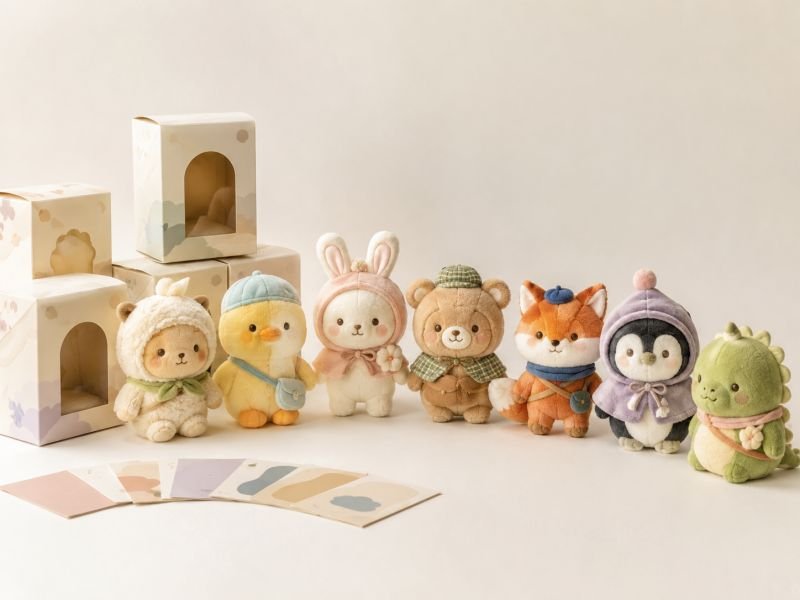
A blind box plush series can look simple from the outside: cute characters, sealed packaging, a little mystery, and the hope of finding a favourite style. But for a brand, the number of designs is one of the most important decisions in the whole project. Too few styles, and the series may feel weak. Too many styles, and the project can become expensive, slow, and difficult to control before the first carton even leaves the factory.
Most blind box plush series should include 3–5 designs for a small test launch, 6–8 designs for a balanced retail collection, and 9–12 designs for a stronger collectible series. A hidden style can be added when the order volume, packaging plan, and production control are strong enough to support rarity without creating confusion.
The real is not “how many designs can we make?” The smarter is: “How many designs can we launch confidently, produce consistently, pack correctly, and restock later?” A good blind box plush collection is not only designed for the first unboxing video. It should also survive sampling, costing, bulk production, quality control, warehouse handling, and repeat orders. That is where many pretty ideas either become a serious product line—or quietly turn into a messy project with too many versions, too many corrections, and not enough control.
What Is a Blind Box Plush Series?
A blind box plush series is a set of soft collectible plush designs packed in sealed boxes, bags, or retail display units, where the exact style inside is not shown before opening. The product is built around surprise, character variety, set completion, and repeat opening. Unlike a single plush toy, the value does not come from one design alone. It comes from the full group: regular styles, rare styles, possible hidden styles, packaging, story theme, and how easy the collection is to understand.
For plush projects, the series structure matters more than many teams expect. A blind box plush is not just “one plush in a closed box.” It is a product system. Each style needs its own design file, sample review, fabric record, face craft, filling control, label, packing rule, and sometimes its own barcode or style code. Once a hidden design is added, the project also needs quantity split, rarity control, and clear carton records.
A strong blind box plush series usually has three layers:
| Layer | What It Includes | Why It Matters |
|---|---|---|
| Plush design | Character shape, face, fabric, size, filling, accessories | Decides whether the product feels cute, soft, and worth keeping |
| Collection structure | Number of regular styles, rare styles, hidden style, theme | Decides whether people want to collect more than one |
| Packaging system | Blind box, inner bag, identity card, labels, display box, carton marks | Decides whether the product is easy to sell, pack, ship, and restock |
Most plush blind box products are planned as small or medium-sized collectible items. Many mini plush projects are around 8–15cm high, while plush charms and keychain styles may be smaller. Larger plush blind boxes can work, but box size, freight volume, shelf space, and shipping recovery need more review. A 10cm plush may be easy to pack into a compact blind box. A 20cm plush may need a larger box, better compression control, and stronger carton planning.
The key idea is simple: the outside gives mystery, while the inside must still deliver quality. If the plush feels flat, poorly shaped, or badly packed, the mystery will not help. If the collection theme is confusing, people may not feel a reason to collect. If the packing records are loose, the hidden style or quantity split can become difficult to control.
What Makes It Different?
A blind box plush series is different from a regular plush line because people do not choose the exact style before opening. That changes how the product should be designed, packed, and reviewed.
A regular plush can be judged directly. People see the character, touch the sample if it is in store, check the size, and decide whether they like it. A blind box plush works differently. The first impression comes from the box, the theme, the character list, and the feeling of chance. The actual plush appears later, after the box is opened.
This makes packaging more important. The box should explain enough without showing too much. It should tell people:
- how many regular styles are in the series
- whether there is a hidden style
- what the theme is
- what size the plush roughly is
- whether it is a keychain, charm, mini plush, or standing plush
- what age or safety information applies
- how the product should be stored, displayed, or used
The plush itself also needs to feel consistent as a set. If one design is 9cm tall and another is 13cm tall without a clear reason, the group may feel uneven. If one style uses long pile fabric and another uses very short fabric, the hand feel may not match. If one face is embroidered with fine detail and another looks too plain, the collection can feel unfinished.
A well-planned series usually controls the shared parts first:
| Shared Detail | Why It Helps |
|---|---|
| Similar body size | Keeps the full set visually balanced |
| Similar filling level | Keeps softness and shape more consistent |
| Similar face scale | Makes characters feel from the same world |
| Similar box size | Helps packing, display, and shipping |
| Similar label position | Makes production and inspection cleaner |
| Similar base pattern | Helps reduce sample complexity |
Variation should be used where it creates real charm: ears, tails, facial expressions, costume details, colour blocking, small props, embroidery, or themed accessories. The best blind box plush series gives every style a personality, but still makes the full set feel connected.
What Is the New Blind Box Trend?
The current blind box plush direction is moving toward softer, more character-led collections. Mini plush charms, plush bag pendants, animal mascots, IP characters, soft dolls, and seasonal plush sets are becoming popular because they are easy to photograph, gift, carry, and display.
A newer plush blind box is rarely just a random toy. It often includes a small world. For example:
- a zoo group with different animal characters
- a dessert pet series with pastel colours
- a travel mascot set inspired by cities
- a school theme with tiny uniforms
- a holiday series with winter outfits
- a food character set with fruit or bakery details
- a plush charm collection designed for bags and backpacks
This trend changes the way design count should be planned. A simple random product can survive with fewer details. A character-led plush series needs stronger structure. Each style should have a role. The collection should be easy to describe. The packaging should show the theme clearly. The hidden style, if included, should feel like a reward rather than a random extra.
Plush charms and mini plush are especially useful for this type of launch because they are small enough for repeated purchases and visible enough for daily use. A plush bag charm can travel on a backpack, handbag, keyring, or luggage handle. That gives the product more exposure after opening. It also gives the owner a reason to keep it close, not just store it on a shelf.
For brand planning, the newer trend also means people expect better finishing. A cute idea alone is no longer enough. The product needs:
- clean embroidery
- stable facial expression
- soft but not collapsed filling
- neat seams
- safe accessory attachment
- pleasant hand feel
- clear identity card or style card
- box structure that protects the plush
- labels suitable for the destination and sales channel
A blind box plush series may look small, but it involves many linked decisions. The trend is becoming more polished, more collectible, and more packaging-driven. That is why design count, sample review, and packing rules should be decided together instead of one by one.
What Factors Make Blind Box Toys Appealing?
Blind box plush products are appealing because they mix surprise with emotional ownership. People do not only open a box. They discover a character. That small moment creates the feeling of play, even when the product is simple.
Several factors usually drive interest:
| Appeal Factor | How It Works In Plush Blind Boxes |
|---|---|
| Surprise | The unopened box creates curiosity before the product is seen |
| Softness | Plush gives warmth, comfort, and touch value |
| Character identity | A strong face or theme makes each style memorable |
| Collection desire | Multiple styles make the full set feel worth chasing |
| Hidden style | A rare design adds excitement and sharing value |
| Gift use | Sealed mystery packaging feels playful and easy to give |
| Display value | Small plush can sit on desks, shelves, bags, or display trays |
| Social sharing | Opening, comparing, and trading styles creates conversation |
| Size convenience | Mini plush and charms are easier to carry and collect |
| Repeat release potential | New waves can bring seasonal or story extensions |
The emotional part is important. People often enjoy blind box plush because the product feels personal. They may say, “I got the sleepy one,” “I wanted the bunny,” or “This one matches my bag.” That personal connection makes the product stronger than a simple random item.
The hidden style adds another feeling: possibility. Even if most people do not get the hidden design, knowing it exists can make the opening moment more exciting. But the regular styles must be strong enough on their own. If only the hidden style feels desirable, the series may create disappointment rather than repeat interest.
A good plush blind box should make each regular style feel like a good result. The hidden style should feel extra special, not like the only one worth having.
Why Design Count Matters
The number of designs affects the entire blind box plush project. It changes how the collection looks, how much quantity is needed, how many samples must be reviewed, how packaging is prepared, and how easily the series can be repeated.
For custom plush production, design count connects directly with MOQ. If MOQ starts from 500pcs per design, the total quantity rises quickly:
| Regular Designs | MOQ Per Design | Total Regular Quantity |
|---|---|---|
| 3 | 500pcs | 1,500pcs |
| 4 | 500pcs | 2,000pcs |
| 6 | 500pcs | 3,000pcs |
| 8 | 500pcs | 4,000pcs |
| 10 | 500pcs | 5,000pcs |
| 12 | 500pcs | 6,000pcs |
This is before adding hidden styles, display boxes, retail packaging, labels, testing needs, or freight. So design count is not only a creative choice. It affects the real production plan.
Design count also affects how people feel about the collection:
| Design Count | How The Series May Feel | Best Use |
|---|---|---|
| 3–5 styles | Small, focused, easy to test | New character launch, event gift, first release |
| 6–8 styles | Complete, balanced, easier to collect | Retail, online drops, plush charm sets |
| 9–12 styles | Richer, more serious, stronger story | Established IP, larger collectible launch |
| 12+ styles | Deep collection, but harder to manage | Advanced line with strong demand and planning |
Too few styles can make the product feel less like a blind box collection. If there are only two or three designs, people may not feel much discovery. Too many styles can create the opposite problem. The set may look rich, but production becomes slower, cost becomes harder to balance, and weaker designs may reduce the charm of the full collection.
The smartest approach is to look at both sides:
- Will the number of styles create enough excitement?
- Can each style be produced with stable shape and quality?
- Can the quantity per design support the project?
- Can the packing team control regular and hidden styles clearly?
- Can the box explain the collection simply?
- Can the series be restocked without losing consistency?
A blind box plush series should feel fun at the opening moment and stable behind the scenes. When the number of designs fits the theme, quantity, packaging, and production path, the product has a much better chance of becoming a collection people remember.
How Many Designs Are Best?

For most blind box plush series, 3–5 designs work well for a first test, 6–8 designs create a stronger retail collection, and 9–12 designs suit a more mature character line with enough volume, time, and packing control. A hidden style can be added when the regular styles are already attractive and the quantity plan can support clear rarity control.
The best number is not always the biggest number. A blind box plush series must be fun to open, but it also has to be practical to develop, pack, inspect, ship, and repeat. A collection with 8 well-connected designs can often feel stronger than 14 weak designs with no clear theme. A smaller set with good facial expressions, soft fabric, neat stitching, and clean box design may perform better than a large set where half of the styles feel like filler.
The number of designs affects five things immediately:
| Design Count | MOQ At 500pcs Per Design | What It Means In Real Planning |
|---|---|---|
| 3 designs | 1,500pcs | Good for first release, event use, small IP test |
| 4 designs | 2,000pcs | Stronger than 3, still easy to control |
| 5 designs | 2,500pcs | Good balance for testing character popularity |
| 6 designs | 3,000pcs | Starts to feel like a proper collection |
| 8 designs | 4,000pcs | Strong retail feel, good full-set appeal |
| 10 designs | 5,000pcs | Better for a more prepared launch |
| 12 designs | 6,000pcs | Richer story, higher sample and packing pressure |
These numbers matter because blind box plush is usually reviewed per design. If every design has its own shape, fabric, embroidery, label, or box record, the work grows fast. A 12-design project is not just “one big order.” It can feel like 12 small projects running together.
A strong collection should be planned by looking at four simple things:
- how many styles people can understand quickly
- how many styles the project can afford to develop properly
- how many pieces per design can be produced without making the cost unstable
- how many styles can be packed and checked without confusion
A good first series should not try to show every idea. It should show the clearest ideas.
Is 3–5 Designs Enough?
Yes, 3–5 designs can be enough when the goal is to test a new plush character line, prepare an event release, launch a small private label series, or check whether people respond to the theme. This number keeps the project clear and gives enough space to improve each plush before bulk production.
A 3–5 design series is especially useful when:
| Project Situation | Why 3–5 Designs Work |
|---|---|
| New character idea | Easier to see which character gets the strongest reaction |
| First plush blind box release | Lower development pressure |
| Limited budget | More money can stay in fabric, embroidery, and box quality |
| Shorter schedule | Fewer styles mean fewer sample changes |
| Event or campaign | Easier to prepare before a fixed date |
| Small retail trial | Less stock pressure if one style sells slower |
| New packaging test | Easier to test box size and opening experience |
A 3-style series can work if each design is very different and the theme is clear. For example, a small animal plush set may include a bear, bunny, and cat. If they share a similar body shape but have different ears, face embroidery, colours, and tails, the set can still feel complete for a first release.
A 4-style series usually feels stronger. It gives the collection a little more rhythm. Four designs can work well for seasonal themes: spring, summer, autumn, winter. It can also work for food themes: strawberry, matcha, chocolate, vanilla. For a small event, four designs are often easier to explain and easier to pack.
A 5-style series gives more room for personality. It can include one “main” style and four supporting styles. This is helpful when the collection has one hero character but needs more variety for blind box opening.
The biggest advantage of 3–5 designs is control. The team can spend more attention on:
- plush size
- face embroidery
- fabric softness
- colour accuracy
- stuffing balance
- box fit
- inner bag
- hangtag or identity card
- style code
- carton packing
For a first release, these details often matter more than adding more characters. A plush blind box is judged by the feeling after opening. If the first product feels soft, cute, and well finished, people are more likely to trust the next release.
A smaller series also helps avoid slow-moving styles. In a large set, weaker designs can stay in stock longer. In a first release, it is safer to choose only the strongest characters. Save secondary ideas for wave two.
A practical 5-design plan may look like this:
| Style | Role In Collection | Notes |
|---|---|---|
| Main Bear | Core character | Strongest face, used for main visuals |
| Bunny | Cute support style | Long ears, different colour |
| Cat | Social-friendly style | Good for bag charm version |
| Puppy | Warm personality | Soft brown or cream fabric |
| Panda | High recognition | Strong contrast, easy to photograph |
This structure gives variety without making production too heavy. If the project performs well, the next release can add 5 more designs or introduce a hidden style.
For 3–5 designs, a hidden style is optional. If the total quantity is limited, it may be better to avoid hidden style pressure at the beginning. If the regular styles are strong enough, the first release can work without a secret design. The hidden style can be saved for the second release when there is more sales data and stronger interest.
When Are 6–8 Designs Better?
Six to eight designs are often the most balanced choice for a blind box plush series. This size feels like a real collection, gives enough variety for repeat opening, and still stays manageable if the structure is planned carefully.
A 6-design set is usually the first level where the product starts to feel complete. It gives enough room for colour variation, character personality, and simple story. A 6-style series can fit many themes:
- six animals
- six moods
- six desserts
- six travel characters
- six school mascots
- six festival outfits
- six city editions
An 8-design set feels richer and more retail-ready. It gives more choice and stronger full-set appeal. It also works well for display boxes because the collection can be shown as a small world rather than a small test.
Six to eight designs are better when the project needs:
| Need | Why 6–8 Designs Help |
|---|---|
| Retail display | The set looks fuller on shelf |
| Online photos | More styles create stronger visual content |
| Repeat opening | More variety gives people a reason to try again |
| Gift use | Different styles fit different personalities |
| IP storytelling | More room for roles, outfits, or moods |
| Display box planning | A fuller set makes the box feel valuable |
| Social sharing | More styles create more comparison and trading |
This design count works best when the series has a shared base. If all plush toys use a similar body size and only change ears, tails, colour blocks, embroidery, or small accessories, the project can stay steady. If every design has a completely different body shape, 6–8 styles can become much harder.
A practical 8-design animal set may use one shared sitting body:
| Style | Shared Parts | Changed Parts |
|---|---|---|
| Bear | Body, arms, legs | Round ears, face embroidery |
| Bunny | Body, arms, legs | Long ears, tail |
| Fox | Body, arms, legs | Pointed ears, tail, colour block |
| Cat | Body, arms, legs | Cat ears, whisker embroidery |
| Dog | Body, arms, legs | Ear shape, nose detail |
| Panda | Body, arms, legs | Eye patch embroidery, colour block |
| Penguin | Body, arms, legs | Wing shape, belly panel |
| Frog | Body, arms, legs | Eye shape, green fabric |
This kind of structure gives the collection visual variety, but it does not rebuild the whole plush for every style. It is usually more efficient than creating eight unrelated shapes.
Six to eight designs also make it easier to add one hidden style later. A 6 + 1 or 8 + 1 structure is easy for people to understand. It gives enough regular designs to enjoy while making the hidden design feel special.
A good hidden style for this level should not be too complicated. It may use:
- a special colour
- a different facial expression
- a small accessory
- a limited outfit
- a shiny fabric detail
- a reversed colour version
- a seasonal version
The hidden style should feel exciting, but it should not break the cost structure. If the hidden style is much more expensive than the regular styles, it can make the whole series harder to price.
For 6–8 designs, packaging should be planned early. The box may show the collection map, character silhouettes, style names, and hidden-style hint. If the product is sold in a display box, the display layout should be checked together with the blind box size.
A 6–8 design series also needs clearer style records. Each design should have:
- style name
- style code
- approved sample
- fabric record
- embroidery file
- packaging rule
- label file
- carton quantity rule
Without these records, the collection can become confusing during packing. Blind box products look similar outside, so inside control must be stronger.
Do 9–12 Designs Work?
Nine to twelve designs can work very well for a stronger plush blind box line, but they need better preparation. This number gives more room for story, rarity, characters, costume changes, colour themes, and seasonal details. It also brings higher sample pressure, higher total quantity, and more packing control.
A 9–12 design series is suitable when:
| Situation | Why 9–12 Designs Make Sense |
|---|---|
| Established IP | More characters already have fans |
| Strong retail plan | Larger set supports bigger display |
| Larger quantity | MOQ per design can be supported |
| Clear launch schedule | Enough time for samples and corrections |
| Strong theme | Each style has a reason to exist |
| Repeat plan | The collection may continue into later waves |
| Good packaging budget | Box, card, and display can support the set |
This number is not ideal when the project is still unclear. If character files are unfinished, if the launch date is too close, if box design has not started, or if quantity per design is too low, a 9–12 design series can become risky.
The challenge is not only the number. It is the difference between designs. A 12-style plush series with shared structure may be easier than an 8-style series with eight different body shapes.
For example:
| Series Type | Design Count | Difficulty |
|---|---|---|
| Same body, different faces and colours | 12 | Medium |
| Same animal, different outfits | 10 | Medium to high |
| Different animals with different tails and ears | 8 | Medium to high |
| Different characters with different body shapes | 6 | High |
| Different sizes, fabrics, and accessories | 5 | Very high |
This is why a larger set should use design discipline. Not every style should introduce a new structure. Some details can change visually without creating heavy production work.
A strong 12-design series may be built like this:
| Group | Example Styles | Purpose |
|---|---|---|
| Core characters | Bear, Bunny, Cat, Dog | Main familiar styles |
| Theme styles | Dessert Bear, Travel Bunny, Artist Cat, Sport Dog | Adds personality |
| Seasonal styles | Winter Bear, Summer Cat | Adds release value |
| Rare feel styles | Star Bunny, Night Panda | Adds excitement |
This gives story depth while keeping the series organised.
For 9–12 designs, every style should pass a simple test:
- Does it look different enough from the others?
- Does it fit the same theme?
- Can it be made with stable quality?
- Can it fit the same box size?
- Can the cost stay close to the other styles?
- Can it be checked clearly during packing?
- Would someone be happy to receive it even if it is not hidden?
The last part is very important. In a good blind box plush series, no regular style should feel like a disappointment. If 3 out of 12 styles feel weak, the collection may create frustration. A smaller set of 8 strong designs is better than 12 designs where several styles feel unfinished.
Nine to twelve designs also require more careful photography and product display. People need to see the full collection clearly. If the collection map is hard to read, the set may feel confusing. Packaging should show the theme in a simple way, not overload the box with tiny details.
For larger sets, carton planning also becomes more important. If the series includes hidden style ratio, mixed packing, or display box packing, the packing record must be checked before shipment. Otherwise, one carton may have poor style balance while another has too many of the same design.
Should You Add a Hidden Style?
A hidden style can make a blind box plush series more exciting, but it should be added carefully. A secret design is not just another cute plush. It changes the way the collection is packed, counted, talked about, and remembered.
The hidden style works best when three conditions are met:
| Condition | Why It Matters |
|---|---|
| Regular styles are already strong | People should still enjoy the normal designs |
| Quantity is large enough | Rarity needs enough pieces to manage properly |
| Packing rules are clear | The hidden style must not be mixed by accident |
If the regular designs are weak, a hidden style will not fix the series. It may even make people feel disappointed when they do not get the secret one. The hidden style should be a bonus, not the only desirable item.
A hidden plush design can be created in several ways:
| Hidden Style Type | Example |
|---|---|
| Colour variation | Gold bear, black bunny, pastel panda |
| Special expression | Winking cat, sleepy puppy |
| Outfit change | Holiday scarf, tiny crown, festival costume |
| Material detail | Shiny ear fabric, textured belly, soft sherpa detail |
| Story version | Night edition, birthday edition, travel edition |
| Accessory version | Star charm, mini bag, flower, small hat |
The design should feel special, but it should still be practical. If the hidden style uses rare fabric that is hard to source, the production schedule may become unstable. If it uses a small accessory, attachment strength and safety review may be needed. If it is a different size, it may not fit the same blind box.
The hidden style also affects quantity planning. There is no one perfect rarity ratio for every plush series. A small release may use a simple hidden split. A larger release may support a rarer secret. The ratio should be decided by total quantity, sales channel, packing method, and how the product will be promoted.
A practical way to think about hidden style planning:
| Total Quantity | Hidden Style Suggestion |
|---|---|
| Under 2,000pcs total | Hidden style may add too much pressure |
| 2,000–4,000pcs total | Simple hidden split can be reviewed |
| 4,000–6,000pcs total | Hidden style becomes more practical |
| 6,000pcs+ total | More controlled rarity planning is easier |
For a first release, it may be better to launch regular styles only or use a simple rare version. For a second release, when sales feedback is clearer, the hidden style can become more meaningful.
The hidden style should also be shown carefully on packaging. Some collections show a black silhouette. Some show a mark. Some say “secret style may appear.” The wording should create excitement without overpromising.
Packing records are critical. The hidden style should have:
- style code
- approved sample
- quantity plan
- packing ratio
- carton record
- display box rule if needed
- final inspection note
Because the outside box may be the same, the inner records must be clear. This protects the launch from complaints, wrong distribution, or accidental overpacking of the secret style.
A hidden style can be powerful when used well. But the heart of the series is still the regular collection. Make the regular styles lovable first. Then let the hidden style add the extra spark.
Which Design Count Fits Your Project?

The right number of blind box plush designs depends on the launch purpose, sales channel, available quantity, theme strength, plush structure, packing plan, and future restock idea. A first release often works better with 3–5 styles. A stronger retail or online release often fits 6–8 styles. A mature IP collection can consider 9–12 styles when artwork, budget, schedule, and packing records are ready.
A blind box plush series should not be planned only from a creative board. It should be planned from the real launch path. A collection used for a one-week event has different needs from a retail shelf program. A plush charm series for an online shop has different needs from a licensed character release. A tourism gift shop may want easy-to-understand animal styles. A game IP may need character accuracy and stronger secrecy before launch.
Design count should match four practical things:
- How many styles can be developed properly?
- How many pieces can be produced per style?
- How many styles can be packed without mistakes?
- How many styles can be explained clearly on the box?
If the number is too small, the series may not feel collectible. If the number is too large, the launch can become heavy before it starts. The best number is the one that makes the collection feel exciting while keeping sample approval, cost, labels, display boxes, carton records, and restock planning under control.
Here is a practical planning table:
| Project Type | Better Design Count | Total Quantity At 500pcs Per Design | Best Use |
|---|---|---|---|
| First concept test | 3 styles | 1,500pcs | Small release, simple theme, quick feedback |
| Stronger first release | 4–5 styles | 2,000–2,500pcs | New character line, gift launch, limited drop |
| Retail shelf launch | 6 styles | 3,000pcs | Display box, small collection, stronger repeat opening |
| Online collectible drop | 6–8 styles | 3,000–4,000pcs | Product photos, social sharing, full-set value |
| IP character line | 8–12 styles | 4,000–6,000pcs | Multiple characters, costumes, story versions |
| Advanced collection | 12+ styles | 6,000pcs+ | Established demand, clear supply plan, strong records |
This table does not mean every project must follow the same number. It simply shows how quickly total quantity grows once each style has its own MOQ. For custom plush projects, 500pcs per design is a more realistic starting base because each style needs pattern work, fabric preparation, craft setup, sewing, filling, inspection, and packing preparation.
The safest choice is often not the smallest or the largest. It is the number that fits the project stage.
Best Count for New Brands
For a new plush line, 3–5 designs are usually the safest and most useful starting choice. This number gives enough variety for people to compare styles, but not so much that sample review, quantity planning, and packing become difficult.
A first release should prove the core idea. It should show whether the character theme is attractive, whether the plush size feels right, whether the box design creates enough curiosity, and whether people want more after opening. A smaller set makes those signals easier to read.
A 3-style series works well when the theme is very clear. For example:
| Theme | 3-Style Plan |
|---|---|
| Forest animals | Bear, fox, rabbit |
| Dessert pets | Strawberry cat, chocolate dog, matcha bunny |
| School mascots | Reading bear, sporty bunny, art cat |
| City travel | London puppy, Paris bunny, Tokyo bear |
| Holiday gift | Snow bear, candy bunny, star cat |
A 4-style series gives more balance. It works well for four seasons, four moods, four colour families, or four character roles. A 5-style series gives more room for a “main style” and supporting characters.
For new projects, the biggest risk is not having too few designs. The bigger risk is spreading the budget across too many unfinished designs. When there are fewer styles, more attention can go into the details that people notice after opening:
- facial expression
- fabric touch
- body roundness
- embroidery neatness
- colour match
- ear and tail shape
- box fit
- identity card
- hangtag
- photo quality
- final packing feel
A small but polished set feels more confident than a large set with weak styles.
From a quantity view, 3–5 designs also make the first bulk plan easier to handle:
| Designs | MOQ Per Design | Total Quantity | Planning Meaning |
|---|---|---|---|
| 3 | 500pcs | 1,500pcs | Good for a focused first test |
| 4 | 500pcs | 2,000pcs | Good balance between variety and control |
| 5 | 500pcs | 2,500pcs | Better character spread without heavy pressure |
This also gives better control over slow-moving styles. In a first release, it is common that one or two styles receive more attention. If the set is too large, weaker styles may remain longer in stock. With 3–5 designs, the result is easier to read and adjust.
A hidden style is not always needed at this stage. If the first release is small, the regular styles should carry the charm. A secret version can be saved for the next wave once the strongest characters are known.
A good first blind box plush series should feel simple to explain:
“Five soft animal charms in one pastel forest collection.”
That one sentence is clearer than a 12-character universe that still has no strong visual identity.
Best Count for Retail Launches
For retail shelves, pop-up shops, museum shops, tourism stores, lifestyle stores, and gift programs, 6–8 designs often work best. This size gives the collection enough depth to feel complete, while still staying easy to display, explain, and reorder.
Retail spaces need quick understanding. People may only look at the product for a few seconds before deciding whether to pick up a box. A 6–8 style series can show variety without making the box crowded. It also gives enough styles for a clear collection map.
A retail-ready blind box plush series should usually solve these practical needs:
| Retail Need | Why 6–8 Styles Help |
|---|---|
| Shelf impact | More styles make the collection feel fuller |
| Display box value | The set looks stronger in a counter display |
| Repeat opening | More designs create more reason to try again |
| Gift choice | Different characters suit different personalities |
| Clear collection map | The full set is easy to show on packaging |
| Restock planning | Quantity is still easier to control than 12+ styles |
| Photo display | More colours and shapes help product visuals |
A 6-design set can work well for compact displays. An 8-design set gives more richness and often feels more like a full collectible release. Both can support a hidden style when the quantity and packing plan are clear.
For retail, box size matters as much as design count. A 10–12cm mini plush may fit a compact blind box. A plush keychain may fit a smaller box or sealed bag. A 15cm plush may need a bigger box, which affects shelf space and carton volume. Before fixing the number of designs, the product size and packaging style should be reviewed together.
Here is a simple retail planning example:
| Item | Practical Choice |
|---|---|
| Plush type | Mini plush charm |
| Size | 10–12cm |
| Regular styles | 6 or 8 |
| Hidden style | Optional 1 |
| Packaging | Blind box + sealed inner bag |
| Extra item | Identity card or small collection card |
| Display | Counter display box |
| Label needs | Care label, warning label, barcode or SKU label |
| Carton control | Mixed style record and display box quantity check |
A retail launch also needs consistent visual weight. If one plush has a large outfit, one has long ears, and one has a wide tail, they may not fit the same box. This creates packing pressure and may make the display look uneven. Keeping a similar body size and changing details is usually safer.
For 6–8 designs, style records become very important. Every design should have a style name, style code, approved sample, fabric note, embroidery file, label file, and packing rule. Since the outside boxes may look the same, the inside records must stay accurate.
A good retail series should not require people to read too much. The box should quickly show:
- the theme
- the possible styles
- the hidden style hint if included
- the product size
- the product form
- safety or age information when needed
- barcode or retail label information
The strongest retail releases often feel playful on the outside and organised behind the scenes.
Best Count for IP Collections
For IP character plush, 6–12 designs can work well, depending on how many characters, costumes, expressions, and story versions are needed. If the IP has a strong character group, a larger set may feel natural. If the IP is built around one mascot, fewer designs with stronger outfit or mood variations may work better.
IP plush blind boxes need more care than simple animal themes because character recognition matters. A small change in eye shape, mouth curve, colour position, costume detail, or accessory shape can change the identity of the character. The number of designs should therefore match the time available for sample correction.
A 6-design IP set may include:
| Style Type | Example |
|---|---|
| Main mascot | Original look |
| Happy version | Smile or open-mouth expression |
| Sleepy version | Closed-eye style |
| Outfit version | Hoodie, scarf, school uniform |
| Event version | Festival or launch outfit |
| Rare-looking version | Special colour or small prop |
An 8–12 design IP set may include more characters or story moments:
| Collection Role | Possible Design Direction |
|---|---|
| Main character | Core identity style |
| Side characters | Friends, pets, team members |
| Costume styles | Seasonal outfits, uniforms, event looks |
| Mood styles | Sleepy, angry, happy, shy |
| Location styles | City, school, zoo, café, travel |
| Limited style | Special colour or celebration version |
| Hidden style | Rare story version or surprise outfit |
The design count should be shaped by the strength of the IP world. If every character already has fans, a wider set can make sense. If the character universe is still new, a smaller release may make it easier for people to remember the core identity.
IP projects also need stronger file preparation. Useful files include:
- front view
- side view
- back view
- facial expression reference
- colour references
- outfit detail
- accessory detail
- logo file
- style names
- style codes
- hidden style instruction
- packaging direction
- approval rules
For IP plush, confidentiality is also part of the work. Unreleased artwork, new character versions, sample photos, and packaging files should be handled carefully. If the project involves licensed characters, ownership and usage rights should be clear before sampling.
From a production view, a 12-design IP series can still be practical if the structure is disciplined. For example, all plush designs may use the same body size, while the outfit, embroidery, and small details change. But if every design has a different body shape, different size, different fabric, and different accessories, even 6 designs may become heavy.
A useful way to choose IP design count is to score each proposed style:
| Review Factor | Why It Matters |
|---|---|
| Character importance | Main characters should come first |
| Visual difference | Each style should feel distinct |
| Plush feasibility | Some details may not work well in soft form |
| Cost balance | No regular style should become too expensive |
| Box fit | All styles should fit the same package |
| Collection value | The set should feel worth completing |
| Restock value | Popular styles should be repeatable |
| Approval difficulty | Complex characters may need more sample time |
The best IP blind box plush set is not the one with every possible character. It is the one that introduces the world clearly, keeps style quality steady, and leaves room for future releases.
What Is in the Mia Zoo Series Plush Blind Box?
Mia Zoo Series Plush Blind Box is a useful reference for blind box plush planning because it shows a compact collection structure: 8 regular designs plus 1 hidden design. This kind of layout is easy to understand, strong enough for collecting, and not as heavy as a very large 12–18 design set.
The structure is simple:
| Series Element | Planning Meaning |
|---|---|
| 8 regular styles | Enough variety for a full collectible set |
| 1 hidden style | Adds surprise and rarity |
| Small plush format | Easier to collect, display, carry, and photograph |
| Sealed packaging | Creates mystery before opening |
| Style card or identity detail | Helps people recognise and remember each design |
| Collection map | Shows the full set and encourages repeat opening |
The reason this type of structure works is not only the number. It works because 8 + 1 feels complete but still manageable. Eight regular styles can show a full mini world. One hidden style creates extra excitement without making the collection too complicated.
For custom plush planning, an 8 + 1 structure can be useful when the theme already has enough strong design ideas. For example:
| Theme | 8 Regular Styles + 1 Hidden Style Idea |
|---|---|
| Zoo animals | Panda, lion, rabbit, fox, penguin, cat, bear, elephant + hidden white tiger |
| Dessert pets | Cake bear, matcha bunny, cookie cat, pudding dog, peach panda, lemon chick, cocoa fox, milk cow + hidden rainbow cake |
| Travel mascots | London bear, Paris bunny, Tokyo cat, Seoul dog, New York fox, Sydney koala, Bangkok elephant, Rome lion + hidden world traveler |
| School animals | Reading bear, music bunny, art cat, football dog, science fox, library panda, math chick, lunch cow + hidden graduation bear |
This type of set is also easier to present on packaging. The box can show all 8 regular styles and one mystery silhouette. The collection map stays clear. The hidden style feels special, but the regular designs still carry the series.
However, the 8 + 1 structure should not be copied blindly. It is a good model only when the project can support the total quantity, sample review, and packing control.
At 500pcs per design, 8 regular styles already mean 4,000pcs before adding a hidden style. If the hidden style is treated as an additional design, the total can move higher. Packaging, display boxes, labels, testing needs, and shipping volume also need to be reviewed.
A practical 8 + 1 project should prepare:
- 8 regular artwork files
- 1 hidden artwork file
- style names and style codes
- target size for all plush styles
- fabric and colour references
- face embroidery files
- accessory details
- blind box dieline
- identity card or collection card
- label files
- quantity split
- hidden-style packing rule
- carton record
- final inspection plan
The real value of the Mia Zoo-style structure is its balance. It gives enough variety for the opening experience, enough rarity for excitement, and enough structure for a neat collection. For many blind box plush projects, that balance is more useful than simply adding more and more styles.
Why Not Make Too Many?
More designs can make a blind box plush series look exciting in the first creative meeting. A big character board feels rich. A 12-style collection looks impressive. A hidden design sounds fun. But once the project moves into sampling, costing, packing, and shipment, too many styles can turn a cute idea into a difficult launch.
The problem is not variety itself. Variety is what makes blind box plush interesting. The real problem is uncontrolled variety. Every new plush design may bring its own pattern, fabric, colour, face embroidery, accessory, label, box record, packing rule, and inspection detail. When the set becomes too large too early, the team may spend more time fixing problems than improving the actual product experience.
A strong blind box plush series should feel full, but not crowded. It should give enough surprise, but not create confusion. It should allow people to collect more than one style, but each style should still feel worth receiving. If several designs feel weak, similar, or unnecessary, the set may look larger but feel less attractive.
The hidden cost of “too many” usually appears in four places: sample development, MOQ pressure, quality control, and packing accuracy.
| Too Many Styles May Cause | What Usually Happens |
|---|---|
| More sample rounds | Each style may need face, shape, stuffing, or colour adjustment |
| Higher total quantity | MOQ grows quickly when each design needs its own quantity |
| Longer approval time | More people need to review more plush samples and packaging files |
| More fabric records | Different colours or piles need separate checking |
| More embroidery files | Each face or detail may need its own setup |
| More packing rules | Regular and hidden styles need clear quantity and carton control |
| Higher defect risk | More structures create more inspection details |
| Harder restock | Repeat orders need accurate style, material, and packaging records |
The best plush blind box collection is not the one with the most characters. It is the one where every style has a reason to exist. If a design does not improve the theme, strengthen the collection, or bring a clear emotional difference, it may be better saved for a second release.
Sample Cost Rises
Every plush design needs real development work before it becomes ready for bulk production. Even if two characters look similar in artwork, they may behave differently once made with soft fabric and filling.
A new design may require:
- a separate paper pattern
- a different cutting layout
- new embroidery file setup
- face position adjustment
- fabric colour checking
- ear, tail, arm, or accessory testing
- stuffing level adjustment
- box fit review
- label position review
- revised sample work
This is why sample cost rises quickly when the set grows. The cost is not only for making one small plush. It reflects the time spent turning flat artwork into a soft, three-dimensional product that can be produced repeatedly.
For example, a 6-style animal set with one shared body shape may be quite practical. The base body, arms, legs, and sitting posture can stay similar. The ears, tails, face embroidery, and colour blocks can change. This gives variety without rebuilding the full structure for every style.
A 6-style set with six different body shapes is a different story. A penguin, giraffe, dragon, octopus, rabbit, and bear may all look cute together, but each one may need its own structure. The giraffe needs neck support. The dragon may need wings and horns. The octopus needs tentacle placement. The rabbit needs long ear shaping. This can multiply sample work even though the set has only six designs.
The difference is easier to see in a table:
| Series Structure | Number Of Styles | Sample Difficulty |
|---|---|---|
| Same body, different colours | 8 | Lower |
| Same body, different ears and tails | 8 | Medium |
| Same size, different outfits | 6 | Medium to high |
| Different animals, different structures | 6 | High |
| Different sizes, fabrics, and accessories | 5 | Very high |
A larger set also slows down approval. One style may look ready. Another may need a new mouth shape. Another may need softer filling. Another may not fit the blind box. Another may have a colour mismatch. When many styles move together, one delayed style can hold up the full series.
For a first release, it is often better to choose fewer, stronger styles and give each one enough attention. A well-shaped 6-style series can feel more polished than a 12-style series where several plush designs still look unfinished.
MOQ Gets Harder
For custom plush projects, quantity is usually reviewed per design. When MOQ starts from 500pcs per design, the total order quickly becomes larger as more styles are added.
| Regular Designs | MOQ Per Design | Total Quantity Before Hidden Style |
|---|---|---|
| 3 | 500pcs | 1,500pcs |
| 4 | 500pcs | 2,000pcs |
| 5 | 500pcs | 2,500pcs |
| 6 | 500pcs | 3,000pcs |
| 8 | 500pcs | 4,000pcs |
| 10 | 500pcs | 5,000pcs |
| 12 | 500pcs | 6,000pcs |
This matters because many teams first think about design count from the creative side. They may say, “Let’s make 12 characters.” But at 500pcs per design, 12 regular styles already mean 6,000pcs before adding hidden styles, blind boxes, display boxes, carton packing, labels, or shipping volume.
If one hidden style is added as a separate design, the total quantity and packing work become heavier again. If the hidden style is produced in a smaller amount, the ratio and carton placement must be controlled carefully.
More designs can also create uneven stock movement. In almost every collection, some styles become more popular than others. A cute rabbit, panda, bear, or hero mascot may move faster, while a less expressive style may sit longer. If the set is too large, slow-moving styles can hold up restock planning and reduce the clean feeling of the launch.
A smaller first release can give better information. With 4–6 designs, it is easier to see which character gets attention, which colour photographs well, which size feels right, and whether the blind box price feels acceptable. After that, a second release can add new styles with more confidence.
A useful planning method is to separate “now” and “later”:
| Character Idea | First Release | Later Release |
|---|---|---|
| Strongest main characters | Yes | Continue |
| Clear theme support styles | Yes | Possible |
| Similar-looking designs | Maybe no | Save for wave two |
| Complex costume versions | Maybe no | Use after core set works |
| Special colours | Maybe no | Good for hidden or seasonal style |
| Risky accessories | No | Test later |
| Large shape changes | No | Review separately |
This keeps the first release focused and avoids turning the first run into a test for every idea at once.
Quality Becomes Harder
Plush quality depends on many small details. A blind box plush may be small, but it still needs a clean shape, soft hand feel, neat face, stable seams, safe accessories, proper filling, correct labels, and good packing recovery.
When the number of styles increases, the number of checks also increases. Each design may need its own quality focus.
| Plush Detail | What Can Go Wrong |
|---|---|
| Face embroidery | Uneven eyes, shifted mouth, unclear expression |
| Fabric direction | Colour looks different under light |
| Stuffing | One style feels too flat, another too hard |
| Ears or tails | Shape collapses or position shifts |
| Small accessories | Loose parts or weak attachment |
| Clothes | Wrinkles, uneven seams, poor fit |
| Printed details | Fading, misalignment, colour difference |
| Box fit | Plush is squeezed or does not recover well |
| Labels | Wrong position, missing label, mismatched style code |
| Packing | Wrong style in wrong box or carton |
A 4-style series may allow the inspection team to focus deeply on each style. A 12-style series needs stricter records and more time. If several designs use different fabrics, pile heights, colours, and accessories, the inspection workload becomes much heavier.
Plush also has natural soft-product variation. A plush body is not a rigid plastic figure. Stuffing pressure, fabric pile direction, seam allowance, and hand-finishing can all affect the final look. The more complex the style, the more important the approved sample becomes.
Each approved sample should define:
- final size
- face position
- fabric type
- fabric colour
- stuffing level
- seam shape
- accessory position
- label placement
- box fit
- final appearance standard
For blind box plush, the full set should be checked together. One style may pass alone, but look too large, too plain, or too different when placed beside the others. A good set should have visual balance. The plush pieces do not need to be identical, but they should feel like they belong in the same collection.
This full-set review can prevent common problems:
- one plush looks much larger than the rest
- one colour does not match the theme
- one expression feels less charming
- one outfit makes the product too bulky
- one accessory causes box fit problems
- one hidden style looks too similar to a regular style
- one design costs much more than the others
Too many designs make this harder. The more styles there are, the easier it is for one or two weak designs to slip through.
Packing Gets Complex
Packing is one of the most underestimated parts of blind box plush. The product looks playful from the outside, but inside the packing process, every style needs clear control.
A normal plush product may have one style, one label, one box, and one carton rule. A blind box plush series may have several inside styles with the same outer packaging. That means the packing team must follow records carefully.
A blind box plush packing plan may include:
| Packing Item | Purpose |
|---|---|
| Blind box | Creates mystery and protects the plush |
| Sealed inner bag | Hides the style before opening |
| Identity card | Helps people recognise the character |
| Collection card | Shows the full set or possible styles |
| Care label | Provides product care information |
| Warning label | Supports age and safety information when needed |
| Barcode label | Helps retail or warehouse handling |
| SKU label | Separates styles or series records |
| FNSKU label | Used for certain e-commerce warehouse needs |
| Display box | Holds multiple blind boxes for shelf or counter display |
| Carton mark | Supports shipping and receiving |
| Packing list | Records quantity, carton count, and style plan |
The hidden style makes packing more sensitive. If the rarity plan is not written clearly, the hidden pieces may be packed unevenly. One carton may contain too many secret styles, while another may contain none. If display boxes are involved, the packing rule becomes even more important.
A simple hidden-style packing instruction may need to define:
- total hidden quantity
- hidden style code
- carton placement rule
- display box rule
- sealed bag rule
- label rule
- inspection check
- final packing record
If the series has 6 regular styles, packing control is manageable. If it has 12 regular styles plus 1 hidden style, the risk increases. The outer box may look the same, but the inside style count must stay accurate.
Packing mistakes can damage the opening experience quickly. People may receive too many repeated styles. A store may get an uneven mix. A warehouse may struggle with label mismatch. A hidden style may appear too often or not appear where expected. These issues are not always caused by poor product design. They often come from unclear packing rules.
This is why packing should be discussed before bulk production, not after all plush toys are finished. Box size, inner bag, label placement, display box quantity, carton quantity, and style mix should be checked early.
Restock Becomes More Difficult
Many teams think only about the first launch. But if the series performs well, restock becomes the next challenge. Too many styles can make repeat production harder, especially if records were not prepared clearly from the beginning.
For a repeat order, the following details should be traceable:
| Record | Why It Matters For Repeat Production |
|---|---|
| Approved sample | Keeps size, shape, and expression consistent |
| Pattern file | Keeps body structure stable |
| Fabric record | Helps match colour, pile, and hand feel |
| Embroidery file | Keeps face detail accurate |
| Thread colour | Reduces visible colour shift |
| Filling standard | Keeps softness and body shape close |
| Accessory record | Helps repeat small parts correctly |
| Label file | Supports retail and warehouse use |
| Box file | Keeps packaging consistent |
| Carton rule | Helps repeat packing quantity and style mix |
| Inspection note | Prevents repeated issues |
If a set has 4 styles, record keeping is easier. If it has 12 or more, each style must be managed carefully. A missing fabric note or outdated embroidery file can create visible differences in the next batch.
Plush materials can also change between batches. Even when the same fabric name is used, pile direction, softness, and colour depth may vary slightly from lot to lot. This is why repeat orders should always be reviewed with records and samples, not assumed to be exactly the same.
A large collection also makes restock quantity harder. If only two styles sell out quickly, should only those two be repeated? Should the full set be repeated? Should the hidden style be included again? Should a second release replace slow-moving styles? These decisions are easier when the first release is focused and data is clear.
A good first series should leave room for growth. Instead of releasing all 15 character ideas at once, a brand may launch 6 first, then add 6 more later. This creates a cleaner product path and gives people a reason to return.
Too Many Designs Can Weaken the Theme
A large blind box plush series can lose focus if the theme is not strong enough. More styles do not automatically make the collection better. Sometimes they make it harder to understand.
A good theme should be easy to say in one sentence:
- “Six soft zoo animals with one hidden night animal.”
- “Eight dessert pets in pastel colours.”
- “Five tiny travel mascots for city souvenir shops.”
- “Four seasonal plush charms with holiday packaging.”
- “Eight school animal characters with one hidden graduation style.”
If the theme needs a long explanation, the set may be too loose. If the characters do not look connected, the collection may feel random. If some styles do not match the colour palette, the packaging may look messy.
Too many designs can also create “filler styles.” These are designs added only to increase the count, not because they add real value. Filler styles weaken the full set. They make people feel that some boxes are less desirable.
A useful way to review each design is to ask:
| Review question | Keep Or Cut |
|---|---|
| Does this style fit the theme clearly? | Keep if yes |
| Does it look different from the others? | Keep if yes |
| Would someone be happy to receive it? | Keep if yes |
| Does it photograph well? | Keep if yes |
| Can it be produced steadily? | Keep if yes |
| Does it need too much extra cost? | Cut or simplify if yes |
| Is it too similar to another style? | Cut or save for later |
| Does it make packing harder without adding charm? | Cut or revise |
This kind of review helps protect the collection from becoming crowded.
The strongest blind box plush set usually has a clear center. It may be a character world, animal family, food theme, mascot group, or seasonal story. The design count should support that center. It should not bury it.
When Fewer Designs Work Better
Fewer designs can work better when the first goal is to test the idea, protect quality, control cost, or meet a fixed date. A smaller set gives more room to polish the plush and packaging.
A 4-style series with strong design can beat a 10-style set with weak control. This is especially true for:
- first release
- event deadline
- new character test
- small retail trial
- limited gift program
- tight packaging schedule
- complex plush shape
- special fabric use
- child-related products needing more safety review
- projects with new labels or destination requirements
Fewer designs also help with storytelling. A small set can be easier to remember. People may know each character by name. The box can show the collection more clearly. The display can look cleaner. The launch message can stay simple.
For example, a first release might choose 5 styles:
| Style | Why It Belongs |
|---|---|
| Hero Bear | Main character and strongest visual |
| Bunny | Soft, cute, easy to like |
| Cat | Good for social sharing and charm use |
| Fox | Adds colour contrast and personality |
| Panda | High recognition and photo appeal |
This set can be expanded later with a hidden bear, seasonal rabbit, travel cat, or new animal friend. The first release does not need to carry every idea.
A smaller set also allows more budget for better details:
- softer fabric
- cleaner embroidery
- stronger box structure
- better identity card
- nicer hangtag
- more careful sample revision
- better photography
- stronger display presentation
For blind box plush, people remember the feeling after opening. If the plush feels pleasant, well-shaped, and worth keeping, the series has a stronger chance of coming back. If the set is too large but the details feel rushed, the number of styles will not save it.
The safer choice is often to launch a tight collection first, learn from it, and then expand with more confidence.
How Does a Factory Review the Series?

A blind box plush series should be reviewed as a complete product set before sampling starts. The review should cover artwork, structure, fabric, size, craft, hidden-style rules, packaging, labels, carton packing, quality checks, and future repeat production. If these details are not reviewed early, the series may look good in artwork but become difficult during sampling, bulk production, or packing.
A plush blind box project has more moving parts than a single plush toy. One character plush may need one pattern, one fabric record, one face embroidery file, one approved sample, and one packing rule. A blind box series may need all of those details repeated across 4, 6, 8, or 12 styles. If a hidden style is added, the packing plan becomes even more sensitive.
The review should not only ask, “Can this design be made?” It should ask:
- Can all styles keep a similar size and hand feel?
- Can each plush fit the same blind box?
- Can the face embroidery stay clear at the chosen size?
- Can long ears, tails, wings, outfits, or accessories stay stable?
- Can the style codes and labels be checked during packing?
- Can the hidden style be controlled without mixing errors?
- Can the approved samples be repeated in future orders?
A good review protects the launch before problems become expensive. Small issues in the first stage are usually easy to fix. The same issues after box printing, fabric purchasing, or bulk cutting may cost more time and money.
For blind box plush, the review normally moves through five layers:
| Review Layer | What Needs To Be Checked | Why It Matters |
|---|---|---|
| Character design | Shape, face, expression, colour, theme | Keeps the series attractive and consistent |
| Plush structure | Pattern, seams, stuffing, posture, accessories | Decides whether the plush can be made steadily |
| Material and craft | Fabric, embroidery, printing, appliqué, hardware | Affects look, touch, cost, and durability |
| Packaging system | Blind box, inner bag, card, label, display box | Controls unboxing, retail use, and shipping |
| Production records | Style code, approved sample, carton rule, inspection note | Helps bulk control and repeat orders |
A series should not pass review only because every style looks cute. It should pass because the set can be sampled, approved, produced, packed, inspected, shipped, and repeated with clear records.
What Artwork Is Needed?
The most useful artwork package shows the plush as a real object, not only as a front-facing cartoon. A blind box plush has thickness, seams, stuffing, back details, side shape, labels, and packaging limits. If the artwork only shows the front view, many details must be guessed during sampling.
A complete file package should include:
| File Or Detail | Why It Helps |
|---|---|
| Front view | Shows face, body proportion, colour blocks, main expression |
| Side view | Shows thickness, nose height, ear angle, tail position, posture |
| Back view | Shows back fabric, tail shape, seam direction, label position |
| Detail views | Shows embroidery, accessories, clothes, small features |
| Colour reference | Helps match fabric, thread, print, and packaging tone |
| Target size | Controls pattern scale, box size, carton volume, and price |
| Style list | Keeps regular styles and hidden styles organised |
| Style names | Helps card design, packaging, and internal records |
| Style codes | Helps sampling, packing, carton marks, and repeat production |
| Packaging direction | Helps check blind box size, inner bag, display, and labels |
| Destination region | Helps review warning labels, care labels, and testing needs |
For a blind box plush series, the style list is one of the most important documents. It should show each regular style, hidden style, quantity per style, target size, colour reference, material note, craft note, and packaging rule.
A simple style list may look like this:
| Style Code | Style Name | Type | Main Fabric | Key Detail | Quantity Plan |
|---|---|---|---|---|---|
| B01 | Honey Bear | Regular | Short plush | Brown face embroidery | 500pcs |
| B02 | Mint Bunny | Regular | Short plush | Long ears, mint body | 500pcs |
| B03 | Cocoa Cat | Regular | Short plush | Whisker embroidery | 500pcs |
| B04 | Snow Panda | Regular | Short plush | Eye patch embroidery | 500pcs |
| B05 | Lemon Puppy | Regular | Short plush | Floppy ears | 500pcs |
| B06 | Peach Fox | Regular | Short plush | Tail colour block | 500pcs |
| H01 | Star Bear | Hidden | Short plush | Special colour + star accessory | To be reviewed |
This kind of list reduces confusion. Without style codes, teams may describe styles by colour or nickname, which can easily lead to mistakes during sampling or packing.
Artwork should also show which details are essential and which details can be simplified. Plush cannot always copy every tiny line from a digital illustration. Very thin outlines, tiny gradients, sharp corners, floating accessories, or extremely small facial details may need adjustment. The best artwork review keeps the character feeling while making the plush stable and pleasant in hand.
For mini plush and plush charms, face details need extra care. If the target size is only 8–12cm, the embroidery area is limited. Eyes, mouth, blush, nose, and small marks should be large enough to remain clear after stitching. A beautiful digital face may become crowded if reduced too much.
A useful artwork review should include these checks:
- Is the face large enough for embroidery?
- Are small marks necessary or can they be simplified?
- Can the ears, tail, or accessories hold their shape?
- Is the colour palette available in plush fabric?
- Does every style fit the same blind box size?
- Does the hidden style require special material or extra cost?
- Are labels and hangtags already planned?
- Is the series intended for children, collectors, gifts, or retail?
The clearer the artwork, the fewer surprises during sampling.
How Does Sampling Work?
Sampling is the stage where the series becomes real. It shows whether the artwork works as soft plush, whether the size feels right, whether the body shape holds well, and whether the product fits inside the planned packaging.
For blind box plush, sampling should not be rushed only to “see a sample.” The sample should solve practical problems before bulk production. A sample confirms the body structure, face expression, fabric choice, filling, craft, size, accessory strength, label position, and box fit.
A practical sampling flow usually includes:
| Step | What Happens | What Should Be Checked |
|---|---|---|
| Artwork review | Files, size, quantity, material, craft, packaging are reviewed | Missing views, unclear details, risky accessories |
| Pattern making | A paper pattern is created for the plush shape | Body proportion, posture, seam placement |
| Material matching | Fabric, filling, thread, accessories, label materials are selected | Colour, pile length, softness, cost |
| Craft setup | Embroidery, printing, appliqué, or small parts are prepared | Face clarity, thread colour, detail scale |
| First sample | A physical plush is made | Shape, size, face, touch, stability |
| Revision | Adjustments are made based on review | Eyes, mouth, body roundness, stuffing, fabric, accessory |
| Approved sample | Final sample is confirmed | Used as bulk production reference |
| Record keeping | Pattern, material, craft, label, packaging files are saved | Supports production and repeat orders |
The first sample is not always perfect. That is normal. Plush development often needs adjustment because soft materials behave differently from flat artwork. A face may need to move 3–5mm. A mouth may need thicker stitching. A body may need more filling. A tail may need stronger sewing. A box may need 5–10mm more space to avoid squeezing the plush too tightly.
For a blind box series, sample review should happen in two ways:
First, each style should be reviewed alone. The team checks whether the character looks correct, the fabric feels right, the face is neat, and the shape is stable.
Second, all styles should be reviewed together. This is where many hidden problems appear. One plush may look too large beside others. One colour may feel outside the theme. One face may look less expressive. One accessory may make the product too bulky. One style may cost much more than the rest.
A full-set sample review can use this table:
| Full-Set Check | What To Look For |
|---|---|
| Size balance | All styles should look similar in scale |
| Theme unity | Colours and characters should belong together |
| Face consistency | Expressions should share the same visual language |
| Fabric harmony | Hand feel should not change too much between styles |
| Box fit | Each plush should fit without heavy distortion |
| Hidden style value | Secret style should feel special but still practical |
| Display effect | The full set should look attractive in photos or display |
| Packing clarity | Each sample should match its style code and record |
Sampling also affects the schedule. A 3-style series may be easier to review quickly. An 8-style series needs more coordination. A 12-style series may require several review rounds if each design has different details. To avoid delays, sample comments should be specific. “Make it cuter” is hard to act on. “Move the eyes 2mm lower, make the mouth wider, reduce the cheek embroidery, and add more filling to the belly” is much more useful.
A good sample review gives clear direction, not vague feeling only.
What Is the Custom Plush Process?
The custom plush process turns character artwork into a soft, repeatable product. For blind box plush, the process also turns several plush styles into one controlled series.
The work begins with structure review. The character may look flat in artwork, but plush needs volume. A round head, small arms, long ears, tail, costume, bag charm loop, keyring, or removable accessory all affect pattern development. The review checks which parts can be sewn, which parts should be embroidered, which parts need reinforcement, and which parts may need simplification.
After structure review, the pattern is developed. Pattern making decides how the plush will sit, stand, curve, fill out, and recover after packing. A small difference in pattern can change the whole expression. For mini plush, the face area is especially sensitive because small proportion changes are very visible.
Then materials are selected. Plush fabric can vary in pile length, softness, stretch, colour depth, and direction. The same colour can look different when the pile direction changes. For a series, material consistency matters because all styles should feel like one collection.
Common material decisions include:
| Material Choice | What It Affects |
|---|---|
| Short plush | Clean shape, good for mini characters and embroidery |
| Crystal plush | Smooth touch, bright surface, soft appearance |
| Sherpa | Warm texture, cute winter or animal feeling |
| Fleece | Soft and casual, good for simple shapes |
| Faux fur | Rich texture, but harder for small facial details |
| PP cotton filling | Softness, body volume, recovery |
| Weighted filling | Needs extra review for safety, leakage, and seam strength |
Craft work comes next. Face embroidery is often the heart of a plush blind box. For small plush, embroidery is usually more stable than tiny printed details. Printing may be useful for flat colour areas, blush, patterns, or small decorative details, but it should be tested on the chosen fabric.
Accessories need special review. Keyrings, hooks, magnets, zippers, small hats, scarves, bows, or removable parts can make the design more fun, but they may also add strength, safety, and inspection requirements. If the product is intended for children, small parts and attachment strength need more careful planning.
Once the approved sample is ready, bulk production can follow the confirmed standard. A clear production path may include:
- fabric inspection
- cutting
- embroidery or printing
- sewing
- filling
- shaping
- cleaning
- needle detection
- final inspection
- label checking
- blind box packing
- carton packing
- shipment preparation
For a blind box series, each style should remain connected to its own record through the whole process. The style code used in sampling should also appear in production records, packing instructions, and carton documents. This reduces the risk of mixing regular styles, hidden styles, or packaging files.
How Is Bulk Quality Controlled?
Bulk quality control for blind box plush should check both the plush product and the series system. The plush must be well made, and the style records must match the packing plan.
Quality checks should begin with materials. Fabric colour, pile direction, softness, thickness, and visible defects should be reviewed before cutting. If a fabric colour is wrong at the beginning, it can affect the whole batch. For a multi-style series, each colour should be compared with the approved sample or confirmed reference.
After cutting, fabric pieces should follow the correct style and direction. Plush fabric can look different when the pile direction changes. If one part is cut in the wrong direction, the finished plush may show uneven colour or texture.
Embroidery is another key checkpoint. For blind box plush, the face usually carries most of the emotional value. Small face errors can make the product look strange. Common checks include:
- eye position
- mouth curve
- nose shape
- thread colour
- embroidery density
- left-right symmetry
- cheek or blush position
- logo or symbol clarity
During sewing, seam strength and part placement should be checked. Long ears, tails, wings, arms, legs, clothes, and small accessories should be attached steadily. Loose sewing may not be obvious in photos, but it can become a complaint after use.
Filling control decides the final hand feel and body shape. Too little filling makes the plush look flat. Too much filling can make the plush hard or distorted. A series should keep a similar filling level across all designs unless a certain style intentionally needs a different shape.
A practical quality control table may look like this:
| Check Stage | Main Check Items |
|---|---|
| Incoming material | Fabric colour, pile, softness, defects, accessories |
| Cutting check | Correct shape, direction, style separation |
| Embroidery check | Face position, thread colour, clarity, symmetry |
| Sewing check | Seam strength, part placement, loose threads |
| Filling check | Softness, weight, body balance, recovery |
| Shaping check | Face expression, posture, roundness, final look |
| Needle detection | Metal safety review before final packing |
| Label check | Care label, warning label, SKU label, barcode |
| Packing check | Correct box, inner bag, card, style code, carton quantity |
| Final carton check | Carton mark, packing list, style record, shipping preparation |
Needle detection is especially important for plush products because sewing involves needles and metal parts during production. A finished plush should go through needle detection according to project requirements before final shipment. For child-related plush, safety review should be treated with extra care, including small accessories, seams, labels, and possible third-party testing needs based on the destination region and age group.
Packing review is different for blind box plush because the outside box may not show the inside style. The packing team should check style codes, hidden-style rules, inner bags, identity cards, barcode labels, display box quantity, and carton marks. If a hidden style is included, its quantity and placement should be recorded clearly.
A good final inspection should not only ask, “Are the plush toys clean?” It should also ask:
- Does each style match the approved sample?
- Are all regular styles packed according to the plan?
- Is the hidden style controlled correctly?
- Are labels correct for the destination?
- Are box and carton records clear?
- Do display boxes contain the right quantity?
- Are carton marks and packing lists consistent?
- Can the series be repeated later with the same records?
Quality control should make the product safer, cleaner, and easier to repeat.
How Are Packaging And Labels Reviewed?
Packaging is part of the product experience. For blind box plush, it is also part of style control. A good package protects the plush, creates mystery, supports retail display, and keeps warehouse handling clear.
Packaging review should begin before bulk production. If the box is designed too late, the plush may not fit well. If the plush is compressed too heavily, it may look flat after opening. If the box is too large, carton volume and shipping cost may increase.
A blind box plush package may include:
| Packaging Part | Purpose |
|---|---|
| Blind box | Creates mystery and protects the plush |
| Inner sealed bag | Keeps the style hidden before opening |
| Identity card | Adds character value and recognition |
| Collection card | Shows regular styles and hidden hint |
| Hangtag | Adds branding or story information |
| Care label | Provides product care information |
| Warning label | Supports safety information where needed |
| Barcode label | Supports retail scanning |
| SKU label | Helps style or series control |
| FNSKU label | Supports certain e-commerce storage needs |
| Display box | Holds multiple blind boxes for shelf display |
| Carton mark | Helps receiving, shipping, and stock handling |
Box size should be checked with the real sample. A plush can look small in measurement but become bulky because of ears, tail, accessories, or stuffing. A rabbit with long ears may need more height. A fox with a large tail may need more depth. A plush charm with a keyring may need extra space to avoid scratching the fabric or bending the card.
Labels should also be reviewed early. Depending on the destination and sales channel, the product may need care labels, warning labels, barcode labels, SKU labels, carton marks, or other packing documents. If these are added late, box files or carton plans may need correction.
For blind box projects, packaging should also make the collection easy to understand. A clear collection map can show the regular styles. A hidden style can be shown as a silhouette or mystery mark. The box should create curiosity without making false promises.
A good packaging review checks:
- Does every style fit the box?
- Does the plush recover after being packed?
- Is the inner bag suitable?
- Is the identity card size correct?
- Are labels placed cleanly?
- Does the display box hold the right number of pieces?
- Are barcode and SKU rules clear?
- Is the hidden-style information handled correctly?
- Is the carton quantity suitable for shipment?
- Are box and carton materials strong enough?
Packaging mistakes can damage the unboxing feeling even when the plush is well made. A soft, cute plush should not arrive crushed, mislabeled, or packed with confusing style records.
How Are Series Records Kept?
Series records are what keep a blind box plush project under control. They help during sampling, bulk production, packing, shipment, and repeat orders.
A complete record set should include:
| Record Type | What It Should Include |
|---|---|
| Style list | Style name, style code, regular or hidden status |
| Artwork file | Front, side, back, detail views |
| Approved sample | Final physical sample or sample photos |
| Pattern file | Final pattern used for each plush |
| Fabric record | Fabric name, colour, pile, batch note |
| Embroidery file | Face file, thread colours, logo details |
| Accessory record | Keyring, hook, bow, outfit, removable parts |
| Filling note | Filling type, softness, weight target |
| Label file | Care label, warning label, barcode, SKU label |
| Packaging file | Blind box, inner bag, card, display box |
| Packing rule | Quantity per style, hidden style plan, carton rule |
| Inspection note | Common checks, approved standard, correction record |
These records reduce mistakes. They also make repeat orders easier. If the first launch sells well and the series needs restock, the team can return to the approved files instead of rebuilding the product from memory.
Record keeping becomes more important as design count grows. A 3-style set may be manageable with simple records. An 8 + 1 set needs stronger style tracking. A 12-style set without clear records can easily become confusing.
For future repeat production, records also help protect consistency. Plush fabric may have batch differences, so exact matching should still be reviewed. But with good records, it becomes much easier to stay close to the original approved sample.
For a blind box plush series, the most valuable record is often the approved sample plus the packing rule. The approved sample controls the product. The packing rule controls the series. Both are needed.
What Affects Price and MOQ?
The price and MOQ of a blind box plush series are shaped by design count, size, fabric, filling, body structure, embroidery, printing, accessories, packaging, labels, testing needs, quantity per style, and delivery timing. A simple 8cm plush charm with one shared body can be much easier to plan than a 12-style series with different shapes, outfits, accessories, and large retail boxes.
The first thing to understand is that plush cost is not decided by size alone. A small plush can still be expensive if the face embroidery is complex, the fabric colours are difficult, the accessory attachment needs extra work, or the blind box uses custom printing and a display tray. A larger plush can sometimes be easier if the body is simple and the craft details are controlled.
For blind box plush, price and MOQ are also connected to the number of styles. Each design may need its own pattern, fabric record, embroidery file, sample review, label setup, packing rule, and inspection focus. This is why adding one more character is not only a creative choice. It also adds work in development, production, packing, and restock records.
A useful way to look at cost is to divide the series into three layers:
| Cost Layer | What It Includes | Why It Changes The Price |
|---|---|---|
| Plush body | Size, fabric, filling, pattern, sewing, shaping | Decides material use, labour time, softness, and shape control |
| Design details | Embroidery, printing, appliqué, outfits, accessories | Adds setup, craft time, inspection, and possible safety review |
| Packaging system | Blind box, inner bag, card, labels, display box, carton | Affects unboxing feel, retail use, warehouse handling, and freight volume |
A blind box plush series with a tight structure is easier to price clearly. For example, 6 designs with the same body size, same fabric family, similar embroidery size, and one box size will be easier to review than 6 designs using different fabrics, different shapes, and different package sizes.
Does Each Design Need Its Own MOQ?
For custom plush projects, MOQ is normally reviewed per design because each style may have its own pattern, material usage, embroidery file, accessory setup, label rule, packaging record, and inspection focus. When MOQ starts from 500pcs per design, total quantity grows quickly as the number of styles increases.
Here is how the total quantity changes:
| Regular Designs | MOQ Per Design | Total Regular Quantity |
|---|---|---|
| 3 | 500pcs | 1,500pcs |
| 4 | 500pcs | 2,000pcs |
| 5 | 500pcs | 2,500pcs |
| 6 | 500pcs | 3,000pcs |
| 8 | 500pcs | 4,000pcs |
| 10 | 500pcs | 5,000pcs |
| 12 | 500pcs | 6,000pcs |
This table is often the moment when a blind box idea becomes more realistic. A 12-style collection may look beautiful on a design board, but it can mean at least 6,000pcs before adding a hidden style, retail boxes, display boxes, labels, testing, or freight. If the series has one hidden style, that style also needs a quantity plan and a packing rule.
MOQ is not only about machine efficiency. It also helps support the full custom process. Plush products need pattern making, material preparation, cutting, embroidery or printing, sewing, stuffing, shaping, inspection, packing, and shipment preparation. If the quantity per design is too low, the development and setup work becomes harder to spread across the order.
Shared structure can help keep the project more efficient, although it does not remove the per-design review. A series with one shared body pattern and different faces, ears, tails, and colours is usually easier than a series where each plush has a totally different body.
For example:
| Series Plan | Style Count | Practical Difference |
|---|---|---|
| Same body, different colours | 8 | Easier pattern control and box fit |
| Same body, different ears and tails | 8 | Good balance between variety and production control |
| Same size, different outfits | 6 | More sewing and inspection work |
| Different animals with different structures | 6 | More pattern and sample work |
| Different sizes and package sizes | 5 | Harder packing and carton planning |
A clear first release often works better than a large set with too many uncertainties. A 4–6 style launch can test theme strength, character popularity, box size, and price acceptance. Later releases can expand the collection with better information from real sales and feedback.
What Raises the Price?
Several details can raise the price of a blind box plush series. Some are easy to see, such as size and packaging. Others are less obvious, such as embroidery density, fabric direction, accessory attachment, carton separation, or label complexity.
The most common price drivers include:
| Price Driver | Why It Adds Cost |
|---|---|
| Larger size | Uses more fabric and filling, increases carton volume |
| Complex body shape | Needs more pattern work, cutting care, and sewing time |
| Many fabric colours | Adds sourcing, colour matching, and cutting control |
| Long pile fabric | Can hide small embroidery and needs more shaping care |
| Large embroidery area | Adds machine time, thread use, and inspection |
| Multiple embroidery colours | Adds setup and thread control |
| Printing on plush fabric | Needs testing for clarity, colour, and durability |
| Appliqué details | Adds cutting, positioning, stitching, and checking |
| Clothes or outfits | Adds fabric layers, sewing time, and fit review |
| Small accessories | Adds attachment work and possible safety review |
| Keyring or hook | Adds hardware cost and pull-strength checking |
| Sound, LED, magnet, zipper | Adds function review, parts sourcing, and inspection |
| Blind box packaging | Adds box printing, structure, assembly, and packing |
| Identity card | Adds design, printing, insertion, and packing control |
| Display box | Adds material, printing, assembly, and carton planning |
| Barcode or SKU labels | Adds file control and warehouse accuracy |
| Testing support | Depends on destination, age group, structure, and materials |
| Urgent timing | May need faster material preparation or schedule review |
The most expensive series is not always the largest one. A small plush charm with tiny embroidery, metal hardware, a printed blind box, identity card, and display tray can have a higher cost structure than a simple medium-size plush with one fabric and no retail box.
Face craft is one area worth watching closely. The face gives the plush its personality, so it should not be cut too aggressively. But face details should be designed at the right scale. On a 8–10cm plush, very small eyes, thin mouth lines, tiny blush marks, or detailed symbols may become difficult to stitch cleanly. Enlarging or simplifying these details often improves both appearance and cost control.
Accessories also need careful review. A scarf, hat, bow, mini bag, wings, horns, crown, keyring, or small charm can make a plush more attractive. But every extra part needs attachment, inspection, and sometimes safety review. If the product is intended for children or public retail channels, small parts should be considered more carefully.
A better cost plan does not mean removing all details. It means choosing the details that people notice most. For blind box plush, the most valuable details are usually:
- clear facial expression
- pleasant fabric touch
- stable body shape
- neat sewing
- clean box design
- good identity card or collection card
- reliable labels
- clear style map
- safe and tidy packing
A series feels premium when the important details are done well, not when every style has too many decorations.
How Do Size And Structure Change Cost?
Size affects fabric use, filling, box size, carton volume, and freight. But structure can affect cost even more than size. A simple 15cm round plush may be easier than a 10cm character with wings, horns, clothes, tail, and tiny embroidered symbols.
The relationship between size and cost is not straight. The shape and details matter.
| Plush Type | Size Example | Cost Pressure |
|---|---|---|
| Simple mini plush | 8–10cm | Lower if face and shape are simple |
| Plush keychain | 8–12cm | Hardware and attachment add work |
| Mini sitting plush | 10–15cm | Balanced size for blind boxes |
| Plush with outfit | 10–15cm | Extra fabric layers and sewing |
| Plush with long ears or tail | 10–15cm | Needs shape and box-fit review |
| Plush with many accessories | 8–15cm | Higher inspection and safety review |
| Larger blind box plush | 15–20cm+ | Bigger box, carton, and freight volume |
Small plush is not always cheaper because sewing space is limited. Tiny parts are harder to place neatly. Embroidery must be scaled carefully. Accessories may look too bulky. Labels and keyrings need enough space to attach cleanly.
Large plush is not always better either. A larger blind box may feel more valuable, but it also affects shipping volume, shelf space, display boxes, and storage. For retail and online channels, the box size should be planned together with the plush size.
For many blind box plush launches, 8–15cm is a practical size area. It is large enough for cute facial details, small enough for collecting, and easier to fit into compact packaging. Plush charms and keychain styles can be smaller, but hardware placement and pull strength need attention.
Structure is the part that often surprises teams. These features may increase development work:
- long ears that need to hold shape
- thin tails that need strong sewing
- wings or horns that require small patterns
- sitting posture that needs balance
- standing shape that needs bottom stability
- removable clothes that need fit control
- tiny hats or scarves that need extra sewing
- round face that needs accurate stuffing
- flat body that may look cheap if underfilled
If a series has 8 styles, it is better to control the base structure and use variation wisely. Change the details people notice, but avoid changing every shape unless the order volume, schedule, and cost plan can support it.
How Do Materials Affect Price?
Fabric choice affects cost, hand feel, appearance, colour consistency, embroidery clarity, and lead time. The same character can look very different depending on pile length, fabric density, surface shine, and stretch.
Common plush material choices include:
| Material | Best For | Price And Production Notes |
|---|---|---|
| Short plush | Mini characters, clean face embroidery | Good detail clarity, practical for many blind box styles |
| Crystal plush | Smooth, soft, bright surface | Good for cute characters and colourful designs |
| Velboa | Short pile, stable surface | Useful for simple shapes and clear embroidery |
| Fleece | Casual soft feel | Good for simple styles, less shiny surface |
| Sherpa | Warm, textured look | Good for winter or animal themes, details need care |
| Faux fur | Rich fluffy effect | Higher shaping difficulty, less ideal for tiny face details |
| Minky-style fabric | Soft baby-like touch | Good hand feel, may need careful colour and stretch review |
Material cost is not only about the fabric price per metre. It also affects cutting, sewing, embroidery, finishing, and inspection. A longer pile fabric may look cute, but it can cover small embroidery or make seams less sharp. A very stretchy fabric may feel soft, but it can distort during sewing. A textured fabric may look premium, but it may not suit every small character.
Colour also matters. If a series uses many fabric colours, sourcing and batch checking become more complex. A 6-style series using 6 fabric colours is easier than a 12-style series using 25 colours. Keeping a controlled colour palette helps price, production speed, and repeat consistency.
A practical colour plan may look like this:
| Colour Plan | Production Impact |
|---|---|
| 3–5 main colours across the full set | Easier fabric sourcing and batch control |
| Shared body colour with different accent colours | Good balance for cost and variety |
| Every style uses different full-body fabric | More material records and higher risk |
| Rare colour only for hidden style | Can work if quantity and sourcing are reviewed |
| Metallic or special fabric | Needs early testing and availability check |
Material selection should also consider the destination and sales channel. Products for children, retail shelves, or certain regions may need additional label or testing review. Fabric, filling, and accessories should be discussed early if testing is expected.
How Does Packaging Affect Price?
Blind box packaging can raise both product value and project cost. The box is not only a container. It creates the first impression, hides the style, protects the plush, explains the collection, and supports retail or warehouse handling.
A blind box plush package may include several parts:
| Packaging Part | Cost Impact |
|---|---|
| Printed blind box | Adds printing, material, structure, and assembly cost |
| Inner sealed bag | Helps hide the style, adds packing step |
| Identity card | Adds printing and insertion work |
| Collection card | Helps show the full set, adds design and print cost |
| Hangtag | Adds branding and product information |
| Care label | Needed for product care and compliance needs |
| Warning label | May be needed depending on age group and destination |
| Barcode label | Helps retail scanning and inventory |
| SKU label | Helps style or warehouse control |
| FNSKU label | Needed for some e-commerce fulfilment paths |
| Display box | Adds shelf presence but increases cost and carton planning |
| Outer carton | Affects protection, volume, and shipping cost |
A small blind box can be cost-efficient, but only if the plush fits well. If the box is too tight, the plush may be crushed and fail to recover nicely after opening. If the box is too large, shipping volume increases. The box should be tested with the real sample, not only with digital dimensions.
Packaging also affects the unboxing experience. A plain box may reduce cost, but it may not support collectible value. A well-designed box with a clean collection map can help the series feel more complete. The best packaging balances charm and efficiency.
A practical packaging plan should check:
- Does every style fit the same box?
- Does the hidden style fit the same box?
- Is the keyring or accessory protected?
- Does the inner bag fully hide the style?
- Is the identity card inserted correctly?
- Are labels placed in the right area?
- Does the display box hold the planned quantity?
- Does the carton protect the display boxes?
- Does the carton volume make freight reasonable?
For online sales, packaging should also survive shipping. A beautiful box that dents easily can create complaints. For retail, the display box should stand neatly and show the theme clearly. For gifts, the opening feeling may matter more than the lowest packaging cost.
How Long Does Production Take?
Lead time depends on design complexity, sample revisions, material sourcing, craft confirmation, packaging development, testing needs, order quantity, peak season planning, and shipping method. A blind box plush series usually needs more coordination than a single plush product because several styles move through sampling and production together.
A practical timeline has several stages:
| Stage | What Happens | What Can Slow It Down |
|---|---|---|
| Project review | Artwork, size, quantity, fabric, craft, packaging are checked | Missing views, unclear size, unfinished style list |
| Sampling | Pattern, fabric, embroidery, sewing, filling, shaping | Complex structure, special fabric, many styles |
| Revision | Sample comments are applied | Vague feedback, repeated design changes |
| Approval | Final sample and packaging rules are confirmed | Late changes, hidden style not decided |
| Material preparation | Fabric, filling, accessories, labels, boxes are prepared | Custom colours, special parts, box printing |
| Bulk production | Cutting, embroidery, sewing, stuffing, shaping | High SKU count, complex craft, peak season |
| Inspection | In-line check, final check, needle detection, packing review | Packing errors, label mismatch, style mix issues |
| Shipment preparation | Carton mark, packing list, documents, logistics | Carton changes, urgent schedule, destination rules |
A 3–5 design series with shared structure may move more smoothly. A 9–12 design series with many differences may need more time for sample review and approval. Late packaging decisions are one of the most common reasons for delay. If the box is not ready when the samples are approved, the project may need another round of box-fit checking.
Timing can be protected by preparing these details early:
- complete style list
- front, side, and back artwork
- target size
- quantity per style
- fabric direction
- craft details
- hidden-style plan
- packaging size
- label needs
- destination
- launch deadline
The worst timing risk is not one big problem. It is many small missing details. A missing barcode file, unclear hidden-style ratio, late box change, or unconfirmed fabric colour can slow the whole series.
Is a Sample Fee Needed?
Custom plush samples usually require a sample fee because the sample is not a ready-stock item. It needs pattern making, material preparation, embroidery or printing setup, cutting, sewing, stuffing, shaping, accessories, packaging review, and revision work.
For blind box plush, the sample stage is even more important because every style must work both alone and as part of the set. A plush may look cute by itself, but when placed beside the others, it may look too large, too small, too plain, too different, or too expensive to include.
A sample helps confirm:
| Sample Check | Why It Matters |
|---|---|
| Shape | Confirms whether the character works in soft form |
| Size | Checks hand feel, box fit, and retail display |
| Fabric | Confirms softness, pile, colour, and appearance |
| Embroidery | Confirms face clarity, thread colour, and expression |
| Filling | Confirms softness, body balance, and recovery |
| Accessories | Checks placement, strength, and visual effect |
| Packaging | Confirms box fit, inner bag, card, and labels |
| Series view | Checks whether all styles look connected |
| Hidden style | Checks whether it feels special and practical |
For projects with a clear bulk plan, the sample fee can be refunded or deducted when the single-style bulk order reaches 2,000pcs. This connects sample development with real production planning and helps keep the process serious.
Trying to skip samples may seem faster at first, but it is risky. Plush products are soft, three-dimensional, and detail-sensitive. A small change in eye position, mouth curve, filling level, or ear shape can change the full expression. Once bulk production starts, those issues are much harder to fix.
A good sample process should not be treated as delay. It is the step that prevents expensive mistakes.
What Information Helps Get A More Accurate Quote?
A more accurate quote needs enough project details. One picture is rarely enough for a blind box plush series because the final cost depends on size, design count, fabric, filling, craft, accessories, packaging, labels, testing needs, quantity, and delivery timing.
The most useful details include:
| Information Needed | Why It Matters |
|---|---|
| Product type | Mini plush, keychain, bag charm, mascot plush, plush doll |
| Artwork | Shows character shape, face, colours, and details |
| Front/side/back views | Helps understand body thickness and structure |
| Target size | Affects fabric use, filling, box size, and shipping |
| Number of styles | Affects MOQ, sampling, packing, and records |
| Quantity per style | Affects unit cost and production planning |
| Fabric preference | Affects touch, colour, embroidery clarity, and price |
| Filling needs | Affects softness, body shape, and recovery |
| Craft details | Embroidery, printing, appliqué, woven label, patch |
| Accessories | Keyring, hook, hat, scarf, magnet, zipper, sound part |
| Packaging | Blind box, inner bag, card, display box, carton |
| Label needs | Care label, warning label, barcode, SKU, FNSKU |
| Destination | Helps review labels, testing, and shipping needs |
| Launch deadline | Helps review schedule and urgency |
| Restock idea | Helps decide records and repeat planning |
The clearer the file package, the easier it is to review cost. If some details are not yet fixed, the quote may need ranges or options. For example, the same plush may have different cost levels depending on whether it uses simple embroidery, extra accessories, retail box packaging, or a display box.
A practical first review can compare options:
| Option | Design Direction | Cost Control |
|---|---|---|
| Basic | Same body, simple embroidery, blind box only | Easier to control |
| Standard | Same body, better face detail, identity card, display box | Balanced |
| Premium | Outfit, accessory, special fabric, card, display box, richer packaging | Higher cost and longer review |
This helps the project choose a direction before spending too much time on details that may not fit the budget.
How Can Cost Stay Under Control?
Cost control does not mean making the plush look cheap. It means spending money where it creates the most value and reducing details that add complexity without improving the product.
Useful cost-control choices include:
- keep a shared body pattern where possible
- keep one consistent size across the series
- reduce the number of fabric types
- use a controlled colour palette
- keep face embroidery clear but not overly tiny
- avoid too many removable accessories
- use one blind box size for all styles
- decide label needs before box printing
- keep hidden style practical
- avoid late design changes after sampling
- prepare a clear style list before quoting
- review packaging and carton volume early
A balanced blind box plush series may use one shared body, 6–8 style variations, clean embroidery, soft fabric, and one well-designed box size. This can look polished without becoming overly complicated.
A high-cost series may use different body shapes, many fabric types, large embroidery areas, outfits, hardware, display boxes, multiple labels, and a rare hidden style. That can work for a strong launch, but only when the order quantity and schedule support it.
The smartest plan is to protect the details people remember:
- the face
- the touch
- the shape
- the opening moment
- the collection map
- the hidden-style excitement
- the neatness after unpacking
Some details create value. Some only create work. A good blind box plush plan knows the difference.
What Is the Blind Box Strategy?

A blind box strategy is the way a plush collection uses surprise, character variety, limited styles, packaging, and repeat opening to make one product line feel more collectible. The strategy is not only about putting random plush toys into closed boxes. It is about building a small world that people can understand quickly, enjoy opening, and want to complete.
A good blind box plush strategy has four working parts:
| Strategy Part | What It Controls | Why It Matters |
|---|---|---|
| Collection theme | Animal group, mascot family, dessert pets, city travel, holiday story | Makes the series easy to remember |
| Design count | Number of regular styles and hidden styles | Decides how collectible the series feels |
| Rarity plan | Common styles, rare style, hidden style | Adds excitement without making the set confusing |
| Packaging flow | Blind box, inner bag, card, labels, display box | Shapes the opening experience and keeps packing organised |
The strongest blind box plush projects do not start by asking, “How many designs can we make?” They start with a more useful thought: “What kind of opening experience should this collection create?”
For example, a zoo plush series may want people to feel like they are discovering different animals. A dessert pet series may focus on colour, sweetness, and gift value. A mascot series may focus on character recognition and brand memory. A tourism plush series may use city symbols, animals, or local culture. Each direction needs a different number of styles, different packaging, and different visual balance.
A blind box plush strategy should also consider how the product will be used after opening. A mini plush may sit on a desk. A plush charm may hang on a bag. A keychain plush may travel with keys or backpacks. A collectible doll may stay in display packaging. The more visible the product is after opening, the more important the character face, fabric feel, and small details become.
The goal is simple: the first box should feel delightful, and the full set should feel worth completing.
Why Do Brands Use It?
Brands use blind box plush because the format turns a simple plush item into a collection experience. Instead of presenting one fixed design, the blind box creates curiosity before opening and emotional connection after opening. This makes the product easier to turn into a campaign, seasonal drop, gift program, retail display, or long-term character line.
Blind box plush works especially well when the series has a strong visual hook. The hook can be a cute animal group, a mascot universe, a food theme, a holiday mood, a fan character set, or a soft accessory line. The theme should be clear enough to understand within a few seconds.
A blind box plush line can support several goals:
| Goal | How Blind Box Plush Supports It |
|---|---|
| Stronger collection value | Multiple styles create a full-set target |
| Repeat opening | Mystery makes another box feel more interesting |
| Gift appeal | Sealed surprise packaging feels playful |
| Character building | Each plush style gives the character world more depth |
| Social sharing | Opening, comparing, and trading styles creates conversation |
| Retail display | Small boxes are easier to arrange than loose plush |
| Seasonal updates | New waves can use holiday colours, outfits, or themes |
| Long-term line planning | First wave can lead to second wave, rare styles, or larger plush |
The emotional driver is important. People often remember the style they opened: “I got the sleepy rabbit,” “I found the panda,” “I wanted the fox,” or “This one matches my bag.” That personal feeling gives blind box plush more life than a normal soft toy sitting on a shelf.
A well-planned set should avoid one common mistake: making only the hidden style desirable. If the regular styles feel weak, the opening experience can become disappointing. Every regular style should feel like a good result. The hidden style should feel like a bonus, not the only prize.
A strong regular set may carry 80–90% of the experience. The hidden style adds the final spark. This is why the regular designs deserve the most attention during concept planning, sampling, and full-set review.
How Should Brands Decide?
The decision should start with the launch purpose, not the drawing board. A 12-style collection may look exciting, but it may not suit a first release with limited time, limited quantity, or unfinished character files. A 4-style set may look small, but it can be powerful if the theme is clear and every plush feels polished.
Before fixing the number of designs, these details should be checked:
- What is the collection theme?
- Is the series for retail, online release, event gift, tourism shop, fan merchandise, or private label line?
- How many regular styles are truly strong?
- Will there be one hidden style?
- What is the target size?
- Will the plush be a mini plush, keychain, charm, mascot, or doll?
- Can all styles fit the same blind box?
- Can every style use a similar body size?
- Is the launch date fixed?
- Is a future restock expected?
- Are labels, barcodes, or carton rules needed?
- Is the destination region already known?
A practical decision table can help:
| Project Situation | Better Design Count | Why It Works |
|---|---|---|
| First release with new characters | 3–5 styles | Easier to test audience response and control samples |
| Small event or gift program | 3–5 styles | Better for fixed dates and simpler packing |
| Retail shelf program | 6–8 styles | Stronger display and better full-set feeling |
| Online plush charm drop | 6–8 styles | More styles for photos, sharing, and repeat opening |
| Established IP character set | 8–12 styles | More room for characters, outfits, and story versions |
| Strong fan community | 9–12 styles + hidden | Works when volume and packing control are ready |
| Tight schedule | Fewer styles, shared body | Reduces sample and packaging risk |
| Higher-end collectible line | Fewer styles, richer details | Better fabric, embroidery, box, and card quality |
Design count should also match product structure. A 6-style series using one shared body pattern can be quite smooth. A 6-style series with six different body shapes may take much more time.
A useful way to compare structure:
| Structure Type | Suitable Design Count | Risk Level |
|---|---|---|
| Same body, different colours | 6–12 styles | Lower |
| Same body, different ears, tails, faces | 6–8 styles | Medium |
| Same size, different outfits | 5–8 styles | Medium to high |
| Different animals with different parts | 4–8 styles | High |
| Different sizes and box sizes | 3–6 styles | Very high |
If a team has many design ideas, it is better to divide them into waves rather than forcing every idea into the first release. A first wave can introduce the strongest characters. A second wave can bring seasonal versions, new friends, special colours, or a hidden style.
For example:
| Wave | Design Direction | Purpose |
|---|---|---|
| Wave 1 | 6 core animal plush charms | Introduce the main collection |
| Wave 2 | 6 dessert outfit versions | Extend the theme |
| Seasonal drop | 4 winter scarf versions | Create a limited release |
| Hidden style | 1 rare night animal | Add surprise after the core line is known |
This staged approach keeps the first launch cleaner and gives the collection more life later.
Blind Box Plush vs Regular Plush
Blind box plush and regular plush may share fabric, filling, embroidery, and sewing methods, but they work differently as products. A regular plush is chosen because people see and like one exact item. A blind box plush is chosen because people like the theme, trust the collection, and enjoy the surprise.
The difference affects design, packaging, and production control.
| Area | Regular Plush | Blind Box Plush |
|---|---|---|
| First impression | The plush itself | Box design, theme, possible styles |
| Product choice | Exact style is visible | Exact style is hidden |
| Design goal | One strong plush | A connected set of plush styles |
| Packaging role | Protection or display | Mystery, collection guide, style control |
| Repeat interest | Gift need or personal liking | Full-set desire, trading, hidden style |
| SKU control | Usually simpler | Needs style code, hidden-style rule, packing record |
| Display method | Plush is shown directly | Box and collection map carry the first look |
| Restock planning | Repeat one design | Repeat a series while keeping style balance |
Blind box plush needs stronger pre-production planning because the outside packaging may be identical while the inside products are different. This creates a need for clear records.
A normal plush can often be checked by one approved sample. A blind box series may need approved samples for every style, plus records for regular styles, hidden style, inner bag, identity card, box, labels, display box, carton mark, and packing list.
A regular plush can still succeed with simple packaging. A blind box plush cannot. The box is part of the experience. If the box does not explain the theme, protect the plush, or show the collection clearly, the opening moment becomes weaker.
This does not mean blind box plush must be complicated. Many successful collections look simple from the outside. The structure behind them is simply well planned.
Series Theme And Style Logic
The theme is the spine of the blind box strategy. Without a clear theme, even a large number of designs can feel random. With a clear theme, a smaller collection can feel complete.
A good theme should be easy to describe in one short sentence:
- “Six soft zoo animals with one hidden night animal.”
- “Eight pastel dessert pets in mini plush charm form.”
- “Five city travel mascots for souvenir shops.”
- “Four winter animal plush charms for holiday gifting.”
- “Eight school animal characters with one graduation secret style.”
The theme should control colour, shape, packaging, and naming. A zoo series may use natural colours and animal identity cards. A dessert series may use pastel boxes and sweet food names. A travel series may use city icons and postcard-style cards. A holiday series may use seasonal patterns, gift-like boxes, and limited release language.
A series can be planned by style roles:
| Style Role | Purpose | Example |
|---|---|---|
| Main style | Carries the strongest visual identity | Bear, mascot, hero character |
| Cute support style | Gives softness and broad appeal | Bunny, cat, puppy |
| Colour contrast style | Makes the set more visually balanced | Fox, panda, penguin |
| Story style | Adds theme depth | Travel outfit, school uniform |
| Rare-feel style | Looks more special without being hidden | Star pattern, special accessory |
| Hidden style | Adds surprise | Secret colour, night version, celebration style |
This approach helps avoid filler designs. Every style should have a role. If two designs look too similar, one may be saved for later or changed into a stronger variation.
A strong blind box plush strategy should also make the full set look good together. The collection map should feel balanced. There should be light and dark colours, simple and detailed styles, calm and expressive faces. If every plush has the same energy, the set may feel flat. If every plush is too different, the set may feel messy.
Rarity And Hidden Style Planning
Rarity is useful only when it is understandable. A hidden style should create excitement, but it should not make the collection feel unfair or confusing.
There are several ways to build rarity:
| Rarity Type | How It Works |
|---|---|
| One hidden style | A secret plush appears in limited quantity |
| Special colour | Same character in rare colourway |
| Special expression | Winking, sleepy, surprised, or shy face |
| Special outfit | Festival costume, scarf, crown, uniform |
| Special material | Shiny fabric, textured ear, sherpa detail |
| Story version | Night edition, birthday edition, travel edition |
For many plush projects, one hidden style is enough. Too many rare levels can make the collection harder to explain and harder to pack. A clear 6 + 1 or 8 + 1 structure is usually easier for people to understand.
Hidden-style planning should include quantity and packing control. A secret plush is not only a design. It is a packing rule.
A hidden-style record should include:
| Record | Why It Matters |
|---|---|
| Hidden style code | Prevents confusion during sampling and packing |
| Approved sample | Controls final look and quality |
| Quantity plan | Defines how many pieces are produced |
| Packing rule | Controls how hidden pieces enter boxes or cartons |
| Inner bag rule | Keeps the style hidden before opening |
| Display box rule | Supports retail shelf packing if needed |
| Carton record | Helps final checking and shipment |
| Inspection note | Confirms quality and style accuracy |
The hidden style should be special but practical. If it needs a rare fabric, extra accessory, or different size, the cost and schedule may change. If it cannot fit the same box, packaging becomes more complicated. If it looks too similar to a regular style, people may not feel rewarded when they find it.
A good hidden style should be easy to recognise, pleasant to receive, and still possible to produce with stable quality.
Packaging As Part Of The Strategy
Packaging is not the last step of blind box plush planning. It is part of the strategy from the beginning. The box creates the first impression, controls the mystery, protects the plush, and helps people understand the collection.
A complete blind box plush package may include:
| Packaging Item | Strategic Value |
|---|---|
| Outer blind box | Creates mystery and shelf presence |
| Inner sealed bag | Prevents people from seeing the style too early |
| Identity card | Gives each plush a name and personality |
| Collection card | Shows regular styles and hidden hint |
| Hangtag | Adds product or brand information |
| Care label | Provides care instructions |
| Warning label | Supports safety communication when needed |
| Barcode label | Helps retail scan and stock handling |
| SKU label | Helps style and series control |
| Display box | Makes shop display cleaner |
| Carton mark | Helps shipping and receiving |
Box size should be reviewed with the real plush sample. A plush with long ears, a big tail, wings, or a keyring may need extra space. If the box is too tight, the plush can be pressed out of shape. If the box is too large, shipping volume increases and the product may feel loose inside.
The collection map should be clear. A small box has limited space, so the design should not be overcrowded. It should show the theme, possible styles, and hidden-style hint in a way that feels exciting but not confusing.
The inside opening moment also matters. The plush may be inside a sealed bag. There may be a character card. The box may unfold nicely. These small details affect whether the product feels like a real collectible or just a small plush in a box.
For retail, packaging should also survive handling. A thin box may look fine in photos but dent easily during shipping or display. For online sales, carton protection matters because crushed boxes can lead to poor reviews even when the plush itself is fine.
Repeat Release Planning
A blind box plush strategy should leave room for the next release. If the first series works well, the next step may be a restock, second wave, seasonal edition, larger plush version, plush keychain version, or display set.
Good repeat planning starts with records from the first series:
| Record To Keep | Why It Helps Later |
|---|---|
| Approved sample | Keeps shape and expression close in repeat runs |
| Pattern file | Keeps body structure stable |
| Fabric record | Helps repeat colour, pile, and hand feel |
| Embroidery file | Keeps face details accurate |
| Thread colour record | Helps control visible colour shifts |
| Filling note | Keeps softness and body shape close |
| Accessory record | Helps repeat small parts correctly |
| Box file | Keeps packaging consistent |
| Card file | Keeps identity and collection information |
| Label file | Supports retail and warehouse needs |
| Packing rule | Keeps style split and carton records clear |
| Inspection notes | Helps avoid repeated issues |
A first release can also be used to decide what comes next. If the bunny style receives more attention, a second wave may include a holiday bunny or larger bunny plush. If the panda becomes a strong photo style, it may become the hidden style in a later series. If the box is too large, the next release can improve the structure.
A good second wave should not feel random. It should extend the first idea:
| First Series | Possible Next Step |
|---|---|
| Zoo animals | Safari animals, ocean animals, night animals |
| Dessert pets | Bakery pets, fruit pets, ice cream pets |
| Travel mascots | City series, airport series, landmark series |
| School animals | Graduation series, sports day series, music class series |
| Holiday animals | Winter edition, Valentine edition, Halloween edition |
This gives the collection a longer life. It also makes the first release feel like the beginning of something, not a one-time product.
Strategy Checklist Before Sampling
Before sampling starts, the collection should be clear enough to review without guessing. A good preparation checklist can prevent many later changes.
| Checklist Item | What To Confirm |
|---|---|
| Theme | What world does the series create? |
| Style count | How many regular styles and hidden styles? |
| Style role | Why does each design belong in the set? |
| Size | Can every style fit the same box? |
| Body structure | Shared pattern or different shapes? |
| Fabric | Same material family or multiple fabrics? |
| Face craft | Embroidery, printing, appliqué, or mixed craft? |
| Accessories | Keyring, hook, clothes, small props, removable parts |
| Packaging | Blind box, inner bag, identity card, display box |
| Labels | Care label, warning label, barcode, SKU, FNSKU if needed |
| Quantity | Quantity per design and hidden style plan |
| Destination | Region for labels, testing, and shipping review |
| Launch date | Time needed for samples, revision, production, and shipment |
| Restock idea | One-time launch or long-term line? |
This checklist keeps the strategy practical. It also helps avoid common late changes, such as adding a hidden style after sampling, changing box size after sample approval, or deciding barcode labels after packaging files are printed.
A blind box plush strategy should feel fun to the person opening the box. Behind that fun, the collection should be organised enough to protect quality, packing, shipment, and future releases.