 Skip to content
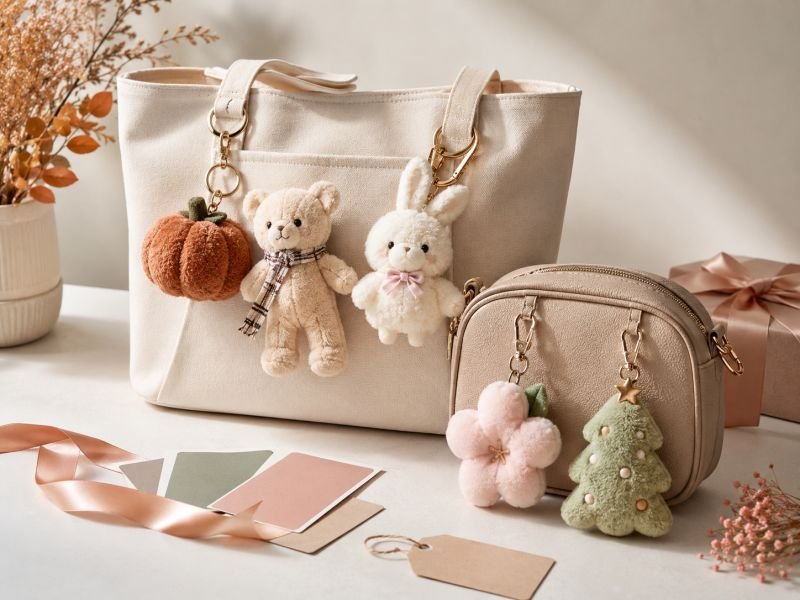
A small plush charm can do more work than many larger brand gifts. It can hang from a tote, a backpack, a handbag, a school bag, a travel pouch, or a retail display hook. It can carry a mascot, a holiday mood, a color story, a fan character, or a campaign idea. That is why more brand teams are looking at custom plush bag charms not as simple giveaways, but as small seasonal products with real collection value.
The charm itself may be small. The project behind it is not.
A seasonal plush bag charm drop needs clear thinking before sampling starts. The brand needs to decide the character, size, fabric, face method, attachment hardware, packaging, label, sales channel, delivery date, and future reorder plan. If the project includes several characters, colors, holidays, or barcode versions, the details need to be controlled even more carefully.
Custom plush bag charms help brands create seasonal drops with lower product risk, strong visual identity, and repeatable collection value. They work well for holiday launches, IP goods, mascot gifts, retail add-ons, event giveaways, and limited releases. Before bulk production, brands should review artwork, size, fabric, embroidery, hardware, packaging, labels, safety needs, approved sample standards, and multi-SKU packing rules.
For brand teams, the value is simple: a plush bag charm can turn a familiar character into something people carry every day. For retailers, it can become an easy add-on. For IP owners, it can become a collectible item. For event teams, it can become a lightweight branded gift. For long-term product teams, it can become a repeatable seasonal program.
Heyzizi helps brands turn plush charm ideas into clear sample and bulk production plans, with support from concept review, pattern development, sampling, revision, quality checking, needle detection, packing, label review, and shipment preparation.
What Are Custom Plush Bag Charms?
Custom plush bag charms are small soft accessories made with plush fabric, filling, face details, and attachment hardware. They are designed to hang on bags, backpacks, keyrings, zippers, gift sets, or retail displays. Brands use them to turn mascots, animals, icons, story characters, holiday themes, and logo ideas into portable soft goods that feel more personal than flat tags or standard plastic keychains.
Are Plush Bag Charms the Same as Plush Keychains?
They are close, but not always the same.
A plush keychain usually focuses on keys or small daily carry use. A plush bag charm is often designed with stronger visual styling for bags, retail display, gift sets, or fashion accessories. It may use a larger character shape, a softer body, a special chain, a ribbon, a branded tag, or a decorative clasp.
In real projects, the two names often overlap. A brand may call the product a plush keychain, plush charm, bag pendant, soft charm, plush hanger, or mascot charm. The better way to define the product is not by name, but by use:
| Product Name | Common Use | Key Detail |
|---|---|---|
| Plush keychain | Keys, backpacks, event gifts | Small size and secure ring |
| Plush bag charm | Handbags, totes, retail accessories | Stronger styling and display value |
| Plush zipper pull | Bags, pouches, apparel | Smaller size and light attachment |
| Mascot plush charm | Brand gifts, IP goods, school spirit | Character accuracy |
| Seasonal plush charm | Holiday drops, limited releases | Color, outfit, tag, and packaging theme |
This matters because the use scene affects size, weight, hardware, packing, and safety review.
Which Brands Use Plush Bag Charms?
Plush bag charms can fit many brand categories.
Fashion and bag brands use them to refresh existing bags without creating a new main product. IP owners use them to turn characters into small collectible goods. Retail stores use them as add-on items near checkout counters or gift sections. Education brands use mascot charms for school programs and student rewards. Event teams use them for campaign gifts, launch kits, and member packs.
The best users are usually brands with one of these assets:
| Brand Asset | Charm Opportunity |
|---|---|
| Mascot | Turn it into a portable soft character |
| IP character | Build collectible seasonal versions |
| Strong logo | Add it through tags, patches, or small accessories |
| Holiday campaign | Create limited gift or retail editions |
| Retail channel | Use charms as add-on products |
| Fan community | Create repeatable character drops |
A plush charm is not only decoration. It gives the brand a small product that people can carry in public.
Why Are Plush Bag Charms Popular for Seasonal Drops?
They work because they are small, emotional, easy to refresh, and easy to collect.
Seasonal drops need products that feel new without requiring a full product rebuild every time. Plush bag charms are well suited for this because the base character can stay the same while colors, outfits, facial expressions, accessories, hangtags, and packaging change by season.
A bear can become a Valentine bear, Halloween bear, Christmas bear, school season bear, or summer travel bear. A mascot can wear different scarves, hats, badges, bags, or ribbon colors. A small change can create a new reason to release, collect, display, and share.
That is why plush charms are useful for brands that want seasonal energy without taking on the risk of a large plush toy launch every time.
Why Do Brands Use Plush Bag Charms for Seasonal Drops?
Brands use plush bag charms for seasonal drops because they combine emotional appeal, small size, practical use, and strong visual identity. They can be sold, gifted, bundled, collected, or used as campaign merchandise. Compared with many standard gifts, plush charms feel more personal and more visible because people can attach them to items they already carry.
Why Do Small Plush Accessories Work for Limited Releases?
Limited releases work best when the product is easy to understand quickly.
A custom plush bag charm does that well. A shopper can see the character, touch the fabric, understand the theme, and imagine where to hang it in seconds. That makes it practical for stores, pop-ups, online drops, holiday gift sets, and fan campaigns.
Small plush accessories also lower the barrier for brand testing. A company may not want to launch a large plush toy line first. A charm gives the team a smaller way to test character appeal, color direction, packaging style, and repeat interest.
That does not mean the project is simple. A tiny charm can still fail if the face is unclear, the hardware feels weak, the filling is uneven, or the packaging makes the product look cheap. Limited release does not mean loose control. It means focused control.
How Do Plush Charms Create Collectible Value?
Collectible value usually comes from three things: character, variation, and scarcity.
A plush bag charm can carry all three.
The character gives people a reason to care. The variation gives people a reason to come back. The seasonal release gives people a reason to act now.
For example, an IP owner can use the same main character across four seasonal versions:
| Drop Theme | Design Change | Collection Value |
|---|---|---|
| Valentine | Heart tag, pink scarf, soft blush detail | Gift and romance mood |
| Summer | Mini beach bag, bright color, travel tag | Vacation and lifestyle mood |
| Halloween | Small cape, pumpkin tag, darker color | Limited seasonal fun |
| Christmas | Red hat, gift box card, snow label | Holiday gifting |
The charm becomes more than a small plush product. It becomes part of the character story.
What Makes Them Different from Standard Promotional Gifts?
Standard promotional gifts often start with the logo. Custom plush bag charms start with the brand feeling.
A flat keychain can show a logo. A plush charm can show a character, a texture, a mood, a season, and a story. That is why they often feel more suitable for brands that care about identity, emotional connection, retail presentation, or fan engagement.
There is also a practical difference. Many promotional items are handed out and forgotten. A well-designed plush charm may stay on a bag, backpack, zipper pull, car key, retail display, or desk for a long time.
The risk is that a plush charm needs better planning. If the item is meant to represent a brand mascot or IP character, “almost right” is not good enough. The face, proportion, color, tag, and final hanging effect need to be reviewed before approval.
Who Should Consider Custom Plush Bag Charms?

Custom plush bag charms are useful for brands that need small, visible, soft, and repeatable products. They fit fashion, bags, lifestyle, IP merchandise, education, events, theme parks, museums, retail stores, and online shops. They are especially useful when the brand has a mascot, character, seasonal campaign, member gift plan, or product line that can be refreshed across several drops.
Are They Suitable for Fashion and Bag Brands?
Yes, especially when the brand wants to give existing bags a fresh seasonal look.
A bag brand does not always need to develop a new handbag to create new excitement. A plush charm can refresh a classic tote, backpack, cosmetic bag, pouch, or travel bag. It can also support matching collections.
For example:
| Brand Product | Plush Charm Use |
|---|---|
| Tote bag | Add-on charm for seasonal styling |
| Backpack | School mascot or youth collection charm |
| Cosmetic pouch | Mini plush zipper pull or soft tag |
| Travel bag | Destination-themed charm |
| Kids bag | Soft animal charm with safe attachment review |
| Gift set | Plush charm as a bonus item |
The charm must not fight with the bag design. Size, color, hardware, and weight should fit the product it hangs from. A charm that is too large may feel clumsy. A charm that is too small may lose character detail. A charm that uses the wrong hardware may not hang well.
Can IP Owners Use Them as Character Merchandise?
Absolutely. Plush bag charms are one of the most flexible ways to turn IP characters into smaller collectible products.
Large plush toys are great for display and gifting, but small charms are easier to carry, collect, bundle, and release by season. They can also reach fans who want a lower-price item than a full-size plush doll.
For IP teams, the main challenge is character accuracy. Small size makes this harder. Eyes, mouth, ears, hair, tail, clothing, and expression may need to be simplified carefully. The goal is not to copy every tiny line from the artwork. The goal is to keep the character recognizable in soft form.
A good review should ask:
| Character Detail | Why It Matters |
|---|---|
| Face shape | Controls first impression |
| Eye size | Affects character emotion |
| Mouth method | Affects cuteness and expression |
| Head-to-body ratio | Affects IP recognition |
| Fabric color | Affects brand consistency |
| Clothing details | Affects story accuracy |
| Attachment position | Affects how the charm hangs |
Do Retailers Use Them as Add-On Products?
Yes. Plush bag charms are well suited for add-on sales because they are small, easy to display, easy to pack, and easy to group by theme.
Retailers can place them near bags, plush toys, gifts, stationery, kids’ goods, seasonal displays, or checkout zones. They can also be sold as part of gift sets or character collections.
Retail teams should review display early. A charm may look nice in a photo but fail in-store if the hangtag covers the face, the product does not face forward, the barcode is hard to scan, or the packaging makes the charm look flat.
Retail-ready plush charms often need:
- A clear front view
- A secure hanging method
- A neat hangtag or backing card
- Barcode or SKU sticker
- Strong carton marks
- Simple style separation
- Clean photo reference for each version
Are They Useful for Events, Campaigns, and Membership Gifts?
They can be very useful, especially when the project needs something memorable but not too large.
For events, plush charms are easier to carry than full-size plush toys. For membership gifts, they feel more personal than paper cards or standard tags. For campaigns, they can carry a theme, mascot, slogan, or color story without needing a complicated product structure.
The timing matters. Event and seasonal projects often have fixed dates. A late charm is not just late stock; it can miss the campaign window. That is why artwork, sample approval, packaging, quantity, and delivery details should be confirmed early.
If your team is planning a launch kit, holiday giveaway, or mascot charm campaign, you can send artwork, target size, quantity, packaging request, and deadline to info@heyzizi.com for a project review.
Which Seasonal Drop Ideas Work Best?
The best seasonal plush bag charm drops are clear, collectible, and easy to recognize. Strong ideas often come from holidays, mascots, IP characters, school seasons, travel themes, sports events, retail anniversaries, or limited color stories. A good drop does not need too many details. It needs one clear theme, one recognizable character, and one packaging idea that supports the release.
What Types of Holiday Plush Charms Can Brands Create?
Holiday plush charms can be playful, premium, cute, nostalgic, or minimal. The right style depends on the brand.
Here are common seasonal ideas:
| Season or Event | Plush Charm Idea |
|---|---|
| Valentine’s Day | Heart charm, blush detail, ribbon, couple set |
| Easter | Bunny, chick, pastel tag, egg card |
| Summer | Travel mascot, beach outfit, fruit color story |
| Back to School | Backpack mascot, school badge, name tag |
| Halloween | Bat, ghost, pumpkin, cape, darker fabric |
| Christmas | Santa hat, scarf, gift card, snow label |
| New Year | Lucky animal, gold tag, celebration outfit |
| Brand anniversary | Limited color, numbered tag, gift box |
A strong holiday charm should not rely only on color. A red version is not always a Valentine product. A green version is not always a Christmas product. The theme becomes stronger when color, accessory, tag, and packaging work together.
How Can One Mascot Become Several Seasonal Versions?
A mascot is one of the best starting for a seasonal charm program.
The base shape can stay stable, while seasonal elements change. This helps save development time and keeps the character recognizable. It also makes future drops easier because the approved pattern, face method, fabric direction, and filling standard can be reused.
Possible seasonal changes include:
- Scarf color
- Small hat
- Mini bag
- Embroidered badge
- Ribbon
- Printed tag
- Seasonal outfit
- Gift card
- Backing card
- Limited color fabric
The key is to avoid changing too much at once. If every season changes the face, body, fabric, outfit, hardware, and packaging, the program becomes harder to control. For repeatable drops, it is smarter to keep the core character stable and change selected seasonal details.
When Should Brands Plan Valentine’s, Halloween, or Christmas Drops?
Earlier than most teams think.
A custom plush charm needs time for artwork review, material selection, pattern making, sample production, revision, final approval, material booking, bulk production, quality checking, packing, and shipping. If testing or special packaging is needed, the timeline becomes longer.
A practical planning view:
| Project Stage | What Happens |
|---|---|
| Concept review | Character, theme, size, quantity, use scene |
| Sample planning | Fabric, face method, hardware, tag, packing |
| First sample | Pattern, sewing, filling, face details |
| Revision | Adjust proportion, expression, color, hardware |
| Final approval | Confirm approved sample and bulk standard |
| Bulk order | Material, cutting, sewing, filling, checking |
| Packing | Hangtags, labels, polybags, cartons |
| Shipping prep | Carton marks, packing list, destination rules |
For seasonal drops, the risk is not only production time. The real risk is decision delay. If the team takes too long to approve artwork, sample changes, or packaging, even a capable factory will have less room to protect the final date.
Which Colors, Outfits, and Tags Help Create a Seasonal Feel?
The best seasonal detail is the one people understand without reading a long description.
A Halloween charm can use a tiny cape, pumpkin tag, darker stitch color, or ghost-shaped backing card. A Christmas charm can use a scarf, snowflake card, red hat, or gift box. A summer charm can use brighter colors, a small beach bag, or travel tag.
Small details work well when they are visible at charm size. Very fine graphics may disappear. Tiny printed patterns may look unclear. Small plastic pieces may raise safety or attachment concerns. A good seasonal design should be simple enough to produce, strong enough to recognize, and clear enough to photograph.
How Do Brands Design Plush Bag Charms That Feel Retail-Ready?

A retail-ready plush bag charm needs more than a cute sketch. It should have a practical size, stable shape, clear face, suitable fabric, secure hardware, clean tag placement, and packaging that supports display. The charm should look good on a bag, in a photo, inside a gift set, and on a retail hook.
What Size Works Best for Bag Charms?
Most plush bag charms need to be small enough to hang comfortably and large enough to show character detail.
If the charm is too small, embroidery and facial details may become unstable. If it is too large, it may feel more like a mini plush toy than a bag accessory. The best size depends on use:
| Use Scene | Size Direction |
|---|---|
| Handbag charm | Compact, light, polished |
| Backpack charm | Slightly larger, stronger visual |
| Kids bag charm | Soft, safe, easy to grip |
| Retail display | Clear front shape, strong tag layout |
| Event gift | Cost-aware and easy to pack |
| IP collectible | Enough size for face and costume detail |
The size should be reviewed together with the face method. A 6 cm charm with complex eyes and mouth may not work as well as a 10 cm charm with cleaner embroidery.
Which Fabric Types Affect Handfeel and Brand Style?
Fabric changes how the charm feels, photographs, and represents the brand.
Short plush can give a clean character look. Minky can feel soft and smooth. Long plush can add warmth and cuteness, but may hide small embroidery or shape lines. Fleece can work for certain simple shapes. Some brands may prefer recycled material direction or special texture, depending on their product values and cost plan.
The decision should not be based only on softness. Brands should also review:
- Color match
- Pile direction
- Cutting accuracy
- Embroidery stability
- Lint control
- Shape clarity
- Photo effect
- Handfeel after packing
A soft fabric that hides the character face may not be the best choice. A beautiful fabric that changes shade under different light may cause approval issues. Fabric should support the character, not distract from it.
How Should Face Details Be Made: Embroidery vs Printing vs Applique?
The face is where many charm projects succeed or fail.
Embroidery is often used for eyes, mouth, brows, logos, and small expression details. It is durable and clean, but very tiny shapes may need simplification. Printing can handle color gradients or flat graphic areas, but it may not give the same raised texture. Applique can add layered fabric detail, but it needs enough space and clean sewing.
A simple comparison:
| Face Method | Best For | Watch Carefully |
|---|---|---|
| Embroidery | Eyes, mouth, logo, clean expression | Minimum line size and stitch density |
| Printing | Flat color, pattern, graphic detail | Color accuracy and surface effect |
| Applique | Larger face panels or clothing detail | Edge sewing and alignment |
| Mixed method | More complex characters | Cost, time, and bulk consistency |
For small plush bag charms, the safest option is often a simplified face with stable embroidery. If the artwork has many tiny lines, Heyzizi usually reviews which details should stay, which should be enlarged, and which should be simplified before sampling.
What Hardware Should Be Used: Keyring, Lobster Clasp, Chain, or Cord?
Hardware affects both function and perceived value.
A keyring is simple and familiar. A lobster clasp is easy to attach to bags. A bead chain can be cost-friendly for light charms. A cord or ribbon can create a softer look. A branded metal part may feel more premium but may increase cost and require more time.
The hardware should match the charm weight and use scene. A heavy charm on a weak chain will not feel reliable. A sharp metal part near a children’s product may need extra review. A clasp that looks good in a photo may not open smoothly in real use.
Hardware placement also matters. If the attachment is too far back, the charm may tilt. If it is placed on a weak seam, it may pull the body out of shape. A good factory review should check how the charm hangs, not only how it looks flat on a table.
What Should Brands Review Before Sampling?
Before sampling, brands should review artwork, target size, character structure, fabric direction, face method, attachment hardware, packaging plan, quantity, target region, safety needs, and delivery date. This helps the factory judge feasibility, cost direction, sample difficulty, and possible risk before making the first piece.
What Artwork and Brand Files Should Be Sent?
The better the starting information, the faster the project can be reviewed.
Useful files include:
| File or Detail | Why It Helps |
|---|---|
| Character artwork | Shows shape, face, color, and style |
| Front and side reference | Helps convert flat art into plush form |
| Logo file | Helps review label, tag, or embroidery method |
| Pantone or color reference | Helps reduce color confusion |
| Target size | Affects pattern, cost, packing, and detail |
| Quantity | Affects price direction and production planning |
| Packaging idea | Affects label, card, carton, and display |
| Target region | Affects safety and label review |
| Delivery date | Affects sample and bulk order planning |
If the design is still early, a rough sketch, mood board, target size, quantity, and use scene are enough to start the first review.
How Does a Factory Review Character Feasibility?
A factory does not only ask, “Can we make it?”
A better review asks:
- Can the character stand or hang correctly?
- Is the face clear at the target size?
- Will the fabric support the shape?
- Can the hardware attach securely?
- Are small parts needed?
- Will the charm look good after packing?
- Can the design stay stable in bulk order?
- Can this style be repeated for future drops?
This is where project experience matters. A flat drawing may look perfect, but plush fabric has thickness, pile direction, stretch, seams, and filling pressure. These physical factors change the final shape.
A good factory review protects both sides. It helps the brand avoid paying for samples that were never likely to work well in the chosen size.
Why Can Tiny Details Become a Sampling Risk?
Small charms make every detail harder.
A tiny eye may be hard to embroider clearly. A narrow mouth may disappear into the plush pile. A small hat may twist during packing. A thin tail may not hold shape. A small logo may not remain readable.
This does not mean the design must become plain. It means the design needs smart translation.
For example, a detailed mascot face may be simplified into larger embroidered eyes, a cleaner mouth, and stronger color blocking. A complex outfit may become a scarf, badge, or printed hangtag. A tiny accessory may become part of the backing card instead of being sewn onto the charm.
The best sample is not always the one that copies every detail. It is the one that keeps the character recognizable while staying suitable for bulk production.
How Long Does a Custom Plush Bag Charm Sample Take?
Sample time depends on complexity, material availability, face method, hardware, packaging, and revision needs.
Simple plush charms may move faster. More complex mascot charms, IP characters, special fabric, custom hardware, multi-piece outfits, or retail packaging can take longer. Revisions also add time, especially when face expression, color, size, or attachment position needs adjustment.
The safest habit is to plan the first sample as a decision tool, not the final product. Teams should expect to review proportion, face, filling, hardware, tag placement, and packing effect before final approval.
For seasonal projects, do not wait until the campaign date is close. A charm is small, but a late decision can still create a big schedule problem.
How Much Do Custom Plush Bag Charms Cost?
Custom plush bag charm cost depends on size, fabric, pattern complexity, embroidery, printing, applique, hardware, filling, accessories, packaging, testing needs, quantity, and delivery timing. Small products are not always cheap because they still need pattern work, material planning, cutting, sewing, checking, packing, and project control.
What Affects the Price of Custom Plush Bag Charms?
Many teams only think about size. Size matters, but it is not the only cost driver.
| Cost Factor | Why It Changes Cost |
|---|---|
| Size | Affects fabric, filling, packing, and detail space |
| Shape | Complex patterns need more cutting and sewing |
| Fabric | Special texture or color may cost more |
| Embroidery | More colors and stitch density add work |
| Printing | Setup and color matching may affect cost |
| Hardware | Keyring, clasp, chain, cord, or custom part |
| Accessories | Hats, scarves, clothing, tails, mini bags |
| Packaging | Polybag, hangtag, card, gift box, barcode |
| Quantity | Smaller runs carry higher unit cost |
| Testing | Extra safety checks may add time and cost |
| Timeline | Rush projects may limit material options |
A cheap-looking charm can hurt a premium brand more than it saves money. Cost control should focus on smart simplification, not random cutting.
Why Do Small Quantity Orders Cost More?
A small order still needs most of the same development steps as a larger order.
Pattern work, sample making, material sourcing, embroidery setup, cutting, sewing, filling, inspection, packing, and project communication do not disappear because the order is small. Many materials and accessories also have minimum purchase requirements.
That is why a 200-piece order may have a higher unit price than a 1,000-piece order. The same setup work is spread across fewer pieces.
For early testing, a smaller quantity may still make sense. But if the brand already plans seasonal drops, retail launch, or long-term repeat orders, a more realistic quantity can often create better cost and better production planning.
How Can Brands Control Cost Without Making the Charm Look Cheap?
The best way is to simplify what people do not notice and protect what people do notice.
Protect:
- Face expression
- Character shape
- Fabric feel
- Attachment strength
- Front view
- Tag quality
- Packaging impression
Simplify:
- Hidden seams
- Overly tiny details
- Too many embroidery colors
- Excessive accessories
- Complicated custom hardware
- Oversized packaging
- Details that do not affect recognition
For example, if the character has a complex jacket, it may be better to use one strong scarf or badge instead of many tiny clothing panels. If the logo is too small for embroidery, it may work better on the hangtag or backing card.
Smart cost control makes the product cleaner. Poor cost control makes the product weaker.
When Is a Higher MOQ Better for Seasonal Drops?
A higher quantity can be better when the drop is tied to a retail launch, large event, national campaign, or multi-store program.
It can help with material purchasing, production line planning, packaging setup, and unit cost. It can also reduce the need to restart the same project too quickly.
For brands planning multiple seasonal versions, it may also be useful to discuss the full program early. If the base character will be reused, the factory can help plan pattern records, material standards, face methods, and packaging rules for future drops.
Heyzizi usually reviews MOQ based on product structure, materials, complexity, and project goals. Standard custom plush projects are often better at 500 pcs or above per style, while simpler styles may be reviewed for smaller runs depending on the design. For sample fee planning, one-style bulk orders reaching 2,000 pcs may qualify for sample fee return or deduction under Heyzizi’s project rules.
How Does a Plush Bag Charm Factory Manage Bulk Production?

A plush bag charm factory manages bulk production by turning the approved sample into a clear production standard. This includes pattern files, fabric color, embroidery details, filling level, hardware position, label content, packing method, barcode rules, carton marks, and quality checks. For seasonal drops with multiple styles, SKU control is just as important as sewing quality.
What Is the Process from Sample to Bulk Order?
The process should be clear enough for both the brand team and the factory team to follow.
A practical flow:
| Step | What Should Be Confirmed |
|---|---|
| Project review | Artwork, size, quantity, use scene, deadline |
| Structure check | Shape, face, hanging position, hardware |
| Sample making | Pattern, fabric, embroidery, sewing, filling |
| Revision | Proportion, expression, color, attachment, tag |
| Approved sample | Final reference for bulk order |
| Production prep | Materials, cutting files, embroidery files, packing rules |
| Bulk order | Cutting, sewing, filling, shaping, checking |
| Packing | Tags, labels, barcodes, polybags, carton marks |
| Shipment prep | Carton list, photos, inspection, delivery documents |
The approved sample should not be treated as a nice photo. It should become the working standard for bulk order control.
How Is the Approved Sample Used as the Bulk Standard?
The approved sample helps control what “correct” means.
It should guide:
- Final size
- Face position
- Fabric color
- Embroidery color
- Filling level
- Hardware position
- Tag placement
- Packaging method
- Weight and carton plan
- Photo reference for each style
For multi-style seasonal drops, each style should have its own approved sample record. A Halloween version and Christmas version may share the same base pattern, but they need separate accessory, tag, color, and packing references.
This prevents small mistakes from becoming large order problems.
How Are Fabric Color, Embroidery Position, and Filling Checked?
These three details affect the final feeling of the charm.
Fabric color controls brand consistency. Embroidery position controls character expression. Filling controls shape and handfeel.
If the eye position moves slightly, the character may look sleepy, angry, or strange. If filling is too loose, the charm may look flat. If filling is too tight, the charm may lose softness or distort the seam. If fabric direction changes, color may look different under light.
Quality checking should include:
| Check Item | What to Review |
|---|---|
| Fabric shade | Match approved reference |
| Cutting | Shape and size consistency |
| Embroidery | Position, color, density, clean back |
| Sewing | Seam strength and neat edge |
| Filling | Balance, softness, shape |
| Hardware | Position, strength, smooth use |
| Appearance | Front view, face, symmetry |
| Packing | Tag, barcode, polybag, carton mark |
| Needle detection | Metal risk control before shipment |
For brand projects, quality is not only about no defects. It is about keeping the character and brand feeling stable across the full order.
How Are Multiple Styles and Seasonal SKUs Controlled?
Seasonal drops often involve more than one version. This is where many projects become messy.
A clear SKU system helps prevent wrong tags, wrong barcodes, mixed packing, and carton confusion.
Each version should have:
- Style name
- Style code
- Color code
- Character name
- Size
- Hardware type
- Hangtag version
- Barcode or SKU sticker
- Polybag rule
- Carton quantity
- Carton mark
- Approved sample photo
For example, a brand may launch four versions of the same mascot: Valentine, Summer, Halloween, and Christmas. The body shape may be similar, but tags, colors, accessories, and carton marks must be separated clearly.
This is one of the biggest differences between a serious plush project and a simple promotional item order.
What Packaging Works Best for Seasonal Plush Charm Drops?

The best packaging for seasonal plush charm drops depends on sales channel, gift purpose, display method, barcode needs, and shipping route. Common choices include polybags, hangtags, backing cards, retail cards, display boxes, gift boxes, barcode stickers, SKU labels, and carton marks. Packaging should protect the charm, support display, and prevent style confusion.
Do Brands Need Hangtags, Barcode Stickers, or Retail Cards?
Most retail or branded projects need at least one of them.
A hangtag can tell the story. A barcode sticker helps scanning. A retail card helps display. A gift box can increase perceived value. A simple polybag can protect the product during transport.
The best choice depends on the channel:
| Channel | Useful Packaging |
|---|---|
| Retail store | Hangtag, barcode, backing card, display box |
| E-commerce | Polybag, SKU label, barcode, protective carton |
| Event gift | Simple bag, campaign tag, carton separation |
| Gift set | Insert card, box, tissue paper, set packing |
| IP collectible | Character card, limited tag, series number |
| School program | Name label, class sorting, safe packing |
Packaging should be planned early. If the product needs a backing card, the charm hole, tag position, and hanging direction should match that card.
Which Packaging Works for Retail, E-Commerce, and Events?
Retail packaging should make the charm easy to see and scan.
E-commerce packaging should protect shape and reduce shipping damage.
Event packaging should make distribution easy.
A retail charm may need a clean front display and barcode. An online charm may need a compact polybag with SKU label. An event charm may need carton grouping by location, team, or attendee type.
The same charm can use different packing versions for different channels, but this needs clear control. A retail version and event version should not be mixed unless the packing rules are clearly written.
How Can Packaging Support Gift Sets and Limited Editions?
Limited editions need packaging that signals the release.
This can be done through:
- Seasonal hangtag
- Gift card
- Character card
- Numbered tag
- Special color card
- Mini gift box
- Display-ready pack
- Set packing with other products
The packaging does not need to be expensive. It needs to feel intentional.
A simple charm with a good seasonal card can feel more complete than a charm thrown into a plain bag. For gift sets, the packing should also protect the charm shape so it does not arrive flattened or twisted.
What Carton Marks and Packing Rules Should Be Confirmed?
Carton details are not exciting, but they protect the order.
For seasonal drops, carton marks should clearly show style, quantity, destination, version, and carton number. Mixed cartons should be planned carefully. If different holiday versions are packed together, the packing list must be easy to follow.
Confirm early:
- Quantity per polybag
- Quantity per inner box
- Quantity per carton
- Mixed or single-style carton
- Barcode placement
- SKU sticker placement
- Carton mark format
- Destination label
- Photo reference before shipment
Good packing control reduces warehouse delays, store confusion, and after-delivery complaints.
Are Plush Bag Charms Safe for Retail and Children’s Markets?
Plush bag charms should be reviewed for safety when they are used for children’s products, school programs, family brands, retail channels, or public campaigns. Key checks include fabric safety, seam strength, small parts, attachment strength, filling, needle detection, labels, warnings, and target-region requirements. Safety should be planned before sampling, not after bulk production.
What Safety Details Should Brands Review Early?
Safety review starts with the user group.
A charm for adult fashion accessories may have different requirements from a charm sold in a children’s store. A school mascot charm may need a more careful review than a decorative handbag charm. A plush charm included in a kids’ gift set may need label and small-parts review.
Early review should cover:
| Safety Detail | Why It Matters |
|---|---|
| Fabric | Skin contact and material compliance |
| Filling | Softness, cleanliness, and consistency |
| Small parts | Choking or detachment risk |
| Hardware | Sharp edge, pull strength, attachment |
| Stitching | Seam strength and durability |
| Face method | Embroidery may reduce hard part risks |
| Label | Age warning and care details |
| Needle detection | Metal risk control before shipment |
The safest design is often the one that uses fewer loose parts and more stable soft construction.
Why Do Small Parts, Attachments, and Pull Strength Matter?
Bag charms often include hardware. That hardware must be reviewed carefully.
Keyrings, chains, clasps, cords, bells, badges, beads, and tiny accessories can all affect safety and durability. If the charm is for children or public retail channels, attachment strength becomes especially important.
A cute accessory that pulls off too easily can become a serious complaint. A metal ring with a rough edge can damage bags or create user concerns. A small plastic eye may not be suitable for certain age groups. These issues should be discussed before the first sample, not after approval.
Is Needle Detection Needed for Plush Bag Charms?
For plush products, needle detection is a valuable control step.
Plush items involve cutting, sewing, and metal tools. Needle detection helps reduce the risk of broken needle fragments or unwanted metal contamination before shipment. For brand projects, this step supports safety, trust, and shipment confidence.
Heyzizi places strong attention on product checking, including needle detection, quality inspection, label review, packing review, and shipment preparation for custom plush orders. For projects aimed at children, retail, education, or overseas channels, safety planning should be part of the early project review.
What Labels or Warnings May Be Needed for Target?
Labels depend on the product, target region, use group, and sales channel.
Common label details may include:
- Brand name
- Product name
- Material content
- Care information
- Age warning
- Tracking information
- Country of origin
- Barcode
- SKU code
- Safety warning
- Retail or warehouse label
For multi-region orders, labels may need different languages or warning formats. This should be confirmed before bulk production because label mistakes can delay selling, warehousing, or shipment clearance.
Custom Plush Bag Charms vs Standard Promo Charms

Custom plush bag charms are better for brand identity, IP products, retail add-ons, and repeat seasonal collections. Standard promo charms are usually better for simple logo exposure, lower-cost giveaways, or short events. The right choice depends on whether the brand needs emotional value, character accuracy, retail presentation, and future collection planning.
Which Option Is Better for Brand Identity?
Custom plush bag charms are usually stronger for identity because they can carry shape, softness, color, character, and emotion.
A standard promo charm may show a logo. A plush charm can show what the brand feels like.
This is especially useful for:
- Mascots
- IP characters
- Lifestyle brands
- Kids brands
- Fan goods
- Retail gifts
- Holiday campaigns
- Soft product collections
If the goal is only to hand out a low-cost logo item, a standard charm may be enough. If the goal is to make people remember the brand, carry the item, and connect with a character, custom plush is stronger.
Which Option Works Better for Retail and IP Merchandise?
For retail and IP merchandise, custom plush bag charms usually have more room to create value.
They can be designed as a series, packed with character cards, grouped by theme, and refreshed by season. They can also support limited colors, special outfits, and fan-focused releases.
Standard promo charms are often too generic for IP fans. Fans notice if the eyes, mouth, expression, or costume feels wrong. A custom plush charm gives more room to preserve character feeling, but it also needs stronger sample review.
Which Option Is Better for Long-Term Seasonal Collections?
Custom plush bag charms are better for long-term seasonal collections because they can be built around repeatable assets.
A brand can keep the base mascot and change:
- Color
- Outfit
- Tag
- Packaging
- Accessory
- Holiday theme
- Channel version
- Size version
Over time, this creates a product family. That is harder to do with generic promo charms because they often lack character depth and collectible value.
How Can Brands Build a Repeatable Seasonal Plush Charm Program?
Brands can build a repeatable seasonal plush charm program by keeping the core character stable while changing selected seasonal details. The factory should preserve patterns, approved sample records, fabric references, embroidery files, hardware details, label rules, packing photos, and carton standards. This makes future drops faster, clearer, and more consistent.
How Can One Character Become a Full Charm Collection?
One strong character can support many drops.
The trick is to build around a stable core. Keep the face, body shape, main fabric, and character proportion recognizable. Then change seasonal details around it.
For example:
| Core Character | Seasonal Change |
|---|---|
| Brand bear | Scarf color, heart tag, gift box |
| Cat mascot | Witch hat, pumpkin card, star charm |
| Bunny character | Pastel ribbon, egg tag, spring card |
| Travel mascot | Mini suitcase, destination label |
| School mascot | Backpack, badge, class color |
| IP hero | Special outfit, series card, limited label |
This approach keeps the product fresh without restarting from zero every time.
How Can Brands Reuse Patterns for Future Drops?
Pattern reuse can save time, reduce confusion, and protect character consistency.
After one charm is approved, the factory can keep the pattern and use it as the base for future versions. The next version may only need changes to accessories, color, tag, or embroidery details.
This works best when the first project is organized properly. If the first version does not have clear records, future drops may become harder. The team may argue over size, color, face position, or filling again.
Good records turn a one-time project into a repeatable product system.
What Project Records Help Future Reorders?
Useful reorder records include:
- Approved sample photos
- Pattern version
- Fabric reference
- Embroidery file
- Stitch color
- Filling standard
- Hardware type
- Attachment position
- Hangtag file
- Label content
- Barcode rule
- Packing method
- Carton quantity
- Carton mark
- QC checklist
- Shipment notes
These details help the next order match the one. They also help when the brand adds new characters, sizes, or seasonal versions.
How Can a Factory Support Long-Term Product Line Development?
A good plush factory does more than sew the current order.
It helps the brand think about what comes next. Can this character become a keychain, pillow, mini pouch, bag charm, mascot doll, or gift set? Can the same style support future holidays? Can the packaging system handle more SKUs? Can the fabric color be repeated next season? Can the approved sample standard be kept?
Heyzizi supports custom plush projects with project review, pattern development, sample making, revision support, bulk order control, quality inspection, needle detection, packing, label review, and shipment preparation. For brands planning a seasonal charm program, this kind of project memory can make the next drop easier to manage.
What Should You Send to Start a Custom Plush Bag Charm Project?
To start a custom plush bag charm project, send character artwork or a reference image, target size, quantity, fabric preference, face method, attachment hardware idea, packaging request, target region, use scene, and delivery date. These details help the factory review structure, price direction, sample difficulty, safety needs, and bulk order planning.
What Basic Files Help a Factory Review the Project?
You do not need a perfect tech pack to begin.
The first review can start with:
- Character artwork
- Reference photo
- Target size
- Quantity
- Use scene
- Preferred fabric
- Face method idea
- Hardware idea
- Packaging request
- Target region
- Delivery deadline
- Destination country
If you already have brand color references, logo files, packaging artwork, or barcode rules, send those too.
Which Details Help Get a Faster Price Direction?
Price review becomes faster when the factory knows the basic project shape.
The most useful details are:
| Detail | Why It Helps |
|---|---|
| Size | Affects material and detail feasibility |
| Quantity | Affects unit cost and production planning |
| Character complexity | Affects pattern, embroidery, sewing |
| Fabric | Affects cost and handfeel |
| Hardware | Affects function and price |
| Packaging | Affects retail readiness and carton plan |
| Target date | Affects schedule planning |
| Target region | Affects label and safety review |
If some details are not ready, that is fine. A strong factory can help you organize the next decisions.
What Should Be Confirmed Before Sample Making?
Before sample making, confirm the direction clearly enough to avoid wasted revisions.
Review:
- Final or working artwork
- Target size
- Main fabric
- Face method
- Hardware type
- Attachment position
- Tag position
- Packaging direction
- Safety concerns
- Quantity direction
- Delivery schedule
Do not rush into sampling if the face method, size, or attachment has not been discussed. For plush bag charms, these details control the final result.
How Can Heyzizi Help Review the Project?
Heyzizi can help review whether your plush bag charm idea is suitable for sampling and bulk production. The team can look at character structure, size, fabric, embroidery, filling, hardware, packaging, safety needs, SKU planning, and delivery schedule before the first sample starts.
This helps reduce repeated revisions and makes the project easier to manage from sample to bulk order.
You can send artwork, target size, quantity, seasonal theme, packaging needs, and delivery deadline to info@heyzizi.com for a project review.
Closing Note
A custom plush bag charm may look like a small product, but for a brand it can carry a full seasonal idea.
It can refresh a bag line, extend an IP character, support a holiday campaign, add value to a gift set, create a collectible series, or test a new product direction with lower risk. The brands that get the best results do not treat it as a random accessory. They treat it as a small product system.
Start with one clear character. Choose one seasonal story. Keep the size practical. Protect the face. Plan the hardware. Think about packaging early. Confirm labels and carton rules before production. Save the approved sample records for the next drop.
That is how a soft little charm becomes more than decoration. It becomes a seasonal product that people can carry, collect, and remember.
FAQs About Custom Plush Bag Charms for Seasonal Drops
1. What is the usual MOQ for custom plush bag charms?
Certainly, most custom plush bag charm projects work better from 500 pcs per style, while simpler designs may be reviewed from 200–300 pcs depending on structure, fabric, hardware, and packing needs. The right quantity is not only about the lowest number. It also affects unit cost, material planning, embroidery setup, cutting, sewing, inspection, packing, and delivery control.
For a seasonal drop, the best MOQ depends on how the charm will be used. A small test for an online shop, event gift, or limited IP release may start with a smaller run if the design is simple. A retail program, multi-store launch, or holiday campaign usually works better at 500 pcs or above because material purchase, line planning, and packing setup become more efficient.
A tiny charm still needs pattern work, sample making, fabric sourcing, embroidery files, hardware selection, filling, checking, tagging, and carton packing. That is why very small runs often have a higher unit cost. If your team plans several seasonal versions, it may be smarter to review the full program early. One base mascot can often support Valentine, Halloween, Christmas, summer, or anniversary versions with controlled changes.
| Quantity Direction | Best Fit |
|---|---|
| 200–300 pcs | Simple test, small event, early product trial |
| 500 pcs+ | Standard custom plush charm project |
| 1,000 pcs+ | Stronger cost control and smoother production |
| 2,000 pcs+ per style | May support sample fee return or deduction under Heyzizi project rules |
Heyzizi can review your artwork, size, quantity, packaging plan, and delivery date before suggesting a practical quantity direction.
2. How long does custom plush bag charm sampling take?
Sure, sample timing depends on design complexity, fabric availability, face method, attachment hardware, and revision needs. A simple plush bag charm may move faster, while a detailed mascot charm, IP character, multi-fabric design, special clasp, custom tag, or retail card can take longer because each detail must be tested in soft form.
Sampling is not only about making one cute piece. It is where the brand checks whether the character can stay recognizable at a small size. For plush bag charms, the face is often the hardest part. Eye size, mouth shape, embroidery density, fabric pile, filling pressure, and hanging position can all change the final feeling. A charm may look right in artwork but feel different after stuffing and sewing.
A practical sample review usually includes:
| Sample Detail | What to Check |
|---|---|
| Size | Does it feel right on a bag or display hook? |
| Face | Are the eyes, mouth, and expression clear? |
| Fabric | Does the handfeel match the brand style? |
| Hardware | Does the charm hang smoothly and securely? |
| Filling | Is the shape balanced, soft, and stable? |
| Tag | Does it block the character or improve display? |
| Packing | Does the product keep its shape after packing? |
For seasonal drops, do not wait until the launch date is close. The first sample should be treated as a decision tool. It helps your team approve structure, face, fabric, hardware, and packing before bulk production starts.
3. What files should we send to start a custom plush bag charm project?
Of course, you do not need a perfect technical package to begin, but clear starting details help the factory review the project faster and avoid repeated changes. The most useful files are character artwork, reference images, target size, quantity, use scene, fabric preference, face method idea, attachment hardware, packaging request, target region, and delivery date.
If the charm is based on a mascot or IP character, front artwork is helpful, but front artwork alone is not always enough. A side view, color reference, logo file, outfit detail, or existing product photo can help the factory understand shape, proportion, and personality. For small plush bag charms, tiny details may need adjustment, so it is better to send the original design and let the factory review which parts should be enlarged, simplified, embroidered, printed, or moved to a tag.
| What to Send | Why It Helps |
|---|---|
| Character artwork | Shows shape, face, color, and style |
| Target size | Affects pattern, cost, detail, and packing |
| Quantity | Helps review cost and production path |
| Use scene | Retail, event, IP goods, gift set, school program |
| Fabric idea | Affects handfeel and appearance |
| Face method | Embroidery, printing, applique, or mixed method |
| Hardware idea | Keyring, clasp, chain, ribbon, or cord |
| Packaging need | Hangtag, retail card, barcode, box, polybag |
| Delivery date | Helps judge schedule risk |
| Target region | Helps review labels and safety direction |
If you are still early in planning, send what you have. Heyzizi can help organize the next details before sampling.
4. How can a brand keep the character accurate on a small plush charm?
Definitely, character accuracy on a small plush charm comes from smart simplification, not from copying every tiny detail. The goal is to keep the character instantly recognizable after the artwork becomes fabric, seams, filling, embroidery, and hardware.
Small size creates real production limits. A thin mouth line may disappear into plush fabric. Tiny eyes may not embroider cleanly. Small ears, tails, wings, or clothing parts may bend during packing. A logo that looks clear on a screen may be unreadable when reduced to charm size. This is why a strong factory will review the artwork before sampling and out which details may need to be adjusted.
The most important character details are usually:
| Detail | Why It Matters |
|---|---|
| Face shape | Controls first recognition |
| Eye size | Creates emotion and personality |
| Mouth style | Changes the whole expression |
| Main color | Connects the charm to the brand |
| Head-to-body ratio | Keeps the character feeling familiar |
| Signature accessory | Helps seasonal or IP recognition |
| Hanging position | Affects how the character is seen on a bag |
For many mascot or IP charm projects, embroidery works well for the face because it is clean and durable. But embroidery still needs enough space and proper stitch density. If the artwork has too many fine lines, Heyzizi may suggest using larger embroidered shapes, cleaner color blocks, or moving some story details to the hangtag or backing card.
A good plush charm should still feel like the brand character, even if some tiny artwork details are simplified.
5. What affects the price of custom plush bag charms?
Absolutely, the price is shaped by size, design complexity, fabric, embroidery, printing, applique, hardware, accessories, packing, quantity, testing needs, and delivery timing. A small plush charm is not always low-cost because it still needs pattern work, material planning, cutting, sewing, filling, checking, tagging, and packing.
The biggest cost mistake is thinking only about size. A 9 cm charm with simple fabric, clean embroidery, and standard hardware may be easier to control than a 7 cm charm with many tiny accessories, several embroidery colors, a custom clasp, and a gift box. Smaller does not always mean simpler.
| Price Factor | How It Affects the Project |
|---|---|
| Size | Affects fabric, filling, and detail space |
| Shape | Complex shapes need more pattern and sewing work |
| Fabric | Special texture or custom color may raise cost |
| Embroidery | More colors and dense stitching add time |
| Printing | Setup and color control may add work |
| Hardware | Standard ring costs less than custom metal parts |
| Accessories | Hats, scarves, outfits, tails, mini bags add labor |
| Packaging | Hangtags, cards, boxes, and barcodes affect cost |
| Quantity | Larger runs usually improve unit cost |
| Timeline | Rush schedules may limit material choices |
The best cost control does not make the charm look cheap. It protects the visible details and simplifies what users do not notice. For example, keep the face, fabric handfeel, and hanging effect strong, but simplify hidden seams, tiny clothing lines, or complex hardware. That way the final charm still feels complete, even when the budget is controlled.
6. Which attachment hardware works best for plush bag charms?
Certainly, the best attachment depends on where the charm will be used, how heavy it is, who will use it, and how the brand wants it to look. Common choices include keyrings, lobster clasps, bead chains, ball chains, cords, ribbons, hooks, and branded metal parts.
A keyring is simple and familiar. A lobster clasp is better for handbags, totes, and backpacks because it is easy to attach and remove. A bead chain can work for lightweight charms and event gifts. A cord or ribbon can create a softer lifestyle look. Custom metal hardware can improve perceived value, but it may increase cost and lead time.
Hardware should never be chosen by appearance alone. It must fit the charm weight and use scene.
| Hardware Type | Best Fit | Watch Carefully |
|---|---|---|
| Keyring | Keychain style, backpack use | Ring size and strength |
| Lobster clasp | Bag charm and retail accessory | Smooth opening and finish |
| Bead chain | Light event gifts | Pull strength and durability |
| Cord or ribbon | Soft lifestyle look | Knot strength and wear |
| Custom metal part | Premium drop or gift set | Cost, timing, and safety review |
The attachment position is just as important as the hardware itself. If the loop is placed too far back, the charm may tilt forward. If it sits on a weak seam, it may distort the plush body. Heyzizi reviews hanging balance, seam strength, and hardware placement before bulk production so the charm looks right when it is actually used, not only when it lies flat on a table.
7. Can we create several seasonal versions from one mascot?
Definitely, one strong mascot can become a full seasonal plush charm program if the base shape is planned correctly from the beginning. This is one of the best uses for custom plush bag charms because the brand can keep the core character stable while changing selected seasonal details.
For example, a brand bear can become a Valentine version with a heart tag, a summer version with a mini travel bag, a Halloween version with a small cape, and a Christmas version with a scarf and gift card. The face, body shape, main fabric, and pattern can stay consistent, while colors, outfits, tags, and packaging create the seasonal feeling.
| Base Mascot | Seasonal Change |
|---|---|
| Bear | Scarf, heart tag, gift card, holiday hat |
| Bunny | Pastel ribbon, Easter card, flower detail |
| Cat | Witch hat, pumpkin tag, dark color story |
| Dog | School badge, backpack, class color |
| Dragon | New Year tag, gold cord, lucky color |
| Brand icon | Limited color, numbered tag, gift box |
This approach helps reduce repeated development work. It also builds collection value because fans and shoppers can recognize the same character across different drops.
The key is record keeping. Pattern files, fabric references, embroidery files, filling standards, hardware details, tag artwork, barcode rules, carton marks, and approved sample photos should be saved. Heyzizi can help keep these project details organized so future seasonal drops do not need to restart from zero.
8. Are custom plush bag charms safe for children’s, school, or retail programs?
Of course, plush bag charms can be planned for children’s, school, family, and retail programs, but safety details should be reviewed early. A charm used as an adult handbag accessory may have different requirements from one used in a children’s gift set, school mascot program, or retail store.
The main safety concerns are small parts, attachment strength, stitching, fabric, filling, sharp edges, labels, and needle detection. If the charm includes metal rings, plastic parts, bells, beads, badges, or removable accessories, those parts need extra review. For younger users, embroidered eyes and soft details may be safer than hard plastic eyes or loose decorative parts.
| Safety Area | What to Review |
|---|---|
| Fabric | Softness, color, material direction |
| Filling | Clean, balanced, and suitable firmness |
| Small parts | Risk of detachment or choking |
| Hardware | Edge smoothness and pull strength |
| Stitching | Seam strength and durability |
| Face method | Embroidery may reduce hard-part risks |
| Label | Age warning, care details, tracking info |
| Needle detection | Metal risk control before shipment |
For overseas retail channels, labels and warnings may need to match the target region. Some projects may also require third-party testing support. Heyzizi pays attention to safety planning, needle detection, label review, QC, and packing checks for custom plush projects. The safest time to discuss these details is before sampling, not after bulk production.
9. How should we pack plush bag charms for retail, online orders, or event gifts?
Sure, packing should match the sales channel, not just protect the charm. A retail charm needs to look good on display and scan easily. An online order needs compact protection and clear SKU control. An event gift needs easy distribution. A limited release may need a card, tag, or small box that makes the drop feel more special.
Packing is often where small plush charm projects become messy. A charm can be beautifully made, but if the hangtag covers the face, the barcode is hard to scan, or holiday versions are mixed in the wrong cartons, the project creates avoidable problems.
| Channel | Useful Packing Details |
|---|---|
| Retail store | Hangtag, barcode, backing card, display box |
| Online shop | Polybag, SKU label, barcode, protective carton |
| Event gift | Campaign tag, simple bag, carton separation |
| IP goods | Character card, series tag, limited version label |
| Gift set | Insert card, gift box, tissue paper, set packing |
| School program | Name label, class sorting, safe bagging |
For seasonal drops with several styles, packing rules should be confirmed style by style. Each version needs a clear style code, barcode, tag file, polybag rule, carton quantity, and carton mark. This makes warehouse receiving, store display, and reorder planning much easier.
10. Why work with a plush factory instead of a standard promotional product platform?
Absolutely, a plush factory is better when the charm needs character accuracy, soft material control, sample revision, safety review, retail packing, multi-SKU management, and long-term reorder support. A standard promotional product platform may be enough for simple logo items, but seasonal plush bag charms usually need more product thinking.
A plush charm is not just a logo on an existing item. It often starts from a mascot, IP character, holiday concept, or retail collection. That means the factory must understand pattern development, fabric behavior, embroidery limits, filling pressure, hardware placement, tag layout, barcode control, packing rules, and bulk consistency.
| Project Need | Why a Plush Factory Helps |
|---|---|
| Character accuracy | Reviews face, shape, proportion, and expression |
| Sampling | Creates and revises soft prototypes |
| Material choice | Matches handfeel, color, and structure |
| Face details | Reviews embroidery, printing, and applique |
| Hardware | Checks hanging balance and pull strength |
| Safety | Reviews small parts, labels, and needle detection |
| Bulk order control | Uses approved sample as production standard |
| Reorders | Keeps patterns, files, tags, and packing records |
Heyzizi is a Guangdong plush factory with 600+ employees, about 18,000㎡ of factory area, 35+ professional pattern makers, 300+ pieces of equipment, 80 QC inspectors, 30+ production lines, and over 20 years of OEM and ODM plush project experience. For brand teams planning seasonal charm drops, this means support is not limited to making one sample. It includes project review, structure adjustment, sample approval, bulk order control, quality inspection, packing, labels, and future product line development.
To begin, send your character artwork, target size, quantity, seasonal theme, packing request, and delivery date to info@heyzizi.com for a practical project review.