 Skip to content
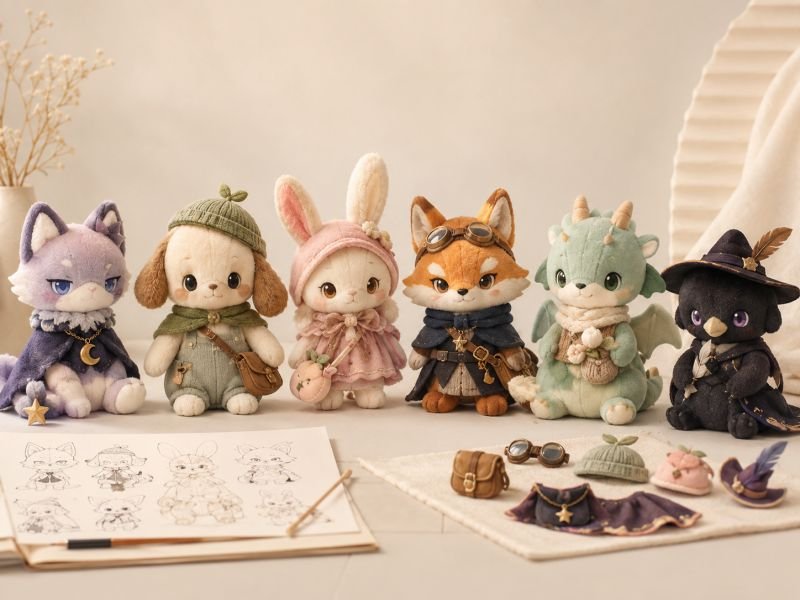
A plush toy becomes collectible when it feels like more than a soft object. It carries a character, a memory, a limited moment, a social signal, or a small piece of a world people want to keep. That is why some plush toys are placed on desks, photographed on bags, protected in original packaging, traded with other fans, or saved for years, while others disappear into the bottom of a drawer.
Custom collectible plush toys are worth collecting when they combine strong character identity, emotional value, limited availability, quality materials, neat craft, clear tags, good packaging, and a series structure people want to follow. Rarity can help, but lasting collectability usually comes from demand, design memory, condition, story, and the ability to build future releases around the same plush world.
For brands, IP teams, retailers, creators, and private label plush lines, this changes the way a plush product should be planned. The is no longer only “Can this character be made in plush?” The better is, “Will someone want to keep it, display it, complete the set, share it, and come back for the next version?” That small shift can decide whether a plush idea becomes a one-time gift or the beginning of a real collectible line.
What Makes Plush Collectible?
A plush becomes collectible when it gives people a reason to keep it, display it, protect it, talk about it, or return for the next release. Softness and cuteness help, but they are not enough. Collectible value usually comes from recognisable character identity, emotional meaning, limited release planning, durable quality, original tags, thoughtful packaging, and a clear series structure.
The difference between an ordinary soft toy and a collectible plush is the difference between “nice to have” and “hard to replace.” A regular plush may be enjoyed for a short time. A collectible plush feels more personal. It may belong to a character world, a fan community, a seasonal release, a blind box set, a mascot program, or a private label collection.
The strongest plush collections usually have several value layers working together:
| Collectible Layer | What It Includes | Why It Matters |
|---|---|---|
| Character memory | Face, shape, name, colour, signature detail | Helps people recognise and remember the plush |
| Emotional pull | Comfort, nostalgia, gift memory, fandom, place memory | Gives people a personal reason to keep it |
| Physical quality | Fabric, filling, sewing, embroidery, shaping | Makes the plush feel worth holding and displaying |
| Release identity | Limited edition, seasonal style, event version, hidden style | Adds timing, rarity, and conversation |
| Preservation value | Hangtag, care label, identity card, box, clean condition | Helps the item feel complete over time |
| Series structure | Main styles, support styles, rare styles, second waves | Encourages people to follow the full collection |
| Repeat consistency | Approved sample, pattern file, fabric record, craft record | Helps future releases stay close to the first standard |
A plush does not need to be expensive to become collectible. A small 10cm charm can be more desirable than a large plush if the design is sharper, the face is more memorable, and the release story is clearer. At the same time, a large plush can become a treasured display piece when the material, body shape, and packaging feel considered.
The key is focus. A collectible plush should not try to do everything. It should make one or two things unforgettable.
What Creates Emotional Value?
Emotional value is the quiet reason people keep plush products long after the first purchase moment. It can come from comfort, memory, fandom, identity, gift meaning, humour, or personal style. A plush may remind someone of a trip, a pet, a childhood feeling, a favourite character, a brand event, or a community they belong to.
For custom collectible plush, emotional value can be planned through design choices:
| Design Choice | Emotional Effect |
|---|---|
| Sleepy eyes | Calm, comfort, gentle personality |
| Small smile | Warmth and friendliness |
| Round body | Softness and hug feeling |
| Tiny accessory | Story and personal detail |
| Familiar mascot colour | Recognition and trust |
| Local animal or landmark | Travel memory |
| Seasonal outfit | Time-based memory |
| Character name card | Stronger attachment |
A plush does not need a complicated story. In many cases, a simple detail is stronger than a long explanation. A bunny with a soft scarf, a bear with honey-coloured fabric, a fox with a star tail, or a panda with a dessert card can create enough personality for people to remember it.
Emotional value is also connected to use. A plush that lives in daily view has more chances to become meaningful. A bag charm may travel every day. A desk plush may sit beside a laptop. A keychain plush may appear in photos. A medium plush may become part of a bedroom or studio space. The more naturally the product fits into life, the more often people interact with it.
For brand mascots and IP characters, emotional value also depends on accuracy. If the plush loses the original expression, fans may feel something is “off.” A mascot with the wrong eye shape, weak smile, or incorrect colour may look like a different character. That is why front, side, back, and detail views matter before sampling.
A useful emotional-value check before sampling:
| Check | Strong Signal | Weak Signal |
|---|---|---|
| Can people name it? | The style has a clear name or role | It is only described by colour |
| Can people describe it? | One detail stands out | It looks like many other plush toys |
| Can people use it? | It fits desk, bag, gift, shelf, or display | It has no clear use scene |
| Can people connect with it? | It carries mood, memory, humour, or fandom | It only looks soft |
| Can it grow? | Future styles are easy to imagine | The idea ends after one product |
The most collectible plush pieces often feel like small companions rather than objects. They carry a feeling people want to keep close.
Why Does Character Identity Matter?
Character identity is the foundation of collectible plush. If a plush cannot be recognised, named, or remembered, it becomes harder to collect as part of a long-term line. A strong character identity gives the plush a face, a role, and a reason to return in future versions.
A collectible character usually has three visible layers:
| Identity Layer | What To Design | Practical Review |
|---|---|---|
| Face identity | Eyes, mouth, nose, blush, expression | Must remain clear after embroidery |
| Body identity | Head shape, ears, tail, posture, belly shape | Must work in soft 3D form |
| Signature identity | Outfit, colour block, symbol, accessory, tag detail | Must be repeatable in bulk production |
The face is usually the most important. A small change in eye size, mouth curve, or embroidery placement can change the whole character. A plush with slightly lower eyes may feel cuter. A mouth that is too narrow may disappear. A blush mark that is too small may not show after stitching. These details may look minor on screen, but they decide whether the plush feels alive in hand.
Silhouette matters because plush is often seen from a distance or in photos. A strong silhouette helps people recognise the character even before they see the face. Long bunny ears, a round panda head, a fox tail, a mascot crown, a star-shaped cheek mark, or a special scarf can make the design easier to remember.
Character identity also helps series planning. A strong character can be extended into different formats:
| Original Format | Possible Future Format |
|---|---|
| Mini plush doll | Plush keychain, blind box style, medium plush |
| Mascot plush | Event edition, uniform version, holiday version |
| Plush charm | Bag charm set, mystery box, gift card set |
| IP character plush | Rare colour, outfit version, larger display plush |
| Tourism plush | City edition, landmark version, seasonal souvenir |
Weak character identity creates the opposite problem. The plush may look cute for one release, but later versions feel forced. A product team may struggle to create a second wave because the original character has no strong shape, role, or signature detail.
Before sampling, a character identity review should ask:
- Which face detail must not change?
- Which silhouette detail makes the plush recognisable?
- Which colour must stay close to the artwork?
- Which accessory or mark gives the style memory?
- Can the design still work at the target size?
- Can the face be embroidered clearly?
- Can future versions be built without losing the original identity?
The best collectible plush designs do not simply copy artwork. They translate the character into soft form while protecting what makes it recognisable.
Which Details Make Plush Memorable?
Memorable plush products usually have one or two clear details people can describe immediately. The detail may be a facial expression, fabric texture, colour combination, accessory, packaging feature, card, tag, or release style. If people can remember the plush in one sentence, it has stronger collectible potential.
Examples of memorable plush descriptions:
- the sleepy bear with the blue scarf
- the fox charm with the star tail
- the panda in the dessert blind box
- the mascot plush with the tiny event hoodie
- the bunny keychain with mint ears
- the winter bear with a numbered hangtag
These descriptions work because they connect a character with a detail. The product is not only “a bear” or “a bunny.” It has a small identity hook.
Several details can strengthen memory:
| Detail Type | Memory Effect | Development Note |
|---|---|---|
| Face expression | Makes the plush feel alive | Embroidery scale must be tested |
| Colour palette | Creates quick visual recognition | Too many colours can raise complexity |
| Fabric texture | Gives a strong hand-feel memory | Pile length affects face clarity |
| Accessory | Adds story and theme | Attachment strength must be checked |
| Outfit | Supports season, event, or character role | Fit and sewing time need review |
| Hangtag | Adds product identity | Should match collection style |
| Identity card | Gives name and story | Useful for blind box and mini plush |
| Gift box or blind box | Shapes first impression | Must protect plush shape |
| Display tray | Supports shelf presentation | Carton packing needs review |
The detail should match the purpose. A plush charm may need one strong visual feature because it is small. A medium plush can carry more body shape and fabric texture. A blind box plush needs a detail that still feels exciting after opening. A mascot plush needs accurate colours and recognisable expression.
Over-detailing can weaken the product. Too many accessories may raise cost and make the plush harder to inspect. Too many fabric types may make repeat production harder. Too many tiny embroidery lines may look messy at small sizes. For collectible plush, clean and memorable often works better than crowded and complicated.
A good detail should pass four tests:
| Test | Good Detail | Risky Detail |
|---|---|---|
| Recognition | Easy to notice quickly | Too small or hidden |
| Production | Can be made consistently | Hard to sew or attach |
| Durability | Can handle packing and use | Easy to bend, tear, or loosen |
| Story | Adds character meaning | Only adds decoration |
Memorable plush is not created by adding more. It is created by choosing better.
Are Custom Plush Toys Different?
Custom plush toys are different because the product can be built around a specific character, release plan, audience, packaging style, and long-term collection path. This gives more control over identity, material, size, craft, labels, and future repeat releases than ready-made stock products.
For collectible plush, control is valuable. A ready-made item may be available quickly, but it usually has fixed size, fixed material, fixed expression, fixed packaging, and weaker uniqueness. A custom plush can be developed around original artwork, licensed characters, brand mascots, private label lines, plush charms, blind box sets, or multi-style collections.
Custom development can shape each value layer:
| Custom Decision | Collectible Benefit |
|---|---|
| Character artwork | Builds unique identity |
| Target size | Fits display, carrying, gifting, or blind box use |
| Fabric selection | Controls touch, mood, and perceived quality |
| Embroidery design | Protects expression and recognition |
| Filling level | Controls softness and body shape |
| Accessory choice | Adds story and style |
| Hangtag | Adds identity and preservation value |
| Care label | Keeps product information attached |
| Blind box | Adds mystery and collection structure |
| Display box | Supports retail presentation |
| SKU and barcode label | Helps multi-style control |
| Approved sample record | Supports future repeat runs |
Custom plush is especially useful when a project needs more than one release. A character can start as a mini plush, then continue as a keychain, bag charm, seasonal edition, blind box style, or larger display plush. The first product becomes the base for a broader character line.
However, custom plush also needs more preparation. The stronger the file package, the smoother the development path. A useful file set includes front view, side view, back view, detail views, target size, colour references, material preference, craft details, packaging direction, label needs, quantity per design, and delivery date.
For collectible projects, the approved sample should be treated as a key asset. It protects expression, size, material feel, filling level, and packaging fit. Pattern files, fabric records, embroidery files, label files, and box files also matter because they help later releases stay close to the original.
Custom plush becomes more powerful when it is not treated as a one-time soft toy. It should be treated as a character product with a future.
How To Judge Collectible Potential Before Sampling
Collectible potential can be reviewed before the first sample by scoring the design across character, emotion, format, packaging, quality risk, and future release strength. This helps product teams avoid spending sample time on a plush idea that looks cute but has weak long-term value.
A simple scoring table can help:
| Review Area | 1–2: Weak | 3: Acceptable | 4–5: Strong |
|---|---|---|---|
| Character identity | Generic, hard to name | Some clear details | Easy to recognise and describe |
| Emotional pull | Looks soft only | Some mood or story | Strong comfort, memory, or fan feeling |
| Format fit | Size/use unclear | Works in one format | Fits display, carry, gift, or blind box clearly |
| Series potential | One-off idea | Could extend slightly | Easy to build second wave or limited styles |
| Packaging value | Basic protection only | Tag or box included | Packaging supports story and preservation |
| Craft feasibility | Too many risky details | Some simplification needed | Details match size and production path |
| Preservation value | No tag, no record | Basic labels | Hangtag, card, box, style record |
| Repeat control | No clear record plan | Basic sample notes | Pattern, fabric, embroidery, packaging records |
A plush with high collectible potential usually earns strong scores in at least four areas:
- clear character identity
- emotional value
- suitable format
- packaging or tag value
- series extension
- stable production feasibility
A weak idea often shows warning signs:
- too similar to common stock toys
- no clear name or role
- too many tiny details for the planned size
- no packaging identity
- no future style direction
- no reason for people to keep the tag or box
- no clear use after opening
This review does not replace sampling. It improves sampling. When the concept is stronger before the first pattern is made, the sample process can focus on refining shape, face, fabric, and packaging rather than fixing the entire direction.
Collectible plush should feel intentional before it becomes physical.
Which Plush Types Work Best?

The plush types with the strongest collectible potential are character plush, mascot plush, blind box plush, plush keychains, plush bag charms, mini plush dolls, limited edition sets, and seasonal plush collections. The best format depends on where the plush will live after opening: on a shelf, on a bag, in a blind box, in a gift set, at an event, or inside a long-term character line.
A plush format should never be chosen only because it looks cute in artwork. The format affects almost everything: target size, fabric choice, face embroidery, accessory strength, packaging cost, carton volume, display method, SKU control, and future release planning. A 10cm plush charm and a 25cm plush doll may share the same character, but they behave like two different products.
A medium plush doll can carry stronger emotional value because it has more body volume, more fabric touch, and better display presence. A mini plush charm can spread faster because it travels on bags, keys, backpacks, and luggage. A blind box plush can create repeat opening because people do not know which style is inside. A mascot plush can make an event or campaign more memorable because it turns a flat identity into something people can hold.
A practical way to compare plush types is by use scene:
| Plush Type | Common Size | Best Use | Collectible Strength | Main Development Risk |
|---|---|---|---|---|
| Character plush | 15–30cm | IP, fan goods, retail shelves | Strong emotional connection | Face and shape accuracy |
| Mascot plush | 15–35cm | Events, schools, sports, museums, campaigns | Strong recognition | Colour and logo accuracy |
| Mini plush doll | 8–15cm | Desk display, blind boxes, small sets | Easy to collect in groups | Small embroidery clarity |
| Plush keychain | 8–12cm | Keys, backpacks, fan merchandise | Daily visibility | Hardware strength |
| Plush bag charm | 10–15cm | Handbags, lifestyle goods, fashion drops | High photo and styling value | Attachment and wear resistance |
| Blind box plush | 8–12cm | Mystery series, retail drops, online launches | Repeat opening and full-set chase | Packing control |
| Limited edition plush | 10–30cm | Seasonal, event, collaboration, anniversary | Scarcity and memory value | Overcomplication |
| Private label plush line | 8–30cm | Long-term retail or online series | Brand-owned identity | Repeat consistency |
| Plush backpack or plush bag | 20cm+ | Functional character products | Daily use plus character appeal | Strap, lining, zipper, load |
The strongest format is the one that matches the character’s role. A cute animal character may work well as a mini plush charm. A brand mascot may need a medium plush doll for stage photos and gift use. A character family may work better as blind box plush because multiple styles create a natural set. A premium collection may need gift boxes, numbered hangtags, or seasonal packaging.
Format choice also affects quantity planning. Since custom plush projects commonly start from 500pcs per design, an 8-style plush charm series means at least 4,000pcs before adding hidden styles, special packaging, or extra labels. A 4-style mascot set may start from 2,000pcs and feel easier to manage for a first release. The best format is not the biggest or most complex one. It is the format that supports the character, budget, packaging, and future release path at the same time.
Which Types Become Collectibles?
Plush becomes collectible more easily when the format supports identity, display, repeat interest, or daily use. The most promising types are usually character plush, mascot plush, blind box plush, plush keychains, plush bag charms, mini plush dolls, and limited release plush sets.
Character plush works well when the artwork already has a strong face, colour system, and personality. This is common for original IP, licensed characters, creator merchandise, animation, game characters, comics, mascots, and fan communities. The plush version must keep the face and silhouette recognisable. If the original character has a special eye shape, tail, outfit, cheek mark, or colour block, that feature should not disappear in the soft version.
Mascot plush is strong when the plush represents a place, team, brand, school, sports group, museum, zoo, festival, or event. Mascot plush often has a practical emotional role: it becomes a keepsake. People may not collect every mascot plush in the world, but they may keep the one connected to a place, activity, team, or memory.
Blind box plush works when there are several strong styles. It is not ideal for a weak set with one good hidden style and several forgettable regular styles. Every regular plush should feel like a good result. A blind box series often needs style codes, approved samples, inner sealed bags, box rules, collection cards, and carton separation records.
Plush keychains and bag charms are powerful because they are visible after opening. They are not hidden at home. They appear on bags, backpacks, keys, travel cases, car mirrors, studio shelves, and social photos. This daily visibility can turn a small plush into a personal style item.
Limited plush sets work when there is a reason for the limitation: event date, holiday, anniversary, collaboration, special colour, retired style, or numbered hangtag. Limitation without character strength feels empty. Limitation with strong design feels meaningful.
Here is a simple selection table:
| Goal | Better Plush Type | Why It Fits |
|---|---|---|
| Build fan merchandise | Character plush, plush keychain | Strong identity and daily use |
| Launch a mascot campaign | Mascot plush, mini mascot charm | Easy recognition and event memory |
| Create repeat opening | Blind box plush | Mystery and full-set desire |
| Build a lifestyle accessory | Plush bag charm | Visible after opening |
| Create a small gift line | Mini plush doll, keychain plush | Easy to pack and collect |
| Build a premium keepsake | Medium plush doll, gift box plush | Stronger emotional presence |
| Extend a private label line | Multi-style plush series | Better for repeat releases |
| Support seasonal sales | Limited edition plush | Time-based interest |
A collectible type should match how people will interact with the plush. Holding, carrying, displaying, gifting, opening, and collecting all lead to different product decisions.
What Toys Do Collectors Want Most?
Collectors usually want plush toys that feel distinct, well made, hard to replace, and easy to identify. The most wanted plush pieces often have strong character identity, limited availability, original tags, complete packaging, good condition, a clear release story, or a complete set relationship.
Collectors do not always chase the most complicated design. Many memorable plush products are simple. What matters is whether the plush has a clear identity and feels worth preserving.
Common collector preferences include:
| Collector Preference | What It Means For Plush Development |
|---|---|
| Recognisable character | Face and silhouette must stay accurate |
| Original tags | Hangtag and care label should feel intentional |
| Complete packaging | Box, card, or bag should not feel disposable |
| Limited release | The reason for scarcity should be clear |
| Good condition | Fabric, shape, stitching, and packaging must survive handling |
| Strong texture | Fabric should feel pleasant and memorable |
| Complete set | Styles should look connected |
| Rare colourway | Colour difference should be visible and attractive |
| Event or seasonal tie | Product should carry a date, mood, or story |
| Social-friendly appearance | Plush should photograph well from common angles |
Collectors often care about preservation. A plush charm with a bent tag may still be cute, but it feels less complete. A blind box plush without the identity card loses part of its story. A mascot plush with colour drift may feel less official. A character plush with misaligned embroidery may lose emotional trust.
A stronger collectible product should be planned with “keep value” in mind:
- The tag should be attractive enough to remain attached.
- The box should protect the plush without crushing it.
- The face should stay consistent across styles.
- The fabric should recover after packing.
- The accessory should not feel easy to break.
- The style name should be easy to remember.
- The product should look good in real photos, not only in artwork.
- The full set should feel balanced when lined up together.
For a collectible series, the weakest style can reduce the appeal of the whole set. If a series has 8 styles, all 8 should feel intentional. A hidden style can add excitement, but it should not be the only style people want.
A useful development rule:
| If Collectors Care About… | Plan This Early |
|---|---|
| Original condition | Strong packaging and clean carton packing |
| Tags | Hangtag shape, material, and attachment position |
| Full set | Size balance, colour balance, style map |
| Character accuracy | Artwork views and approved sample comparison |
| Rare styles | Quantity plan and packing rule |
| Long-term display | Stable shape and neat fabric surface |
| Daily carry | Hardware and seam strength |
The most wanted plush toys are not only cute. They feel complete.
Plush Dolls vs Plush Charms
Plush dolls and plush charms both work for collectible lines, but they serve different habits. Plush dolls are better for display, gifting, emotional comfort, and character storytelling. Plush charms are better for daily use, small collections, fan goods, bags, keys, backpacks, and fast style rotation.
A plush doll has more visual weight. It can show body shape, fabric texture, outfit, posture, and character mood more clearly. It is easier to use as a gift, desk piece, shelf display, event souvenir, or mascot keepsake. A medium plush doll can also carry a stronger emotional feeling because it has more touch area and more presence.
A plush charm is more social. It moves with the person. It appears on bags, photos, videos, travel cases, and daily outfits. It may be smaller, but it can be seen more often. That visibility can make a character feel closer to real life.
Here is a practical comparison:
| Factor | Plush Doll | Plush Charm |
|---|---|---|
| Common size | 15–30cm | 8–15cm |
| Main use | Display, gift, shelf, mascot, comfort | Bag, key, backpack, daily accessory |
| Character detail | More room for face and body shape | Must simplify details clearly |
| Packaging | Polybag, hangtag, gift box, display box | Hangtag, back card, small box, blind bag |
| Freight volume | Higher | Lower |
| Repeat style potential | Good for seasonal and size variations | Good for multi-style collections |
| Best strength | Emotional presence | Daily visibility |
| Main risk | Higher material and shipping volume | Hardware and small embroidery accuracy |
The same character can use both formats, but not always at the same time. A smart first release may start with one format and expand later.
Possible expansion paths:
| First Product | Later Expansion |
|---|---|
| Mini plush doll | Blind box set, plush keychain, medium doll |
| Plush bag charm | Seasonal colour, mystery charm, gift set |
| Mascot plush doll | Event charm, holiday outfit, larger version |
| Character plush | Mini charm, blind box line, limited plush set |
| Blind box mini plush | Full-size favourite character, rare colour charm |
Small format does not mean simple development. Plush charms need careful review of hardware, attachment seam, face scale, and pull strength. If the character has small eyes, thin mouth lines, or tiny logo marks, the design may need adjustment so the face remains clear.
Medium plush dolls need more attention to body balance, filling, and shipping recovery. A soft body may feel nice but collapse in display. A firm body may hold shape but feel less huggable. The right filling depends on the product role.
A good choice depends on the main use:
- For shelf display: choose plush dolls.
- For everyday visibility: choose plush charms.
- For fan merchandise: both can work.
- For gift programs: plush dolls often feel more complete.
- For travel and tourism: charms are easier to carry.
- For character storytelling: dolls give more space.
- For fast series expansion: charms are easier to group.
When Do Blind Boxes Help?
Blind boxes help when a plush line has a clear theme, multiple desirable styles, compact size, strong packaging, and enough variation to make repeat opening feel natural. They are especially useful for mini plush dolls, plush charms, animal groups, mascot families, dessert pets, holiday characters, and themed IP collections.
The main strength of blind box plush is not secrecy alone. It is structure. A blind box turns individual plush styles into a collection experience. People are not only receiving one plush. They are entering a set.
A good blind box plush line needs:
| Element | Why It Matters |
|---|---|
| Clear theme | Makes the series easy to understand |
| 4–8 strong regular styles | Gives enough variety without losing control |
| Optional hidden style | Adds excitement if regular styles are already strong |
| Consistent size | Helps box fit and shelf display |
| Similar body system | Supports production stability |
| Collection card | Shows full-set logic |
| Inner sealed bag | Protects the mystery |
| Style codes | Prevents packing confusion |
| Box strength | Protects plush and unboxing quality |
| Packing record | Controls style split and hidden-style placement |
Blind boxes can fail when the regular styles are weak. If people open a box and feel disappointed with most regular designs, the hidden style cannot save the series. The strongest blind box collections make every style feel acceptable, while the hidden style feels like a bonus.
Common design-count choices:
| Series Size | Best Use | Notes |
|---|---|---|
| 3–4 styles | Small event, first test, simple theme | Easy to manage but may feel less collectible |
| 5–6 styles | First retail or online release | Balanced variety and control |
| 7–8 styles | Stronger collection line | Better full-set feeling |
| 9–12 styles | Mature IP or fan line | Needs stronger records and quantity planning |
| 6 + 1 hidden | Practical mystery format | Easy to explain and control |
| 8 + 1 hidden | Richer set structure | Requires stronger production planning |
Blind box plush also needs packaging decisions early. A long ear, tail, wing, or keyring may affect box size. If the box is too tight, the plush may arrive crushed. If it is too large, carton volume increases and the product may feel loose. The box should be checked with the real sample, not only a drawing.
Blind box projects also require stronger records than single plush products:
- approved sample for each style
- style code
- inner bag rule
- hidden style rule
- barcode or SKU label if needed
- display box quantity
- carton mark
- packing list
- inspection notes
A blind box plush line works best when the outside feels mysterious and the inside feels controlled.
Who Collects These Plush Toys?
Collectible plush reaches people for different reasons. Some want comfort. Some want a favourite character. Some want a rare release. Some like small bag charms. Some keep event souvenirs. Some display full sets. Each group values different product details, so the plush type should match the intended use.
Collector groups often include:
| Group | Plush Type That Fits | What They Usually Value |
|---|---|---|
| Adult collectors | Medium plush dolls, limited sets | Comfort, design, shelf appeal |
| IP fans | Character plush, blind box plush | Accuracy, rare versions, set completion |
| Event audiences | Mascot plush, limited plush | Date, memory, exclusivity |
| Tourism gift shoppers | Animal plush, plush keychains | Local identity, easy carry |
| Retail shoppers | Mini plush, gift box plush | Packaging, display, gift value |
| Online followers | Plush charms, blind boxes | Photo appeal, opening experience |
| School or sports groups | Mascot plush, keychains | Identity and group memory |
| Lifestyle accessory fans | Bag charms, plush keychains | Styling and daily use |
The same design may need different format choices for different groups. A city mascot may work as a 20cm plush doll for official gifts and a 10cm charm for tourism shops. A character series may start with blind box mini plush and later expand into medium plush dolls for top-performing styles. A sports mascot may work as both a stadium giveaway and a premium boxed plush.
Use scene changes the product:
| Use Scene | Better Format | Key Detail |
|---|---|---|
| Desk display | Mini or medium plush doll | Stable sitting shape |
| Bag decoration | Plush bag charm | Strong attachment |
| Key use | Plush keychain | Hardware and seam strength |
| Mystery opening | Blind box plush | Style control |
| Retail shelf | Boxed plush, display box set | Packaging strength |
| Event giveaway | Mascot plush, keychain | Fast recognition |
| Premium gift | Medium plush, gift box | Fabric and presentation |
| Tourism souvenir | Small plush, keychain, charm | Local identity |
| Private label line | Multi-style plush series | Repeat records |
A strong collectible plush line should know where the product will be seen after opening. If the plush stays visible in life, it gains more emotional presence. If it is easy to photograph, it travels further. If it belongs to a clear set, it encourages people to keep looking for the next style.
How To Choose The Right Plush Type
The right plush type should match character strength, sales channel, packaging plan, quantity, budget, deadline, and future release goals. A simple decision table can prevent a good character from being placed into the wrong format.
| Project Situation | Recommended Type | Reason |
|---|---|---|
| New character with unknown demand | 4–6 mini plush styles | Easier first release, lower style risk |
| Strong IP with fan base | Character plush + blind box plush | Supports both display and full-set collection |
| Brand mascot event | 15–25cm mascot plush | Better photo and gift presence |
| Fashion or lifestyle product | Plush bag charm | Works with daily styling |
| Tourism gift shop | Plush keychain or mini animal plush | Easy to carry, clear souvenir value |
| Online drop | Blind box plush or plush charm | Good for unboxing and photos |
| Premium holiday gift | Medium plush with gift box | Stronger presentation |
| Private label series | Multi-style plush dolls or charms | Better long-term product line |
There are also cases where a plush type may not fit:
| Risk Situation | Format To Avoid | Why |
|---|---|---|
| Very detailed face at tiny size | 8cm charm | Embroidery may lose clarity |
| Very tight deadline with many styles | 10–12 blind box set | Sampling and packing risk increase |
| Heavy accessory design | Small keychain plush | Attachment and safety review become harder |
| Premium gift positioning | Very basic polybag-only mini plush | Presentation may feel too simple |
| Limited budget with large size | 30cm+ plush doll | Material and freight volume rise |
| Long-term repeat plan without records | Any multi-style series | Consistency may drift |
A good format choice protects the character. It also protects the launch. When the plush type, size, packaging, and quantity all fit together, the product feels more natural and the project becomes easier to control.
The strongest collectible plush format is not always the trendiest one. It is the one that makes the character easier to love, easier to use, easier to preserve, and easier to extend.
Why Do Rarity And Series Matter?

Rarity and series planning matter because they turn a single plush into something people can follow, compare, complete, protect, and remember. A plush with a clear theme, limited release reason, original tag, good condition, and future release path feels more collectible than a soft toy with no identity after opening.
Rarity is powerful, but it is also easy to misunderstand. A plush does not become desirable only because there are fewer pieces. A rare plush with weak design may still be ignored. A simple plush with a strong character, clean packaging, attached tag, good condition, and a clear place in a series can stay interesting for much longer.
Series planning gives people a reason to come back. One plush can be cute. A connected group can become a habit. A 6-style animal set, an 8-style dessert pet line, a mascot series with seasonal outfits, or a blind box plush family with one hidden style gives the product more depth than a one-off release.
A strong collectible plush series usually has several parts working together:
| Series Element | What It Does | Why It Matters |
|---|---|---|
| Clear theme | Defines the world of the plush | Helps people understand the collection quickly |
| Main styles | Carry the core identity | Give the set a strong base |
| Support styles | Add variety | Make the set feel richer |
| Rare style | Adds extra excitement | Gives collectors a special target |
| Seasonal style | Connects to timing | Works well for holiday or event releases |
| Tags and cards | Preserve identity | Help people remember style name and series |
| Packaging | Protects and presents the plush | Makes the item feel worth keeping |
| Repeat records | Protect future releases | Help maintain shape, fabric, face, and labels |
The best rarity plan supports the collection instead of covering its weakness. If the regular styles are not strong, a hidden style will not solve the problem. If the theme is unclear, limitation will not make the set easier to understand. If the packaging is weak, the product may lose part of its collectible feeling before it even reaches the shelf.
A collectible plush line should feel organised without feeling cold. It should have enough structure for production, packing, and repeat releases, but enough charm for people to feel the product has a personality.
What Plush Toys Are Worth Money?
Plush toys are more likely to hold monetary interest when they have strong demand, limited release, retired status, original tags, clean packaging, good condition, recognisable character identity, full-set connection, or a meaningful release story. Most ordinary mass-produced plush products do not gain lasting value without demand, identity, and preservation.
Several value factors often work together:
| Value Factor | What It Means | Why It Matters |
|---|---|---|
| Strong demand | People still look for the plush after release | Demand gives rarity real power |
| Limited release | Fewer pieces are available | Can create urgency if the design is wanted |
| Retired style | Production has ended | Later availability becomes lower |
| Original hangtag | Product identity remains attached | Helps preserve recognition |
| Complete packaging | Box, card, bag, or display case remains clean | Supports condition and presentation |
| Strong character | The plush is easy to recognise | Makes the product easier to remember |
| IP or mascot connection | Character has an existing audience | Strengthens emotional and fan value |
| Full set | The plush belongs to a larger group | Encourages completion |
| Good condition | Fabric, shape, stitching, and tag stay clean | Protects long-term appeal |
| Release story | Event, holiday, collaboration, or limited timing | Adds context beyond the product itself |
A plush with only one value factor may not be enough. A limited plush with no character strength may feel artificial. A soft plush with a cute face but no tag, no packaging, and no series identity may be loved personally but harder to preserve as a collectible item.
For custom collectible plush, “worth money” should be treated carefully. The safer planning goal is not to promise future value. The stronger goal is to build a plush people genuinely want to keep. If the design, quality, tags, packaging, and release identity are strong, the product has a better chance of staying desirable.
A practical value review can look like this:
| Review Area | Weak Collectible Signal | Strong Collectible Signal |
|---|---|---|
| Character | Looks like a common animal plush | Has a clear face, name, and signature feature |
| Release | Always available with no story | Seasonal, event-based, limited, or retired |
| Packaging | Plain protection only | Box, hangtag, card, or display system |
| Condition | Easy to deform or stain | Holds shape and arrives clean |
| Series | Single product only | Belongs to a set or release wave |
| Repeat potential | No future direction | Can grow into charms, larger plush, or new styles |
| Identification | No style code or tag | Style name, hangtag, label, and record |
Plush that becomes valuable usually feels complete. People know what it is, why it matters, where it belongs, and why it may be harder to find later.
Why Do Some Stuffed Toys Become Highly Sought After?
Some stuffed toys become highly sought after because the product sits at the meeting place of character love, scarcity, timing, social visibility, good condition, and story. People chase the plush because it feels hard to replace, not simply because it is soft.
A plush can become highly sought after when:
- the character becomes popular
- the style is retired
- the release was limited
- the plush was tied to an event or collaboration
- the colourway is unusual
- the original tag remains attached
- the packaging is complete
- the product appears often in photos or fan discussions
- the regular styles are strong enough to support a set
- clean pieces become harder to find
Scarcity alone is not enough. A plush can be rare because few pieces were made, but if few people care, the rarity does not create strong desire. Demand gives rarity meaning. That demand may come from character recognition, design quality, emotional attachment, social sharing, or the difficulty of completing a set.
The strongest sought-after plush usually has a simple reason people can repeat:
| Reason People Want It | Example |
|---|---|
| It is tied to a loved character | Original IP plush, mascot plush, licensed character plush |
| It is hard to find | Retired style, limited event plush |
| It completes a set | One missing animal from a 6-style series |
| It looks different | Rare colourway or special fabric |
| It preserves a memory | Festival plush, tourism plush, anniversary edition |
| It feels premium | Better fabric, neat face, good packaging |
| It is visible in daily life | Plush charm, keychain, bag charm |
For custom plush, the sought-after effect can be supported by planning the collection carefully. The regular styles must be attractive. The rare style should be visibly special. The packaging should make the release easy to recognise. The tags should preserve identity. Production records should help future repeats stay close to the approved sample.
A plush becomes harder to replace when people can name it, describe it, and remember when it appeared.
How Does Limited Edition Work?
Limited edition plush works best when the limitation has a clear reason. A holiday style, event version, anniversary plush, artist version, special colour, numbered hangtag, or limited box can make the release feel meaningful. Limitation should support the character, not replace good design.
A limited edition can be created in several practical ways:
| Limited Edition Type | Example | Best Use |
|---|---|---|
| Seasonal edition | Winter scarf bear, spring bunny | Holiday sales and gift releases |
| Event edition | Festival mascot, launch-day plush | Events, pop-ups, fan meetings |
| Colour edition | Midnight fox, gold panda, pastel bear | Rare colour or photo appeal |
| Outfit edition | Graduation costume, travel outfit | Schools, tourism, brand events |
| Collaboration edition | Artist version, museum version | Joint releases and special projects |
| Numbered edition | Hangtag with release number | Premium collectible positioning |
| Packaging edition | Special gift box or blind box sleeve | Shelf display and preservation |
| Hidden style | Secret colour or special character | Blind box series |
The limited detail must be easy to notice. If the rare feature is too small, people may not feel the difference. A slight thread colour change may not feel meaningful. A special scarf, different fabric, rare expression, limited card, or special box is easier to understand.
Limited edition planning should also stay production-friendly. Some ideas look good on paper but create risk during production or packing:
| Limited Idea | Possible Risk | Better Planning Method |
|---|---|---|
| Very delicate accessory | May bend, loosen, or fail inspection | Use stronger attachment and test sample |
| Special long pile fabric | May hide embroidery | Use shorter pile on face area |
| Complex printed box | May delay packing files | Confirm box design early |
| Different size rare style | May need separate box | Keep same box size if possible |
| Too many rare styles | Confuses the series | Use one clear rare style first |
| Metallic or shiny fabric | May need sourcing review | Check availability before sampling |
A limited edition should feel special but still stable. If the product is too fragile, difficult to pack, or too different from the regular styles, the release may become harder to manage.
The best limited plush usually follows this balance:
| Planning Goal | Practical Rule |
|---|---|
| Easy to recognise | Make the limited feature visible |
| Easy to explain | Connect the release to time, event, story, or colour |
| Easy to produce | Avoid unnecessary structure changes |
| Easy to preserve | Use good tags, cards, or packaging |
| Easy to repeat wisely | Keep records if a later related style is planned |
A limited plush should feel like a special chapter in the collection, not a random decoration added at the end.
What Makes A Set Complete?
A plush set feels complete when every style has a role, the theme is clear, the sizes are balanced, the colours work together, and the packaging shows how the pieces belong to one world. A complete set should make people feel that collecting more than one style is natural.
A set does not need many styles to feel complete. Four strong designs can feel complete if the theme is clear. Eight designs can feel weak if the styles look random. Completeness comes from structure, not only quantity.
A strong plush set usually includes:
| Set Part | Role In The Collection |
|---|---|
| Core style | The strongest character or mascot |
| Support style | Adds personality and variation |
| Contrast style | Different colour, mood, or animal type |
| Rare style | Adds excitement |
| Seasonal style | Creates time-based interest |
| Collection card | Shows the full set |
| Shared packaging | Makes the release feel unified |
| Style names | Help people remember each plush |
| Similar size | Keeps display neat |
| Related fabric choices | Keeps touch and visual style connected |
A balanced set often uses contrast and unity at the same time.
Contrast makes the set interesting:
- happy face vs sleepy face
- light colour vs dark colour
- round shape vs long-ear shape
- simple style vs accessory style
- regular style vs rare style
Unity keeps the set together:
- same size level
- same fabric family
- same face language
- same hangtag design
- same box structure
- same collection theme
A set may feel incomplete when:
- styles look unrelated
- one design is much weaker
- sizes vary without reason
- packaging does not match
- colours feel random
- some styles have names but others do not
- there is no collection map
- rare style looks better than all regular styles
- the series has no future direction
Design count should match the project goal:
| Design Count | Best Use | Strength | Risk |
|---|---|---|---|
| 3–4 styles | Small launch, event, test release | Easy to control | May feel too small for collection |
| 5–6 styles | First collectible plush line | Balanced and practical | Needs strong theme |
| 7–8 styles | Retail or online series | Stronger set feeling | More sampling and packing records |
| 9–12 styles | Mature IP or fan line | Richer world | Higher MOQ and production complexity |
| 6 + 1 hidden | Blind box plush | Easy to understand | Hidden style needs packing rule |
| 8 + 1 hidden | Richer blind box set | Strong full-set feeling | Requires stronger quantity planning |
Since custom plush projects commonly start from 500pcs per design, design count quickly affects total quantity. A 6-style series starts from 3,000pcs. An 8-style series starts from 4,000pcs. A 12-style series starts from 6,000pcs before any hidden style or special version is added. This makes set planning both creative and practical.
What Toys May Increase In Value?
Toys may increase in value when demand remains strong after availability becomes limited. For plush, this usually depends on character recognition, retired status, limited release, original packaging, good condition, fan interest, and whether the plush belongs to a complete set. Future value is possible, but it should never be treated as guaranteed.
Plush with stronger long-term interest often includes:
| Plush Type | Why It May Gain Interest |
|---|---|
| Retired character plush | No longer easy to find |
| Limited edition plush | Lower availability and stronger release identity |
| Event-exclusive plush | Connected to a specific time or place |
| Collaboration plush | Carries joint identity and shared audience |
| Complete plush set | Stronger than unrelated single pieces |
| Blind box hidden style | Surprise and rarity create a chase effect |
| Mascot plush from major events | Connected to memory and place |
| Original IP plush with growing fans | Demand may increase as the character grows |
| Plush with original tags | Easier to identify and preserve |
| Plush in clean packaging | Better for display and storage |
Not every toy labelled limited will become valuable. A plush needs more than a scarcity message. It needs people who care about the character, the design, the release, or the set. A product with weak emotional pull may not gain much interest even if the quantity is small.
A safer planning approach is to focus on “keep value” first:
| Keep Value Factor | What To Build |
|---|---|
| Strong design | Clear character, memorable feature |
| Good touch | Fabric and filling that feel pleasant |
| Stable shape | Proper stuffing and seam control |
| Clean identity | Hangtag, card, label, box |
| Collection structure | Main styles, rare style, future wave |
| Good preservation | Packaging that protects the plush |
| Repeat control | Approved sample and production records |
If a plush feels worth keeping, it has a better chance of holding attention. If it is planned only around future resale, the product can feel hollow.
For custom plush lines, value should be built through product quality, not promises. A well-made collectible plush gives people a reason to save it whether or not it later gains monetary value.
Do Tags And Packaging Add Value?
Tags and packaging add value because they preserve the identity, condition, and release story of the plush. A hangtag, care label, identity card, blind box, display box, gift box, barcode label, SKU label, or carton record helps the plush feel complete, traceable, and easier to keep in good condition.
For collectible plush, packaging has three jobs:
| Packaging Job | What It Protects |
|---|---|
| Product condition | Shape, fabric, accessories, cleanliness |
| Release identity | Style name, series, event, limited version |
| Handling accuracy | SKU, barcode, carton, display arrangement |
Different products need different packaging systems:
| Product Type | Useful Packaging |
|---|---|
| Plush charm | Hangtag, back card, small polybag, retail display card |
| Plush keychain | Hangtag, barcode label, small bag or card |
| Blind box plush | Outer box, inner sealed bag, identity card, collection card |
| Mascot plush | Hangtag, care label, event card, gift bag |
| Limited plush | Numbered hangtag, collector card, gift box |
| Retail plush | Barcode label, SKU label, display box |
| Online plush | Protective bag, carton planning, FNSKU if needed |
| Multi-style series | Style code, packing list, carton mark |
Collectors often keep tags and boxes because they prove what the product is. A plush without a tag may still be loved, but it can lose part of its identity. A plush with original tag, clean card, and matching box feels more complete.
Packaging should also protect the physical plush. If a blind box presses the ears flat, if a gift box dents easily, or if a charm card bends during shipment, the collectible feeling drops. The package should be tested with the real sample, not only with drawings.
For blind box plush, packaging also controls the mystery. The inner sealed bag should hide the style. The outer box should show the collection clearly. The collection card should explain regular styles and hidden-style hints without making the design look crowded.
A practical packaging review should check:
- Does the plush fit without being crushed?
- Does the box protect ears, tail, outfit, or hardware?
- Does the hangtag position look clean?
- Are care labels and warning labels placed correctly?
- Does the barcode or SKU label match the style?
- Can the display box hold the planned quantity?
- Does the carton protect the retail packaging?
- Can the packing team identify style codes correctly?
- Does the packaging look worth keeping?
For collectible plush, the box is not only a container. It is part of the memory.
Is Resale Value Always Real?
Resale value is not always real. A plush may be rare but unwanted, cute but overproduced, limited but poorly made, or popular for only a short time. Real resale interest usually needs demand, condition, original tags, recognisable character identity, release timing, and preservation.
Several factors can weaken resale interest:
| Weakness | Why It Hurts |
|---|---|
| No clear character | Hard to remember or search |
| Too many similar styles | Reduces uniqueness |
| Weak regular designs | Set feels unbalanced |
| Missing hangtag | Identity feels incomplete |
| Damaged packaging | Collectible condition drops |
| Poor stitching | Reduces trust |
| Flattened shape | Hurts display value |
| No release story | Less reason to preserve |
| No fan interest | Rarity has little effect |
| No future series | Product feels like a one-off |
Rarity can create attention, but it cannot protect a weak product. A collectible plush should first succeed as something people want to own. Then rarity, packaging, tags, and release timing can strengthen its appeal.
For a custom plush project, a healthier goal is not to promise resale value. A better goal is to create a product with strong keep value:
- clear character identity
- enjoyable fabric touch
- stable shape
- neat embroidery
- secure accessories
- complete tags
- protective packaging
- clear release identity
- full-set structure
- reliable production records
If resale interest happens later, it is a result of demand. It should not be the foundation of the product.
How To Plan Rarity Without Hurting The Series
Rarity should be planned in a way that strengthens the series, not frustrates the people trying to complete it. A rare style should feel special, easy to recognise, and possible to manage during production and packing.
A practical rarity plan may include:
| Rarity Method | Good Use | Risk To Avoid |
|---|---|---|
| Hidden style | Blind box plush | Making regular styles feel weak |
| Special colour | Character series | Colour too subtle to notice |
| Event version | Festival or launch release | Release story unclear |
| Numbered tag | Premium plush | Tag design feels cheap |
| Seasonal outfit | Holiday collection | Outfit too complex or fragile |
| Retired style | Long-term series | Retiring too early before demand grows |
| Limited box | Collector release | Box not strong enough for shipping |
For blind box plush, rare-style planning needs extra care. The hidden style must have its own code, approved sample, quantity plan, packing rule, and carton record. If the outside box is identical, internal control becomes very important.
Regular styles should carry most of the collection value. A hidden style should add excitement, not rescue the set. If people only want the hidden style, the series may create disappointment. If people like all regular styles and love the hidden style, the collection feels healthier.
A useful planning rule:
| Series Health | What It Looks Like |
|---|---|
| Weak | One great hidden style, weak regular styles |
| Better | Several strong regular styles, one attractive hidden style |
| Strong | Every regular style feels desirable, hidden style feels special |
| Best | Regular set is complete, hidden style adds a memorable surprise |
Rarity should also match quantity. If a product line has a small first release, too many rare styles can make production and packing harder. If the series has a larger release plan, a single hidden style or seasonal rare style may be easier to manage.
The goal is not to make people feel they lost. The goal is to make every opening, purchase, or display feel rewarding.
How Do Materials And Craft Add Value?
Materials and craft add value because collectible plush is judged by the eyes, hands, and long-term condition. Fabric touch, filling, face embroidery, sewing neatness, accessory strength, tag quality, packaging fit, and shape recovery all affect whether a plush feels worth keeping or simply feels like another soft toy.
A collectible plush should look good in photos, feel good in hand, and stay close to the approved sample after bulk production, packing, and shipment. That is why material and craft choices should be discussed before sampling, not after the design is already fixed.
The same character can feel very different depending on fabric and craft:
| Design Choice | Low-Value Result | Stronger Collectible Result |
|---|---|---|
| Fabric | Rough, thin, uneven pile | Soft, stable, pleasant hand feel |
| Filling | Flat, lumpy, weak recovery | Even, supportive, shaped correctly |
| Face embroidery | Misaligned, unclear, wrong expression | Clean, balanced, character-accurate |
| Sewing | Loose threads, uneven seams | Neat stitch lines and secure joints |
| Accessories | Fragile or poorly placed | Secure, useful, theme-related |
| Tag | Plain or easy to ignore | Designed as part of the collection |
| Packaging | Crushes plush shape | Protects plush and adds release value |
| Records | Hard to repeat later | Pattern, fabric, thread, and box files saved |
Material and craft also affect price and timing. A long-pile fabric may feel premium, but it may hide small embroidery. A small plush charm may look simple, but tiny face details and hardware attachment can raise development difficulty. A gift box may improve presentation, but it also affects carton volume and shipping protection.
For collectible plush, the best decision is rarely “use the most expensive material.” The better decision is “use the material and craft that protect the character, support the intended use, and stay stable across the order.”
Which Fabrics Feel Premium?
Premium fabric is not only about softness. It is about the right softness for the character, the right pile length for face clarity, the right colour effect for the series, and the right stability for cutting, sewing, packing, and repeat releases.
Different plush fabrics create different product feelings:
| Fabric Type | Best Use | Collectible Strength | Development Watchout |
|---|---|---|---|
| Short plush | Mini plush, blind box plush, character plush | Clean surface, clear embroidery | May feel less fluffy if too short |
| Crystal plush | Cute animals, colourful characters | Smooth hand feel, soft shine | Colour and pile direction need review |
| Velboa | Simple shapes, small plush, clear faces | Stable surface, neat appearance | Less fluffy than longer pile fabrics |
| Sherpa | Winter plush, cosy animals, holiday styles | Warm, textured, emotional feel | Small details may get hidden |
| Fleece | Casual soft plush, simple dolls | Gentle, familiar touch | Less premium for some retail displays |
| Faux fur | Animal plush, fluffy characters | Rich texture, strong shelf impact | Face embroidery and seam control need care |
| Minky-style fabric | Soft dolls, baby-like characters | Very smooth and gentle | Stretch may affect sewing shape |
| Mixed fabrics | Outfit, ear lining, belly patch, paws | Adds character detail | Too many materials can raise complexity |
The right fabric should match the character role. A mini blind box plush with small eyes usually needs a cleaner surface so the face remains visible. A winter animal may feel better in sherpa or a textured fabric. A realistic pet plush may need faux fur, but the face area may need shorter pile to keep details sharp.
Fabric also changes how colour looks. Plush pile reflects light differently from flat artwork. The same Pantone reference may look warmer, darker, lighter, or more muted depending on pile height, pile direction, lighting, and material batch. For this reason, fabric swatches or physical material references are important before final approval.
Fabric selection should consider six practical details:
| Review Item | Why It Matters |
|---|---|
| Pile length | Affects face visibility and softness |
| Fabric density | Affects hand feel and durability |
| Stretch | Affects sewing accuracy and body shape |
| Colour stability | Affects repeat orders and series consistency |
| Cutting direction | Affects surface reflection and texture |
| Availability | Affects schedule and later restocks |
For multi-style collectible sets, too many fabric types can make production and repeat orders harder. A 6-style line using one main fabric family and controlled accent colours is often easier to keep consistent than a 6-style line using many unrelated textures.
A practical fabric plan may look like this:
| Series Type | Fabric Plan |
|---|---|
| 6-style mini plush line | Same short plush base, different accent colours |
| Winter animal series | Sherpa body, short plush face area |
| Mascot plush | Stable fabric with controlled brand colour |
| Plush charm line | Short or crystal plush for clear small embroidery |
| Premium gift plush | Softer plush fabric, stable filling, gift box |
| Pet-like animal plush | Faux fur body, shorter pile for face details |
A premium feeling comes from matching fabric to purpose, not simply using the fluffiest material.
How Does Embroidery Shape Identity?
Embroidery gives collectible plush its face, and the face carries the character. Eye shape, mouth curve, nose size, cheek detail, thread colour, line thickness, and position can change the entire feeling of a plush.
A character that looks cute in artwork may look different after stitching. Fabric has pile. Filling creates curves. Sewing changes surface tension. If embroidery is too small, it may disappear. If thread contrast is too low, the expression may look weak. If eyes move slightly, the whole character can look surprised, tired, or less friendly.
Important embroidery details include:
| Embroidery Detail | What It Controls | Risk If Ignored |
|---|---|---|
| Eye shape | Character expression | Plush feels unlike the artwork |
| Eye position | Cuteness and balance | Face looks strange or unfocused |
| Mouth curve | Mood and personality | Character feels flat |
| Nose shape | Animal identity | Species becomes unclear |
| Thread colour | Contrast and accuracy | Face loses visibility |
| Line thickness | Small-size readability | Details disappear |
| Blush marks | Soft emotional tone | Face feels less warm |
| Logo or symbol | Series or brand identity | Recognition weakens |
| Symmetry | Neatness and trust | Product looks careless |
For mini plush and plush charms, embroidery should often be simplified. Small plush does not have enough face space for every tiny artwork detail. A thin eyelash, tiny mouth line, small logo, or detailed expression may need enlargement or cleaner lines.
Size changes embroidery strategy:
| Plush Size | Embroidery Advice |
|---|---|
| 8–10cm | Use bold, simple face lines; avoid tiny details |
| 10–15cm | Good for blind box plush and charms; moderate detail works |
| 15–25cm | More room for expression, logo, and cheek details |
| 25cm+ | Allows richer face work and outfit embroidery |
Embroidery should be reviewed on the real fabric. A face that looks clear on paper may not look clear on sherpa or faux fur. Long pile may cover thread edges. Dark fabrics may need stronger contrast. Light fabrics may show thread density more clearly.
For IP characters and mascot plush, approved embroidery files should be saved carefully. Thread colours, face position, stitch size, and approved sample photos help protect later production. In a collectible plush line, facial consistency is not a small detail. It is part of product identity.
Why Do Size And Touch Matter?
Size and touch decide how people live with the plush after opening. A small plush can be carried every day. A medium plush can be displayed or gifted. A large plush can create stronger emotional presence. The right size depends on use, packaging, freight, and character detail.
Common collectible plush sizes:
| Plush Format | Common Size | Best Use | Main Review |
|---|---|---|---|
| Mini plush | 8–15cm | Blind box, desk display, small sets | Face clarity and box fit |
| Plush keychain | 8–12cm | Bags, keys, fan goods | Hardware strength and seam support |
| Plush bag charm | 10–15cm | Handbags, backpacks, travel bags | Attachment, shape, visual style |
| Medium plush doll | 18–30cm | Gifts, mascots, retail display | Filling, shape, carton volume |
| Large plush | 30cm+ | Premium gifts, display, emotional plush | Freight volume and body support |
Small plush is not always simple. The smaller the plush, the harder it is to keep embroidery clear and sewing neat. A tiny plush charm may need more careful face scaling than a larger plush doll. If the character has many details, a small size may require simplification.
Larger plush has its own challenges. It uses more fabric and filling, needs stronger shape control, and affects packaging and freight. A large plush may feel more valuable, but it must recover well after packing and shipping. If the head collapses, limbs twist, or filling feels uneven, the product loses its premium feeling.
Touch is connected to filling as much as fabric. A good plush should feel balanced:
| Filling Issue | How It Feels | Result |
|---|---|---|
| Too little filling | Flat, loose, weak shape | Looks low value |
| Too much filling | Hard, distorted | Less pleasant to hold |
| Uneven filling | Lumpy, unstable | Poor shape and feel |
| Weak recovery | Does not regain shape after packing | Bad opening experience |
| Wrong filling style | Does not match product role | Feels inconsistent |
Different product roles need different filling:
| Product Role | Better Filling Direction |
|---|---|
| Plush charm | Slightly firmer to hold shape |
| Comfort plush | Softer, smoother hand feel |
| Display plush | Stable enough to sit or stand |
| Blind box plush | Good recovery after compact packing |
| Mascot plush | Balanced body shape and expression |
| Large plush | Even filling and strong body support |
A collectible plush should not only look cute when photographed once. It should feel right each time it is picked up.
What Quality Checks Protect Value?
Quality checks protect collectible value by keeping the plush close to the approved sample. They help control fabric, colour, face embroidery, stitching, filling, shape, accessories, tags, packing, and carton details before shipment.
For collectible plush, inspection should not only look for defects. It should protect identity. A small error in face position or tag matching can reduce the value of the whole set.
Important checks include:
| Check Stage | What To Review | Why It Matters |
|---|---|---|
| Material check | Fabric colour, pile, softness, surface defects | Protects first-touch quality |
| Cutting check | Pattern shape, fabric direction, style separation | Protects body shape and colour direction |
| Embroidery check | Face position, thread colour, clarity, symmetry | Protects character identity |
| Sewing check | Seam strength, loose threads, part placement | Protects durability |
| Filling check | Softness, shape, balance, recovery | Protects touch and display |
| Shaping check | Face mood, posture, roundness | Protects final appearance |
| Accessory check | Keyring, hook, bow, scarf, outfit, props | Protects use and safety |
| Needle detection | Metal safety review before final packing | Important for plush production control |
| Label check | Care label, warning label, barcode, SKU, FNSKU | Protects product and packing accuracy |
| Packing review | Hangtag, card, box, inner bag, carton | Protects presentation and logistics |
| Final carton check | Carton mark, packing list, style quantity | Protects shipment accuracy |
For multi-style series, QC should also review the full set together. Each style may pass alone, but the series can still feel unbalanced if one style is too flat, too dark, too small, or less expressive.
A full-set review should check:
- Are all styles close in size?
- Do all faces have similar quality?
- Are fabric colours within the approved direction?
- Does each plush fit the same box if required?
- Are style codes and labels correct?
- Is the hidden style packed according to the rule?
- Does the full set look cohesive in photos?
- Are tags and identity cards matched correctly?
Needle detection should be included according to project and production requirements, especially before final packing and shipment. Plush production uses sewing needles, so metal safety review is a practical step, not a decorative claim.
QC also supports repeat releases. Inspection notes from the first production run can prevent the same issue in the next wave.
How Do Accessories Affect Collectible Value?
Accessories can make a plush more memorable, but they also increase development and inspection needs. A scarf, bow, hat, bag, wing, tail, keyring, hook, bell, badge, or tiny outfit can give the plush a stronger role. At the same time, every extra part must be secure, neat, and suitable for the intended use.
Accessories often add story:
| Accessory | Value It Adds |
|---|---|
| Scarf | Seasonal warmth or character mood |
| Hat | Festival, school, travel, or mascot theme |
| Bow | Cute identity and colour accent |
| Mini bag | Lifestyle or fashion detail |
| Wing | Fantasy or animal identity |
| Tail | Silhouette and character recognition |
| Keyring | Daily use |
| Hook | Bag charm function |
| Badge | Brand or event identity |
| Outfit | Stronger series variation |
The risk is overuse. Too many accessories can make a plush expensive, fragile, hard to pack, or less pleasant to hold. Small parts may also need extra safety review depending on age group and destination region.
Accessory planning should check:
| Review Item | Why It Matters |
|---|---|
| Attachment strength | Prevents parts from loosening |
| Size proportion | Keeps the plush balanced |
| Material compatibility | Prevents colour or texture mismatch |
| Packing fit | Avoids crushing or bending |
| Safety needs | Important for child-related products |
| Repeat availability | Helps future production stay consistent |
| Visual role | Ensures accessory adds identity, not clutter |
For plush keychains and bag charms, hardware is especially important. A keyring or hook is not only decoration. It carries the product during daily use. The seam where the hardware attaches should be reviewed carefully.
For limited editions, accessories can be a smart way to create variation without changing the entire body pattern. A winter scarf, graduation cap, holiday bow, or event badge can create a new release while keeping production more stable.
The best accessory feels like it belongs to the character. If it can be removed from the design without losing meaning, it may not be necessary.
How Do Tags And Packaging Support Craft Value?
Tags and packaging show whether a collectible plush has been planned as a complete product. A good hangtag, care label, identity card, blind box, display box, or gift box adds information, presentation, preservation, and release identity.
For collectible plush, packaging is part of the product experience. People may keep the box, card, tag, or sleeve. That means these items should not look like temporary packing materials.
Useful tag and packaging options include:
| Item | Best Use | Collectible Benefit |
|---|---|---|
| Hangtag | Plush dolls, charms, mascots | Adds identity and series information |
| Care label | Most plush products | Keeps product information attached |
| Warning label | Child-related or region-specific needs | Supports safety communication |
| Identity card | Blind box, character plush, mini plush | Gives name and personality |
| Collection card | Blind box and multi-style sets | Shows full set and hidden style hint |
| Back card | Plush keychains and charms | Good for retail display |
| Gift box | Premium plush and special releases | Improves presentation |
| Blind box | Mystery plush sets | Creates opening experience |
| Display box | Retail and series presentation | Organises multiple boxes |
| Barcode/SKU label | Retail, online, warehouse needs | Helps style and stock control |
| Carton mark | Shipment | Helps receiving and sorting |
Packaging should be checked with the real sample. A box that looks good on screen may press the ears, bend the tail, or crush the face. A card may cover too much of a plush charm. A hangtag may sit in an awkward position. A display box may not hold the planned number neatly.
A packaging review should include:
- plush fit inside box or bag
- tag position
- card size
- barcode or SKU placement
- inner bag size
- carton quantity
- protection for ears, tail, wings, outfit, and hardware
- visual match between product and packaging
- ease of packing during production
Good packaging raises perceived value because it makes the plush feel intentional. Poor packaging can make even a well-made plush feel unfinished.
How To Keep Repeat Releases Consistent
Repeat consistency is essential for collectible plush. If a character returns in a second wave, restock, seasonal version, or larger size, people expect the face, fabric feel, body shape, and overall quality to stay close to the original.
Repeat consistency depends on records:
| Record Type | What To Save |
|---|---|
| Approved sample | Final look, size, shape, expression |
| Pattern file | Body structure and seam lines |
| Fabric record | Material type, colour, pile direction |
| Thread record | Embroidery colours and stitch details |
| Filling note | Softness, body volume, recovery |
| Accessory record | Size, material, attachment position |
| Label file | Care label, warning label, barcode, SKU |
| Packaging file | Box, card, hangtag, display box |
| Packing rule | Style separation and carton details |
| Inspection note | Issues found and corrected |
Material batches can still vary slightly. Plush fabric may look different due to pile height, pile direction, lighting, and batch differences. Good records do not remove every natural variation, but they reduce avoidable changes.
For long-term collectible lines, repeat review should compare:
- new fabric swatch against approved sample
- embroidery test against approved face
- first repeat sample against original golden sample
- packaging colour against previous box
- hangtag layout against old file
- filling feel against previous production note
- carton packing against previous shipment record
A collectible plush line loses trust when repeat products drift too much. If the face changes, the character feels different. If the fabric changes without review, the series may look uneven. If packaging changes suddenly, collectors may feel the release is less complete.
Consistency is not about making every piece look mathematically identical. Plush is soft and handmade in many steps. Consistency means the product still feels like the same character, the same series, and the same level of care.
How Does Custom Plush Production Work?

Custom plush production turns a character idea into a soft product that can be sampled, approved, produced in bulk, packed, checked, shipped, and repeated later. For collectible plush, the work is not only about making the toy soft. It must protect the face, shape, fabric touch, tags, packaging, series balance, and future release consistency.
A collectible plush project usually moves through several connected stages: artwork review, structure review, pattern making, material selection, craft setup, sample making, sample revision, approved sample confirmation, bulk order preparation, cutting, embroidery or printing, sewing, filling, shaping, inspection, needle detection, packing, carton review, and shipment preparation.
If any one stage is rushed, the final plush may lose value. A face can look different from the artwork. A body can become too flat. A box can press the ears. A tag can be placed poorly. A hidden style can be packed incorrectly. These issues are small on paper, but they matter a lot when the product is designed to be collected, displayed, gifted, or released as part of a long-term character line.
A practical production path looks like this:
| Stage | What Happens | Main Risk To Control |
|---|---|---|
| Artwork review | Character files, size, fabric, craft, packaging are checked | Missing views, unclear details |
| Pattern making | Flat artwork becomes 3D plush structure | Wrong shape or poor posture |
| Material matching | Fabric, filling, thread, accessories are selected | Poor touch, colour mismatch |
| Craft setup | Embroidery, printing, appliqué, tags are prepared | Face not clear or details too small |
| First sample | Physical plush is made | Shape, face, size, softness need correction |
| Revised sample | Adjustments are made | Repeated changes if comments are vague |
| Approved sample | Final standard is confirmed | No clear record for bulk order |
| Bulk order preparation | Materials, files, labels, boxes, quantity are arranged | Late packaging or label changes |
| Bulk work | Cutting, embroidery, sewing, filling, shaping | Style mix, uneven quality |
| Inspection | Material, sewing, face, filling, labels, packing checked | Defects, wrong tags, wrong style codes |
| Needle detection | Metal safety review before final packing | Missed control step |
| Packing and shipment | Hangtags, boxes, cartons, documents prepared | Crushed plush or carton mismatch |
| Record keeping | Pattern, fabric, craft, packaging files saved | Repeat release becomes inconsistent |
For collectible plush, production is not finished when the first batch ships. The approved sample, pattern file, fabric record, thread colour, embroidery file, label file, box file, and packing rule all become useful later. They help protect restocks, second waves, seasonal versions, and limited styles.
What Files Are Needed?
A strong file package helps the first sample get closer to the intended design. One front image is rarely enough for a collectible plush project because plush has thickness, seams, filling, fabric direction, side shape, back details, and packaging fit.
Useful project files include:
| File Or Detail | Why It Matters |
|---|---|
| Front view | Shows face, body shape, colour blocks, main identity |
| Side view | Shows nose height, body thickness, ear angle, tail position |
| Back view | Shows back colour, tail, seam area, label placement |
| Detail views | Shows eyes, mouth, logo, accessories, small marks |
| Size target | Affects pattern, embroidery scale, box size, and freight volume |
| Colour reference | Helps fabric and thread matching |
| Material direction | Shows whether the plush should feel smooth, fluffy, firm, or cosy |
| Quantity per design | Affects MOQ, cost review, and production planning |
| Style list | Keeps multi-style projects organised |
| Packaging direction | Blind box, gift box, hangtag, display box, polybag |
| Label needs | Care label, warning label, barcode, SKU label, FNSKU label |
| Destination region | Helps review labels, testing, and shipment needs |
| Launch deadline | Helps review sample time, order schedule, and shipping method |
| Repeat plan | Helps decide how deeply records should be kept |
For collectible lines, a style list is essential. It prevents confusion when a project has several colours, characters, hidden styles, accessories, or packaging versions.
A simple style list may look like this:
| Style Code | Style Name | Product Type | Key Detail | Quantity |
|---|---|---|---|---|
| CC01 | Honey Bear | Mini plush doll | Blue scarf, sleepy eyes | 500pcs |
| CC02 | Mint Bunny | Plush charm | Long ears, mint body | 500pcs |
| CC03 | Cocoa Cat | Plush keychain | Whisker embroidery | 500pcs |
| CC04 | Peach Fox | Plush charm | Star tail | 500pcs |
| CC05 | Snow Panda | Mini plush doll | Eye patch, soft belly | 500pcs |
| CC06 | Night Bear | Rare style | Special colour, identity card | To review |
A clear file set does not need to be beautiful. It needs to be readable. Mark the must-keep features. Note which details can be simplified. Show the planned size. Mention whether the plush will be displayed, carried, packed in a blind box, used as a mascot gift, or sold as part of a retail-style set.
The better the file package, the fewer guesses are needed during sample development.
How Is Artwork Turned Into Pattern?
Pattern making is the step where flat artwork becomes a soft 3D shape. This is one of the most important stages because plush does not behave like a drawing. Fabric stretches, filling expands, seams change the surface, and small parts must be shaped through cutting and sewing.
A pattern maker reviews:
- head shape
- body posture
- ear size
- arm and leg position
- tail angle
- belly volume
- seam position
- accessory placement
- fabric direction
- label position
- stuffing opening
- sitting or standing balance
A flat character may need changes to work as plush. A very sharp corner may need to become rounder. A tiny arm may need to be enlarged. A long thin tail may need stronger sewing. A flat face may need more head volume. A small symbol may need embroidery simplification.
Common artwork-to-pattern adjustments:
| Artwork Detail | Plush Adjustment |
|---|---|
| Very thin limbs | Slightly widened for sewing and filling |
| Sharp ears | Rounded or reinforced for better shape |
| Tiny eyes | Enlarged for embroidery clarity |
| Long tail | Checked for seam strength and box fit |
| Flat body | Added thickness for better hand feel |
| Small logo | Simplified or moved to hangtag/label |
| Complex outfit | Separated into simpler fabric layers |
| Fine lines | Converted into stronger embroidery lines |
This does not mean the design is changed randomly. The goal is to keep the character recognisable while making it workable in fabric. A good plush pattern respects both artwork and production reality.
For collectible plush, the pattern should also support future versions. If the base body can be reused for a seasonal outfit, charm version, rare colour, or second wave, the character line becomes easier to extend.
How Does The Sample Process Work?
Sampling is where the collectible idea becomes real. It confirms whether the face feels right, whether the fabric suits the character, whether the size fits the use scene, whether the packaging protects the plush, and whether the design is ready for bulk order planning.
A practical sample path includes:
| Step | What Happens | What To Review |
|---|---|---|
| Design review | Files, size, fabric, craft, packaging checked | Missing views, small details, accessory risk |
| Pattern making | Paper pattern created | Shape, seam line, posture, body volume |
| Material matching | Fabric, filling, thread, accessories chosen | Hand feel, colour, pile, availability |
| Craft setup | Embroidery, printing, appliqué prepared | Face clarity, thread colour, detail size |
| First sample | Physical sample made | Overall look, size, softness, expression |
| Sample review | Product team checks details | Face, body shape, fabric, accessories, labels |
| Revised sample | Corrections made | Specific changes confirmed |
| Approved sample | Final sample confirmed | Bulk standard |
| Record saving | Files and sample details recorded | Repeat release control |
The first sample should be treated as a test, not as a final product. Plush often needs small corrections after the first version. Eye position may need to move. The mouth may need to be wider. The head may need more filling. The ears may be too long for the box. The fabric may look different under real light.
Useful sample comments are specific:
- Move eyes 2mm lower.
- Increase mouth embroidery width by 15%.
- Add more filling to the belly.
- Reduce ear length by 5mm.
- Change the scarf to a softer fabric.
- Make cheek blush larger.
- Check if the plush can recover after blind box packing.
- Adjust hangtag position to avoid covering the face.
Vague notes such as “make it cuter” or “make it look more premium” are harder to turn into action. Collectible plush improves through precise corrections.
For multi-style collections, samples should be reviewed both individually and as a group. One plush may look fine alone, but the full set may reveal problems:
| Full-Set Review | What To Check |
|---|---|
| Size balance | Do all styles look like one series? |
| Face quality | Are expressions equally clear? |
| Colour balance | Does the set look coordinated? |
| Style role | Does each plush have a reason to exist? |
| Packaging fit | Does every style fit the same box if needed? |
| Hidden style | Does it feel special without breaking the set? |
| Photo appeal | Does the full group look strong together? |
For collectible plush, the approved sample is not only a reference. It is the product standard.
What Affects Price And MOQ?
Price and MOQ depend on size, fabric, filling, structure, embroidery, printing, accessories, packaging, labels, testing needs, quantity per design, and timing. For custom plush projects, MOQ usually starts from 500pcs per design because each style needs its own development, production, inspection, and packing path.
A small plush is not always cheaper. A 9cm charm with detailed embroidery, metal keyring, special fabric, identity card, and blind box packaging may involve more work than a 20cm simple plush doll. Cost depends on structure and detail, not size alone.
Main price factors include:
| Factor | Cost Effect |
|---|---|
| Size | Fabric use, filling, carton volume |
| Body structure | Pattern work, sewing time, shaping difficulty |
| Fabric type | Material cost, sourcing, cutting control |
| Filling | Softness, volume, recovery, product role |
| Embroidery | Machine time, thread colours, face complexity |
| Printing | Surface test, colour control, durability |
| Appliqué | Cutting, positioning, stitching |
| Accessories | Hardware, attachment, safety review |
| Outfit | Extra pattern, fabric, sewing, fit check |
| Packaging | Box, card, hangtag, labels, display tray |
| Testing needs | Depends on age group, region, material, accessories |
| Quantity | Cost spread and production efficiency |
| Timing | Rush review, material availability, schedule pressure |
Design count affects total quantity quickly:
| Number Of Designs | MOQ Per Design | Total Quantity |
|---|---|---|
| 3 styles | 500pcs | 1,500pcs |
| 4 styles | 500pcs | 2,000pcs |
| 6 styles | 500pcs | 3,000pcs |
| 8 styles | 500pcs | 4,000pcs |
| 10 styles | 500pcs | 5,000pcs |
| 12 styles | 500pcs | 6,000pcs |
For a first collectible release, 4–6 strong styles may be more practical than 10–12 styles. It gives enough variety without making sampling, packaging, and quantity planning too heavy. A larger series works better when the character line already has strong demand and a clear packing plan.
Custom plush samples usually require a sample fee because they may involve pattern making, material preparation, embroidery or printing setup, cutting, sewing, stuffing, shaping, accessories, and revision work. For clear bulk plans, the sample fee can be refunded or deducted when the single-style bulk order reaches 2,000pcs.
How Long Does Production Take?
Production time depends on product complexity, sample revisions, material sourcing, craft confirmation, packaging development, testing needs, order quantity, peak season schedule, and shipping method. A simple plush keychain with shared structure may move more smoothly than a 10-style collectible series with different fabrics, outfits, boxes, and labels.
A realistic timeline should be viewed by stage:
| Stage | What Happens | What Can Add Time |
|---|---|---|
| Project review | Artwork, size, quantity, material, packaging checked | Missing files, unclear target size |
| Sample development | Pattern, fabric, embroidery, sewing, filling | Complex shapes, many styles |
| Sample revision | Corrections after first sample | Vague comments, repeated design changes |
| Sample approval | Final sample and files confirmed | Late changes to face, fabric, or size |
| Material preparation | Fabric, filling, accessories, labels, boxes prepared | Custom colours, hardware, printed packaging |
| Bulk work | Cutting, embroidery, sewing, stuffing, shaping | Many styles, peak season, complex accessories |
| Inspection | Material, sewing, embroidery, filling, needle detection, packing | Label mismatch, style mix, carton errors |
| Shipment preparation | Cartons, packing list, commercial invoice, logistics arranged | Carton rule changes, destination requirements |
Timing risks often come from small late decisions. A barcode file arrives after packaging approval. A hidden style is added after samples. A box size is changed after plush approval. A label requirement is discovered near shipment. Each change may affect time, cost, or production sequence.
To protect timing, confirm these before bulk order:
- final artwork or near-final artwork
- front, side, back, and detail views
- target size
- quantity per design
- fabric direction
- embroidery or printing needs
- accessories
- packaging method
- label files
- destination region
- testing needs if any
- launch deadline
- shipping method
- repeat plan
The safest schedule is not always the shortest one. A collectible plush line often needs time for detail refinement. A better face, better filling, better box fit, or clearer tag can improve the whole release.
How Are Materials And Craft Confirmed?
Materials and craft are confirmed through swatches, sample testing, embroidery review, filling checks, accessory review, and packaging fit. This step protects the plush from looking good in artwork but feeling wrong in real life.
Material confirmation usually includes:
| Material Item | What To Review |
|---|---|
| Main fabric | Softness, pile, colour, density, stretch |
| Accent fabric | Ear lining, belly patch, outfit, paws |
| Filling | Softness, body support, recovery |
| Embroidery thread | Colour, thickness, contrast |
| Printing method | Clarity, surface effect, durability |
| Appliqué fabric | Edge neatness and placement |
| Hardware | Keyring, hook, chain, clip strength |
| Packaging material | Box strength, card thickness, bag size |
Craft confirmation depends on product type. A plush charm needs small embroidery and hardware review. A blind box plush needs box fit and inner bag. A mascot plush needs colour accuracy and face recognition. A gift plush needs fabric touch and presentation.
During sample review, material and craft should be checked together. A fabric may feel soft but hide the embroidery. A thread colour may look accurate on the chart but too weak on the real fabric. A keyring may look good but pull too strongly on a small seam.
Good sample development checks how all parts work together.
How Is Bulk Quality Controlled?
Bulk quality is controlled by comparing production pieces against the approved sample and checking materials, cutting, embroidery, sewing, filling, shaping, accessories, labels, packaging, needle detection, and carton details. For collectible plush, visual consistency across styles is just as important as defect control.
A practical quality review includes:
| Check Area | Key Review |
|---|---|
| Fabric | Colour, pile direction, hand feel, stains, defects |
| Cutting | Correct pattern, fabric direction, style separation |
| Embroidery | Face position, thread colour, symmetry, clarity |
| Sewing | Seam strength, loose threads, part placement |
| Filling | Softness, fullness, body shape, recovery |
| Shaping | Face mood, posture, roundness |
| Accessories | Attachment strength, position, proportion |
| Labels | Care label, warning label, barcode, SKU, FNSKU |
| Packaging | Hangtag, card, box, inner bag, style match |
| Needle detection | Metal safety review before final packing |
| Carton | Quantity, carton mark, packing list |
For a collectible series, the full group should be checked together. If one style looks weaker, flatter, darker, or less expressive, the whole set may feel less premium. This matters for blind box plush, mini plush series, mascot sets, and private label collections.
Needle detection should be carried out according to project and production requirements, especially before final packing and shipment. It is a practical control step in plush production because sewing involves needles and metal tools.
Quality control should protect three things:
- product safety
- product appearance
- collection consistency
A collectible plush line should arrive looking like the approved sample promised.
How Are Packaging And Labels Managed?
Packaging and labels are managed as part of the product, not as a final decoration. For collectible plush, hangtags, care labels, warning labels, barcode labels, SKU labels, FNSKU labels, identity cards, blind boxes, gift boxes, display boxes, carton marks, and packing lists all affect presentation, accuracy, and shipment.
Different product types need different packaging details:
| Product Type | Common Packaging And Label Needs |
|---|---|
| Plush doll | Polybag, hangtag, care label, gift box if needed |
| Plush keychain | Hangtag, back card, barcode label, small bag |
| Plush bag charm | Hangtag, card, hook protection, retail display option |
| Blind box plush | Outer box, inner sealed bag, identity card, collection card |
| Mascot plush | Hangtag, care label, event card, gift packaging |
| Retail plush | Barcode label, SKU label, display box, carton mark |
| Online plush | Protective packing, FNSKU if needed, carton rule |
| Multi-style series | Style code, packing list, carton separation |
Packaging should be tested with the real plush sample. A box that looks right in a design file may press the ears, flatten the face, bend the tail, or damage a keyring. A plush charm card may cover too much of the product. A gift box may look premium but need stronger carton protection.
Label accuracy matters for multi-style projects. A wrong barcode or SKU label can create warehouse problems. A mismatched identity card can disappoint collectors. A wrong warning label can cause sales-region issues.
A practical packaging check includes:
- Does the plush fit without being crushed?
- Is the tag position clean?
- Is the care label placed correctly?
- Does the barcode match the style?
- Does the inner bag hide the blind box style?
- Does the collection card match the actual series?
- Does the display box hold the right quantity?
- Does the carton mark match the packing list?
- Are rare or hidden styles packed according to the rule?
For collectible plush, packaging is part of the release memory. It should protect the plush and make the product feel complete.
How Are Repeat Records Kept?
Repeat records help future releases stay close to the approved product. A collectible plush line may need restocks, second waves, seasonal styles, rare colourways, larger versions, or charm versions. Without records, the face, fabric, shape, labels, and packaging can drift over time.
Important records include:
| Record | What It Protects |
|---|---|
| Approved sample | Shape, size, face, filling, overall standard |
| Pattern file | Body structure and seam position |
| Fabric record | Material type, colour, pile, batch notes |
| Thread record | Embroidery colour and stitch details |
| Embroidery file | Face, logo, symbol, expression |
| Filling note | Softness and body volume |
| Accessory record | Size, material, attachment position |
| Label file | Care label, warning label, barcode, SKU |
| Packaging file | Box, card, hangtag, display box |
| Packing rule | Style separation, hidden style, carton details |
| Inspection notes | Issues found and corrected |
Repeat records do not make every plush mathematically identical. Plush is soft, and material batches may have slight differences. Fabric pile, colour, stretch, and hand feel can vary. But good records reduce avoidable changes and keep future runs closer to the original.
Before a repeat order or second wave, compare:
- new fabric swatch with approved sample
- embroidery test with original face
- first repeat sample with golden sample
- new packaging colour with old box
- hangtag file with original layout
- filling feel with previous note
- carton rule with previous shipment record
A collectible plush line gains trust when future releases feel connected to the first one. The face still feels familiar. The fabric still feels right. The packaging still belongs to the same world. The product does not feel like a different version by accident.
That is why record keeping is not a back-office detail. It is part of long-term collectible value.
How Does Custom Plush Production Work?
Custom plush production turns a character idea into a soft product that can be sampled, approved, produced in bulk, packed, checked, shipped, and repeated later. For collectible plush, the work is not only about making the toy soft. It must protect the face, shape, fabric touch, tags, packaging, series balance, and future release consistency.
A collectible plush project usually moves through several connected stages: artwork review, structure review, pattern making, material selection, craft setup, sample making, sample revision, approved sample confirmation, bulk order preparation, cutting, embroidery or printing, sewing, filling, shaping, inspection, needle detection, packing, carton review, and shipment preparation.
If any one stage is rushed, the final plush may lose value. A face can look different from the artwork. A body can become too flat. A box can press the ears. A tag can be placed poorly. A hidden style can be packed incorrectly. These issues are small on paper, but they matter a lot when the product is designed to be collected, displayed, gifted, or released as part of a long-term character line.
A practical production path looks like this:
| Stage | What Happens | Main Risk To Control |
|---|---|---|
| Artwork review | Character files, size, fabric, craft, packaging are checked | Missing views, unclear details |
| Pattern making | Flat artwork becomes 3D plush structure | Wrong shape or poor posture |
| Material matching | Fabric, filling, thread, accessories are selected | Poor touch, colour mismatch |
| Craft setup | Embroidery, printing, appliqué, tags are prepared | Face not clear or details too small |
| First sample | Physical plush is made | Shape, face, size, softness need correction |
| Revised sample | Adjustments are made | Repeated changes if comments are vague |
| Approved sample | Final standard is confirmed | No clear record for bulk order |
| Bulk order preparation | Materials, files, labels, boxes, quantity are arranged | Late packaging or label changes |
| Bulk work | Cutting, embroidery, sewing, filling, shaping | Style mix, uneven quality |
| Inspection | Material, sewing, face, filling, labels, packing checked | Defects, wrong tags, wrong style codes |
| Needle detection | Metal safety review before final packing | Missed control step |
| Packing and shipment | Hangtags, boxes, cartons, documents prepared | Crushed plush or carton mismatch |
| Record keeping | Pattern, fabric, craft, packaging files saved | Repeat release becomes inconsistent |
For collectible plush, production is not finished when the first batch ships. The approved sample, pattern file, fabric record, thread colour, embroidery file, label file, box file, and packing rule all become useful later. They help protect restocks, second waves, seasonal versions, and limited styles.
What Files Are Needed?
A strong file package helps the first sample get closer to the intended design. One front image is rarely enough for a collectible plush project because plush has thickness, seams, filling, fabric direction, side shape, back details, and packaging fit.
Useful project files include:
| File Or Detail | Why It Matters |
|---|---|
| Front view | Shows face, body shape, colour blocks, main identity |
| Side view | Shows nose height, body thickness, ear angle, tail position |
| Back view | Shows back colour, tail, seam area, label placement |
| Detail views | Shows eyes, mouth, logo, accessories, small marks |
| Size target | Affects pattern, embroidery scale, box size, and freight volume |
| Colour reference | Helps fabric and thread matching |
| Material direction | Shows whether the plush should feel smooth, fluffy, firm, or cosy |
| Quantity per design | Affects MOQ, cost review, and production planning |
| Style list | Keeps multi-style projects organised |
| Packaging direction | Blind box, gift box, hangtag, display box, polybag |
| Label needs | Care label, warning label, barcode, SKU label, FNSKU label |
| Destination region | Helps review labels, testing, and shipment needs |
| Launch deadline | Helps review sample time, order schedule, and shipping method |
| Repeat plan | Helps decide how deeply records should be kept |
For collectible lines, a style list is essential. It prevents confusion when a project has several colours, characters, hidden styles, accessories, or packaging versions.
A simple style list may look like this:
| Style Code | Style Name | Product Type | Key Detail | Quantity |
|---|---|---|---|---|
| CC01 | Honey Bear | Mini plush doll | Blue scarf, sleepy eyes | 500pcs |
| CC02 | Mint Bunny | Plush charm | Long ears, mint body | 500pcs |
| CC03 | Cocoa Cat | Plush keychain | Whisker embroidery | 500pcs |
| CC04 | Peach Fox | Plush charm | Star tail | 500pcs |
| CC05 | Snow Panda | Mini plush doll | Eye patch, soft belly | 500pcs |
| CC06 | Night Bear | Rare style | Special colour, identity card | To review |
A clear file set does not need to be beautiful. It needs to be readable. Mark the must-keep features. Note which details can be simplified. Show the planned size. Mention whether the plush will be displayed, carried, packed in a blind box, used as a mascot gift, or sold as part of a retail-style set.
The better the file package, the fewer guesses are needed during sample development.
How Is Artwork Turned Into Pattern?
Pattern making is the step where flat artwork becomes a soft 3D shape. This is one of the most important stages because plush does not behave like a drawing. Fabric stretches, filling expands, seams change the surface, and small parts must be shaped through cutting and sewing.
A pattern maker reviews:
- head shape
- body posture
- ear size
- arm and leg position
- tail angle
- belly volume
- seam position
- accessory placement
- fabric direction
- label position
- stuffing opening
- sitting or standing balance
A flat character may need changes to work as plush. A very sharp corner may need to become rounder. A tiny arm may need to be enlarged. A long thin tail may need stronger sewing. A flat face may need more head volume. A small symbol may need embroidery simplification.
Common artwork-to-pattern adjustments:
| Artwork Detail | Plush Adjustment |
|---|---|
| Very thin limbs | Slightly widened for sewing and filling |
| Sharp ears | Rounded or reinforced for better shape |
| Tiny eyes | Enlarged for embroidery clarity |
| Long tail | Checked for seam strength and box fit |
| Flat body | Added thickness for better hand feel |
| Small logo | Simplified or moved to hangtag/label |
| Complex outfit | Separated into simpler fabric layers |
| Fine lines | Converted into stronger embroidery lines |
This does not mean the design is changed randomly. The goal is to keep the character recognisable while making it workable in fabric. A good plush pattern respects both artwork and production reality.
For collectible plush, the pattern should also support future versions. If the base body can be reused for a seasonal outfit, charm version, rare colour, or second wave, the character line becomes easier to extend.
How Does The Sample Process Work?
Sampling is where the collectible idea becomes real. It confirms whether the face feels right, whether the fabric suits the character, whether the size fits the use scene, whether the packaging protects the plush, and whether the design is ready for bulk order planning.
A practical sample path includes:
| Step | What Happens | What To Review |
|---|---|---|
| Design review | Files, size, fabric, craft, packaging checked | Missing views, small details, accessory risk |
| Pattern making | Paper pattern created | Shape, seam line, posture, body volume |
| Material matching | Fabric, filling, thread, accessories chosen | Hand feel, colour, pile, availability |
| Craft setup | Embroidery, printing, appliqué prepared | Face clarity, thread colour, detail size |
| First sample | Physical sample made | Overall look, size, softness, expression |
| Sample review | Product team checks details | Face, body shape, fabric, accessories, labels |
| Revised sample | Corrections made | Specific changes confirmed |
| Approved sample | Final sample confirmed | Bulk standard |
| Record saving | Files and sample details recorded | Repeat release control |
The first sample should be treated as a test, not as a final product. Plush often needs small corrections after the first version. Eye position may need to move. The mouth may need to be wider. The head may need more filling. The ears may be too long for the box. The fabric may look different under real light.
Useful sample comments are specific:
- Move eyes 2mm lower.
- Increase mouth embroidery width by 15%.
- Add more filling to the belly.
- Reduce ear length by 5mm.
- Change the scarf to a softer fabric.
- Make cheek blush larger.
- Check if the plush can recover after blind box packing.
- Adjust hangtag position to avoid covering the face.
Vague notes such as “make it cuter” or “make it look more premium” are harder to turn into action. Collectible plush improves through precise corrections.
For multi-style collections, samples should be reviewed both individually and as a group. One plush may look fine alone, but the full set may reveal problems:
| Full-Set Review | What To Check |
|---|---|
| Size balance | Do all styles look like one series? |
| Face quality | Are expressions equally clear? |
| Colour balance | Does the set look coordinated? |
| Style role | Does each plush have a reason to exist? |
| Packaging fit | Does every style fit the same box if needed? |
| Hidden style | Does it feel special without breaking the set? |
| Photo appeal | Does the full group look strong together? |
For collectible plush, the approved sample is not only a reference. It is the product standard.
What Affects Price And MOQ?
Price and MOQ depend on size, fabric, filling, structure, embroidery, printing, accessories, packaging, labels, testing needs, quantity per design, and timing. For custom plush projects, MOQ usually starts from 500pcs per design because each style needs its own development, production, inspection, and packing path.
A small plush is not always cheaper. A 9cm charm with detailed embroidery, metal keyring, special fabric, identity card, and blind box packaging may involve more work than a 20cm simple plush doll. Cost depends on structure and detail, not size alone.
Main price factors include:
| Factor | Cost Effect |
|---|---|
| Size | Fabric use, filling, carton volume |
| Body structure | Pattern work, sewing time, shaping difficulty |
| Fabric type | Material cost, sourcing, cutting control |
| Filling | Softness, volume, recovery, product role |
| Embroidery | Machine time, thread colours, face complexity |
| Printing | Surface test, colour control, durability |
| Appliqué | Cutting, positioning, stitching |
| Accessories | Hardware, attachment, safety review |
| Outfit | Extra pattern, fabric, sewing, fit check |
| Packaging | Box, card, hangtag, labels, display tray |
| Testing needs | Depends on age group, region, material, accessories |
| Quantity | Cost spread and production efficiency |
| Timing | Rush review, material availability, schedule pressure |
Design count affects total quantity quickly:
| Number Of Designs | MOQ Per Design | Total Quantity |
|---|---|---|
| 3 styles | 500pcs | 1,500pcs |
| 4 styles | 500pcs | 2,000pcs |
| 6 styles | 500pcs | 3,000pcs |
| 8 styles | 500pcs | 4,000pcs |
| 10 styles | 500pcs | 5,000pcs |
| 12 styles | 500pcs | 6,000pcs |
For a first collectible release, 4–6 strong styles may be more practical than 10–12 styles. It gives enough variety without making sampling, packaging, and quantity planning too heavy. A larger series works better when the character line already has strong demand and a clear packing plan.
Custom plush samples usually require a sample fee because they may involve pattern making, material preparation, embroidery or printing setup, cutting, sewing, stuffing, shaping, accessories, and revision work. For clear bulk plans, the sample fee can be refunded or deducted when the single-style bulk order reaches 2,000pcs.
How Long Does Production Take?
Production time depends on product complexity, sample revisions, material sourcing, craft confirmation, packaging development, testing needs, order quantity, peak season schedule, and shipping method. A simple plush keychain with shared structure may move more smoothly than a 10-style collectible series with different fabrics, outfits, boxes, and labels.
A realistic timeline should be viewed by stage:
| Stage | What Happens | What Can Add Time |
|---|---|---|
| Project review | Artwork, size, quantity, material, packaging checked | Missing files, unclear target size |
| Sample development | Pattern, fabric, embroidery, sewing, filling | Complex shapes, many styles |
| Sample revision | Corrections after first sample | Vague comments, repeated design changes |
| Sample approval | Final sample and files confirmed | Late changes to face, fabric, or size |
| Material preparation | Fabric, filling, accessories, labels, boxes prepared | Custom colours, hardware, printed packaging |
| Bulk work | Cutting, embroidery, sewing, stuffing, shaping | Many styles, peak season, complex accessories |
| Inspection | Material, sewing, embroidery, filling, needle detection, packing | Label mismatch, style mix, carton errors |
| Shipment preparation | Cartons, packing list, commercial invoice, logistics arranged | Carton rule changes, destination requirements |
Timing risks often come from small late decisions. A barcode file arrives after packaging approval. A hidden style is added after samples. A box size is changed after plush approval. A label requirement is discovered near shipment. Each change may affect time, cost, or production sequence.
To protect timing, confirm these before bulk order:
- final artwork or near-final artwork
- front, side, back, and detail views
- target size
- quantity per design
- fabric direction
- embroidery or printing needs
- accessories
- packaging method
- label files
- destination region
- testing needs if any
- launch deadline
- shipping method
- repeat plan
The safest schedule is not always the shortest one. A collectible plush line often needs time for detail refinement. A better face, better filling, better box fit, or clearer tag can improve the whole release.
How Are Materials And Craft Confirmed?
Materials and craft are confirmed through swatches, sample testing, embroidery review, filling checks, accessory review, and packaging fit. This step protects the plush from looking good in artwork but feeling wrong in real life.
Material confirmation usually includes:
| Material Item | What To Review |
|---|---|
| Main fabric | Softness, pile, colour, density, stretch |
| Accent fabric | Ear lining, belly patch, outfit, paws |
| Filling | Softness, body support, recovery |
| Embroidery thread | Colour, thickness, contrast |
| Printing method | Clarity, surface effect, durability |
| Appliqué fabric | Edge neatness and placement |
| Hardware | Keyring, hook, chain, clip strength |
| Packaging material | Box strength, card thickness, bag size |
Craft confirmation depends on product type. A plush charm needs small embroidery and hardware review. A blind box plush needs box fit and inner bag. A mascot plush needs colour accuracy and face recognition. A gift plush needs fabric touch and presentation.
During sample review, material and craft should be checked together. A fabric may feel soft but hide the embroidery. A thread colour may look accurate on the chart but too weak on the real fabric. A keyring may look good but pull too strongly on a small seam.
Good sample development checks how all parts work together.
How Is Bulk Quality Controlled?
Bulk quality is controlled by comparing production pieces against the approved sample and checking materials, cutting, embroidery, sewing, filling, shaping, accessories, labels, packaging, needle detection, and carton details. For collectible plush, visual consistency across styles is just as important as defect control.
A practical quality review includes:
| Check Area | Key Review |
|---|---|
| Fabric | Colour, pile direction, hand feel, stains, defects |
| Cutting | Correct pattern, fabric direction, style separation |
| Embroidery | Face position, thread colour, symmetry, clarity |
| Sewing | Seam strength, loose threads, part placement |
| Filling | Softness, fullness, body shape, recovery |
| Shaping | Face mood, posture, roundness |
| Accessories | Attachment strength, position, proportion |
| Labels | Care label, warning label, barcode, SKU, FNSKU |
| Packaging | Hangtag, card, box, inner bag, style match |
| Needle detection | Metal safety review before final packing |
| Carton | Quantity, carton mark, packing list |
For a collectible series, the full group should be checked together. If one style looks weaker, flatter, darker, or less expressive, the whole set may feel less premium. This matters for blind box plush, mini plush series, mascot sets, and private label collections.
Needle detection should be carried out according to project and production requirements, especially before final packing and shipment. It is a practical control step in plush production because sewing involves needles and metal tools.
Quality control should protect three things:
- product safety
- product appearance
- collection consistency
A collectible plush line should arrive looking like the approved sample promised.
How Are Packaging And Labels Managed?
Packaging and labels are managed as part of the product, not as a final decoration. For collectible plush, hangtags, care labels, warning labels, barcode labels, SKU labels, FNSKU labels, identity cards, blind boxes, gift boxes, display boxes, carton marks, and packing lists all affect presentation, accuracy, and shipment.
Different product types need different packaging details:
| Product Type | Common Packaging And Label Needs |
|---|---|
| Plush doll | Polybag, hangtag, care label, gift box if needed |
| Plush keychain | Hangtag, back card, barcode label, small bag |
| Plush bag charm | Hangtag, card, hook protection, retail display option |
| Blind box plush | Outer box, inner sealed bag, identity card, collection card |
| Mascot plush | Hangtag, care label, event card, gift packaging |
| Retail plush | Barcode label, SKU label, display box, carton mark |
| Online plush | Protective packing, FNSKU if needed, carton rule |
| Multi-style series | Style code, packing list, carton separation |
Packaging should be tested with the real plush sample. A box that looks right in a design file may press the ears, flatten the face, bend the tail, or damage a keyring. A plush charm card may cover too much of the product. A gift box may look premium but need stronger carton protection.
Label accuracy matters for multi-style projects. A wrong barcode or SKU label can create warehouse problems. A mismatched identity card can disappoint collectors. A wrong warning label can cause sales-region issues.
A practical packaging check includes:
- Does the plush fit without being crushed?
- Is the tag position clean?
- Is the care label placed correctly?
- Does the barcode match the style?
- Does the inner bag hide the blind box style?
- Does the collection card match the actual series?
- Does the display box hold the right quantity?
- Does the carton mark match the packing list?
- Are rare or hidden styles packed according to the rule?
For collectible plush, packaging is part of the release memory. It should protect the plush and make the product feel complete.
How Are Repeat Records Kept?
Repeat records help future releases stay close to the approved product. A collectible plush line may need restocks, second waves, seasonal styles, rare colourways, larger versions, or charm versions. Without records, the face, fabric, shape, labels, and packaging can drift over time.
Important records include:
| Record | What It Protects |
|---|---|
| Approved sample | Shape, size, face, filling, overall standard |
| Pattern file | Body structure and seam position |
| Fabric record | Material type, colour, pile, batch notes |
| Thread record | Embroidery colour and stitch details |
| Embroidery file | Face, logo, symbol, expression |
| Filling note | Softness and body volume |
| Accessory record | Size, material, attachment position |
| Label file | Care label, warning label, barcode, SKU |
| Packaging file | Box, card, hangtag, display box |
| Packing rule | Style separation, hidden style, carton details |
| Inspection notes | Issues found and corrected |
Repeat records do not make every plush mathematically identical. Plush is soft, and material batches may have slight differences. Fabric pile, colour, stretch, and hand feel can vary. But good records reduce avoidable changes and keep future runs closer to the original.
Before a repeat order or second wave, compare:
- new fabric swatch with approved sample
- embroidery test with original face
- first repeat sample with golden sample
- new packaging colour with old box
- hangtag file with original layout
- filling feel with previous note
- carton rule with previous shipment record
A collectible plush line gains trust when future releases feel connected to the first one. The face still feels familiar. The fabric still feels right. The packaging still belongs to the same world. The product does not feel like a different version by accident.
That is why record keeping is not a back-office detail. It is part of long-term collectible value.
How Should Brands Plan A Collectible Plush Line?
A collectible plush line should begin with a clear character world, a focused first release, a practical design count, stable sample control, thoughtful packaging, and records for future restocks or second waves. A plush line becomes stronger when each style has a role, every detail supports the theme, and the first release leaves room for growth.
A strong collectible plush line is not built by making as many designs as possible. It is built by choosing the right first group. The first release should introduce the character world clearly. It should not overload the product plan with too many styles, too many fabrics, too many accessories, or packaging that has not been tested with real samples.
A well-planned line usually has three layers:
| Planning Layer | What It Covers | Why It Matters |
|---|---|---|
| Creative layer | Theme, character roles, style names, visual identity | Makes the line easy to remember |
| Product layer | Size, fabric, filling, craft, accessories, packaging | Makes the plush real, stable, and pleasant |
| Release layer | Quantity, MOQ, sample approval, tags, carton rules, repeat records | Makes the launch manageable and repeatable |
The best collectible plush line often starts smaller than the idea board. A team may have 20 character sketches, but the first release may only need 4–6 strong styles. This gives the line enough variety without making sampling, cost, and packing too heavy. Later waves can bring new outfits, new colours, new sizes, blind box versions, charms, or seasonal styles.
A practical plush line should make people think:
- I understand the theme.
- I can remember each style.
- I want more than one.
- The packaging feels worth keeping.
- The plush looks good in real photos.
- The product feels stable enough to display or carry.
- The next release would make sense.
A collectible plush line should also be planned with production reality in mind. Custom plush projects commonly start from 500pcs per design. This means a 4-style first release starts from 2,000pcs, while an 8-style release starts from 4,000pcs. If a hidden style, special box, identity card, or display box is added, the quantity and packing plan need closer review.
What Is The Best Launch Strategy?
The best launch strategy is to start with a clear theme and a limited group of strong designs. A first release should prove that the character world works. It should show the strongest faces, best colours, easiest-to-understand story, and most practical product format before expanding into a larger series.
A first release should usually avoid three mistakes:
- too many styles before the theme is proven
- too many tiny details before sampling
- too much packaging complexity before box fit is tested
A focused launch can still feel complete. Four well-designed plush charms can feel stronger than ten weak styles. Six blind box mini plush can feel enough if each style has a clear role. A mascot series with three main characters and one seasonal version can feel more memorable than a scattered set with no centre.
A practical first-release table:
| Launch Situation | Suggested First Release | Why It Works |
|---|---|---|
| New character line | 4–6 styles | Easier to test character appeal and control samples |
| Existing mascot | 1–3 core plush styles | Keeps recognition strong and avoids confusion |
| Blind box mini plush | 6 styles or 6 + 1 hidden | Good balance between variety and control |
| Plush charm line | 5–8 styles | Small format supports multiple designs |
| Premium gift plush | 1–3 styles | Better for fabric, box, and detail focus |
| Seasonal plush drop | 3–5 styles | Strong timing and easier packing |
| Established IP line | 6–12 styles | Works when audience demand and files are strong |
Design count should be matched with MOQ and budget early. Since custom plush MOQ usually starts from 500pcs per design, each added style increases the total order size.
| Design Count | MOQ Per Design | Starting Total Quantity | Practical Meaning |
|---|---|---|---|
| 1 style | 500pcs | 500pcs | Good for one mascot or hero character |
| 3 styles | 500pcs | 1,500pcs | Suitable for small themed releases |
| 4 styles | 500pcs | 2,000pcs | Strong for a focused first line |
| 6 styles | 500pcs | 3,000pcs | Balanced for blind box or mini plush set |
| 8 styles | 500pcs | 4,000pcs | Stronger collection feeling |
| 10 styles | 500pcs | 5,000pcs | Better for mature character programs |
| 12 styles | 500pcs | 6,000pcs | Needs strong planning and packing control |
The best first release also needs a clear product role. A plush can be for shelf display, daily carry, gifting, mystery opening, retail display, tourism memory, event use, or long-term private label development. The role changes size, fabric, packaging, and price planning.
| Product Role | Better Format | Main Planning Focus |
|---|---|---|
| Shelf display | Mini or medium plush doll | Stable sitting shape and face quality |
| Daily carry | Plush keychain or bag charm | Hardware strength and small embroidery |
| Gift release | Medium plush with box | Fabric touch and presentation |
| Mystery opening | Blind box plush | Style codes and packing rules |
| Event memory | Mascot plush or charm | Fast recognition and date-related details |
| Retail shelf | Boxed plush or display box | Packaging strength and barcode labels |
| Online release | Plush charm or blind box | Photo appeal and carton protection |
A strong launch strategy should also leave room for the next step. If all best ideas are used at once, the second release may feel weaker. A smarter path keeps some themes, colours, outfits, or rare versions for later.
How To Plan Repeat Releases?
Repeat releases should be considered from the first sample. If a plush line works well, the next move may be a restock, second wave, seasonal style, larger plush, charm version, blind box set, or special colour. Future releases become easier when the first order already has clear records.
A repeat-ready plush line should keep these files and samples:
| Record | What It Protects |
|---|---|
| Approved sample | Face, shape, size, filling, final look |
| Pattern file | Body structure and seam positions |
| Fabric record | Material type, colour, pile direction |
| Thread colour | Embroidery consistency |
| Embroidery file | Face, logo, symbol, expression |
| Filling note | Softness and body volume |
| Accessory record | Hook, keyring, scarf, outfit, badge |
| Hangtag file | Style name and series identity |
| Care label file | Product information |
| Barcode/SKU file | Style and warehouse control |
| Packaging file | Box, card, display tray, bag |
| Packing rule | Style split, carton plan, hidden style rule |
| Inspection notes | Issues found and corrected |
Repeat releases should not feel random. They should extend the first idea.
| First Release Theme | Repeat Direction | Why It Works |
|---|---|---|
| Forest animal plush | Winter forest, night forest, baby animals | Keeps the same world |
| Dessert pets | Bakery pets, fruit pets, ice cream pets | Expands the food theme |
| School mascot plush | Sports day, graduation, music class | Adds time and activity |
| City souvenir plush | Landmark version, airport version, festival version | Builds local identity |
| Holiday bear | Valentine bear, Halloween bear, New Year bear | Creates seasonal rhythm |
| Blind box mini plush | Hidden style, second wave, larger favourite style | Uses existing collection interest |
| Plush charm line | Rare colour charm, gift set, bag charm card | Adds daily use value |
A repeat release should learn from the first order. The first release can reveal which character photographs best, which colour is most popular, which fabric receives better feedback, which box size protects the plush better, and which style deserves a larger version.
Useful feedback to track:
- Which style sells or moves fastest?
- Which style gets more photos or social sharing?
- Which colour looks best in real use?
- Which packaging receives better reactions?
- Which plush shape recovers best after shipping?
- Which accessory creates handling issues?
- Which style could become a larger plush?
- Which character could become a rare colour version?
Repeat releases also need material review. Plush fabric may vary across batches because pile height, colour, stretch, and hand feel can shift slightly. Records help reduce avoidable changes, but each repeat order should still review swatches and samples before bulk production.
A good repeat release should feel familiar but fresh. People should recognise the world, but still feel there is something new to collect.
Custom Plush vs Ready Stock
Custom plush and ready-stock plush serve different purposes. Ready-stock plush can be fast for simple use, but custom plush gives much stronger control over character identity, material feel, size, craft, packaging, labels, release story, and future series planning.
For collectible plush, uniqueness matters. If many sellers can offer the same ready-stock plush, the product has weaker identity. It may be cute, but it does not clearly belong to one character world, one event, one brand, one IP, or one private label line.
Custom plush gives control over the parts that create collection value:
| Area | Custom Plush | Ready-Stock Plush |
|---|---|---|
| Character identity | Built from original artwork or licensed files | Limited to existing shapes |
| Face expression | Can be developed through embroidery files | Usually fixed |
| Size | Planned for display, charm, blind box, or gift use | Fixed size |
| Fabric | Can match touch and visual goal | Fixed material |
| Accessories | Can support story or release theme | Limited changes |
| Tags | Can include style name and collection identity | Often generic |
| Packaging | Can support blind box, gift box, display box | Usually basic |
| Series plan | Can grow into waves and limited versions | Hard to make unique |
| Repeat records | Pattern, fabric, embroidery, box files can be saved | Less control |
| IP protection | Better for owned or licensed designs | Stock identity may be weak |
Custom plush is stronger for:
- original IP characters
- brand mascot plush
- private label plush lines
- collectible plush series
- blind box plush
- plush keychains and bag charms
- event or tourism plush
- limited edition plush
- multi-style character programs
- long-term repeat releases
Ready-stock plush may make sense when speed matters more than identity. But for collectible value, identity is the heart of the product. A collectible plush should feel like it belongs to a specific story, place, release, or character system.
The custom route needs more preparation. Artwork, views, size, quantity, fabric, craft, packaging, labels, destination region, and launch schedule should be reviewed early. Samples usually require a sample fee because the product needs pattern making, material preparation, embroidery or printing setup, cutting, sewing, stuffing, shaping, accessories, and revisions. For clear bulk plans, the sample fee can be refunded or deducted when the single-style bulk order reaches 2,000pcs.
Custom plush is not the shortest path. It is the path that gives a collectible line its own identity.
Factory Checklist Before Bulk Order
Before bulk production starts, a collectible plush line should have confirmed artwork, approved samples, fabric records, craft files, labels, packaging, quantities, inspection needs, and shipment details. This checklist helps protect character accuracy, packing accuracy, and repeat-release consistency.
A pre-bulk checklist should include:
| Checklist Item | What To Confirm | Why It Matters |
|---|---|---|
| Final artwork | Front, side, back, detail views | Protects character identity |
| Style list | Names, codes, regular styles, rare styles | Prevents style confusion |
| Approved sample | Final physical standard | Guides bulk production |
| Size record | Height, width, thickness | Helps packing and inspection |
| Pattern file | Body structure | Supports consistency |
| Fabric record | Material, colour, pile direction | Helps repeat releases |
| Thread record | Embroidery colours | Protects face accuracy |
| Craft file | Embroidery, printing, appliqué | Prevents detail mismatch |
| Filling standard | Softness, body shape, recovery | Protects touch and display |
| Accessory file | Keyring, hook, scarf, badge, outfit | Protects function and style |
| Hangtag file | Style name, series, release identity | Supports collectible feeling |
| Care label | Product information | Important for product use |
| Warning label | Age or region-related notice if needed | Supports safer communication |
| Barcode/SKU label | Retail or stock control | Prevents style mismatch |
| FNSKU label | Online fulfilment if needed | Supports warehouse handling |
| Packaging file | Box, bag, card, display tray | Protects presentation |
| Packing rule | Style split, hidden style, carton plan | Prevents packing errors |
| QC requirements | Material, sewing, filling, label, box checks | Protects quality |
| Needle detection | Metal safety review before final packing | Important for plush production |
| Carton mark | Outer carton identification | Helps receiving |
| Packing list | Carton quantity and style details | Supports shipment checking |
| Delivery deadline | Event date, warehouse date, release date | Helps schedule planning |
This checklist should be finished before bulk cutting begins. Late changes can affect cost, time, and quality. A changed label may affect packaging. A changed box may affect carton volume. A changed face embroidery may affect the sample standard. A changed accessory may affect safety and packing.
For blind box plush, the checklist needs extra care:
| Blind Box Item | What To Confirm |
|---|---|
| Regular style list | Style names and codes |
| Hidden style | Design, quantity, packing rule |
| Outer box | Same or different box design |
| Inner sealed bag | Style should remain hidden |
| Collection card | Regular styles and hidden hint |
| Display box | Quantity per tray |
| Carton rule | Style split and hidden-style placement |
| Barcode/SKU | Retail or warehouse accuracy |
For plush keychains and bag charms, the checklist should focus more on hardware:
| Charm Item | What To Confirm |
|---|---|
| Keyring or hook | Material, size, finish |
| Attachment seam | Strength and placement |
| Charm card | Size and display method |
| Hangtag | Position and style |
| Small embroidery | Clarity at actual size |
| Packing | Protection from bending or scratching |
For medium plush dolls, the checklist should focus more on shape and packing:
| Medium Plush Item | What To Confirm |
|---|---|
| Filling level | Softness and body support |
| Sitting or standing shape | Stability |
| Box or bag size | Avoid crushing |
| Face position | Approved sample comparison |
| Fabric direction | Consistent visual effect |
| Carton volume | Freight and storage planning |
A collectible plush line becomes easier to control when every detail is confirmed before the order moves forward. The checklist is not paperwork. It protects the plush that people will later collect.
How To Choose The First Release Size
The first release size should match the product’s goal, budget, MOQ, packaging plan, and future release idea. A new character line usually benefits from fewer, stronger styles. A mature IP or active fan program can support a larger set if the style files, packaging, and quantity plan are ready.
A practical first release may look like this:
| Release Type | Style Count | MOQ Impact | Best Use |
|---|---|---|---|
| Hero plush | 1 style | 500pcs | One mascot or main character |
| Small capsule | 3 styles | 1,500pcs | Event, gift, tourism, first trial |
| Focused line | 4 styles | 2,000pcs | First collectible launch |
| Strong mini set | 6 styles | 3,000pcs | Blind box, charm line, retail set |
| Full collection | 8 styles | 4,000pcs | Established theme |
| Large character world | 10–12 styles | 5,000–6,000pcs | Mature IP or strong fan base |
The first release should not only be judged by quantity. It should be judged by clarity. A 4-style line with strong names, matching packaging, and clear character roles can feel more complete than an 8-style line with weak design separation.
The first release should prove:
- character appeal
- face accuracy
- fabric direction
- packaging strength
- price level
- style balance
- photo appeal
- repeat potential
If the first release works, the second release can add more depth.
How To Avoid Overbuilding The First Plush Line
Overbuilding happens when too many ideas are pushed into the first release. It often creates higher cost, longer sampling time, harder QC, larger MOQ, more packaging files, and weaker focus.
Common overbuilding signs:
| Sign | Why It Becomes A Problem |
|---|---|
| Too many styles | MOQ and sample work increase quickly |
| Too many fabric types | Material control becomes harder |
| Too many accessories | Sewing and inspection become slower |
| Too many box versions | Packing and carton control become complex |
| Too many rare styles | Series becomes confusing |
| Too many tiny details | Small plush may lose clarity |
| Too many untested formats | Product line feels scattered |
A cleaner first release may use:
- one main fabric family
- one size level
- one packaging system
- one clear theme
- four to six strong designs
- one optional rare or hidden style
- one repeat plan for later
Saving ideas for later is not a loss. It gives the line a future. A scarf style can become winter wave. A special colour can become event version. A larger plush can become premium release. A charm can become second format. A hidden style can appear after the regular set is loved.
The first plush line should open the door. It does not need to empty the whole room.