 Skip to content
Custom Mini Plush Toys Size Choices: Which Size Works Best For Your Project?
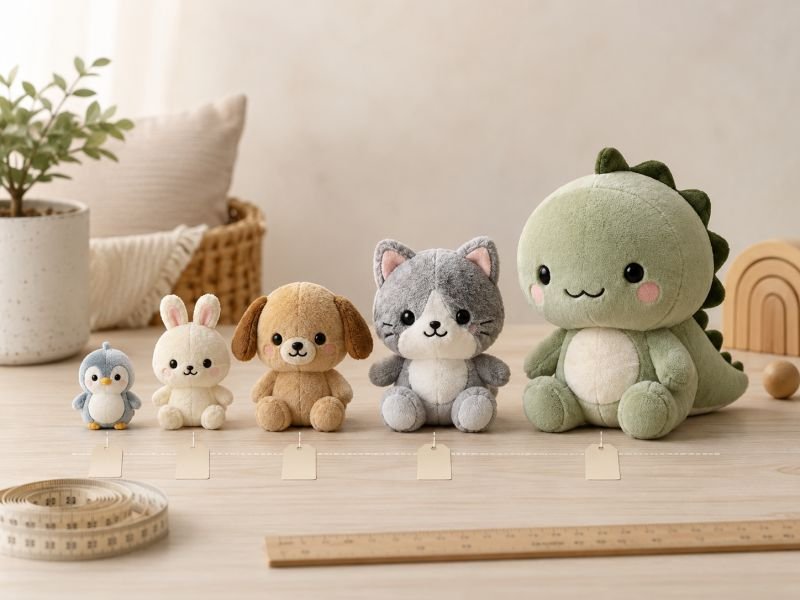
A mini plush toy is small enough to feel easy, cute, and collectible, yet big enough to carry a character’s personality. That balance is where many projects succeed or fail. A 6cm plush head can be charming for a festival giveaway, but the same size may not protect a detailed mascot face. A 10cm plush keychain can feel perfect on a backpack, while a 15cm bag charm may look richer in photos and retail displays. Size is not only a number on a spec sheet. It decides how the face reads, how seams hold, how much filling is needed, how packaging fits, and how the final product feels in the hand.
The best size for custom mini plush toys depends on use, character detail, budget, packaging, and sales channel. 5–8cm works for simple charms and giveaways. 8–12cm is strong for keychains, bag charms, and blind boxes. 12–15cm is better when the plush needs cleaner embroidery, clothing, tails, ears, or stronger gift value.
Think of two plush projects with the same 10cm height. One is a round animal with embroidered eyes and short ears. The other is a fantasy character with hair, jacket, shoes, wings, and a small logo. On paper, both are “10cm.” In real production, they are completely different jobs. The first may look full and cute. The second may need simplification, a larger size, or a different structure. Good size planning turns an idea into a plush that can be sampled, produced, packed, and repeated with fewer surprises.
What Size Is A Mini Plush Toy?
A mini plush toy is usually a compact soft product designed for carrying, collecting, gifting, or small-box display. In custom plush development, 5–8cm suits simple charms, 8–12cm works well for keychains and blind box plush, and 12–15cm gives more room for facial expression, clothing, ears, tails, and a fuller hand feel.
The word “mini” can be misleading because size alone does not tell the full story. A 10cm round animal can look soft, full, and giftable. A 10cm standing character with hair, shoes, jacket, tail, and logo may feel crowded because the same height is divided into many small parts. A seated plush can feel larger than its height because the body has more depth. A plush head charm can look clear at 7cm, while a full-body doll may need 12cm or more to keep the face and body balanced.
For custom mini plush toys, three measurements should be reviewed together: height, width, and thickness. Height is the number most people notice first, but width and depth decide how much fabric, filling, and packing space the product needs. A wide 10cm plush may use more material than a narrow 12cm plush. A thick sitting pose may need a larger box than a slim standing pose. A plush with tall ears may exceed the planned package height even if the body itself is small.
A practical mini plush size should protect the design, not just reduce the number on the spec sheet. The smaller the toy, the more the design should rely on clean shapes, bold face details, fewer tiny parts, and stable fabric choices. The larger the mini size, the more room there is for embroidery, color blocks, clothing, accessories, and a stronger sense of value.
Common size planning can be viewed like this:
| Finished Size | Best Use | Design Capacity | Main Risk |
|---|---|---|---|
| 5–6cm | Tiny mascot heads, simple charms, small giveaways | Very simple face, round shapes, few parts | Facial detail may become too tight |
| 7–8cm | Mini hanging charms, small plush icons, compact gifts | Basic eyes, mouth, small ears, simple body | Full-body designs may look squeezed |
| 9–10cm | Plush keychains, blind box plush, small fan items | Clearer face, short limbs, simple tail or ears | Complex clothing still needs simplification |
| 11–12cm | Bag charms, collectible mini plush, retail add-ons | Better body shape, embroidery, small accessories | Packing size and hanging weight need review |
| 13–15cm | Detailed mini plush, gift sets, character plush | Stronger expression, fuller hand feel, clothing details | Higher material use and larger carton volume |
A good way to choose size is to ask what the plush must do in real life. If it needs to hang from a backpack, it should stay light and balanced. If it needs to sit inside a blind box, the package size should be checked early. If it needs to represent a licensed character or mascot, the face and signature features must stay recognizable. If it will be sold as a gift item, it should feel valuable enough in the hand and in the package.
What Are The Different Plush Toy Sizes?
Plush toys are usually separated by use, not only by height. Mini plush toys often sit around 5–15cm. Small plush toys often sit around 15–20cm. Medium plush toys commonly sit around 20–35cm. Larger plush toys may go above 35cm and are often used for hugging, home decoration, shelf display, mascot presentation, or premium gift programs.
For mini plush planning, the most useful split is not “small or large.” It is “charm size, keychain size, collectible size, or gift size.” Each size group has a different job.
5–8cm works best when the design is simple and the purpose is easy carrying. This can include plush heads, small mascot icons, tiny animals, festival gifts, and light hanging pieces. At this size, embroidery should be bold, the body should be simple, and small extra parts should be controlled.
8–12cm is often the most flexible group. It can work for keychains, bag charms, blind box plush, mascot gifts, and small retail accessories. There is enough room for a clear face, short limbs, small ears, a tail, or basic clothing effects. This size also feels more valuable than a tiny charm while still staying portable.
12–15cm is stronger when the design needs personality. It can support clearer facial expression, more balanced body shape, small outfits, stitched patches, fabric color blocks, and a richer hand feel. For a character with hair, ears, clothes, or a signature accessory, this size often gives a cleaner result than forcing the design into 8cm.
The size should also consider body style. A round animal, a sitting character, a long-limbed doll, and a plush head charm should not be judged by height alone.
| Plush Style | Same Height May Feel Larger When… | Same Height May Feel Smaller When… |
|---|---|---|
| Round animal | Body is wide and thick | Face details are too tiny |
| Plush head charm | Head is full and simple | Ears or hair take too much height |
| Standing character | Head and body are balanced | Legs are thin and body is narrow |
| Sitting plush | Depth is full and stable | Sitting pose reduces visible height |
| Character with clothes | Outfit adds color and richness | Clothing covers too much body area |
For multi-style collections, equal height does not always create equal value. A rabbit with tall ears may need a shorter body. A round bear may need more width. A cat with a tail may need extra back depth. A character with a hat may need height adjustment so it fits the same package. The goal is visual balance, not blind uniformity.
What Is The Smallest Plush?
The smallest practical plush depends on how simple the design is. A very small plush can be made when the shape is rounded, the face is basic, the fabric does not hide detail, and there are few separate parts. For many custom mini plush projects, 5–6cm is close to the lower practical size for simple plush heads, tiny mascot charms, soft hanging decorations, and compact giveaway items.
Below this size, many details become difficult to control. The seam allowance still needs space. Fabric still has thickness. Small parts still need to be cut, sewn, turned, and filled. Embroidery threads still need room to form clean shapes. A logo that looks clear on a screen may become unreadable when stitched into a few millimeters of fabric. A tiny smile may become too thick. A narrow arm may lose shape after stuffing.
The smallest size is suitable when the design has:
- One simple main shape
- No complex clothing
- Few fabric color changes
- Large, clean facial features
- Short ears or no thin parts
- No tiny removable accessories
- Light hardware if it needs to hang
- Simple packing such as polybag, hangtag, or small card
The smallest size is usually not suitable when the design has:
- Full body with detailed clothes
- Thin horns, wings, fingers, or shoes
- Small logo embroidery on the body
- Many face lines or tiny eye highlights
- Several separate fabric colors
- Heavy metal hardware
- A premium gift goal where hand feel matters
A very small plush can be attractive when it is designed for that size from the beginning. Problems appear when a detailed 20cm character is simply reduced to 6cm without redesign. The better approach is to keep the most recognizable features and remove anything that weakens the final look. For example, a complex mascot can become a simple plush head charm at 6cm, a full-body keychain at 10cm, and a detailed collectible plush at 15cm.
Are 8–12cm Plush Toys Good For Keychains?
8–12cm is one of the strongest size choices for plush keychains because it balances visibility, weight, cost, and daily use. A keychain plush should be small enough to hang comfortably from a bag, yet large enough to show the face and main character features. This size group can usually support eyes, mouth, ears, a simple body, short limbs, a tail, and a secure hanging area.
At 8cm, simple plush heads and compact mascots often work well. The product feels light, easy to carry, and suitable for event gifts or small retail accessories. The design should avoid too much clothing or tiny logo detail.
At 10cm, the plush gains better face space and body balance. This size is often a good starting place for full-body keychain plush. It can support a clear front view, basic side depth, and a better attachment position.
At 12cm, the plush feels more like a small collectible charm. It can show more character detail and stronger hand feel, but weight and hanging angle must be checked. A thick 12cm plush with metal hardware may feel heavier than expected.
For keychains, size should always be reviewed with hanging performance. A product that looks good lying flat may hang poorly from a backpack. The top loop or ring should be placed so the plush faces forward. If the head is large and the body is small, the product may tilt. If the tail or ears pull weight to one side, the plush may hang unevenly. If the ring is attached to a weak seam, long-term use may become a problem.
Useful checks for plush keychain sizing include:
| Check Item | Why It Matters |
|---|---|
| Finished weight | A charm should not feel heavy during daily use |
| Top attachment | The plush should hang straight and show the face |
| Face size | Expression should be visible at normal distance |
| Hardware type | Split ring, lobster clasp, ball chain, or fabric loop changes use |
| Seam strength | Pulling and swinging create stress |
| Body thickness | Too much depth can make the charm bulky |
| Label position | Labels should not cover the design or disturb hanging |
8–12cm works especially well when the plush is meant for backpacks, tote bags, pencil cases, travel bags, fan events, retail counters, or gift bundles. If the project needs a tiny giveaway, 6–8cm may be enough. If it needs a more premium charm, 12–15cm may look richer, but the product should no longer be treated like a standard small keychain.
When Does A Mini Plush Become A Small Plush?
A mini plush starts to feel like a small plush when it is no longer mainly a compact charm or add-on item. In many projects, 12–15cm is the transition zone. Below 12cm, the product often feels easy to carry, collect, or pack into small boxes. Above 15cm, it begins to feel more like a handheld plush with stronger display value.
The difference is not only the number. It is how the product behaves. A mini plush is usually meant to be clipped, collected, opened from a small package, handed out, or added to another item. A small plush is more likely to be held, placed on a desk, displayed on a shelf, gifted in a box, or sold as a standalone character item.
The same 14cm height can feel different depending on shape:
- A 14cm plush head charm may feel large for a bag
- A 14cm sitting animal may feel like a compact gift
- A 14cm standing doll may still look slim
- A 14cm round mascot may feel full and valuable
- A 14cm character with large ears may need taller packaging
The transition from mini to small plush should be decided by use. If the product must hang from a bag every day, a lighter 8–12cm size may be better. If the product needs to stand as a gift or collectible, 12–15cm may be stronger. If the character has important clothing, hair, face expression, or accessories, moving from 10cm to 14cm can improve the product more than adding extra craft at a smaller size.
Here is a practical way to separate the two:
| Decision Factor | Mini Plush Direction | Small Plush Direction |
|---|---|---|
| Main use | Carry, clip, collect, small gift | Hold, gift, display, retail shelf |
| Common size | 5–12cm | 13–20cm |
| Best structure | Simple and compact | More complete body shape |
| Detail level | Controlled and simplified | More embroidery and clothing possible |
| Packing | Polybag, hangtag, blind box, small box | Gift box, window box, display packing |
| Perceived value | Cute, portable, collectible | Fuller, more complete, more giftable |
There is no need to force every design into the mini category. Some characters become more attractive when allowed to grow a little. A 10cm plush may win on portability. A 14cm plush may win on expression and gift value. The best size is the one that makes the product feel intentional.
What Size Works For Blind Box Plush?
Blind box plush often works well around 8–12cm because this size feels collectible while keeping the package compact. A blind box plush should create surprise, cuteness, and value in a small space. If it is too tiny, the product may feel weak after opening. If it is too large, the box becomes bulky, freight volume increases, and shelf planning becomes harder.
For a single blind box series, size should be planned around the most difficult style, not the simplest one. If one character has long ears, one has a hat, one has a tail, and one is round, the package must work for all of them. The series should feel fair when people compare different styles. A simple character should not feel smaller or cheaper than a more decorated character. This can be solved through body width, texture, pose, embroidery area, or small design accents.
8cm blind box plush can work when the series is simple and the package must stay very small. It is suitable for round animals, mascot heads, or simple soft icons.
10cm is often a balanced size for blind box plush. It gives enough room for a clear face and basic body while keeping the box manageable.
12cm feels more collectible and giftable. It works better for richer characters, but box size, carton quantity, and shipping volume should be checked early.
For blind box plush, the packed size can be more important than the plush height. A sitting pose may reduce height but increase depth. A long ear may increase package height. A wide tail may require a deeper box. If the package is too tight, the plush may arrive flattened or bent. If the package is too large, the product may slide inside and feel poorly fitted.
Useful blind box size planning includes:
| Planning Item | Recommended Review |
|---|---|
| Plush height | 8–12cm for many mini blind box plush projects |
| Widest style | Check ears, arms, tail, wings, hat, hair |
| Thickest style | Check seated pose, round body, tail, accessories |
| Box fit | Avoid squeezing face, ears, or body shape |
| Series balance | Keep similar visual value across all styles |
| Packing insert | Consider card, inner tray, or simple protection |
| Carton quantity | Review how many boxes fit per export carton |
| Repeat series | Keep size records for future character releases |
A blind box plush should feel satisfying the moment it is opened. The face should be visible, the body should recover well, and the size should feel worth the package. Good blind box sizing is not only about fitting the toy inside the box. It is about making the whole unboxing moment feel right.
What Size Is A Mini Plush Toy?
A mini plush toy is a compact soft product made for carrying, collecting, gifting, small-box presentation, or add-on sales. In custom plush development, 5–8cm is better for simple charms and small giveaways, 8–12cm works well for keychains and blind box plush, while 12–15cm gives more room for facial expression, embroidery, clothing, ears, tails, and a fuller hand feel.
The word “mini” sounds simple, but it can create confusion during product planning. A 6cm plush head, a 10cm keychain, a 12cm blind box character, and a 15cm collectible plush may all be called mini in different product lines. The real difference is not only height. It is how the plush feels, how much detail it can carry, how it fits packaging, how it hangs or sits, and how clearly the character is recognized after sewing and filling.
A 10cm round bear may look soft and complete because the design uses one full body shape. A 10cm standing character with hair, jacket, shoes, tail, and a chest logo may feel crowded because the same height is split into many tiny areas. A 9cm seated plush may feel larger than expected because the body has more depth. A 12cm flat-body plush may feel smaller because the thickness is limited. This is why height should never be reviewed alone.
For a mini plush toy, three measurements matter together:
- Finished height: from the lowest body part to the highest finished part, including ears, hat, hair, horn, or loop if needed
- Finished width: the widest part across arms, ears, tail, clothing, or body shape
- Finished depth: front-to-back thickness after stuffing, including snout, belly, tail, wings, or seated body depth
These three numbers affect fabric use, stuffing volume, carton quantity, shelf fit, blind box size, shipping volume, and the final feel in the hand. A wide 10cm plush can take more space than a narrow 12cm plush. A thick seated 11cm plush may need a deeper box than a standing 13cm doll. A plush with tall ears may need packaging planned around the ears, not only the head.
A good mini plush size should protect the design instead of only reducing cost or saving space. The smaller the plush, the more the design should rely on bold features, simple outlines, clean color blocks, and stable fabric. As the plush becomes larger, there is more room for embroidery, small accessories, clothing, texture changes, and a stronger gift feeling.
| Finished Size | Better Use | Detail Capacity | Main Risk |
|---|---|---|---|
| 5–6cm | Tiny mascot heads, small hanging icons, lightweight giveaways | Very simple face, round shape, few parts | Face may lose clarity; tiny parts are hard to shape |
| 7–8cm | Mini charms, small animal icons, compact gift items | Basic eyes, mouth, short ears, simple body | Full-body characters may look squeezed |
| 9–10cm | Plush keychains, blind box items, small fan goods | Clearer face, short limbs, simple tail or ears | Clothing and small logos still need careful control |
| 11–12cm | Bag charms, blind box plush, retail add-ons | Better body shape, more stable embroidery, small accessories | Packed size and hanging weight need review |
| 13–15cm | Collectible mini plush, gift sets, detailed characters | Stronger expression, fuller touch, clothing details | More material, larger box, higher carton volume |
A practical size choice should start from the product’s real use. A plush made to hang from a backpack should stay light, balanced, and strong at the top loop. A blind box plush should fit the package without being squeezed. A character plush should keep its face and signature features clear. A gift plush should feel valuable enough when held. A collectible series should keep similar visual value across all styles.
What Are The Different Plush Toy Sizes?
Plush toy sizes are usually understood by use, not only by centimeters. Mini plush toys often sit around 5–15cm. Small plush toys often sit around 15–20cm. Medium plush toys often sit around 20–35cm. Larger plush toys may go beyond 35cm and are often used for hugging, home display, shelf presentation, mascot items, or premium gift programs.
For mini plush planning, it is more useful to separate sizes by product role:
| Size Group | Product Role | Best For | Notes |
|---|---|---|---|
| 5–8cm | Tiny charm size | Simple plush heads, mini mascots, small giveaways | Keep shape round and details minimal |
| 8–10cm | Keychain size | Backpack charms, plush icons, small fan items | A strong start for simple full-body designs |
| 10–12cm | Collectible mini size | Blind box plush, bag charms, mini characters | Better balance between detail and portability |
| 12–15cm | Giftable mini size | Retail sets, character gifts, richer bag charms | More room for expression and small outfit details |
| 15–20cm | Small plush size | Desk plush, shelf plush, gift plush | Less compact, but stronger product presence |
The same height can look very different depending on shape. A round 10cm animal may feel full because most of the height becomes body volume. A 10cm standing doll may feel slimmer because the head, torso, arms, legs, and hair all share the same space. A 12cm plush head charm may feel large, while a 12cm full-body character may feel moderate. This is why a product team should review front, side, and back views before confirming size.
Size also changes when the plush has special features. Long ears, horns, wings, hats, tails, bows, jackets, shoes, and bags all add volume. If the product is part of a multi-style series, exact same height is not always the best choice. A rabbit with tall ears may need a shorter body. A round bear may need more width. A cat with a tail may need more depth. A character with a hat may need lower body height so the whole item fits the same package.
For a balanced series, visual weight often matters more than identical measurement. When all pieces are placed together, each one should feel equal in value. One design should not look tiny beside another simply because it has fewer parts. This can be adjusted through body width, pose, embroidery area, fabric texture, or small added details.
| Plush Style | Same Height Feels Larger When… | Same Height Feels Smaller When… |
|---|---|---|
| Round animal | Body is wide, thick, and softly filled | Face is too small or body is too flat |
| Plush head charm | Head is full with clear ears or snout | Hair or ears take most of the height |
| Standing doll | Head and body are balanced | Legs are thin and torso is narrow |
| Sitting plush | Body depth is full and stable | Visible height is reduced by seated pose |
| Character with outfit | Clothing adds color and identity | Outfit covers too much face or body area |
What Is The Smallest Plush?
The smallest practical plush depends on design simplicity. A very small plush can work when the shape is rounded, the face is basic, the fabric is stable, and there are few separate pieces. In many custom mini plush projects, 5–6cm is close to the lower practical size for simple plush heads, tiny mascot charms, soft hanging decorations, and compact giveaway items.
Once the design includes a full body, clothing, tiny logo, separate limbs, thin tail, long ears, small accessories, or detailed embroidery, a larger size becomes safer. Very small plush pieces still need seam allowance. Fabric still has thickness. Embroidery thread still needs space. Small arms and legs still need to be cut, sewn, turned, filled, and shaped. A detail that looks clear in digital artwork may become unclear when reduced to only a few millimeters.
A 5–6cm plush can work well when the design has:
- One main rounded shape
- A simple face with large eyes or short mouth line
- Short ears or no thin parts
- Few fabric color changes
- No removable clothing
- No tiny printed or embroidered logo
- Light hanging hardware
- Simple packaging such as polybag, hangtag, or small card
A very small plush is usually risky when the design includes:
- Full-body character details
- Hair, shoes, jacket, cape, or layered outfit
- Thin horns, wings, fingers, or long tail
- Small logo on chest, foot, or clothing
- Multi-color face panels
- Heavy metal hardware
- Premium gift positioning where hand feel is important
The smallest size is not always the most efficient. Although it uses less fabric and filling, it can be slower to handle if there are many tiny pieces. Small panels can shift during sewing. Narrow parts may not turn cleanly. Stuffing can make the body look swollen if the structure is too small. A 7cm plush with too many features may cost more effort than a clean 10cm plush with fewer parts.
For character-based products, a better method is to simplify the concept for each size. A complex mascot could become:
- 6cm: plush head charm with simple face
- 8cm: mini icon with head and small body
- 10cm: keychain with short limbs and clear face
- 12cm: blind box character with better shape
- 15cm: collectible plush with richer detail
This keeps the product intentional at each size instead of forcing a detailed design into a tiny body.
Are 8–12cm Plush Toys Good For Keychains?
8–12cm is one of the most practical size groups for plush keychains. It is small enough to hang from backpacks, handbags, pencil cases, tote bags, travel bags, and event lanyards, while still large enough to show a clear face, short limbs, ears, tail, and a secure hanging area.
At 8cm, simple plush heads, round mascots, and compact animals can work well. This size is light and easy to carry, so it is suitable for events, simple retail add-ons, and playful gift items. The design should avoid too much clothing or tiny body text.
At 10cm, the product usually gains better balance. A full-body plush keychain can have a clearer face, more stable body shape, and better attachment position. This is often a strong starting size when the design includes a head, body, short arms, short legs, and one or two simple character features.
At 12cm, the plush feels more like a collectible charm. It can show stronger personality and better hand feel, but the final weight and hanging angle need review. A thick 12cm plush with metal hardware may feel heavier than expected during daily use.
A keychain plush should be reviewed as a moving object, not a static display item. It swings, rubs, gets pulled, and may hang from the same top area for a long time. The top loop, ring, chain, or hook must work with the product’s weight and balance. If the plush tilts forward, the face may not show. If the ring is too close to a weak seam, durability may suffer. If the body is too thick, the charm may feel bulky on a small bag.
| Keychain Size | Suitable Design | Main Benefit | What To Check |
|---|---|---|---|
| 6–8cm | Plush head, simple animal, small icon | Light and easy to carry | Face clarity and hardware scale |
| 8–10cm | Compact full-body plush | Good balance for daily use | Top loop strength and hanging angle |
| 10–12cm | Character keychain, mascot charm | Better detail and stronger feel | Weight, body depth, seam stress |
| 12–15cm | Large bag charm, gift charm | More visible and giftable | May be too heavy for standard keychain use |
For plush keychains, hardware choice also affects size planning:
| Hardware Type | Best Match | Notes |
|---|---|---|
| Split ring | Everyday keychain use | Strong, but may feel more functional |
| Lobster clasp | Bag charm and lifestyle use | Easy to attach and remove |
| Ball chain | Light charm and display use | Less premium, but simple and flexible |
| Fabric loop | Soft look and lighter weight | Needs strong sewing |
| Plastic hook | Kids items or light gifts | Weight and strength need review |
8–12cm works especially well when the item needs both portability and character value. If the purpose is a tiny giveaway, 6–8cm may be enough. If the item should feel more premium, 12–15cm may be better, but it should be treated as a bag charm or collectible charm rather than a standard keychain.
When Does A Mini Plush Become A Small Plush?
A mini plush starts to feel like a small plush when it is no longer mainly a compact charm, add-on item, or small-box collectible. In many product plans, 12–15cm is the transition zone. Below 12cm, the plush often feels portable and easy to collect. Above 15cm, it begins to feel more like a handheld plush with stronger display and gift value.
The difference is not only size. It is the way the product is used. A mini plush is often clipped, carried, opened from a blind box, handed out, or collected in multiple styles. A small plush is more likely to be held, placed on a desk, displayed on a shelf, packed in a gift box, or sold as a standalone character item.
A 14cm plush can feel mini or small depending on shape:
- A 14cm plush head charm may feel large for a bag
- A 14cm sitting animal may feel like a compact gift
- A 14cm slim standing doll may still look delicate
- A 14cm round mascot may feel full and valuable
- A 14cm character with tall ears may need packaging closer to a larger plush
A useful way to separate mini plush and small plush is to look at function:
| Decision Factor | Mini Plush Direction | Small Plush Direction |
|---|---|---|
| Main use | Carry, clip, collect, small gift | Hold, display, gift, shelf placement |
| Common size | 5–12cm | 13–20cm |
| Best shape | Compact and simple | Fuller and more complete |
| Detail level | Controlled, simplified | More room for face and clothing |
| Packaging | Polybag, hangtag, blind box, small box | Window box, gift box, display packing |
| Feel | Cute, light, easy to own | Richer, fuller, more giftable |
There is no need to force every design into the mini category. Some characters become much stronger when allowed to grow slightly. A 10cm plush may win on portability. A 14cm plush may win on expression and perceived value. If the design includes an important outfit, hairstyle, accessory, or logo detail, moving from 10cm to 14cm can improve the final look more than adding extra craft at the smaller size.
For a product line, it can also be useful to create size tiers. A 10cm charm can serve daily carrying and collecting. A 15cm plush can serve gifting and display. A 20cm version can become a more premium item. This creates a cleaner product ladder without making one size carry every purpose.
What Size Works For Blind Box Plush?
Blind box plush often works well around 8–12cm because this size feels collectible while keeping packaging compact. The plush should feel satisfying when opened, but it also needs to fit a box that can be stacked, shipped, displayed, and stored without wasting too much space.
8cm blind box plush can work when the series uses simple shapes, round animals, plush heads, or soft icons. It keeps the box small and can support a cute surprise effect. The design should be clean because there is limited space for facial detail and body features.
10cm is a strong middle size for many blind box plush designs. It gives more room for a clear face, short limbs, ears, tail, and basic body shape. The product feels more substantial than a tiny charm while keeping the package manageable.
12cm feels more collectible and giftable. It supports richer character details, better hand feel, and stronger display value. The trade-off is larger packaging and fewer units per carton, especially if the plush has ears, thick body depth, or accessories.
For blind box plush, the package should be planned around the largest or most difficult style in the series. If one character has long ears, another has a hat, another has wings, and another has a round body, the box must fit all of them. The simple style should not feel less valuable beside the detailed style. Balance can be improved through body volume, texture, pose, facial expression, small accessories, or packaging artwork.
| Blind Box Size | Best For | Package Impact | Design Note |
|---|---|---|---|
| 8cm | Simple series, plush heads, small animals | Very compact box | Keep details bold and minimal |
| 10cm | Most mini blind box plush lines | Balanced box size | Good for face and basic body |
| 12cm | Richer characters and giftable series | Larger box and carton volume | Better for clothing and accessories |
| 13–15cm | Premium mystery plush | Bigger display package | Stronger value, less compact |
The packed size can matter more than plush height. A sitting plush may reduce visible height but increase depth. Tall ears may require a taller box. A tail may need more back space. A round body may require a wider box. If the box is too tight, the plush may arrive flattened, bent, or with the face pressed against the inner wall. If the box is too large, the plush may slide inside and feel poorly fitted.
Useful checks before confirming blind box size include:
- Tallest style in the series
- Widest style in the series
- Thickest body depth after filling
- Ear, hat, wing, tail, or accessory position
- Whether the plush needs an inner tray, card, or simple protection
- Whether the face stays visible after unpacking
- Carton quantity after box size is confirmed
- Future series plans using the same box format
A strong blind box plush should feel right at the opening moment. The size should be cute, the body should recover well, the character should be clear, and the package should feel matched to the item inside. Good blind box sizing is not only about fitting the plush into a box. It is about making the whole product experience feel complete.
Which Mini Plush Size Fits Each Use?

The right mini plush size depends on how the product will be used after it leaves the carton. A 6cm charm may be perfect for a high-volume event gift, but too small for a detailed character. A 10cm plush keychain may hang neatly on a backpack, while a 14cm bag charm may create stronger style impact. For most mini plush projects, the size should match five things at the same time: use scene, character detail, hand feel, packing method, and expected value.
A plush item is not judged only by height. It is judged by how it looks from one arm’s distance, how it feels when held, how it hangs from a bag, how it sits in a box, and whether the face still feels alive after sewing and filling. This is why two products with the same 10cm height can perform very differently. A round animal with a simple face may look full and polished. A human-like character with hair, jacket, shoes, tail, and small logo may need 12cm or 15cm to avoid looking cramped.
Use scene should guide size choice before details are added. If the plush must be carried daily, weight and hanging balance matter. If it will be opened from a blind box, packed size and series harmony matter. If it will sit in a retail display, front-view appeal and hand feel matter. If it will be handed out at an event, simplicity and schedule stability matter. If it represents a character or mascot, recognizable features matter most.
| Use Scene | Suggested Finished Size | Best Fit | Main Risk |
|---|---|---|---|
| Tiny charm giveaway | 5–8cm | Simple plush head, round icon, small mascot | Details may become unclear |
| Plush keychain | 8–12cm | Backpack charm, fan item, everyday carry item | Too heavy or tilted when hanging |
| Bag charm | 10–15cm | Lifestyle accessory, gift add-on, fashion bag detail | Bulky body or oversized hardware |
| Blind box plush | 8–12cm | Mystery series, collectible mini character | Uneven value between different styles |
| Retail set | 10–15cm | Gift box, counter display, themed plush set | Box and carton size growing quickly |
| Character fan item | 10–15cm | Mascot, IP character, collectible plush | Loss of signature details if too small |
| Premium gift plush | 12–15cm | Higher perceived value, stronger hand feel | Higher fabric and packing volume |
A useful way to choose is to start with the product role. A mini plush does not need to be large to feel valuable. It needs to feel intentional. A tiny charm should look clean and easy to keep. A keychain should hang well. A bag charm should be visible but not annoying. A blind box plush should feel satisfying when opened. A retail set should look neat in its package and still feel good when removed.
Which Size Works Best For Plush Keychains?
For plush keychains, 8–12cm is usually the most practical size area. It offers enough room for a clear face, short limbs, ears, tail, or small body details, while staying light enough for backpacks, handbags, pencil cases, tote bags, event lanyards, and travel bags. A 6–8cm size can work for a simple plush head or icon, but a full-body character often looks cleaner at 10–12cm.
A keychain plush should be reviewed as something that moves. It swings, rubs against bags, gets pulled by the ring, and may hang from the same seam for a long time. The top attachment should not be treated as a decorative afterthought. A beautiful plush that hangs sideways will feel less polished. A face that points downward may lose its charm. A heavy body with weak top stitching can create durability concerns.
Useful sizing checks for plush keychains include:
| Check Item | Why It Matters |
|---|---|
| Finished weight | The plush should feel comfortable during daily carrying |
| Top loop position | The face should stay visible when hanging |
| Body thickness | Too much depth may make the charm bulky |
| Hardware scale | Ring, clasp, or chain should match size and style |
| Face size | Expression should be clear from normal viewing distance |
| Seam strength | Pulling and swinging add stress to the top area |
| Label placement | Care label should not cover the design or disturb hanging |
8cm is suitable for a simple mascot head, animal face, or soft icon. 10cm is a safer choice for a compact full-body design. 12cm works well when the plush needs a stronger character look, but weight should be checked. Once a keychain goes beyond 12–13cm with thick filling and metal hardware, it may feel closer to a bag charm than a standard keychain.
For best results, keep the body compact, avoid long thin limbs, place the ring where the plush stays balanced, and keep the face bold. If a logo is required, it may work better on a woven label, hangtag, or small fabric tab than squeezed into tiny body embroidery.
Which Size Works Best For Bag Charms?
Bag charms can be slightly larger than plush keychains because they are often used for style, gifting, and visual presence. 10–15cm is a strong size choice for many plush bag charms. This size is still portable, but it gives more room for soft texture, fuller shape, embroidery, color blocking, small outfit details, ribbons, labels, or signature character features.
A bag charm should be matched to the bag it will decorate. A small pouch may look better with an 8–10cm charm. A tote bag, backpack, cosmetic bag, or travel bag can carry 12–15cm more naturally. A charm that is too small may disappear on a large bag. A charm that is too large may swing too much or feel inconvenient.
The size should also match the style goal:
| Bag Charm Style | Better Size | Design Direction |
|---|---|---|
| Small soft accent | 8–10cm | Simple animal, plush head, round mascot |
| Daily backpack charm | 10–12cm | Full-body character, short limbs, clear face |
| Fashion plush charm | 12–15cm | Fuller body, richer texture, stronger silhouette |
| Gift charm set | 10–15cm | Coordinated colors, hangtag, small box |
| Character charm | 12–15cm | Better for face, clothing, and accessories |
Bag charms often need stronger visual value than keychains. This does not always mean more details. It can mean better proportion, softer fabric, a fuller head, cleaner stitching, a nicer clasp, or more thoughtful packaging. A 12cm plush with a neat lobster clasp, good face alignment, and a small branded hangtag can feel much richer than a 15cm plush with a messy shape.
The main mistake is treating a bag charm like a small doll with hardware added later. The attachment method should be planned together with the pose. If the charm has a large head, the ring may need to sit slightly behind the top center. If the plush has a tail or side accessory, the hanging balance should be checked. If the charm uses a soft fabric loop, the loop seam must be strong enough for repeated use.
Which Size Works Best For Event Gifts?
Event gifts need to be easy to carry, easy to hand out, and easy to remember. 5–10cm is often a strong size choice for mascot charms, plush heads, simple animals, sports-themed icons, festival gifts, school campaign items, and small brand souvenirs. This size keeps the item light and compact while still offering a soft, friendly feeling.
For event use, the best plush is often the one people keep after leaving the venue. That means the design should be instantly clear. A small mascot face, a bright color, a recognizable body shape, or a useful hanging loop can create more value than a complicated mini doll with too many tiny details.
Size planning for event gifts should consider:
| Event Need | Better Direction |
|---|---|
| Fast handout | 5–8cm, simple shape, polybag or hangtag |
| Backpack-friendly gift | 8–10cm with loop, ring, or clasp |
| Mascot recognition | Keep face large and details bold |
| Large quantity | Reduce tiny parts and fabric changes |
| Tight schedule | Choose stable materials and simple craft |
| Easy transport | Keep packed size compact |
A 6cm plush head can be excellent for a large event when the mascot face is simple and recognizable. An 8cm full-body charm can feel more complete while still staying light. A 10cm plush may be better when the item needs more gift value or when the character has a body shape that matters.
For event gifts, over-design is a common trap. A small plush with five fabric colors, tiny embroidery, removable clothing, a printed logo, and custom hardware can become harder to sample and produce smoothly. A cleaner version often performs better: bold eyes, simple body, soft fabric, neat loop, clear hangtag, and compact packing.
Which Size Works Best For Retail Sets?
Retail sets usually need stronger perceived value, so 10–15cm often works better than very tiny sizes. This size supports clearer expression, better hand feel, nicer packaging, and more attractive display. It is suitable for seasonal gift sets, themed character collections, museum shop items, plush pair sets, mascot gifts, fandom goods, and private label plush lines.
In retail, the plush and its package should feel matched. A tiny plush in a large box may feel empty. A larger plush squeezed into a tight box may arrive flattened. A 10cm plush may work well with a small window box or counter display. A 12cm plush can feel balanced in blind box or gift box formats. A 15cm plush often looks better in photos and feels more giftable, but it can increase box size and carton volume.
Retail sizing should review both product size and packed size:
| Finished Plush Size | Packaging Direction | Best Use |
|---|---|---|
| 8–10cm | Small box, header card, compact display | Add-on item or lower price tier |
| 10–12cm | Blind box, small gift box, counter display | Collectible mini plush |
| 12–15cm | Window box, gift box, themed set | Higher gift value and stronger shelf effect |
| 15–20cm | Larger display box or soft packing | Standalone plush gift |
For sets with several styles, harmony matters. Equal height may not create equal value if one character has tall ears and another has a round body. It may be better to set a maximum package size, then adjust each style so it fills the visual space well. One plush may need more width. Another may need a fuller head. Another may need a small accessory or richer embroidery to feel balanced beside the rest.
A strong retail set also needs clear front-view appeal. When the plush sits inside a box, the face, body color, and signature detail should be visible. If the item is sold online, the plush should photograph well from the front and at a slight angle. At 12–15cm, there is more room to create this effect without making the product too large.
Mini Plush vs Small Plush: Which Looks Better?

Mini plush looks better when the product is meant to be carried, clipped, collected, opened from a small package, or given away in larger quantities. Small plush looks better when the product needs stronger character expression, better hand feel, more visible clothing, richer packaging, or display value. Neither size is automatically better. The stronger choice depends on the role of the product.
Mini plush has a special advantage: it feels easy to own. A 10cm plush keychain can become part of daily life. A blind box mini plush can encourage collecting. A small event charm can travel home in a pocket or bag. Mini size works well when the product should feel playful, accessible, and portable.
Small plush has a different strength. At 15–20cm, the product can show more shape, more softness, and more character. It feels more like a gift than an add-on. It can sit on a desk, shelf, bed, or retail display. It also gives more space for facial expression, clothing, accessories, and fabric texture.
| Comparison | Mini Plush | Small Plush |
|---|---|---|
| Common size | 5–15cm | 15–20cm or larger |
| Best use | Carrying, collecting, blind box, event gifts | Display, gifting, retail plush, premium items |
| Detail level | Simple to moderate | Moderate to rich |
| Hand feel | Cute, light, compact | Fuller and more giftable |
| Packing | Polybag, hangtag, blind box, small box | Gift box, window box, larger carton |
| Cost control | Good when design stays simple | Higher material and packing volume |
| Product emotion | Easy to keep, playful, collectible | More complete, warmer, more expressive |
Many strong plush lines use both sizes. A 10cm charm can serve daily carrying. A 12cm blind box plush can support collection. A 15–20cm plush can serve gifting or display. This creates a natural product ladder without forcing one size to do everything.
The final choice should protect the design. If the character has a simple round face, mini plush may look perfect. If the character has layered clothing, hair, tail, shoes, or an important expression, a small plush may look cleaner. A few extra centimeters can make the product feel more finished, while a compact size can make it easier to collect and carry. The best size is the one where the product feels natural, clear, and worth keeping.
How Does Size Affect Design Details?
Size changes the way every detail behaves on a mini plush toy. A small plush has less room for embroidery, seams, fabric turns, stuffing, clothing, and accessories, so the design must become cleaner and more selective. A larger mini size gives more space for expression, balanced body shape, fabric color changes, and small decorations without making the finished toy look crowded.
A plush design does not stay flat after production. A line drawing becomes fabric panels. The panels become seams. The seams take space. Filling pushes the body outward. Fabric pile softens edges. A thin arm becomes thicker after sewing. A sharp hair shape becomes rounder after stuffing. This is why a 2D character file can look perfect on screen but need adjustment when it becomes a 3D soft toy.
For mini plush toys, the smaller the size, the more each detail competes for space. A face may only have 25–40mm of usable embroidery area. A tiny mouth line may become too thick after stitching. A small clothing edge may disappear into the seam. A tail may look cute in the drawing but become too small to fill neatly. These are not mistakes; they are normal results of soft product construction.
A good mini plush keeps the details that create recognition. It does not try to copy every line. For a mascot, the key features may be the eye shape, face color, ear shape, and body outline. For a character, the key features may be the hairstyle, outfit color, facial expression, and one signature accessory. For a gift plush, softness, clean shape, and color harmony may matter more than tiny decoration.
Before confirming the final size, the design should be checked at real scale. A face that looks clean on a large screen may look crowded when printed at 8cm. A logo that looks fine in artwork may need to move to a hangtag, woven label, foot patch, or package card. A jacket that looks detailed in a drawing may need to become a simple color block at mini size.
| Detail Type | 5–8cm Plush | 8–12cm Plush | 12–15cm Plush |
|---|---|---|---|
| Simple eyes | Works well | Works well | Works well |
| Eye highlight | Needs very simple shape | Usually possible | Cleaner result |
| Small mouth | Short line only | Better control | More expression possible |
| Blush marks | Simple oval or circle | Good option | More flexible |
| Tiny logo | Usually not ideal | Needs size check | Better chance of clarity |
| Short ears | Works if wide enough | Good option | Stronger shape |
| Long ears | May distort | Needs support | More stable |
| Small limbs | Limited | Possible with simple shape | Better volume |
| Tail | Very simple only | Good for short tail | Better for shaped tail |
| Clothing | Not ideal | Simple fixed clothing | Better details possible |
| Separate accessories | High risk | Limited use | More practical |
How Small Can Embroidery Be?
Embroidery needs enough space for thread thickness, stitch direction, backing, and clean edges. On mini plush toys, the smallest embroidery details should be kept simple. Very thin lines, tiny letters, small eye highlights, detailed eyelashes, teeth, and miniature logos can lose clarity after stitching. The smaller the plush face, the more important it is to use bold shapes and clean spacing.
A practical way to judge embroidery is to review the artwork at the real finished size. If an eye becomes only a few millimeters wide on the printed sample drawing, it may be too small for a clean embroidered result. If the mouth line is too close to the nose, the expression may become heavy or unclear. If several colors are stitched into one small eye, the thread may look crowded.
For many mini plush designs, the face is the most important area. If the face fails, the whole toy feels wrong. Strong mini plush faces usually use fewer elements:
- Clear eye shape
- Enough space between eyes
- Simple mouth curve
- Limited tiny highlights
- Strong contrast between face fabric and thread color
- Blush or cheek detail only when there is enough room
- Logo embroidery only when the size can keep it readable
| Embroidery Area | Safer Design Choice | Risky Design Choice |
|---|---|---|
| Under 5mm | Simple dot, short line, tiny mark | Lettering, detailed icon, layered eye |
| 5–10mm | Simple eye, short mouth, small blush | Thin outline with several colors |
| 10–20mm | Clear eye shape, small nose, simple expression | Dense stitch pattern with tiny gaps |
| 20mm+ | More expressive face detail | Still needs spacing and fabric review |
When the logo or detail is too small for embroidery, it does not need to be removed completely. It can be moved to a woven label, printed hangtag, small card, belly patch, foot patch, or package design. This keeps the plush clean while still protecting the identity of the project.
Do Small Plush Toys Need Simpler Shapes?
Small plush toys usually need simpler shapes because every part must survive cutting, sewing, turning, filling, shaping, and repeated handling. A thin horn, sharp hair spike, tiny shoe, narrow wing, small finger, or skinny tail may look good in a drawing, but soft fabric cannot always hold those shapes at mini scale.
Simple shape does not mean weak design. In many mini plush projects, the strongest result comes from a clear silhouette. A round head, short ears, compact body, and one special feature can be more memorable than a crowded toy with too many tiny pieces. Mini plush is often viewed quickly: on a bag, inside a box, in a hand, or in a product photo. The shape should be readable at a glance.
A small plush shape should be checked through three practical questions:
- Can the part be cut with stable size?
- Can the part be sewn and turned without losing shape?
- Can the part be filled without becoming lumpy, flat, or twisted?
If the answer is no, the part may need adjustment. A thin tail can become wider. A sharp hairpiece can become a rounded fabric shape. A tiny hand can become a simple paw. A jacket edge can become an embroidered line. A tiny scarf can become a fixed fabric band instead of a removable accessory.
| Design Feature | Better Mini Plush Treatment |
|---|---|
| Thin fingers | Turn into mitten-style hands or simple paws |
| Sharp hair spikes | Round the tips and reduce piece count |
| Tiny shoes | Use fabric color blocking or embroidery |
| Small wings | Widen the shape and reduce seam turns |
| Long tail | Shorten, widen, or attach closer to body |
| Layered outfit | Use fixed clothing effect, applique, or color blocks |
| Tiny necklace | Move to printed detail or hangtag artwork |
| Small badge | Use larger patch, woven label, or packaging element |
A mini plush should look intentional, not reduced. When a detailed character is squeezed into a tiny size without simplification, the toy can feel messy. When the shape is redesigned for the chosen size, the toy feels clear, soft, and easy to love.
Why Do Ears, Tails, And Clothes Change Size?
Ears, tails, and clothes often need size changes because plush fabric has thickness and softness. A part that looks slim in artwork becomes wider after sewing. A small tube-shaped tail may be difficult to turn. A flat ear may collapse if it is too tall and narrow. A tiny jacket may cover too much of the body and make the plush stiff.
Ears need enough width to keep shape. Long ears may also increase the total finished height, which affects packaging. A 10cm bunny body with 4cm ears may become a 14cm product once packed. If the box was planned for 10cm, the ears may bend or flatten. For blind box plush, this is especially important because all styles need to fit one package.
Tails affect both look and balance. A short tail can add charm without much risk. A long or thick tail may push the plush backward, increase package depth, or change how the item hangs. If the toy is a keychain, a side tail can cause the plush to tilt unless the top attachment is adjusted.
Clothing adds another layer of difficulty. At mini size, removable clothing is often hard to keep neat because seams, Velcro, snaps, ribbons, and tiny hems take space. Fixed clothing usually gives a cleaner result. It can be made through fabric color blocks, embroidery, applique, printed details, or sewn-in panels.
| Detail | Mini Size Concern | Practical Adjustment |
|---|---|---|
| Long ears | May bend, raise package height | Shorten, widen, add inner support if needed |
| Thin tail | Hard to fill and shape | Widen or simplify |
| Side tail | May affect hanging balance | Adjust attachment or tail position |
| Tiny jacket | May look bulky | Use fixed color blocks or applique |
| Removable outfit | Hard to control at small size | Use sewn-in outfit effect |
| Bow or ribbon | May cover the face | Scale down or move position |
| Hood or hat | May hide expression | Reduce size or simplify seam structure |
These changes are not a compromise in quality. They are part of making the plush work as a soft product. A well-adjusted ear, tail, or outfit looks natural. An unchanged detail copied too literally from artwork may become the part that makes the toy feel awkward.
How Does Fabric Thickness Affect Mini Plush?
Fabric thickness can change the final shape more than the pattern itself. Long-pile plush makes a toy feel soft and full, but it can hide small embroidery, blur seam edges, and make tiny parts look bulky. Short-pile plush gives cleaner shape control and keeps facial details more visible. Minky and velboa are often useful for small character plush because the surface is smoother and easier to control.
At mini size, even 1–2mm of pile height can matter. If a small ear is made with thick fabric, the ear may become rounder than expected. If the face uses long-pile plush, the eyes may sink into the surface visually. If several small fabric panels meet in one area, thick fabric can make the seams feel crowded.
Fabric stretch also matters. A stretchy fabric can help create a rounded body, but it may distort embroidery or make small parts less stable. A firmer fabric can help hold shape, but it may feel less soft. The best material choice depends on whether the plush needs a clean character look, fluffy hand feel, or a more premium texture.
Color can also shift with pile direction. Plush fabric may look lighter or darker depending on how the fibers lie. On small multi-color faces, different pile directions can make panels look inconsistent even when the material color is correct. This is why fabric direction should be reviewed carefully for mini plush with face patches, belly patches, ears, paws, or clothing panels.
| Fabric Choice | Strength For Mini Plush | Watch Carefully |
|---|---|---|
| Short-pile plush | Clean shape, better detail visibility | Less fluffy feeling |
| Long-pile plush | Soft, cute, fuller look | Can hide eyes, mouth, and seams |
| Minky | Smooth, soft, good for character faces | Stretch and color direction need review |
| Velboa | Stable for small shapes | May feel flatter |
| Faux fur | Strong texture and personality | Often too bulky for small details |
| Felt detail | Sharp flat accents | Edge durability and washing needs review |
| Printed fabric | Useful for patterns | Print scale must match product size |
A small fabric swatch can look perfect alone, but the final plush may behave differently after cutting, sewing, and stuffing. It is better to check fabric together with the pattern and embroidery, not separately. The same 10cm plush may look clean in short-pile fabric and too bulky in long-pile fabric. Size and material should be selected together.
What Details Need Review First?
The first review should focus on the parts that decide whether the plush can look clean at the chosen size. These are the face, body proportion, fabric choice, seam structure, small parts, attachment method, and packaging fit. If these areas are reviewed early, the first sample is more likely to move in the right direction.
A front view is useful, but it is not enough. Mini plush needs side and back thinking too. The head needs depth. The body needs filling space. The tail needs position. The ears need height control. A sitting pose needs bottom stability. A keychain loop needs a strong top area. A blind box plush needs to fit inside the package without crushing the face or bending the ears.
Important details to check before sample development include:
- Target finished height, width, and depth
- Head-to-body proportion
- Face embroidery size and spacing
- Smallest fabric part size
- Ear, horn, wing, tail, or hair shape
- Clothing style and whether it is fixed or removable
- Fabric pile height and stretch
- Filling level and softness
- Keyring, hook, chain, loop, or other hardware
- Care label and warning label placement
- Package size, especially for blind box or gift box use
- Quantity per style and whether there are several styles in one series
| Review Area | Why It Matters | Best Timing |
|---|---|---|
| Face layout | Decides recognition and emotional appeal | Before embroidery file setup |
| Body proportion | Affects cuteness, balance, and hand feel | Before pattern development |
| Small parts | Can change sewing difficulty and shape stability | Before sample cutting |
| Fabric type | Changes softness, color, and final volume | Before material purchase |
| Attachment | Affects hanging angle and durability | Before first sample |
| Packaging fit | Avoids crushing, bending, or oversized box | Before package artwork |
| Label position | Avoids covering key design areas | Before bulk layout |
| Multi-style balance | Keeps series visually consistent | Before all samples are made |
The safest approach is to treat size as part of design, not as a number filled in at the end. A plush that is planned around its real size will look cleaner, feel better, and move through sampling with fewer changes. A plush that is reduced after the design is already too complex may need repeated corrections.
Mini plush design works best when every detail has a reason. The face should be clear. The body should feel balanced. The fabric should match the size. Accessories should not overpower the toy. Packaging should protect the shape. When these elements work together, a small plush can still feel rich, expressive, and worth keeping.
How Should Brands Choose The Best Size?

The best mini plush size should be chosen by matching the character design with its real use, packing style, budget level, and long-term product plan. 5–8cm works for simple charms, 8–12cm fits most keychains and blind box plush, and 12–15cm gives more room for details, softness, and higher gift value.
A strong size decision starts with one simple idea: the plush should feel right in the hand and make sense in its sales scene. A tiny plush may look adorable in a mockup, but if the logo is unreadable or the face loses emotion, the size is not doing its job. A larger mini plush may look richer, but if it becomes too bulky for a keychain or too expensive to pack in a blind box, the product may lose its original purpose.
The right size also depends on whether the plush is a one-style project or part of a longer product line. A single mascot gift can be sized around one design. A blind box or character collection needs size harmony across all styles. A future repeat program needs records for size, pattern, fabric, embroidery, filling, hardware, labels, and packing so the next order can stay close to the approved version.
Before confirming size, review the project from five angles:
- Use: keychain, bag charm, blind box, retail set, event gift, mascot gift, or fan item
- Design: simple animal, round mascot, full-body character, clothing, accessories, or complex silhouette
- Feel: tiny and cute, soft and full, giftable, collectible, or display-ready
- Packing: polybag, hangtag, blind box, window box, gift box, display box, or e-commerce carton
- Scale: one design, multi-SKU set, seasonal program, or repeat product line
A useful decision path is not “choose the smallest size to save cost.” It is “choose the smallest size that still protects the design.” Sometimes that is 8cm. Sometimes it is 12cm. Sometimes a detailed character should move to 15cm to avoid losing the face, outfit, or shape. Good plush sizing is a balance between charm, clarity, cost, and production stability.
| Project Goal | Better Size Direction | Why It Makes Sense | What To Avoid |
|---|---|---|---|
| Lightweight giveaway | 5–8cm | Easy to carry and distribute | Too many tiny details |
| Backpack keychain | 8–12cm | Clear enough, still portable | Weak top loop or heavy body |
| Fashion bag charm | 10–15cm | More visible and giftable | Overly bulky shape |
| Blind box series | 8–12cm | Compact box and collectibility | Uneven size value across styles |
| Retail plush set | 10–15cm | Better shelf and photo effect | Packing volume growing too fast |
| Licensed character gift | 12–15cm | More detail and stronger expression | Shrinking key features too much |
| Mascot campaign item | 8–15cm | Flexible for simple or detailed mascots | Face or logo too small to recognize |
Who Should Choose 5–8cm Plush?
5–8cm plush works best when the design is simple, compact, and meant for quick emotional impact. This size is suitable for tiny plush heads, small mascot charms, hanging decorations, festival giveaways, capsule-style mini gifts, and simple animal icons. It can also work for projects that need lightweight packing and easy distribution.
The design should stay clean at this size. Round shapes, basic faces, short ears, simple color blocking, and one clear signature feature are safer than complex outfits or thin limbs. A 6cm plush with two embroidered eyes and one cute mouth may look neat. A 6cm plush with hair, jacket, shoes, tail, logo, and layered colors may look squeezed.
5–8cm is more suitable when:
- The plush is used as a small charm, not a full character doll
- The body shape is round or simple
- The face has few embroidery elements
- The project needs light weight and compact packing
- The item is given away, clipped, collected, or included as an add-on
- The packaging can carry extra story, logo, or product information
The main risk is perceived value. A very small plush can look cute, but it may also feel too light if the material, face, and packing are not carefully planned. If the item represents a premium brand, original IP, or paid collectible, the project may need richer fabric, cleaner embroidery, or a slightly larger size. Tiny plush is powerful when it is intentional. It feels weak when it looks like a downsized version of a bigger idea.
Who Should Choose 8–12cm Plush?
8–12cm is one of the most flexible size groups for custom mini plush toys. It works for plush keychains, bag charms, blind box plush, mascot gifts, fan merchandise, retail add-ons, and event items with stronger visual value. This size gives enough room for a face, basic body, short limbs, ears, tail, small accessories, and a stable hanging attachment.
This size is often the safest starting area when the project needs both cuteness and practicality. A 10cm plush keychain can hang well without feeling too heavy. A 10–12cm blind box plush can feel collectible without forcing a large box. A simple 8cm mascot may be cost-efficient, while a 12cm version may feel more giftable and easier to photograph.
8–12cm works well when:
- The plush needs to be carried or clipped to another item
- The character has a simple body and moderate face detail
- The project includes blind box or mystery packaging
- The product should feel more valuable than a tiny charm
- The design needs basic embroidery, short limbs, or small accessories
- The line may expand into multiple styles later
The key is not to overload the plush. At 8–12cm, there is room for detail, but not unlimited room. Small logos, thin mouth lines, separate fingers, layered clothing, and delicate accessories still need review. If every feature is marked “must keep,” the better move may be to choose 12cm rather than 8cm, or to simplify the design while protecting the most recognizable elements.
Who Should Choose 12–15cm Plush?
12–15cm plush is better when the product needs stronger character expression, better hand feel, cleaner embroidery, clothing details, or higher gift value. This size is still compact, but it gives the design more space to breathe. It works well for collectible mini plush, premium bag charms, retail gifts, IP character items, mascot gifts, and multi-SKU product lines with richer design.
At 12–15cm, facial features can usually be more balanced. Eyes can be clearer. The mouth can carry more emotion. Ears, tails, wings, or hair can be shaped with more control. Simple clothing can look less cramped. The plush can also feel fuller in the hand, which matters for paid retail products and gift sets.
12–15cm is a strong choice when:
- The character has clothing, accessories, or a distinctive silhouette
- The plush needs to be photographed for online selling
- The product is placed in a gift box, retail box, or display set
- The design has multiple fabric colors
- The face must carry a clear expression
- The product should feel more complete than a small charm
- The project may become a repeat or seasonal collection
The trade-off is packing and freight volume. A 15cm plush may need a larger box than expected, especially with ears, a tail, a seated pose, or thick fabric. If the plush is used as a keychain, the final weight should be checked carefully. A 15cm plush can work as a bag charm, but only if the body shape and hardware are planned for daily use. This size is excellent for value, but it should not be chosen blindly.
How To Make Your Own Mini Plush With A Factory?
Making a custom mini plush with a factory starts with a clear design package. The more complete the early information is, the easier it becomes to review size, structure, material, craft, packing, cost, and production timing. A single front-view drawing may be enough for early discussion, but it is not enough for a stable production plan.
A practical custom mini plush process can follow this path:
| Step | What Happens | What To Prepare |
|---|---|---|
| 1 | Design review | Artwork, reference images, character notes |
| 2 | Size review | Target height, width, depth, use scene |
| 3 | Structure planning | Pose, limbs, ears, tail, clothing, hardware |
| 4 | Material selection | Fabric type, color reference, hand feel |
| 5 | Craft planning | Embroidery, printing, applique, woven label |
| 6 | Sample development | Pattern, cutting, sewing, filling, shaping |
| 7 | Sample revision | Face, proportion, size, details, packing notes |
| 8 | Approved sample | Final version used as bulk reference |
| 9 | Bulk production | Material, cutting, embroidery, sewing, filling, QC |
| 10 | Packing and shipment | Labels, boxes, cartons, shipping documents |
The best starting files include:
- Front, side, and back views if available
- Close-up face details
- Target size and preferred proportion
- Fabric reference or desired hand feel
- Quantity per design
- Any keyring, chain, hook, ribbon, magnet, zipper, or sound part
- Packing style, such as polybag, hangtag, blind box, or gift box
- Target sales region and age group
- Deadline, launch date, or event date
For custom plush projects, Heyzizi’s standard MOQ starts from 500pcs per design. Custom samples usually require a sample fee because sample work may include pattern development, material preparation, embroidery or printing, cutting, sewing, stuffing, shaping, accessory placement, and revision. When a single-style bulk order reaches 2,000pcs, the sample fee can be refunded or deducted.
A good sample should be reviewed closely before bulk production. Check the face from a normal viewing distance, not only through close-up photos. Hold the plush if a physical sample is available. Check whether the body feels full, whether the ears or tail sit correctly, whether the attachment loop is strong, whether the label position is acceptable, and whether the packed product still looks good after shipping-style compression.
Where Can You Get A Custom Plush Toy Made?
A custom plush toy should be made with a factory that can review artwork, size, fabric, structure, sampling, packing, quality control, and delivery needs together. For mini plush, this matters even more because small design mistakes become visible quickly. A production partner should not only ask for quantity and offer a quick price. It should help check whether the chosen size can support the design.
A reliable plush factory should be able to discuss:
- Whether the artwork is suitable for the target size
- Which details need embroidery, printing, applique, or fabric changes
- Whether the plush should be 8cm, 10cm, 12cm, or 15cm
- Whether the body should be standing, sitting, flat, or rounded
- Where the keyring, hook, loop, or label should be placed
- Which fabric gives the right softness and shape
- How packing affects size, cost, and delivery
- What information is needed for quote review
- How the sample will be checked and revised
- How the approved sample will guide bulk production
Heyzizi is a Guangdong-based custom plush products factory focused on custom plush development and bulk production for global brands, IP programs, retailers, promotional projects, educational product teams, private label plush collections, and long-term plush product lines. The factory supports OEM, ODM, private label, and custom plush production, with project support from material selection and sampling to bulk production, quality control, packaging, labeling, and shipment preparation.
For teams preparing a mini plush project, the most useful first step is to send the design file, target size, quantity, material idea, packing method, sales region, and deadline for review. This allows the size choice to be checked against real production needs instead of guessing from a picture alone.
A custom plush factory is not only a place that sews plush toys. For a well-planned project, it becomes the bridge between concept and repeatable product: pattern, sample, approved version, bulk quality, packing, labels, cartons, shipping preparation, and future reorder records.
Closing
Custom mini plush size choice should never be treated as a small detail. It shapes the entire product. A few centimeters can change the face, body proportion, embroidery clarity, fabric behavior, packing style, unit cost, carton volume, and final user impression. A well-sized mini plush feels natural. It looks clear. It carries the character. It fits the packaging. It arrives in good shape. Most importantly, it supports the reason the product was created in the first place.
For simple charms and giveaways, 5–8cm can be a smart direction. For plush keychains, bag charms, and blind box plush, 8–12cm often brings the best balance. For collectible mini plush, gift sets, retail products, and detailed character designs, 12–15cm often gives more control and stronger value. The best size is not always the smallest or the largest. It is the size where the design, cost, function, and presentation work together.
Before starting a custom mini plush project, prepare artwork, target size, quantity, fabric preference, craft details, accessories, packing style, sales region, and deadline. With those details, the project can be reviewed more accurately, and the first sample can move in a clearer direction.
If you are developing mini plush keychains, blind box plush, character charms, mascot gifts, or a multi-SKU plush collection, Heyzizi can review your design, size plan, material direction, sample path, packing needs, and bulk production feasibility. You can send project details to info@heyzizi.com for review.